Quote of the Month

When love and skill work together, expect a miracle. John Ruskin


Showing posts with label Summer-Fiction. Show all posts

Tuesday, July 19, 2022

Freedom To Have Fun

There are many individuals who adhere to the unofficial beginning of summer as Memorial Day weekend and the ending of summer after Labor Day weekend.  In truth, summer begins on the summer solstice and ends on the autumnal solstice.  Those dates are usually around the third week in June and the third week in September.  There are others who base the beginning and ending of summer with the ending and beginning of the school year.  

Regardless of when it starts, there are other signs of this seasonal shift.  Morning and evenings are heralded by the sounds of birds and crickets.  The air is thick with humidity and the scent of blossoming flowers.  In my neighborhood, fawns wander with their mothers.  Children race past on scooters and bikes.  Thunderstorms quench thirsty lawns and gardens.

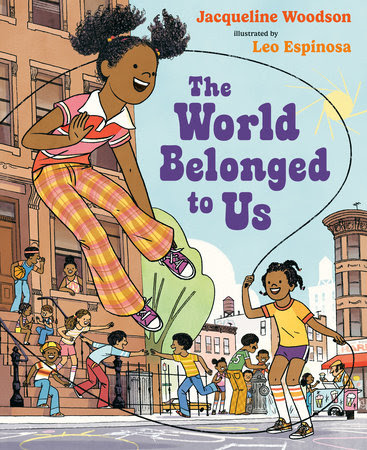
As a child summer meant floating stick and leaf boats down gutters during rainy days, spending hours under a large tree playing Monopoly when seated on an old quilt, playing softball on the vacant lot with the neighborhood kids, running through sprinklers until our skin was wrinkled, and calling out here I come, ready or not as we played hide-and-seek until mothers called us inside.  In The World Belonged to Us (Nancy Paulsen Books, an imprint of Penguin Random House LLC, May 10, 2022) written by Jacqueline Woodson with illustrations by Leo Espinosa, readers are transported to the freedom summer offers children.  Let's follow them!
In Brooklyn
in the summer
not so long ago

grown-ups always had someplace to be or some kind of work to do, but the minute school ended, us kids were free as air.
Free as sun.  Free as summer.

The heat in the city was intense even before school ended.  Wearing their school clothes, children ran through the water released by a hydrant enhanced with a can as their moms yelled at them.  The person handy with a wrench and the rest of the children intended to enjoy every single minute of summer.

All day long games were played on chalk-drawn boards on the streets.  The children were in constant motion, hopping to jump-rope chants, running, and spinning tops.  Their hearts soared.  When bumps and bruises happened, the older kids would step up and help and tell their own tales.

Cardboard creations rose like skyscrapers and the children admired the work of all their fellow builders.  During the summer in Brooklyn, imaginations and hope grew.  When others rose to renown in the world of sports, music, and literature, the kids believed they could, too.

Balls, bats, and cans were ready gear for more than one kind of game.  Senses were honed during play.  It was hardly surprising that everyone could hear the music of the ice cream truck blocks before it arrived.   Moms tossed money from windows inside tied handkerchiefs.  Ice cream was enjoyed and shared.  As the sky darkened, children still played calling out to one another in an array of languages.  When their moms began to call them home, they shouted out promises to each other.  Promises of another day filled with the freedom to have fun.


Author Jacqueline Woodson has an adept ability to reach into the past and bring it alive in the present. Five times the initial three phrase refrain is placed in the narrative to invite us into the summer with these children.  We experience what they are experiencing.  When dialogue is placed in the story, it rings with truth.  We know.  We've heard the same or similar words.  This is what Jacqueline Woodson does beautifully, she connects us regardless of when or where we were (or are) children.  Here is a passage.

In Brooklyn 
in the summer
not so long ago

we learned to watch and listen
playing tag, ringolevio, and hide-and-seek
inside hallways and behind thin-limbed trees
and garbage cans.

And our block was the whole wide world
and the world belonged to us.


There is so much fun happening on the front and back, right and left, of the open and matching dust jacket and book case, you want to jump in and join the children.  Many of the remembered activities highlighted in the text are featured in these two scenes.  These depictions do reflect when we believed

the world belonged to us.

To the left of the spine, on a background the same hue as the title text, is a golden oval.  Children are running inside and outside the oval, playing kick the can.  Underneath this image are words of praise for previous books by both the author and the illustrator.

On a marbled, muted canvas of dark orange on the opening and closing endpapers are drawings in red.  These drawings appear to be made in chalk or crayon.  They are childlike portrayals of activities enjoyed by the kids in Brooklyn.  You cannot look at these without smiling.  On the title page, we are given a more bird's eye view of the block in Brooklyn.  Along the bottom of the verso and dedication pages  are the tops of buildings in Brooklyn beneath a summer sun on the right.  The dedications read:

To young people everywhere.
Keep playing!---J.W.

To my childhood friends.
Tag, you're all it!---L.E.

Rendered by Leo Espinosa

with a mighty pencil and Adobe Photoshop

these single-page and double-page illustrations radiate warmth and happiness.  The children are placed foremost in the images in full color.  In one of the visuals, we are looking down on the block as the kids are actively engaged in a variety of games.  By their facial expressions and body postures, we know they are overjoyed that it's summer.  

Each line drawn by Leo Esinosa vibrates with fun, even when a child might be seated.  We know they are ready to spring into action.  Leo Espinosa has shown us what summer was, is and should be for all children.  Even though these scenes are in Brooklyn, there is a universality to them.

One of my many favorite illustrations is a double-page picture.  Dusk is arriving in the upper parts of the sky.  Darkening clouds move across a pale golden horizon.  Streetlights are on.  In the background on either side of the street are homes and buildings.  Children are running and calling to each other in the foreground.  One child, close to us on the right side, hands cupped to her mouth is shouting at readers.  Each of us can imagine what she is saying.


In truth, everyone feels different in the summer.  That subtle change in how time is spent affects each of us, thankfully.  In this book, The World Belonged to Us written by Jacqueline Woodson with artwork by Leo Espinosa, we are not only reminded of this, but encouraged to continue and support it.  It is a time to be cherished.  You will want to place a copy of this outstanding title on your personal bookshelves and more than one on your professional bookshelves. 

To discover more about Jacqueline Woodson and Leo Espinosa and their other work, please access their websites by following the link attached to their names.  Jacqueline Woodson has accounts on Instagram and Twitter.  Leo Espinosa has accounts on Facebook, Instagram, and Twitter.  At the publisher's website, you can view the title page.  At Seven Impossible Things Before Breakfast, Julie Danielson talks about this book as only she can and shares multiple interior images.  This book is included with two other Jacqueline Woodson titles in an Educator's Guide.  The publisher has a sneak peek preview here.

Tuesday, May 21, 2019

Finding Heart In The Heat

The next solstice is fast approaching; only thirty more days until the time between sunrise and sunset is nearly fourteen hours.  With the longer amounts of daylight, temperatures will become warmer.  With each subsequent year, we have seen record-breaking heat.  In this heat every living thing needs shade and water.

On those days with the sun relentlessly shining and no breeze to assist in any type of cooling, a stillness settles over Earth's inhabitants.  In their newest collaboration, Summer (Imprint, a part of Macmillan Publishing Group, LLC, May 7, 2019) renowned Chinese author Cao Wenxuan and Chinese illustrator Yu Rong create an original tale happening during one of those sultry afternoons.  Respite comes through observation amid controversy.

IN SUMMER,
the burning hot sun
hangs in the sky.

Creatures wild and domestic and humans, along the banks of a river, seek cover from heat.  Out on the grasslands, everything is dry from lack of rain and the sun.  The animals, stirring up dust as they move, search for shade.

Unexpectedly the jackal spots a tree and shouts about the discovery.  It's a race to see who will arrive there first.  All seven of them believe they are first, especially the smallest of them, a mouse.  Let's remember readers, it's in the middle of a hot, hot summer.  There are only a few leaves on one branch.  The animals fight. 

As the largest, the elephant makes a decision.  He stands under the tree.  He trumpets out dust to chase the mouse, lynx, jackal, leopard, brown bear, and rhino away.  Finally, one animal laughs at the sight of the elephant.  Soon they are all laughing at a huge beast trying to find shade under a few leaves.  In the middle of their laughter, two humans walk past.  The animals go silent, watching a father and his son. 

The son is completely shaded by his father's shadow.  The animals keep watching in silence until the duo have disappeared.  The lynx speaks and the mouse moves.  Without another word each animal adjusts their position.  The heat from the summer sun is still present but change is in the air.


For those who have not experienced the unbearable heat of a summer with no rain and the sun constantly shining, author Cao Wenxuan supplies vivid images through his word choices.  We become more personally involved in the story when he gives voice to the animals. We realize their desperation through their argument and fight, but even in their frustration they can find humor.  This, I believe, is an important point.  It opens them up to the transformation of their perspectives which comes.  Here is a portion of a passage.

A frog floats on a lotus leaf,
beneath the umbrella of another.
Ducks sleep with
heads tucked in wings
beneath the cool arching bridge.


Rendered in cut paper and pencil by Yu Rong all the illustrations, beginning on the open dust jacket, will astound readers.  The fine lines and intricate, tiny details work together marvelously.  The illustration seen on the front of the dust jacket hints at a long-awaited event.  Notice the green beetle climbing up the elephant.  This creature is also featured.

The design of radiating black lines from a yellow circle on a bright blue continues to the left, on the back.  Six of the animals are gathered together under the words:

In Summer 
seven animals learn
to share. 

The sun, the yellow circle, is varnished on the dust jacket.  On the book case the lines from the sun stretch over the spine and to the edge of the back on the same bright blue background.  The only thing inside the sun is the text.  The animals are absent.

On the opening and closing endpapers Yu Rong presents a vast grassland landscape with mountains in the distance.  In the first scene shades of yellow and blue are prominent.  The sun is shining over the mountains.  The landscape, although still vast, is altered in the second set of endpapers.  Hues of blue, purple and pink are present.  Something has caused a shift.

The title page image spans two pages.  The large yellow sun beats down on the animals in a row, largest to smallest, left to right, on a yellow background with mountains in the distance.  In tiny, tiny print the dedications by Cao Wenxuan and Yu Rong weave over the backs of the elephant and rhino.

Many of the pictures are double-page pictures.  The circle design continues and is present in some of the illustrations with the text on the opposite page.  Readers will appreciate the different, vibrant colors of the animals, especially on crisp white backgrounds.  They will also enjoy the pencil drawings of the animals.

One of the cleverest elements is supplied after the animals watch the father and son disappear in silence.  The next five page turns are surprisingly modified.  (I don't to say anything more.)  Each item in all the illustrations is carefully placed to convey an emotion or capture a moment. 

One of my many, many favorite illustrations is toward the end of the story.  It is a single-page picture with a white canvas.  The animals' backs are to readers.  They are standing in a row along the bottom, largest on the left and ending with the lynx on the right.  All we can see are their necks and heads.  The mouse and the beetle are seated on the elephant's head.  None of them are moving.  They are hopefully watching something. 


Summer written by Cao Wenxuan with illustrations by Yu Rong is brilliant.  Sometimes in the middle of an unsolvable situation, an answer appears.  We wonder if we had been willing to shift our point of view earlier, we might have found the solution ourselves. Cooperation and selflessness are presented with perfection.  I highly recommend this for your professional and personal book collections.

This article in Publishers Weekly about Cao Wenxuan provides information about this highly acclaimed author.  You can find information about Yu Rong at Walker Books.  You can view interior images at the publisher's website.

Sunday, July 15, 2018

Seasonal Views And Hues

This year in the northern hemisphere on September 22 summer will come to a close.  The daylight hours are already shortening but during those minutes the world around us is bursting with color in every hue imaginable.  The blend of shadow and the height of the sun give us breathtaking beauty.

We wake to filtered sunrise rays peeking through trees, bushes and flowers giving them a golden glow.  Cloud cover alters every instance.  Wind works a special wonder.  Summer Color! (Little, Brown And Company, May 15, 2018) written by Diana Murray with illustrations by Zoe Persico takes us on a tour of a summer day shared by siblings and their family.

The hot summer sun lights the sky like a torch
as folks fan themselves on the shady back porch.

With this opening sentence we see the first hue of the day---yellow.  It shines on the sunflowers.  As parents and cousins join the duo ice cold sweet treats on a stick are shared.  Their vibrancy shines with a primary color.

Brother and sister run fast past familiar places until they realize the day has darkened.  Clouds swell turning a stormy gray.  All the animals in the field hurry toward the safety of the green woods.  As the rain falls everything starts to shimmer.  Brights are brighter.

The companions traverse farther into the forest, seeking a cool sheet of white water tumbling to a pond.  Making their way home past the lake with people seeking shelter beneath blankets of purple and past meadow mice tucked in their cozy abode, they run to their door.

Soaked through and through, they cuddle under the warmth of orange towels noticing the color of the fence and shed in their backyard.  As suddenly as it arrived, the disturbance disappears.  The leftover droplets cast a silvery sheen.  The children run outside looking at the clear blue of the sky only to find an arching surprise.


Listening and reading children alike will find themselves caught in the cadence of the words written by Diana Murray.  Twelve vivid hues are spotlighted in rhyming couplets (and other poetic techniques such as alliteration), each focusing on an action; everything and everyone is in motion.  Diana Murray's descriptions of place and time entice us to recall similar experiences or to create new adventures in the near future.  Here are two couplets.

Splashing and splattering, streak after streak,
the rain soaks the earth and sweeps over the creek,
where frogs start to croak and the water snakes slink,
and wildflowers glisten with petals so pink.


Using an F & G (looking forward to having my own copy of the book), the dust jacket unfolds to display a green hill topped with the children's home, a field of flowers spreads from flap edge to flap edge.  The blue summer sky holds places for fluffy white clouds, the warm yellow sun and a cardinal gliding on the breeze in the far left upper corner.  On the opening and closing endpapers a fun-filled meadow scene is shown. (In the back these endpapers also display the dedication and publication information.)

A fox calmly watches eleven white mice and nine blue-green frogs frolic on and off the pages.  Eight snails slide across the right corner.  A variety of flowers and mushrooms grow in clusters.  Two of those snails move across a meadow with brown farm fencing on the two-page picture for the title page.  In each corner we are given a close-up view of flowers.

Rendered by Zoe Persico using traditional-art-inspired digital brushes and media the illustrations radiate from every page, blissfully conveying the magic of a summer day.  Each two-page picture feels as though it's in motion, frozen only for a moment until we can jump in and join the characters.  The facial features on the humans are those of contentment and happiness.  Even in the animals there is a sense of harmony.

One of my many favorite illustrations is a close-up of the children running from stone to stone across the creek as the rain begins in earnest.  They are moving from left to right on the left side.  All we can see are their sneakers, legs, a pair of shorts, a skirt and the bottom portion of their shirts.  The girl's hands and arms move in motion with her legs.  Pink land and water flowers dot the image.  A snake glides toward the left side of the page.  A brilliant green frog watches from a rock on the right.  We can see the rain drops streaking downward.


You'll want to use this title, Summer Color! written by Diana Murray with illustrations by Zoe Persico, for your seasonal story times as a charming introduction to all that can be seen in a single summer day. It can also be used with a unit on weather and for any theme involving the concept of color.  Children (and children at heart) will be attracted to the gentle but energetic beat of the words and the spirited illustrations.  It would be wonderful to have this title on your professional and personal bookshelves.

To learn more about Diana Murray and Zoe Persico and their other work, please follow the links attached to their names to access their websites.  Both Diana and Zoe are on Twitter. Diana has an account on Pinterest.  Zoe has Tumblr pages and an Instagram account.  Both of them are interviewed by writer and illustrator Jena Benton about this book on her blog.  Enjoy the trailer.


Saturday, May 5, 2018

Summer Gold

Two meals were consumed today on the gray, weathered steps of a wrap-around porch on the front of a large log home.  It was like being a turtle on a log soaking up the spring sunshine beneath a startling cloudless blue sky.  A chorus of chickadees supplied a cheery song from the nearby woods.  Clusters of daffodils scattered on the front lawn nodded in the wisp of breeze.  The promise of summer was in the air.

The work of insects is beginning but their jobs will start in earnest when all the buds burst forth with blossoms.  One of the most welcome sounds is the familiar buzz of bees as they gather nectar.  To see, touch, smell and taste Mother Nature's ambrosia is sheer heaven.  Honey (Nancy Paulsen Books, an imprint of Penguin Random House LLC, March 27, 2018) written and illustrated by David Ezra Stein is a delightful complement to the first title, Leaves, featuring Bear.

It was his second year.
"I'm back!" he said.

After his long winter nap, Bear was hungry.  As he was looking for a meal or even a snack, his mind thought of honey.  Every single aspect of honey, every descriptive phrase, floated through his conscience.  He had to have honey!

Peering in the hole in the honey tree yielded no results.  It was not time for honey.  As he tried to banish honey from his immediate attention, it seemed as if everything reminded him of it.  He ran to look at the tree one more time.  No honey.

The heat of summer warmed his world.  Storms crashed in and out.  He remembered how much he enjoyed the rain.  It felt wonderful.  He checked the tree again.  No honey.  And this time he paid the price of sticking his nose into an active hive.

To find relief from the heat he played and relaxed in a pond and a waterfall.  The days of the summer season were passing.  One day Bear heard a glorious sound. He could not get to that tree fast enough.  There was HONEY!  All the sensations associated with this sweetness returned. One grateful bear was filled with joy, memories and of course, honey.


A cadence as sweet as honey is supplied by the word choices of David Ezra Stein.  We completely understand Bear's desire for honey.  Everything in his world reminds him of its deliciousness.  David builds anticipation with the repetition of the word honey and

But it was too soon for honey.

His introduction of other summer activities assist Bear in temporarily forgetting about the liquid gold.  We gladly share these moments with Bear who finds joy in all he does.  Here is the passage describing rain.

With a rush came the rain.
He had forgotten how good a rain could be.

It splattered on his head
and shivered down his back.


The magic associated with seeing a familiar face on the front of the matching dust jacket and book case is going to have every reader smiling.  The curiosity on Bear's face watching the bees buzz around the honey tree is like us watching a pot of water come to a boiling point. The title is varnished and raised for emphasis.  The loose lines and soft watercolor washes are signature David Ezra Stein.

To the left, on the back, on a canvas of white is a small interior image beneath the words:

Celebrate the gifts of the seasons with Bear!

Praise for Leaves (5) follows.  The blue shown on the front becomes the color on the opening and closing endpapers.  An island, Bear's home, is shown on the title page.  Spring is pushing through the remaining mounds of snow.  On the verso page we move in closer to the top of the island.

David continues using a crisp white background for all of his illustrations rendered using a bamboo pen, watercolors, and a hint of white acrylic.  Most of his images appear on a single page; some with a loose frame and others with no frame.  His two-page pictures are sure to have readers smiling at the way Bear embraces his life.  You can't help but fall in love with Bear through the portrayals of his daily adventures.  His body postures and facial expressions are full of merriment and completely up-lifting.

One of my many favorite images is when Bear is remembering all the excellence of honey.  In this particular single page picture he is seated in a tree in full bloom.  He has plucked a flower, admiring its smell.  David Ezra Stein has a variety of shades of pink, orange, red, yellow and green embracing Bear.  Three bees are buzzing around the blossoms.  It's as if Bear has sunk within a feather bed.  The words beneath this visual, reading like poetry, are:

spicy, aromatic,
sparkling with sunlight--- 


For a theme or discussion about the seasons, summer, bears, honey or appreciation for the natural world, I highly recommend Honey written and illustrated by David Ezra Stein.  David's depictions of Bear will find a place in your heart.  His words will have you reaching for the nearest jar of honey and longing just a little bit more for the soothing days of summer.  I hope you will place a copy of this in your personal and professional collections.

To learn more about David Ezra Stein and his other work, please follow the link attached to his name to access his website.  David has a lot of extras at his website as well as a link to his Facebook page. At the publisher's website you can view a single interior image.  David is interviewed at The Children's Book Review regarding this book.

Friday, June 5, 2015

Seasonal Confection

Summer represents a host of memories and a time to conjure up more.  In our family it meant enjoying time in the gardens, softball games, fishing, boating, bike riding, grilling in the back yard, endless games of hide-and-seek at dusk, campfires and lots of ice cream.  Every single Sunday evening we would travel to a nearby town to get ice cream cones at the Dairy Queen across from the county fairgrounds.  On very special occasions we would make our own.

We had one of those old wooden hand crank makers.  We would put the ingredients inside the metal container, surround is with ice and salt and turn the handle until our arms felt like putty.  When it was finally set to a soft solid, we scooped it out and savored every single swallow.  To this day I've never tasted anything as scrumptious.

Even on chillier days, this season signals the time to try this tasty treat.  Ice Cream Summer (Scholastic Press, May 26, 2015) written and illustrated by Peter Sis is a boy's journey through learning and leisure.  It begins with a letter.

Dear Grandpa,
Thank you for your letter.
So far, it's been a delicious summer.

After receiving a letter from his grandpa promising a special trip, Joe begins to talk about his summer days.  He stays busy with visits to the beach with his family.  He's quick to mention it's not all fun in the sun.

He remembers to read daily.  New words are becoming part of his vocabulary.  His writing skills are growing.  In fact, he is making a book.

Addition, subtraction and story problems are practiced.  His day camp adventures include lessons in cartography and treks to new places.  The set of encyclopedias his grandpa gave him are put to use in exploring world and American history.

There is never a dull moment in this little guy's days.  He's excited about the new adventure he is sharing with his grandpa.  Where are they going you ask?  It's a surprise you'll have to discover for yourself.


With younger readers in mind, Peter Sis uses one or two conversational sentences per page.  Sometimes a sentence will work in tandem with a double-page illustration or will be spread over a page turn between two double-page illustrations.  The words are so carefully chosen you can almost hear the boy speaking to his grandpa.  What makes this title appeal to older readers is the additional explanatory text woven into the illustrations.  It's genuinely clever how the two work together to make a delightful whole.  Here is a sample.

Sometimes I trip over a simple equation.
But if I slow down, I always get it right.

Above in the illustration where the boy and his dog have tripped losing scoops of ice cream, we see

 10-7=?
3-2=?


What draws the reader to this title is the spirited uplifting color palette used throughout.  It's like Sis has captured summer and spread it over the pages.  Joe and his ever-present pooch pal on the front of the dust jacket announce their passion for ice cream.  Multiple flavors are spinning about them as a hint of the events to come.  On the back, to the left, a portion of an interior illustration is shown.  Joe is reading one of the encyclopedias while sitting in a hammock strung between two giant ice cream cones.

Darker shades of the hue used for Cream on the jacket cover the book case like a sunset.  On the front Joe and his dog are carrying ice cream cones piled high with a variety of scoops.  The opening and closing endpapers are the blue used for Ice on the dust jacket.  Rows of ice cream treats cover both in an identical pattern.

The spinning cones from the jacket become a rainbow surrounding the boy and his buddy on the page opposite the title.  Some of the text forms a large ice cream cone.  Every single illustration which follows elevates the boy's sentences using ice cream cones for everything possible.  In the first two-page illustration, Joe's bedroom, cones can be seen in every element.

With a page turn the family is at the beach.  Their umbrella is shaped like an ice cream treat.  Joe is making a sand castle extravaganza with ice cream sundaes.  The legs on a crab are cones.  The stacks on a ship are cones.  An airplane shaped like a cone is pulling a sign reading ice cream.  The narrative says one thing, the images say even more.

At times Sis will give us a panoramic view of Joe's activities.  Other times we zoom in close to see him intently at work.  Peter Sis's eyes on his characters are remarkable.  His details will have readers pausing, determined not to miss a single item.

One of my favorite illustrations is of Joe standing in front of the ice cream stand.  The flavors are listed on a board above the circles representing the tubs of ice cream.  His back is to us as he is trying to decide.  His dog is sitting next to him as the ice cream woman wearing bright yellow sneakers waits. This picture goes with the sentence

I am conquering big words like
tornado and explosion! 

These are part of the flavor names.


Ice Cream Summer written and illustrated by Peter Sis is simply delectable.  It is a delightful example of illustrations enlarging the narrative.  I can see using this for pure fun, to introduce a unit on seasons or a how-to on research.  It provides endless possibilities.  I most certainly guarantee you will be craving ice cream within a few page turns.

To learn more about Peter Sis please follow the link attached to his name to access his website.  

Thursday, July 31, 2014

Why Not?

For those students and teachers who began their summer vacation in May, starting another academic year is becoming a reality.  In the state of Michigan, school, by law, begins after Labor Day.  For guys and gals here more than a month of seasonal bliss remains.

For children (and adults too) the words summer and rules don't seem to go together.  Summer is a signal for requirements followed during the school year to be relaxed; alarm clocks are not set, uniforms or specific clothing are traded in for more comfort, a rigid schedule vanishes and schoolwork deadlines are set aside. In his April 2014 release, Rules of Summer (Arthur A. Levine, an imprint of Scholastic Inc.), author illustrator Shaun Tan sets forth another viewpoint entirely.  What he purposes in text and illustrations will have readers mulling over in their minds for weeks or longer.

This is what I learned last summer:

The first rule begins with the word

Never

followed by a request about leaving a particular article of red colored clothing on the clothesline.  On the opposite page to the right readers can see the results of disobeying said rule.  The older boy and his younger brother are crouching behind a tall fence together.  The first has his hand over the other's mouth.  On the other side of the barrier we see just enough of a gigantic red rabbit with a piercing red eye to give us the heebie-jeebies.

We read about table manners, care with glass, making sure everything is secure for the night, honoring even the tiniest and slowest of creatures, being on time, following a process, questioning authority, behavior around unknown beings, the importance of secrets, explanations, the value of winning and expecting to hear I'm sorry.  Each of these twelve rules is preceded by the word

Never.  

The corresponding visuals reflect the bizarre, the fantastic, extreme adventure, forces of nature, steampunk and stark landscapes.  They unlike the text show a shift in the relationship between the two boys.  The older one is distancing himself from the other; his treatment becoming mean.  Is the elder sibling disgusted?  What is the purpose of his actions?  With the reading of each rule, the questions multiple.

After three two-page illustrations sans text the rules begin again.  The word never has been replaced with the word

Always.

The bond between the two boys changes swiftly.  We are told to carry a specific tool, be sure of the right directions to the right place and to

Never

miss a significant moment in time.  The final two words of this conversation about the dos and don'ts of summer are accompanied by the most puzzling illustration of all.


Shaun Tan's single sentence rules without the illustrations sometimes state the obvious but other times one cannot help but think, Why not?  Regardless of this each paves the way for dynamic discussion.  His switching from the word never to always and back to never is sure to prompt additional inquiries.

Rendered in oil paint all the illustrations, including the matching dust jacket and book case, are open to interpretation.  Where is the field with the town off in the distance located?  Who are these two children?  What kind of place contains large wind-up creatures?  There is so much wonder even before the cover is opened.  The identical opening and closing endpapers show the two boys alone on an empty street cast in darkness either after sunset or prior to sunrise.  The oldest one is whispering something to the other.  The marvelous mystery commences.

The title page is mind-blowing; the oldest brother is taking off in some sort of hovercraft as the other runs across a green field carrying a suitcase.  Again the potential for possibilities is without end.  Each succeeding illustration challenges the limits of each reader's imagination.

Impeccable design and altered perspectives invite readers to pause.  Brush strokes on larger items and fine details are smaller elements contribute to create stunning visuals.  Careful readers will speculate about the presence of the crows in most of the illustrations.


Rules of Summer written and illustrated by Shaun Tan is a true mind-bender.  I would not hesitate to use this with students at the beginning of the school year to promote discussions about expectations, perceptions and of course, rules.  It would be interesting to see what images students would pair with each rule.  Do they agree with those of Shaun Tan?  You could have Rules of _____ as an exercise working in groups or pairs.

Another good point of discussion is the relationship between the brothers.    What would they do or not do if in the same situation as the characters in this book?  How do children feel about their siblings?

By following the link embedded in Shaun Tan's name you can access the page at his website devoted to this book.  He has written commentary about each of the illustrations.  The link embedded in the title leads to a website completely devoted to the book.  There are seven videos and an extensive teacher's guide.

This book is also reviewed by Travis Jonker, teacher librarian and blogger at 100 Scope Notes as well as Elizabeth (Betsy) Bird, New York Public Library's Youth Materials Collections Specialist and blogger at A Fuse #8 Production.