Quote of the Month

When love and skill work together, expect a miracle. John Ruskin


Showing posts with label Owls-Fiction. Show all posts

Tuesday, April 5, 2022

It Takes Heart And Smart

Their incredible eyes are huge. They have what is known as binocular vision.  Although their eyes (tubes) are fixed in place, they can move their heads 270 degrees around and 90 degrees up or down.  They do this firmly in place.  They prefer the shadows of the night to the light of day, flying on silent wings.  Most of them are known as nocturnal beings.  Indeed, given these characteristics, owls would make excellent guardians from sunset to sunrise.

 Humans who mirror some of these qualities are called "night owls."  Knight Owl (Christy Ottaviano Books, Little, Brown And Company, March 15, 2022), the debut picture book from Christopher Denise as both author and illustrator, masterfully plays with words to bring readers a tale worth telling.  It is about fulfilling a wish regardless of unfavorable odds.  It is about courage and cleverness.  It is about honoring what is held in your heart.

Since the day he hatched,
Owl had one wish.

To be a knight.

He dreamed of being a knight before falling asleep each morning.  He would uphold all the fine attributes of being a knight.  One day in that place between wondering whether you can make something happen and knowing it will never happen, events worked in Owl's favor.  Knights were vanishing.

Owl applied to Knight School.  Shockingly enough, he was allowed to attend.  He embraced his studies.  The equipment was a little tricky to manipulate, but he proudly finished all his courses to become a knight.

Owl was assigned the 

Knight Night Watch.  

As you can imagine, he excelled.  He did not doze and enjoyed being alone.  He was living his dream until one night an unusual noise broke the silence.  

Whoosh!!!

He heard the sound repeatedly and called out with a distinctive "who."  After a brief conversation, Owl found himself staring into the face of an enormous and very hungry dragon.  (This might explain all the vanishing knights.)  Owl used his knightly bravery to confront the beast.

For every statement by the dragon, Owl astutely countered with his comments.  Owl finally offered a delicious solution which will elicit a quiet and stunned pause in readers and listeners before they knowingly burst out laughing.  Needless to say, the kingdom was never the same after Owl became a Knight on Night Watch. 


As clever as his character, Christopher Denise blends truths about owls with a heroic quest.  Owl's size and his attendance and graduation at Knight School supply opportunities for wordplay and humor which Christopher Denise uses skillfully.  His excellent pacing adds the right amount of tension.  The verbal exchanges between Owl and the dragon reveal the personalities of them both, two creatures of the night.  Here is a passage.

The other knights usually fell asleep during the long
Knight Night Watch, but Owl didn't mind.  All alone
on the castle wall, he finally felt like a real knight.

Until late one evening, it was very dark
and very, very quiet, when . . .


When you look at Owl's posture on the front, right side of the open dust jacket, it is as if all his desires and realities have enveloped him.  He is ready and willing to be a knight.  By placing him on the top of the rampart, we are able to understand his size in comparison to his undertaking.  The full moon provides a wonderful background.  The dragon in the corner of the moon gives readers a hint of what to expect.  Owl and the title text are varnished.

To the left of the spine, on the back, is a collage of notices placed on a stone wall in this medieval kingdom.  Even the ISBN is placed in a notice.  There is a shadow over these notices on the wall.  It is the face of the dragon, mouth open and showing rows of sharp teeth.

On the book case is an interior image.  Left to right, it shows a group of graduating knights in full armor with spears.  One is carrying their shield with a dragon on it.  In the lower, right-hand corner stands Owl, resolute and holding a spear.  He has a red feather sticking out of his helmet.  He is tiny compared to the others. 

On the opening and closing endpapers in muted red, green and golden yellow is a diamond pattern outlined in golden yellow.  Within the diamonds are dragons and knight's helmets.  There are signs of aging over the entire image.  

On the title page is a glorious two-page picture.  Here we see Owl in his room at home.  It is filled with all things knight.  There are toy dragons.  There are knightly posters on the walls.  Owl is reading a book about knights.  The color palette here is rich with hues alluding to history.  Here, too, we see the brilliant dance of light and shadow used by Christopher Denise throughout the book.

The illustrations for this book were done using Adobe Photoshop, a Wacom tablet, Procreate, and an iPad.

Their sizes are full-page with a wide white border, two-page, edge to edge, a dream feature looking like a tapestry from medieval times, and smaller visuals on a single page.  The perspectives shift allowing us to see Owl in comparison to his surroundings and bring us in close for heightened drama.  It is guaranteed you will laugh out loud at some of the thoughts of the characters reflected in their eyes.  Smart readers will see hints of Owl's witty resolution early in the book as well as why he appears as he does in the image opposite the dedication and publication information.

One of my many favorite illustrations in addition to the illustration on the book case is a two-page picture when Owl hears the strange sounds again.  The background is an inky sky with a few stars.  Most of the right side is a rampart wall, crossing the gutter to the left and getting much smaller as it moves to the lower, left-hand corner.  We are looking up at the stony wall.  Owl is peeking over the edge at the top with only his eyes and helmet showing.  Behind him is the glow from his fire.  On the wall is a huge shadow only readers can see.  It is a dragon in flight.


Be ready for readers to request this title, Knight Owl written and illustrated by Christopher Denise, repeatedly.  It is brimming with adventure, fun, and new-found friendship.  It is the best kind of "what if" story enhanced by marvelous works of art.  You will want several copies in your professional collections and at least one on your personal bookshelves.

To learn more about Christopher Denise and his other work, access his website by following the link attached to his name.  He has a blog linked here.  He has accounts on Facebook, Instagram, and Twitter.  Christopher Denise and this title are the focus of an interview at A Fuse #8 Production, School Library Journal by Elizabeth Bird.

Christopher Denise Presents KNIGHT OWL from LB School on Vimeo.

Tuesday, September 21, 2021

Dear Readers

Stitched in librarians' hearts are the words

the right book for the right reader at the right time.

When this happens, the world of that reader and those around them changes.  In their excitement at reading this book, they read it to others or speak about it with others.  These others in turn do the same.  Words are powerful.  They are even more transformative in books.

It is also said this purpose is shared by all those devoted to books and reading.  It is a gift happily given again and again.  Yours In Books (Cameron Kids, September 21, 2021) written by Julie Falatko with illustrations by Gabriel Alborozo is an endearing correspondence between two individuals,  One is a bookshop owner.  The other is someone seeking solitude to read.  During the course of their written conversations, we grow in understanding of the power of words lovingly written and illustrated in books.

Pine: A Bookshop
Knobby Pine Northeast of the Big Fir

Dear Sirs:

I received your marvelous catalog in the mail and
spent many long hours reading the descriptions
of all the books.

Owl T. Fencepost has requested a book be sent to his address at the 

Top of Oak
Near the Clearing
and the Noisy Small Animals.

He wants to soundproof his home so he can read in peace and quiet.  B. Squirrel, the bookshop owner, replies to Owl his desired title is out of stock.  Is there another title he wishes to purchase?

Well, Owl has decided to vacant his premises and wants to locate on an island far, far away from the Top of Oak.  As the second title is also out of stock, B. Squirrel decides to send a book encouraging Owl T. Fencepost to stay where he is.  You get the real sense of Owl's frustration in his next letter.  As he reads another book aloud, the noisy neighborhood children appear and want him to read it aloud to them.  He does this but writes it will be for the last time.  

The other thing readers will notice is the shift in the letter writing between B. Squirrel and Owl T. Fencepost.  Their greetings and closings are becoming friendly rather than professional.  A relationship is forming.  Instead of a book on fence building, B. Squirrel sends Owl T. a book on cooking and baking.

Each book B. Squirrel sends is having the opposite effect Owl T. wants in response to the boisterous children.  The evident humor and budding trust in their letter writing increases.  An invitation is issued by Bessie.  She wants Owl to visit the bookshop.  In the next several exchanges between Bessie and Owl, something is being planned by the children who now fill Owl's abode.  The messages between Owl and Bessie get shorter as anticipation and excitement build.  Books, reading, and most importantly, children, can make our lives better.  They did for a bookshop owner and an individual who thought he wanted to read in solitude.


There is an art to letter writing.  That art is even more evident when an author pens letters written between two characters.  Julie Falatko through the exchange of letters allows us to participate in the developing relationship between Bessie and Owl.

This friendship forms through their shared love of books.  In the titles of the requested books and those sent by Bessie to Owl, we are recipients of Julie Falatko's wonderful sense of finding and sharing joy and her keen observation skills of relationships.  Here are portions of a letter to Bessie from Owl and her reply.

However, the aromas of warm food heating on
my stove brought all the noisy neighborhood
children to my doorstep.  Please send The
Busy Owl's Guide to Food That Will Not Entice
Neighborhood Children to Stop By Uninvited.

The book you requested does not seem to exist.
Is it possible you were making a joke?  If so, I
am delighted.  It sounds like you and the children
might enjoy 50 Fanciful Biscuits and Cakes, which
I have enclosed, of course.


When you look at the open dust jacket, you get a preview of what artist Gabriel Alborozo imagined when reading the manuscript written by Julie Falatko.  To the left of the spine, on the back, is a close-up view of Owl T. Fencepost's writing desk.  He has started a letter to the bookshop.  His pen rests on the paper with his glasses nearby.  Stacks of books can be seen on either side as well as a vase with flowers and a matching teacup and saucer.  Through a picture window we get his view from the Top of Oak.

To the right of the spine, on the front, we see Owl and Bessie reading together in her bookshop with some of the children.  Do you see the snail in the lower right-hand corner?  It is a postal worker.  (I love the nod to snail mail.)  Another enchanting aspect are the two birds holding the paper, letter writing paper, with the text.

The book case is designed to be a book wrapped in brown paper, tied with two-tone string.  The bow is on the front along with a cancelled stamp.  The cancellation is for Oak Post Office.  A crowned owl is featured on the stamp.

Two distinct scenes are showcased on the opening and closing endpapers.  They are fine-lined drawings in black on creme.  The first is an overview of the oak in the lower, right-hand corner and the bookshop in the upper, left-hand corner.  Included are a pathway with a bridge over a stream, other trees, a pond, and a playground.  We zoom in to Owl's tree on the closing endpapers.  It is large and fills nearly all the right side, crossing the gutter as the treetops spread to the left.  Owl stands in his doorway holding a book as the children play below him.  Owl and Bessie, each holding a book, stand together on the title page.

These full-color images vary in size and perspective.  Many of them are double-page pictures with the letter placed on the side opposite most of the illustration.  Sometimes, for the purpose of pacing, single pages are devoted to the letters and their writers.  And to heighten the expectations of events to come, smaller visuals are grouped two to a page for several pages.  These illustrations reveal the personalities of Bessie and Owl in the descriptive and included details.  You will be thrilled with two wordless, double-page pictures.

One of my favorite illustrations is a double-page picture.  We are inside Owl's home.  Celebratory chaos is evident.  Birds are flying.  A bunny swings on a ceiling lamp.  A tiny hedgehog clings to the broom handle held by Owl.  Other animals are scampering about the room.  Owl holds a red balloon in one claw.  Food is scattered.  Is that water on the floor?  Is that a plunger a squirrel is holding?  Is that a roll of toilet paper unraveling?


If you are of the mind one can never have too many books to read or too many friends, Yours In Books written by Julie Falatko with artwork by Gabriel Alborozo is the title for you.  Read this book for sheer enjoyment or to promote a discussion about the power of books to change lives or how letter writing can forge friendships.  This title is charming from beginning to end and should find a place on both your personal and professional bookshelves.

To discover more about Julie Falatko and Gabriel Alborozo and their other work, please access their respective websites by following the link attached to their names.  Julie Falatko has accounts on Instagram and Twitter.  Julie Falatko chats with Heidi Fiedler at Book Magic.  Gabriel Alborozo is highlighted at Words & Pictures.  After watching this video, you'll be inspired to bake or you might get lost down the rabbit hole of acorn crafts, book making crafts or tea parties on Pinterest.

Tuesday, April 14, 2020

A Horde Of Hares

In our neck of the northern Michigan woods, the wild rabbits have huge appetites for . . . everything.  No item is safe from their voracious desire to sample a range of perennial plants and shrubs, regardless of the season.  They are both clever and determined despite the use of carefully placed and secured netting and burlap wrap. 

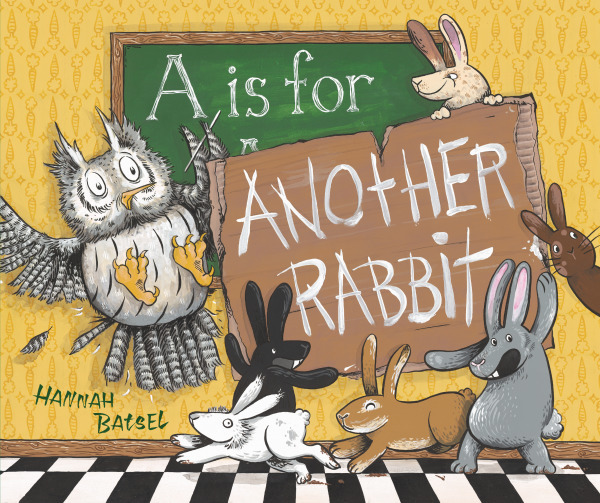
Most of them are the normal size of wild rabbits but one or two are rather large which confirms their considerable abilities not only in enjoying a banquet of edibles but in eluding the prevalent raptors and coyotes.  It's hard to know how many there are in residence, but their frequent appearances indicate their numbers are growing.  A is for Another Rabbit (Carolrhoda Books, an imprint of Lerner Publishing Group, April 7, 2020) written and illustrated by Hannah Batsel is an alphabet adventure gone awry due to an overabundance of bunnies.  Trust me when I relate that this is no laughing matter to one particular owl, but the hares find it hilarious (and you will, too.)

A is for A rabbit.

Wait---
rabbit starts with R! 

Yes, but "a rabbit" starts with A.

As you might surmise the letter B is represented by the word bunny which, I might add, is quickly pointed out by the disturbed owl as being a synonym for rabbit.  As the narrative proceeds through the letters of C and D, entire phrases represent those letters because of the first word in those very phrases.  A promise is made for the letter E.  Initially, the owl is happy because it seems this alphabet book is back on track until he uncovers a wily disguise. 

The presentations for letters F through J are outrageously focused on rabbits rather than the specific letters.  Owl is fearful of being fired.  Clearly Owl is getting more and more rattled when he mistakes the word Kit for Kite.  Kit happens to be the term for a baby . . . rabbit.

The farther into the alphabet we go, the more despondent Owl becomes. He's a complete bundle of nerves.  The unseen narrator convinces him to rest for a few pages after the letter P.  Owl readily agrees.

The silence that settles over the pages for Q is laden with suspense because the next letter is R for . . . RABBITS, oodles of rabbits.  Owl is flabbergasted as he shouts out S for stop!  An obvious message is conveyed.  With letters T through Y, it's fulfilled.  As the alphabet book comes to a close, Owl, frazzled to within an inch of his bird life, finally gets his wish.  Although, others get the last word.


Author Hannah Batsel begins her comedic tale immediately as we read the first three sentences.  It builds with each letter of the alphabet as the banter increases between Owl and the unseen narrator.  Every alphabetical statement, more preposterous than the last, is countered by Owl as his frustration escalates.  This supplies readers with humor which multiplies proportionality.  The pure fun at reading this text aloud increases with the use of alliteration and rhyming.  It's a joyful rabbit jubilee!  Here is a passage.

G is for Goodness me!
Another page
of rabbits?

Now, look here.  I may
be small, but I refuse to be
pushed around by a pack
of long-eared, carrot-eating
furballs!  If you don't stop
this nonsense, I'll---


The full-color images on the front and back of the open and matching dust jacket and book case declare shocked surprise and marvelous merriment. Clearly on the right, the rabbits have no intention of stopping their quest to occupy every single letter of this alphabet book, much to the dismay of Owl.  To the left a multitude of rabbits in an array of colors and attire are layered together.  Among them is a rabbit robot, a pastry chef rabbit carrying a cake with lighted candles, a rabbit wearing a Wisconsin cheesehead hat, a crown-wearing royal rabbit, a rabbit opera singer donned in a Viking helmet with horns and braids and rabbits wearing lion and alligator costumes.

On the opening endpapers in lavender as a canvas with brown etching is a gallery of animal portraits, meant to be a part of this alphabet book.  Owl is entering from the far-left walking along, carrying a book under one wing and a hot beverage in the other wing.  On the closing endpapers, a white rabbit on a ladder and with telltale red paint has made alterations to the gallery.  An exhausted Owl, beverage spilled and book on the floor, is sleeping on the sofa on the far right.

These images

painted with acrylics, black ink brush pens, and liquid gold leaf

by Hannah Batsel are a reflection of her gift of humor and love of rabbits per her dedication and note on the verso page.  On the title page Owl is quietly at rest in an easy chair in front of his fireplace.  Careful readers will notice an odd shape on the globe next to his chair. 

Each illustration spanning two pages or single pages is highly animated with bright and lively characters.  Their facial features especially those of Owl mirror every mood.  Readers will pause at each page turn to notice the details and myriad elements.  The use of white space is instrumental in depicting the comedy and drama to perfection most notably for the letter Q.

One of my many, many favorite illustrations is for the letter E.  Spanning across from the left, over the gutter and nearly to the edge on the right is an elephant.  This is no ordinary elephant.  This elephant is formed from patched gray blankets of different textures, with cardboard ears painted pink, cardboard tubes for tusks and a trunk manipulated by three rabbits and a stick contraption.  On the green and yellow tile floor are splatters of pink paint and a dropped paint brush.  Owl is basking in a glow of suspicious confidence with closed eyes.  This page is sure to evoke bursts of laughter.


This book, A is for Another Rabbit written and illustrated by Hannah Batsel, is a celebration of all things rabbit.  It is one of the funniest alphabet books with bunnies busting out of the seams. It can be used with other alphabet books, a unit about rabbits or a theme based on humor, one discussing what makes a book hilarious.  I highly recommend this title for your personal and professional collections.

To learn more about Hannah Batsel and her other work, please follow the link attached to her name to access her website.  At her website a page dedicated to this book provides a glimpse at illustrations.  Hannah Batsel has accounts on Facebook and Instagram.  At the publisher's website you can view interior images and read an excerpt.

Tuesday, June 12, 2018

Wide-Eyed And Wide Awake

We all know children are the last people to admit they are sleepy.  Even if they can hardly sit or stand upright, they would rather give up dessert for a year than admit they are tired.  They live life to the fullest and simply don't want to end any of their days.  You have to love their energy and attitude, even if you long for them go to bed and fall asleep.

Give a child a game especially with a challenge and it's an invitation they can't refuse.  DON'T BLINK! (Random House, April 3, 2018) written by Amy Krouse Rosenthal with illustrations by David Roberts openly asks for reader participation.  It's the best kind of dare.

Here's how it works.
If you can avoid getting to the end of this book, you can avoid bedtime, simple as that.
(It's a pretty sweet deal, actually.) 

The true test is the tricky part.  Every time you blink you have to turn a page.  You don't want to turn pages, so you definitely can't blink.

Now we all know as soon as you've been told not to do something, you have a difficult time not doing it.  It's as if all of a sudden you have to do the thing you are not supposed to do. Of course, readers will be unable to stop from going to the next page.  The narrator, the owl, is flabbergasted that a page is turned.  He believes you blinked.  You are warned again.

NO BLINKING!

As each page is turned (you can't help it), the owl continues to issue his statement.  You are getting closer and closer to completing the book.  We know what that means.  Game over.  Bedtime.

In his infinite wisdom the owl suggests you do the opposite of blinking which is staring.  A variety of subjects are presented for your attempt at staring.  With each new tactic (and there are many), the reader is getting nearer to the end of the book.  With a final exclamation

Holy pillow puffs!

an entirely new approach is suggested.  This clever twist will have readers wondering, smiling and requesting "read it again" unless they are already on their way to dreamland.


For those of you familiar with the writing of Amy Krouse Rosenthal (or even if this is the first of her books you read), you will be astounded at the way in which she finds the universality in any given area.  She has an innate manner in reaching out to all readers creating a genuine and shared experience.  In this particular title she involves readers through the dialogue of the owl.  He talks directly to us on every page guiding us to avoid bedtime with ample doses of humor.  Here is a passage.

JEEPERS!
You BLINKED again.
I thought you wanted to stay awake!
You do realize that each BLINK
gets you closer to you-know-what?!


Look at the front of the dust jacket.  Look at those large eyes.  Despite the words of the title, don't you want to blink?  This owl is a definite attention-grabber.  The limited color palette used in this first image is maintained throughout the book.  If you look closely, the tag on the body of the owl is the illustrator's name, David Roberts.  To the left, on the back of the dust jacket, the owl is starring at a toy zebra, trying not to blink. 

The opened book case is on a canvas of black.  The illustration on the back is identical to the dust jacket but on the front there is a distinctive difference.  It hints at the book's conclusion.  The opening endpapers are bright yellow and the closing endpapers are black.  These are other indications at the twist the story will take.

On the title page the text, DON'T BLINK!, appears within the owl's eyes.  The liberal use of white space accentuates the words, expressions and body language of the owl.  A slight change in his arms and eyelids conveys the exact mood being depicted.  It also will have you laughing out loud.  An ingenious technique employed toward the end of the book has the elements in the visuals shown as if they are within an eye, an eye slowly closing in sleep.

One of my many favorite illustrations is when the owl (Is he a beloved stuffed animal?) is asking the reader to

STARE at the person next to you.

That person happens to be a toy zebra, casually sitting upright.  The chunky body, stripes, rounded-ears, large nose and wide eyes are guaranteed to make you smile.  This picture (all the pictures) is surrounded by white.  It is on a single page. 


No matter how many times this book, DON'T BLINK! written by Amy Krouse Rosenthal with illustrations by David Roberts, is read laughter is sure to be part of the story.  Readers will be commenting in response to everything the owl says.  You might want to pair this with Good Night Owl (Disney Hyperion, April 19, 2016) written and illustrated by Greg Pizzoli.  This is a surefire winner for story times and bedtimes.  I hope you place a copy on your personal and professional bookshelves.

To learn more about the late Amy Krouse Rosenthal and David Roberts and their other work, please follow the links attached to their names to access their sites. David Roberts maintains an Instagram account.  At the publisher's website you can view interior images.

Friday, December 8, 2017

Silent Beauty

Waking up to a fresh, first blanket of snow is exhilarating.  No one enjoys it more than a puppy.  Their stops, nose to the ground, followed by quick starts and hops along with full-blown running in circles enlivens the heart of any individual.  They are soaking up this gift from Mother Nature and expressing their gratitude in ways we humans can never replicate.

Even more enchanting is to witness a living being experience the first snowfall of their lives. All their senses awaken to it. Hoot and Peep:  A Song for Snow (Dial Books for Young Readers, Penguin Young Readers Group, an imprint of Penguin Random House LLC, November 14, 2017) written and illustrated by Lita Judge is a charming blend of anticipation and the value of patience.

It was Peep's first winter,
and she cuddled close to
her big brother, Hoot.

There was a chill in the air; the kind of chill signaling the arrival of snow.  Peep thought snow was a she.  Hoot explained it was a thing.

Peep, full of questions, wanted to know what sound snow made.  Was it like rain, wind or falling leaves?  Hoot had a hard time replying because he was as young as Peep when he first heard snow.  Its melody was too faint for him to remember.

Hoot was content to wait calmly for snow.  Peep was too excited to perch and ponder.  She flew off to search for it.  Squirrel was as new to the world as Peep and he had not seen snow either.  He did offer Peep his song.

Without any fanfare snow came, flake by flake.  Peep, Squirrel and a little mouse companion sat watching in wonder.  Peep swooped back to join Hoot.  Wisdom was appreciated.  Playful tunes were sung until dawn's first light.

The conversations between this older brother and baby sister endear these two characters to readers.  The simple innocence of Peep and the insights offered by Hoot will resonate with readers and listeners alike.  Lita Judge in this title (in all her titles) finds a way to express with her words a needed gentleness and a thoughtful way at looking at our world.  Lively humor is found in the voicing of sounds by Peep in contrast to Hoot's soft Hooo.  Here is a passage.

"Rain falls from the sky," said Peep.
"Does snow drop, ploppety splop,
like the rain's song?" 


When you look at the matching opened dust jacket and book case, the happiness exhibited by the owl siblings and their mouse friend spills outward filling your heart with warmth.  You also wish you could fly to their starred roost and join them.  Everything but the soft background is varnished.  The title text is raised to our touch. To the left, on the back, Peep tosses snowballs at Hoot as they stand in a courtyard of trees dressed in soft drifts.

The opening and closing endpapers are a very pale blue with exquisite snowflakes floating across the pages.  On the title page Peep, Hoot and the mouse are looking directly at us from the top of a tall shrub shining with Christmas lights as the snow falls.  Here and throughout the book, with her flair for choosing a color palette, the background lifts the characters forward without diminishing its nature.

Rendered in watercolors with a few digital finishing touches these pictures literally glow.  Lita Judge includes lights in windows, tiny lights on the starry tower top, lighted shop window displays, street lamps, Italian lights strung in park trees and Christmas lights woven into the decorative garden.  The images either span two pages, a single page, a page and a half or portions of a single page to enhance the narrative's pacing.  They are loosely framed with elements occasionally leaving the border.

The brush strokes for the birds' feathers, the tufting around the mouse's ears and Squirrel's tail invite you to reach out and touch the pages.  The large eyes full of emotional expression connect us to the characters.  They draw us into their experiences.

So many of these illustrations are favorites.  One beautiful picture spans two pages.  Hoot is leading the way through a city street to the best place to wait for snow.  Peep is following with the little mouse riding on her back.  They are flying by a pastry shop.  All shapes and sizes of delectable desserts are on display in the window.  Large circular peppermint candies hang from the awning.  A mobile of toys sways as they pass.  The name of the shop is fashioned into a metal sign with an attached lamp.  Oh, to have been there when they passed!


Without a doubt readers who enjoyed the first title Hoot and Peep (students were singing the sounds during a read aloud) will find themselves loving Hoot and Peep:  A Song for Snow written and illustrated by Lita Judge.  This uplifting story of an once-in-a-lifetime event is told with words and art which convey pure magic.  Children will ask for this story repeatedly.  Soon they will have the sounds memorized.  I recommend this for your professional and personal collections.

To learn more about Lita Judge, please follow the link attached to her name to access her website.  She has a short video there about the creation of an image for this book.  If you click on Inside this book you can view five interior illustrations including several favorites of mine.  At the publisher's website you can view the title page and a portion of the first picture. If you follow this link you'll discover two pages from the book to color courtesy of the publishers.  Lita Judge has been a guest at author, reviewer and blogger Julie Danielson's Seven Impossible Things Before Breakfast several times, herehere and here.  Lita Judge is interviewed at Great! Storybook.

Friday, March 11, 2016

A Trio Of Tantalizing Treats

The number three is commonly found in folklore.  As a storytelling technique it supplies a cadence to the narrative.  Listeners and readers seem to gravitate to this rhythm as if it's wired into their DNA passed on from generation to generation.

 Believing good things come in threes, the three most recent years have provided younger readers with a trio of charming titles.  Early Bird (Feiwel And Friends, January 28, 2014), Night Owl (Feiwel And Friends, January 27, 2015 and Cat Nap (Feiwel And Friends, January 26, 2016) all written and illustrated by Toni Yuly draw readers' attention to a single character in each book.  Within their stories each reveals a surprise.

Early Bird likes to wake up early.

A morning stretch helps her to feel tall.  Filling her lungs with daybreak's clear air, she sets off with a mission on her mind.  Nothing distracts her from her path; not even the spider peering from her web.

She weaves her way through grass, flowers and past the fence in the yard.  Cleverly she eludes a sleeping cat.  Moments later she reaches her goal, the garden.

Waiting there is

the Early Worm!

After this trek Early Bird finds herself with a healthy appetite.  It's time for a juicy feast.


Five sentences form this story.  Toni Yuly uses easily understood adverbs defining them within the text and her illustrations.  They are used to indicate direction making them integral to Early Bird's early morning trip.  Here is a sample portion of one sentence.

Across the grass
through the flowerbed
under the spiderweb ...

Though the illustrations on the front and the back of the matching dust jacket and book case are different, Toni Yuly has them placed to create a pleasing blend as if they are one.  Primary colors paired with the white picket fence and firm black lines have a huge appeal for the intended audience.  The opening endpapers are done in a deep midnight blue.  A cheerful golden yellow, the same as the butterfly on the front, covers the closing endpapers.

Yuly uses the title page to begin the story with a crescent moon in the sky over a sleeping Early Bird in her nest.  Sixteen double-page images follow Early Bird on her journey with the backgrounds gradually getting lighter until the shade on the closing endpaper is reached.  There are two exceptions to this pattern with the background in white.  They represent critical events in the story.

Very exact details dictate the mood in this story; the eyelashes on the sun peeking over the horizon, the three ladybugs on the blade of grass, three bees among the flowers, a flower becoming the letter o and the musical notes on the final picture.  There are not a lot of elements in each picture but each is essential.  The layout and design form a wonderful pace along with the placement of the text.

One of my favorite illustrations is of Early Bird breathing in the crisp morning air.  The background is a lighter hue of the dark blue.  On the left side of the image is a large orange, pink and white blooming flower.  To the left on a darkened hill stands Early Bird head tipped back, eyes closed and beak open.  The air is moving around her.


Night Owl likes to stay up late.

He bids the sun farewell and greets the moon.  Someone is missing.  Mommy Owl has disappeared.  He hears a sound.  Perhaps it is Mommy Owl.

It's not quite right.  It's only Woodpecker.  What's that noise?  Flying to investigate, Night Owl discovers that this sound is too long to belong to his mother.

He looks high and he looks low.  Mommy is not to be found.  A noisy storm sends him back to the safety of his tree hollow home.  Comfy and as brave as a little owl can be, Night Owl starts to drift into dreamland when he suddenly finds himself awake.  Mommy?


Using more sentences in this story allows Yuly to establish a different sort of rhythm.  As soon as Night Owl discovers Mommy is missing he listens, hears a sound and looks to see if it's his mother.  It's a question followed by an observation and then an answer.  Readers learn about short, long, high, and low kinds of sounds. Here is a sample portion.

He listens...
tap tap tap
...is that Mommy Owl?
No, that sound is too short.
It is Woodpecker.

As in the first book, Toni Yuly astutely blends the front image with the back illustration on the matching dust jacket and book case.  The branch on which Night Owl is perched goes to the dark spine.  To the left of the spine is a large tree supporting another branch holding up Woodpecker as he makes a hole in the trunk.  The endpapers' colors are a reverse of the first book; a paler golden yellow to a deeper blue.

On the title page Night Owl is resting his head on his wing as if it's a hand, looking outside the hole in his tree.  All of the illustrations span two pages with the exception of two single page pictures.  The background hues are varying shades of the blue and purple colors of night.

Careful readers will see that Yuly places small details from one illustration in another.  On the page with Woodpecker, the train tracks appear at the bottom.  Cricket follows Night Owl to the pond.  Using a much light shade of purple for the sounds, different fonts and positioning them apart from the narrative text is wonderful.

When Night Owl first finds out he is alone is one of several favorite pictures of mine.  A lighter purple background blended with a slighter darker layer on the bottom allows the moon partially covered by clouds and the tree branch to stand out to the reader.  Night Owl is shown with four different head positions on the same branch; right, back, left and forward.  He is most definitely more wide-eyed than usual.


The clock says noon.
It's time to rest.

Clearly Cat is in agreement with taking a nap.  Clearly Kitten would much rather seek out fun. And she does not want to do it alone.  Nothing would please her more than sharing this enjoyment with Cat.

A suggestion of a game of hide-and-seek is met with grudging acceptance.  This might work out for Cat if the right spot is found.  Unfortunately Kitten is a very skilled detective.

Wherever Cat goes, Kitten follows.  All this hiding has made Cat more tired than ever.  He can hardly wait to curl up in his bed and fall fast asleep.  Kitten wins again!


Toni Yuly lets her readers know very quickly there is a contest of wills which will drive this story.  Each time Cat hides and is found by Kitten the tension grows as we move high and then low, in the dark and into the light and inside and outside.  It is the perfect setup for the conclusion.  Here is a single portion.

Cat hides down low.
Kitten finds him.  Again. 

The colors shown on the front of the matching dust jacket and book case are used throughout the title with the addition of shades of brown and gray.  You can tell from the wide-eyed look of Cat and the eager grin on Kitten's face, this story is going to be filled with humor.  The red from the jacket and case is used for the opening and closing endpapers.

On the title page Kitten is leaping beneath the text after Cat who is almost off the page to the right.  With the exception of two pages divided into four images, all of the illustrations are spread across both pages.  There is a definite retro feel to the interior of the home based upon the design and individual elements.  The shelving is filled with many interesting items sure to generate further investigation and discussion.

The looks on Kitten's face declare her to be a complete scamp.  Cat tolerates Kitten's antics...barely.  A tiny mouse is included in nearly all the illustrations.  When Cat and Kitten are in the basement, the expression on the mouse's face near the spider web will ring true with many readers.

One of my many favorite illustrations is when near the beginning Kitten pounces on Cat.  Yuly has given us a close-up perspective of Cat's face wearing a perturbed expression and eyes looking upward at Kitten.  Kitten is on top of Cat's head, arms and paws holding on between his ears.  Kitten is looking downright gleeful, giving us a toothy grin.


Early Bird, Night Owl, and Cat Nap written and illustrated by Toni Yuly are absolutely brilliant.  Superb pacing in the text and careful placement of details within the illustrations (which appear simple but are more complex in what they convey) make all three of these titles reader favorites during group story time or one-on-one at bedtime.  You must have these on your personal and professional shelves.

To learn more about Toni Yuly and her work please follow the link attached to her name to access her website. Here are the links for the books in order by publication date featured at the publisher's website; here, here and here.  Each one has eight illustrations for you to view.  Toni Yuly and her work are highlighted by author, reviewer and blogger, Julie Danielson at Seven Impossible Things Before Breakfast.  Scholastic Ambassador for School Libraries John Schumacher features her on his blog, Watch. Connect. Read.  Toni Yuly is interviewed at Miss Marple's Musings, The Little Crooked Cottage, KidLit411 and Writing For Kids (While Raising Them).  Podcast chats with Toni Yuly can be found at The Picturebooking Podcast, Storybook Spotlight and All The Wonders.