Quote of the Month

When love and skill work together, expect a miracle. John Ruskin


Showing posts with label Katherine Applegate. Show all posts

Tuesday, April 4, 2023

Early Reader Extravaganza #3

Waiting for the next book in a series is far more exciting than waiting for your birthday or a special holiday.  As the saying goes, a book is a gift you can open again and again. (attributed to Garrison Keillor) For early readers, those beings who are feeling the fire of story ignite in new ways, the return of beloved characters is like welcoming home our best friends. We can hardly wait to read about their new adventures and discoveries.  Where will they go?  Who will they meet?  Will their new story make us laugh or cry or think about possibilities or maybe all of those and more?

Early readers and the books written for them are a joy to watch when they connect.  As said in the previous posts, Early Reader Extravaganza and Early Reader Extravaganza #2, the engaging characters in these stories make lifelong bonds with readers.  These characters stay with us for the rest of our lives. 

For those of us who love canine characters, there is no better way to celebrate our shared experiences with them than through the laughter they provide and their special outlook on their lives and our lives. How fortunate we are to have within the past week two releases of the third book in an early reader series featuring dogs we cannot help but love.  Doggo and Pupper Search For Cozy (Feiwel and Friends, an imprint of Macmillan Publishing Group, LLC, March 28, 2023) written by Katherine Applegate with illustrations by Charlie Alder is seven chapters of dog and cat logic destined to have readers smiling and laughing out loud before the final sigh at the end.

Chapter One
Bad News

"Bad news," said Cat.  "The humans
had another idea."
"Uh-oh," said Doggo.
"Oh no," said Pupper.

As Doggo and Pupper question Cat about the bad news, they find out it is not ridiculous hats, bubble baths, fireworks, or vacuum cleaners.  This bad news only affects Cat.  The humans have purchased a new bed for Cat.

While the bed is identical to the previous bed, it lacks one essential property.  It has no cozy.  Cat declares there will be no more sleep for this feline fussbudget.

An outside adventure does not lift Cat's spirits.  Neither does a discussion on pickiness. When Nap Time rolls around Doggo is ready for a snooze.  Pupper, as you might expect, is not.  Pupper can't quit talking and wondering about Cat and her bed. 

That night during a storm, Pupper is truly glad to have Doggo close.  Cat can not get settled; no place has cozy.  So, guess what?  No one sleeps.  Doggo and Pupper know they have to fix this dilemma.  

The next day after clever trickery (humans are gullible) on their parts, Doggo and Pupper go outside to locate the old bed.  Digging in garbage cans is smelly business, but triumphant, or is it?  Sometimes, cozy arrives exactly when it should.


Through a marvelous blend of narrative and dialogue, author Katherine Applegate further endears us to these individuals, Doggo, Pupper, and Cat.  Their distinctive personalities are revealed in their conversations and antics.  We sympathize with the sometimes-unsettling nature of change.  The friendship between the trio has never been more apparent.  Amid our empathy (and love) for them, we cannot help but find the hilarity in their reasoning.  I found the parallels between the storm and Cat finding cozy to be fantastic storytelling.  Here is a passage.

"Cat is never going to sleep again," said Pupper.  "Why do I have to?"
Doggo opened one eye.  "Trust me," he said.
"Cat will sleep again.  Sleeping is her superpower."

"I wonder where her old bed is," said Pupper.
Doggo made an extra-loud snore.


Artist Charlie Alder enhances an already joyous story with her fun and funny illustrations.  Her full-color pictures are lively and captivating.  We can tell Doggo and Pupper extend their full sympathies to the plight of Cat by looking at the front of the book case.  On the back of the case is text we would usually find on the front and back flaps of a dust jacket.  There is a blurb for the book, information about the creators, and reviews for the series. The entire case is varnished.

The color of the title text on the front of the case is replicated on the opening and closing endpapers.  Small images of Pupper, Doggo, Cat and pet toys decorate the title, verso, and contents pages. Prior to the beginning of each chapter, there is a large image on the left foreshadowing the chapter highlights with the text on the right.

Throughout the book, the picture sizes vary.  We have dramatic double-page pictures followed by colorful single-page visuals.  Sometimes, there is a group of smaller images on one page.  These different illustration sizes amplify the text.  By bringing us close to the activities portrayed, we feel as though we are a part of the story.

What readers will enjoy most are the facial expressions, body postures, and antics depicted of Doggo, Pupper, and Cat.  They are highly animated, leaving no doubt as to their mood at any given moment.  Readers will find themselves laughing page after page, sometimes for most of a chapter.

One of my many favorite illustrations is actually a group of images.  There are six smaller pictures of Pupper doing everything but napping.  He is flying with a balloon, ready for a swim with flippers, a tube, and snorkel, zooming on his belly on a skateboard, roller blading, standing on his head and hopping over a lounging Cat, sipping her drink through her striped straw, and Doggo on his back eating popcorn, the bowl on his stomach.  This trio is comic and highly entertaining.

Readers will be cheering for these animal friends page after page in Doggo And Pupper Search For Cozy written by Katherine Applegate with artwork by Charlie Alder.  I can only imagine readers will be rereading the first two books again after reading this one and then reading the third book for a second time.  We simply don't want to let our favorite friends go.  At the close of the book is Cat's Guide to Napping.  These ten recommendations are sure to bring on the giggles.  You will want at least one copy of this title in your professional collections and one for your personal bookshelves.

To learn more about Katherine Applegate and Charlie Alder and their other work, please visit the websites highlighting them by following the link attached to their names.  Katherine Applegate has accounts on Facebook, Instagram, and Twitter.  Charlie Alder has accounts on Facebook, Instagram, and Twitter.  At the publisher's website, you can view interior pages to get a glimpse of the fun waiting for you.


A third dose of comedy (and truth as only dogs can tell us) is charming its way into our hearts and minds today.  Fenway And The Loudmouth Bird (Make Way For Fenway series)(Putnam, G. Putnam's Sons, April 4, 2023) written by Victoria J. Coe with illustrations by Joanne Lew-Vriethoff is a treasured look in ten chapters at how our canine friends perceive their worlds and us.  In this newest early reader, we can see Fenway is learning more with each experience.  He is also making us better humans.  

1
NANA'S

As soon as my short human, Hattie,
opens the car door, I hop outside.
My ears are perked.  My nose is high.
And my tail is wagging.

I hear a lawn mower.  I smell the
faint aromas of coffee, licorice,
and a little bit of cherry.  And I
see sidewalks, grass, and rows of 
buildings.

Now that Fenway has assessed his surroundings with his senses, he is delighted to know they are at Hattie's grandmother's home.  This always means good things for Fenway.  They will play his favorite game, Abracadabra, which involves treats.

Can you imagine Fenway's shock to discover a bird in Nana's home?  Birds and squirrels (those nasty sneaks) belong outside.  But Merlin is Nana's new feathered friend.  To Fenway's chagrin, Merlin can talk human!  And everyone is giving this bird their undivided attention.  Fenway wants to play the Abracadabra game and get some treats.  But wait, the treats are in the car.

As the group heads to the car, Fenway is hopeful, but Fetch Man and Food Lady leave with the treats.  Now it's just Nana, Hattie, Fenway and that dratted bird, Merlin.  Nana and Hattie play the Abracadabra game with Merlin who now knows how to call out Fenway's name in the you're-in-trouble voice.  Fenway decides to turn his attention to the squirrels outside Nana's window.  As he barks at them to protect Hattie and Nana, Merline starts squawking out SQUIRRELS!  Fenway is wondering if Merline might get that squirrels are not a good thing.

Activities progress on day two, which puzzle Fenway and make Merlin uncomfortable.  Fenway is starting to empathize with the bird.  The afternoon gets interesting when Hattie and Nana leave the bird and dog alone.  Fenway is awakened from a nap by calls from Merlin. The bird is even starting to bark.  Yes, you read that right . . . bark.  Something has upset the bird and Fenway, as is his purpose, is on the job.

Readers suddenly find themselves cheering even more for the determined little terrier.  Will he be able to accomplish this newest feat?  Merlin's calling of his name has changed in tone.  Is that bird cheering for Fenway, too?  When Nana and Hattie return, they are greeted by several surprises.  The best one, according to Fenway, is the new words Merlin utters.  GIVE FENWAY A TREAT!


With every book showcasing Fenway, we readers learn more about dogs and their minds and hearts.  This is a gift author Victoria J. Coe gives to readers with each title.  It is easy to understand how Fenway acts and reacts in each situation in this story through narrative, his thoughts, and dialogue. 

Each individual, including Fenway, approaches each situation with expectations.  When those are altered, adjustments must be made.  The results of those adjustments are sometimes surprising and, in this case, highly favorable.  Fenway learns a bump in the road can lead to a new pathway, one shared with friends.  Here is a passage.

"FEN-way! FEN-way!" comes
from the big cage.  I hear rustling
and jabbing sounds.  What a racket!
I try to ignore him, but it's no
use.
"FEN-way! FEN-way!"
Why does Merlin have to be so
loud?  It sounds like he's freaking
out in the cage.  Is he mad at it 
or something?

I get up and trot toward the cage.
"Quiet down, loudmouth!" I bark.

I watch him flit back and forth and
peck the metal bars. He's clearly 
upset about something.  Is he just as
sad as I am that Nana and 
Hattie left?


Nobody looks more surprised than Fenway at the appearance of a parakeet at Nana's house.  What's a dog supposed to do when a bird, who is clearly to be outside, is now inside?  This bird looks as though it has something to say to Fenway.  This image on the front, right side, of the matching dust jacket and book case, will have readers asking all kinds of questions before they start to gobble up the goodness of the story.  

To the left of the spine is an introduction to this title, along with thumbnails of the three books in the series.  There is also a nod to the original Fenway and Hattie title for older readers.  On the title page, Fenway, tail wagging in happiness, greets readers.

These images in black, white, and gray by Joanne Lew-Vriethoff throughout the book on cream-colored canvases convey the best moments in each chapter.  We know exactly where Fenway is, who Fenway is with, and what all the characters are feeling.  You will be pausing at page turns to study the details.  Each illustration is as lively as our favorite Jack Russell terrier.  Through these pictures our understanding of Fenway grows stronger. 

One of my many favorite illustrations is actually a series of three smaller images on two pages.  We see Fenway on the hunt for something lost.  He is peering around the drapes in Nana's apartment.  Then, we see the back portion of him snooping under the drapes.  In the final one, all we see is Fenway's nose peeking from under the bottom of the drapes.  This is so typical of dogs looking for something, I laughed out loud.  They are always led by their super-sniffer noses.


The best part about Fenway is his ability to learn.  In this third book in the early reader series, Fenway And The Loudmouth Bird written by Victoria J. Coe with artwork by Joanne Lew-Vriethoff, Fenway does not falter from his job of protecting his young human Hattie and the older humans around her.  But, he, wise dog he is, shows us how friendships can form in the most unlikely of places.  You will most definitely want more than one copy of this title on your professional bookshelves and one for your personal collections.  

To learn more about Victoria J. Coe and Joanne Lew-Vriethoff and their other work, please take a few minutes to visit their websites by following the link attached to their names.  Victoria J. Coe has accounts on Instagram, Twitter, and YouTube.  Joanne Lew-Vriethoff has accounts on Facebook, Instagram, and Twitter.  At the publisher's website, you can read an excerpt from the book plus view the chapter contents.

Wednesday, May 4, 2022

Early Reader Extravaganza #2

As mentioned in a previous post, Early Reader Extravaganza, when we first learn to read our perceptions about our world change.  We gobble up words to quench a hunger.  It is a hunger to know, to understand, to explore, to travel to places real and imagined, to have sensory experiences, to laugh, to cry, to have our hearts warmed, broken and healed and to meet people like us and completely different from us.  We feed this hunger as early readers by bonding with what we find within the pages of books; whether it is information satisfying our curiosity or characters and their situations that actively engage us.

For lovers of canines, two new early reader series supply loads of laughter and the antics of dogs living their best lives.  Doggo And Pupper (Feiwel and Friends, March 23, 2021) and Doggo and Pupper Save The World (Feiwel and Friends, March 22, 2022) written by Katherine Applegate with illustrations by Charlie Alder take us into the home of an older dog living with a cat.  Their humans decide to introduce another dog, a younger dog, into the family.  The results are comedic to say the least.

Chapter One
Same Old, Same Old

Every night Cat asked,
How was your day,
Doggo?"

Every night Doggo said,
"Same old, same old."

Then he would wink at the 
smiling moon and say, "Could have
been worse."

In support of his same old, same old assessment, Doggo in rhyming two word phrases, seven couplets, describes his day.  He is quick to point out the value of quenching thirst and dispelling tiredness.  To up the funny factor, we discover what Doggo does when his humans are absent.

The subsequent six chapters reveal how Doggo's humans decide to add pep and purpose to his days.  Cat reminds and warns Doggo of the dire consequences of human intervention.  The presence of Pupper changes everything.  Doggo's days are wild because Pupper is wild.  Pupper needs to go to charm school.  He is not happy about this apparent requirement.

Upon his return, his humans are pleased with his behavior.  Doggo is pleased, too.  Cat is the first to point out that Pupper may have lost his wild ways, but he is hardly happy.  That night Doggo is the one with an idea.

His sleepy humans allow Doggo to take the car keys.  Road trip!  Pupper and Doggo play and play and play. Would you believe they went to a drive-in movie?  The duo silently sneak back inside their home.  Cat has a few things to say the next day.  Doggo replies with a familiar refrain.


Chapter One
Wonderful

In a sweet spot of sun,
Doggo dozed.
In a fine patch of dirt,
Pupper dug.
Life was good.

When Pupper spots a bird and her fledglings, he declares his desire to fly like Wonder Dog.  He also expresses his fear of giant squirrels.  Pupper believes he cannot be a hero because he worries.  Doggo says Pupper does not need to fly to be a hero.

When their humans leave, Doggo, Pupper, and Cat watch a hero show on television.  Pupper needs someone to save.  Doggo picks the next show reminding him of his days in a rock band.  Pupper decides being a hero might be less work than learning to be a drummer, but . . .

Pupper drums and drums and drums for more than a week.  Cat is not happy.  When Doggo announces a band is playing in the park the next day, Pupper can hardly wait to go.  He is also distracted by the baby birds learning to fly.

The next morning on their way to the park, Pupper hears a chirping in some nearby bushes.  Is it giant squirrels?  It is one of the baby birds.  It is all alone.  Pupper knows the baby bird needs saving.  The band is starting to play, but Pupper and Doggo wait until their work is done.  As the dog duo savor the remaining hours of the day, they understand several things about music and heroes.  We do, too.


Using a blend of short narrative phrases and sentences and lively canine/feline conversations, Katherine Applegate entertains readers from beginning to end.  The interactions between Doggo and Pupper (and Cat) convey bits of wisdom, each character informing the other through their personalities.  And in these short narrative phrases and sentences, conversations, and interactions, there is laugh-out-loud hilarity.  Katherine Applegate also uses rhyming and alliteration when it is appropriate.  This technique invites readers into the stories.  Here are two passages, one from each title.

"Watch out, Doggo," said Cat one day.  "I
think the humans have an idea."
She licked a paw.  "Remember the last time
they had an idea?

Doggo remembered.

It was not pretty.


They turned a corner.
The breeze was soft.

It smelled like ice cream.
It held happy voices.


Illustrator Charlie Alder using

a combination of collage and digital techniques

fashioned the full-color illustrations on the book case and throughout the book.  Doggo and Pupper are showcased in the center on the front of both books.  On the back of the book case, amid text you would normally find on the front and back end flaps of a dust jacket, Doggo, Pupper, and Cat are doing what they do best, enjoying each other and life.  The characters and title text on the front of both books are varnished.

The opening and closing endpapers in the first title are a darker shade of sky blue.  In the second title, the endpapers are the same darker orange we see on the front of the book case.  After the title and verso pages, a contents page is supplied in both books.  Small images are on these pages; a reflection of the characters and their activities in the chapters.

Opposite each chapter page is a full-page picture alluding to the chapter revelations.  Throughout the books, the illustrations vary in size to complement the pacing of the narrative.  There are two-page images, single-page pictures, edge to edge or surrounded by white space, groups of smaller images on one or two pages, framed and unframed, and there are vertical panels and horizontal panels.  We are usually close to the characters which makes us feel a part of the story.

The expressions on the faces of the characters depict their every emotion.  Some of the details, like Cat drinking through a long, striped curly straw, will have you giggling at the very least.  All we see of the humans are portions of their bodies.  We never see their faces.

One of my many favorite illustrations from Doggo And Pupper is a series of four images for the above-noted text.  In the first image, Doggo is dressed like a ghost for Halloween.  Cat, on top of a pumpkin, is howling with laughter.  Doggo is wearing a yellow and white polka-dotted raincoat and booties in the second scene.  In the third picture, Doggo's fur, ears, and tail are tied in a series of colorful bows.  Doggo has been trimmed to the max in the final visual.  Portions of Doggo's body are dyed pink to make it appear as if Doggo is a ballerina.  

One of my many favorite illustrations from Doggo And Pupper Save The World is a double-page picture.  It is a close-up of them finding the tiny bird, the fledgling, under the bushes.  Pupper is peeking through the bushes on the left near the bird.  Doggo has his head through the bushes on the right.  We feel as though we are a part of this moment with them.


These two titles, Doggo And Pupper and Doggo And Pupper Save The World written by Katherine Applegate with artwork by Charlie Alder, are stellar early reader books.  At the close of the first book is a list titled Doggo's Guide to Puppies.  These ten items speak simple truths about puppies.  At the end of the second book is another list of ten thoughts to guide readers.  They are titled Pupper's Guide to Being a Hero.  I highly recommend this series for your professional and personal collections.  You might want more than one copy of each.

To learn more about Katherine Applegate and Charlie Alder and their other work, please follow the link attached to their names to access their websites.  Katherine Applegate has accounts on Facebook, Instagram, and Twitter.  Charlie Alder has accounts on Facebook, Instagram, and Twitter.  At the publisher's website, you can view interior images for Doggo And Pupper and Doggo And Pupper Save The World.


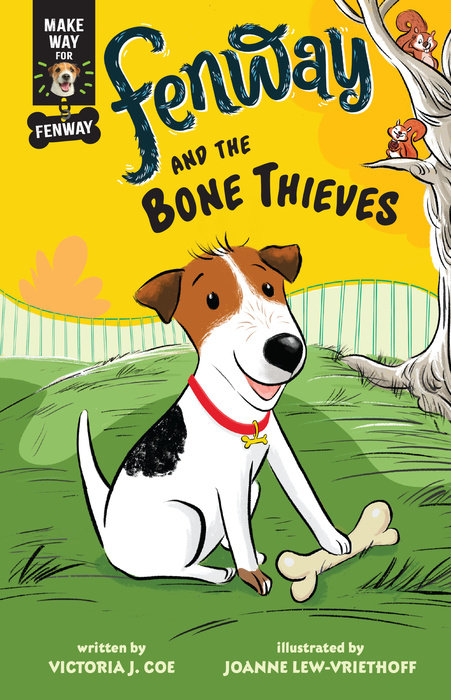
This second series of books highlights a character older readers already know.  His name is Fenway, a Jack Russell terrier.  He made a name for himself in the upper elementary/middle grade novels, Fenway and Hattie, Fenway and Hattie and the Evil Bunny Gang, Fenway and Hattie Up to New Tricks, and Fenway and Hattie In the Wild.  With each title, readers are able to see the progress as Fenway and his human grow better together.  In Fenway And The Bone Thieves (G. P. Putnam's Sons, May 3, 2022) and Fenway And The Frisbee Trick (G. P. Putnam's Sons, May 3, 2022) written by Victoria J. Coe with illustrations by Joanne Lew-Vriethoff, Fenway is still offering his spot-on insights in his own voice about his next-door neighbor dog friends, his humans, sneaky squirrels, and the elusive Frisbee.

1
THE TREAT PLACE

Everyone knows that dogs are
better than squirrels.  Dogs make
humans happy.  Dogs live
in houses.  Dogs
ride in cars.
Squirrels do
none of these
things.

In this first of ten chapters, Fenway and his humans, Hattie, Food Lady, and Fetch Man are visiting the large store filled with special things for dogs.  All Fenway can think about is treats.  His humans steer clear of the treat section, adding yucky shampoo to the cart.  It is only through sheer perseverance on Fenway's part, that a bone is added to the cart.  Unfortunately, it ends up in the trunk of the car instead of his mouth.

Finally at home, with the bone in his mouth, Fenway shows his treasure to his neighbors, Patches and Goldie, two dogs enjoying their Dog Park next to Fenway's Dog Park.  Then, Fenway hears a horrible and irritating sound.  It is the chattering of not one but two squirrels.  They are plotting to take away his bone.  After successfully chasing them away, Fenway decides the only way to enjoy his bone is to hide it from the squirrels.

After lunch, the rain begins.  Fenway is inside without his bone.  Now he is thinking his big idea is not such a good idea.  Nothing, not a single toy or game, can take away Fenway's desire for that bone, buried in the garden, outside in the rain.

The next morning when the rain has stopped, Fenway can hardly wait to get outside and dig up his bone.  There are two huge problems.  He can't remember where he buried it and the pesky squirrels are back.  Many holes later, Hattie and her friend Angel, Patches' and Goldie's short human, discover the damage done by Fenway.  As they chase him, he initially thinks it's a game, but it is most definitely not a game.  

After a flowery shampoo, a nap complete with a squirrel nightmare, and another encounter with the sneaky squirrels in his Dog Park, Fenway makes a startling discovery.  His perspective on the several days of the events are destined to have readers laughing and laughing.  As he is finally chewing on his bone on the back porch, he gets a whiff of hot dogs.  Yum!


1
THE BIG PARK

Romping in the Dog Park behind
our house is pretty awesome.  But
riding in the car with Hattie and 
Fetch Man is even better, because
we're going to the Big Park.

Fenway is having a rousing romp with Hattie and Fetch man in the Big Park.  He loves chasing after the stick and returning it, sometimes reluctant to give it to Fetch Man.  But that is all part of the game.  Just when Fenway thinks the day can't get any better, he spots a Rottweiler leaping into the air to catch a Frisbee.

Fenway wishes with all his doggy heart he could do the same trick as Carmen.  She is amazing at jumping in the air at the right moment.  He tries to do her moves with a stick.  It does not work.  He needs a Frisbee.

No one seems to understand this need, not Hattie or Patches and Goldie.  What's a dog to do?  Several days later the Big Brown Truck arrives.  After Fenway barks it away, Food Lady, Hattie and Fenway gather around a box.  What do you think is inside?  

Fenway and Hattie rush outside so Fenway can catch that new Frisbee in the air.  He is so ready to perform a trick and receive the same praise as Carmen.  All of a sudden there are the sounds of 

CHIPPER-CHATTER-SQUAWK!

Later, a frustrated Fenway, who has not caught the Frisbee yet because of the sneaky squirrels, goes on a walk with his canine pals and their humans.  Back home, Fenway convinces Hattie to throw the Frisbee in the house where there are no squirrel distractions.  As you might imagine, it ends in disaster.  That evening is very somber, but Fenway fails to understand.  The next day at the Big Park, unintentionally, Fenway creates his own special trick.  Try to read this without laughing.  It is impossible.  Oh, Fenway.

I've said it before, but I'll say it again.  Author Victoria J. Coe knows dogs, especially this dog, Fenway.  Each of the ten chapters in each book flows flawlessly with the same energy as if the words were written by a Jack Russell terrier.  The chapters end with a sentence inviting us to proceed with anticipation to the next chapter.  The upbeat narrative, Fenway's thoughts and conversations and those of the humans are thoughtful, exuberant, and funny.  Here are passages from both titles.

CHIPPER-CHATTER-SQUAWK! sounds
behind me.
Uh-oh! The first squirrel is
headed this way!  I should have 
known the two of them were in this 
together.
I run faster.  "That bone is
mine!" I bark.
The big squirrel waits until I'm 
about to lunge.  Then he suddenly
hops up and scampers across the
Dog Park.
The chase is on!  "You don't
belong here!" I bark.  I follow
that squirrel 
to the wooden
fence behind
the giant tree.


I thrust my snout into the box.
Whoopee! It smells like a Frisbee
that no other dogs have played
with.  It must be my reward for
scaring away that truck.
Hattie reaches into the box and
pulls it out.  "Ready, Fenway?" she
says.
I back up.  "I'm ready!" I bark.
"I'm so ready!"
Hattie's elbow bends.  She's going
to fling the Frisbee!
I leap onto the couch, racing
back and forth.  Hooray!  Hooray!
I'm going to catch that Frisbee in
midair!

You cannot look at the front, right side, of the matching and open dust jacket and book case for either book without smiling.  Who can resist the happy-go-lucky look on Fenway's face?  In both of these scenes, it is as if the illustrator has frozen a moment from the narrative.  The back, left side, of both books features short descriptions of the books beneath the series title, Make Way For Fenway.  Hanging from those banners is a bone-shaped dog tag with the words:

A little dog with a
GIANT personality!

The opening and closing endpapers for both books are creamy white, the same as the interior pages.  Illustrator Joanne Lew-Vriethoff has filled this book with images of varying sizes done in black, gray, and white.  With the exception of only two, Fenway makes an appearance in all of them.

The vibrancy of Fenway's personality is reflected in the artwork.  Even when he is still, it is as if he is ready to burst into action.  Readers will pause at every illustration to appreciate the details included in the pictures.  The facial looks on Fenway, the squirrels, Carmen, Patches, Goldie, and the humans leave no doubt as to what any of them are thinking.  You can't help but smile, giggle, or laugh out loud.

In Fenway And The Bone Thieves, one of my favorite pictures is a double-page image with a phrase and two sentences placed in the upper, left-hand corner.  On the left side a big squirrel with a gleam in its eyes, protruding teeth, and a big fluffy tail is ready to pounce on Fenway's bone which extends from the left side and over the gutter to the right.  Toward the top of the right side in the Dog Park is Fenway.  Flowers border the wooden fence behind him.  He is aghast at the audacity of that squirrel.  He is ready to run.

One of my favorite visuals in Fenway And The Frisbee Trick is a smaller illustration.  It is a perfectly captured moment by Joanne Lew-Vriethoff. (I should know because it happens frequently at my own home.)  The family sofa is placed in front of an arched large window.  Fenway is on the sofa, standing on his hind legs with his front paws on the back of the sofa.  He is watching the man from the Big Brown Truck carrying a package and walking toward their house.  Fenway is barking in full security mode.


To have early readers based on a beloved dog character is, in the words of my canine companion, woof-tastic!  Fenway And The Bone Thieves and Fenway And The Frisbee Trick written by Victoria J. Coe with illustrations by Joanne Lew-Vriethoff are brimming with humor and non-stop action whether read by an individual or as a read aloud.  Readers will hardly be able to wait for another installment in the series.  You will certainly need one or more copies of both books in your personal and professional collections.

By following the link attached to the names of Victoria J. Coe and Joanne Lew-Vriethoff, you can access their websites to learn more about them and their other work.  Victoria J. Coe has accounts on Instagram and Twitter.  Joanne Lew-Vriethoff has accounts on Facebook, Instagram, and Twitter.  At the publisher's website, you can view interior images and read an excerpt for Fenway And The Bone Thieves and Fenway And The Frisbee Trick.  The cover reveal for these titles with author and illustrator interviews was hosted by educator Michele Knott at Mrs. Knott's Book Nook.

Saturday, May 19, 2018

Practice Can Make Perfection

It's not an easy lesson but it's based in truth.  It seems the younger you are, the more you struggle with the art of mistakes, the art of trying something over and over again.  It's a rarity if someone reaches their ideal after a single attempt.

When we see the end result, an accomplishment, we have no idea how much effort was given to achieve that outcome.  Newbery Medalist (The One and Only Ivan, HarperCollinsPublishers, January 17, 2012) Katherine Applegate in collaboration with illustrator Jennifer Black Reinhardt (Blue Ethel, Margaret Ferguson Books, Farrar Straus Giroux Books for Young Readers, an imprint of Macmillan Publishing Group, LLC, May 30, 2017) remind us of the endeavors prior to amazing and lasting deeds.  Sometimes You Fly (Clarion Books, Houghton Mifflin Harcourt, April 3, 2018) asks us to never give up.

Before the cake . . .

Unless you are in the presence of the cook, you have no idea of the commotion in the realm of the kitchen prior to any portion of a meal being served.  Some desserts are particularly difficult, especially if you are not a culinary expert or a chef.  Babies find some activities like the act of eating something undesirable or struggling to find happiness in the hugging of a beloved toy more challenging than older children . . . usually.

If you are not a duck, the act of getting into wading pool is downright terrifying but it makes enjoying the sea much better if you embrace the wonder of water with comfortable caution.  Each act, regardless of how small, can lead to greater exploits.  We grow with every attempt.

Reaching out to people, supporting them and believing in them, can form permanent partnerships.  Academic achievement is based on study.  Being a member of a team requires dedication.

Raise your hand if you remember your driver's education teacher and all those lessons and the joy of driving alone in your first car.  Each time we try something new repeatedly, each time we overcome adversity, we get better at whatever we are seeking to do.  We get better at life.


An almost melodic rhythm is established with the twelve phrases written by Katherine Applegate prior to the five final sentences.  Two words, before the, are followed by a single word in these twelve phrases.  The single words are familiar to most of us.  Many of them are laden with memories.  The words in the second and fourth phrases rhyme.

With the five final sentences Katherine Applegate ties the phrases together and brings us back to the beginning.  It is done with love for her readers and the art of storytelling.  Here is the first of the final five sentences.

Each recipe we undertake
can rise or fall,
can burn or bake.


Rendered in ink and watercolor the art of illustrator Jennifer Black Reinhardt is tender, heartwarming and inviting.  As evidenced by the front of the dust jacket her delicate details, fine lines and realistic color choices ask us to join the characters in her images. Who wouldn't want to run after a flying kite?  To the left, on the back, two children within a loose circle are bending over a newly planted seed.  You can almost feel them willing it to grow.  A trowel and seed packet is lying nearby.  The girl is holding a watering can.

Without spoiling the book case for you, rest assured the theme of the book is portrayed on the front and the back on a canvas of another sunny day outside.  A bright, sky blue covers the opening and closing endpapers.  The dog shown on the front of the dust jacket gazes at the kite lying in the grass beneath the text on the title page.

A single page is devoted to a picture with Katherine's opening phrases.  These are followed by another single page, a wordless picture depicting the merriment found in success.  Jennifer's interpretation of the text goes straight to your heart.  Liberal use of white space frames the first picture but the second visual fills the following page.  A fine black line is used as a border.

For the final triumphant effect Jennifer gives us an expansive two-page illustration with an element soaring as if it's a kite.  A blend of small images on several pages and two-page pictures bring us to the final visual which will have readers wondering what might happen next.  There is a lingering feeling of suspense.

One of my many favorite illustrations follows the phrase

before the know . . .

A girl is tucked in bed but sitting up reading a book.  The scalloped headboard and footboard of her bed are softened in shadow as is most of the illustration.  We can see a goldfish swimming in a bowl next to her bed.  Stuffed toy animals are snuggled next to her.  A family cat sits on the bed.  An overhead lamp attached to the bed creates a cone of light in those shadows lighting her up as she reads.  This is a universal moment for many.


When you finish reading Sometimes You Fly written by Katherine Applegate with illustrations by Jennifer Black Reinhardt the first time and the second time (and all the other times) you feel your spirit lighten.  This is a book reinforcing the importance of making mistakes, learning from them and persisting.  Our efforts will be rewarded.  I highly recommend this title for your professional and personal collections.

To discover more about Katherine Applegate and Jennifer Black Reinhardt and their other work, please follow the links attached to their names to access their websites.  Katherine and Jennifer are both on Twitter and Instagram. (Katherine and Jennifer)  Sometimes You Fly has its own website.  There is quite a bit of art on Jennifer's blog.  You'll enjoy the article at Picture Book Builders about why this book was made.  Scholastic's Ambassador of School Libraries, John Schumacher, premiered the book trailer on his site, Watch. Connect. Read.  You'll want to read the interview of both Katherine and Jennifer there.

Tuesday, September 26, 2017

If Only We Would Listen

In this new home, to make a back yard space, a fenced-in place for Mulan, my chocolate Labrador, a tree service was hired to remove sixteen trees.  My apologies on that fateful day, to the trees, were profuse.  Trees have always been a huge part of my life.  Climbing to the tops of a special willow and another maple as a child, our entire neighborhood was spread before me.  Swings were tied to their sturdy boughs for hours of dizzy contemplation. Picnics were consumed and game board competitions were played in their shade.  Yellow ribbons were bravely tied all over one particular maple on another street in a different town years later.  A now tall, majestic blue spruce still grows in the back yard of my parent's former home, a tribute to my father.  Author friends sent me a tree in memory of my sweet Xena when she passed away.  The Xena tree moves with me.

The weather here has been unseasonably dry and very hot.  Even though the calendar has declared it's autumn, Mother Nature has other ideas.  Walking outside now, the katydids are singing.  It's still seventy-eight degrees.  There's not a breath of air.  Tears still fill my eyes as I walk up to one of the thirty-three trees remaining on my corner lot.  My arms wrap around the rough bark of one as I lean my head on the trunk and whisper an apology and a thank you.  I have just finished reading Katherine Applegate's newest title, Wishtree (Feiwel and Friends, an imprint of Macmillan Publishing Group LLC, September 26, 2017).  I am listening.  I know you will, too.

It's hard to talk to trees.  We're not big on chitchat.

Red, a northern red oak, is speaking to us.  Two hundred sixteen rings count the days he has spent rooted to the land on a street near one small green and one small blue house.  Across the street another larger home stands.  This resident owns the little green and blue houses and the tree. You should know Red is the name given to him by his animal friends.  Humans know him as the wishtree.

Each year on the first day of May people come, hang and tie their wishes, hopes and dreams to his branches.  Some are whispered aloud as the paper, cloth, and even a pair of gym socks are attached.  Red keeps all the softly spoken conversations on this day and throughout the year a secret.  It's a rule trees and animals have to remain silent even though they can communicate.  Currently owl, raccoon and opossum babies and their mamas reside in Red's hollows.  Nearby a group of skunks, living under a porch, visit regularly.  A crow named Bongo is Red's best friend in every respect.

This past winter a new family moved into the little blue home.  One early morning at 2am the ten-year-old girl, Samar, visits Red leaving a wish.  She longs for a friend.  Thereafter when she comes to the tree, as the rest of the neighborhood sleeps, the baby animals come to her as she sits on a blanket.  She is no ordinary girl but there are those who do not like her or her family.  Everything is about to change.

One day a boy, an older boy, not known to Red approaches.  He carves something in the tree.  Red wonders if it is an early wish.  It is not.  It says

LEAVE.

Two local police officers investigate, a reporter asks questions, and Francesca, the owner of the tree and two small houses, one blue and one green, arrives.  She makes a decision which shocks and saddens the animal realm.  It rallies Red.  There isn't much a tree can do, but Red like Samar is no ordinary tree.

A wish must be fulfilled.  A story stretching back through generations must be revealed.  A key must unlock forgotten history.  A four-letter word first uttered by one and then by many ignites the truth hidden in hearts.


By page two the first of thirty-two sticky notes was placed in my copy of Katherine Applegate's marvelous masterpiece.  Completely captivated by the voice of Red readers will eagerly embrace the ways of trees and animals learning about names, family dynamics and observations current and over the course of two-hundred plus years.  Red describes his domain as

Different languages, different food, different customs.  That's our neighborhood:  wild and tangled and colorful.  Like the best kind of garden.

Now something has changed.  A Muslim family in the small blue house is not welcomed by the adults in the small green house.  When Katherine introduces readers to the boy, Stephen, living in the green house, she sends out the beginning of hope.

Each of the short but insightful chapters ends with a sentence, a thought, which propels you forward and promotes reflection.  Through the conversations between the animals and Samar and Stephen we find ourselves trusting the unbelievable and wishing, yes wishing, for it all to be true.  And that's the gift Katherine Applegate has given readers with her words in this book.  She has given us the means to make a difference, to be agents of change, and to raise up the beauty found in human hearts and the world in which we live.  Here are a few sample passages.

Trees can't tell jokes.
But we can certainly tell stories.
And if all you hear is the whisper of leaves, don't
worry.  Most trees are introverts at heart.  

Hollows are proof that something bad can become
something good with enough time and care
and hope.

Animals compete for resources, just like humans.
They eat one another.  They fight for dominance.
Nature is not always pretty or fair or kind.
But sometimes surprises happen.  And Samar
every spring night, reminded me there is beauty in
stillness and grace in acceptance.
And that you're never too old to be surprised.


I've read Wishtree written by Katherine Applegate with artwork on the cover and final black-and-white illustrations throughout by Charles Santoso (Ida, Always) twice in one evening.  I have returned to those thirty-two marked passages and read them repeatedly.  Every page sings out hope.  I will be ordering multiple copies to give away at Halloween.  You will want multiple copies on your professional bookshelves and one for your home collection.

A special website is dedicated to Wishtree.  You can leave a virtual wish there.  This coming Thursday is Nationwide Wishing Day.  Read how you can participate.  There is an event kit and a teacher's guide you can download.  The cover was revealed on the Nerdy Book Club by Katherine Applegate.  Katherine answers four questions at Publishers Weekly.  This book trailer was premiered on Scholastic's Ambassador of School Libraries, John Schumacher's blog, Watch. Connect. Read.  You will enjoy the chat there about this title with Katherine.

Sunday, November 8, 2015

To Go Without

I may have mentioned more than once about my parents growing up during the Depression in the United States.  This translated into my sister and I living in a home with economy in all things stressed.  You did not stand in the shower with the water running.  You got wet, turned off the water, soaped up and turned the water back on to rinse.  The end.  You only turned the lights on in a room when you entered.  When you left, off went the lights.  Our clothes were hand-me downs or hand-sewn.  We hung our laundry outside weather permitting or on lines strung in the basement.  My parents never had a mortgage or a car payment. I was an adult before they owned a credit card, used a check book and finally purchased a clothes dryer.  There was no extra but our lives were rich in other ways due to the frugality and creativity of Mom and Dad.

This practice became invaluable when I found myself in my twenties living in a tent for several months and then in motel rooms for several more months.  Finally with a home built, times were still tough.  Many evenings arriving home from work meant going out into the woods to cut wood for heat because the cost of fuel was too expensive.  There were nine weeks without a trip to the grocery store so money could be used to pay bills and provide food for my two black Labrador friends. These experiences taught me to be exceedingly grateful for what I have today and to be exceedingly compassionate for those who do not.

When my ARC and swag purple package for Katherine Applegate's newest title Crenshaw (Feiwel & Friends, September 22, 2015) arrived I did not open it.  When I purchased more than one copy at a local big box store and from a bookshop, I did not read them.  I was waiting for the right moment, wondering how Katherine would tell this story.  Several weeks later as soon as I read the first sentence I knew I would not be able to stop reading until I finished the final word.

I noticed several weird things about the surfboarding cat.

It's a little bit unsettling to realize you are the only person on a beach in June to see a surfboarding cat that opens his umbrella too soon and then floats over your head.  After closing your eyes and counting to ten, the cat and the dropped umbrella eventually vanish but not before you recognize him.  It has been years since you've seen him; he is an imaginary friend after all.  Why are you seeing him now?

Jackson is about to begin his fifth grade year in school.  This guy deals strictly in facts wanting to become an animal scientist as an adult.  He and his best friend, Marisol, have started a dog-walking business, See Spot Walk.  

When four purple jellybeans, Jackson's favorite flavor, appear in the middle of a cerealball game with his five-year-old sister, Robin, he is sure Crenshaw is in the vicinity.  Cerealball is a game of having the right aim plus it helps to chase away the hunger pangs.

Three years ago when Jackson was seven he first saw Crenshaw.  Lots of guys and gals have imaginary friends so he took it in stride not even wondering why the cat chooses then to appear.  Now when questioned Crenshaw says imaginary friends must be invited.  He asks Jackson to tell the truth.

As Jackson probes for real answers, we learn of his family living in a minivan when he was seven.  We understand the strain of a father forced to leave a job due to a debilitating illness, a mother working three jobs because her teaching position is cut and of the necessity and humility of playing your guitar on a busy street corner to earn a meager amount of money for your family.  The sadness of having to sell all your possessions except those filling a grocery bag at a neighborhood yard sale is deeply felt.

Crenshaw is unable to leave Jackson, engaging him in conversations about the current state of his family's crisis.  The boy comes to the realization there is only one plan which will work but Robin unknowingly circumvents his idea.  After several poignant scenes Jackson feels deep in his heart the value of holding on to a little bit of magic for as long as you need it, even if your head tells you otherwise.

Divided into three parts Katherine Applegate opens each with a quote from A Hole Is To Dig: A First Book Of First Definitions written by Ruth Krauss with illustrations by Maurice Sendak.  This is Jackson's treasured childhood book.  Each part, a blend of now and three years previously, completely captivates readers with short chapters containing profound truths within, at the beginning and end of each.

The dialogue between Jackson and Crenshaw is wise, wonderful and funny.  It's not every day a large cat who enjoys taking bubble baths is part of your world.  In talking with his parents, sister and best friend we come to respect and love their individual personalities.  Here are several example passages.

It was late, June, nice and warm, but I shivered.
I felt the way you do the instant before you leap into the deep end of a pool
You're on your way to somewhere else.  You're not there yet.  But you know there's no turning back.

Maybe that's why I liked the name Crenshaw.  It felt like a blank piece of paper before you draw on it.
It was an anything-is-possible kind of name.

"Well, what if you are visible?  I can't let you just walk down the hall to my room.  What, if my dad wakes up to get a snack?  What if Robin has to go to the bathroom?
"She doesn't have a litter box in her room?"
"No. She does not have a litter box in her room."
I pointed to the toilet.
"Ah, yes. It's all coming back to me now."
"Look, we're going to my room.  Be quiet.  And if anybody comes out, just, I don't know, freeze.  Pretend you're a stuffed animal."
"Stuffed?" He sounded offended.  "I beg your pardon?"

Having no permanent home or regular income and going hungry is a tragic truth for too many people.  Crenshaw written by Katherine Applegate depicts this reality through the voice of a ten-year-old boy and his imaginary friend.  It will find a place in your heart, counsel your head and give you hope.  I urge you to read this more than once and share it as often as possible.

There is a website dedicated to this title which can be accessed by following the link attached to Katherine Applegate's name.  At the publisher's website you can read an excerpt.  At School Library Journal Rocco Staino conducts an interview with Katherine Applegate, Q&A: Katherine Applegate Talks about Her Upoming Novel "Crenshaw".  A guest post by Katherine Applegate and the cover reveal can be found at the Nerdy Book Club.  On the release date Crenshaw was celebrated on Watch. Connect. Read. the blog of John Schumacher, Scholastic Ambassador of School Libraries, on Sharpread, the blog of I Love Reading 3rd grade teacher, Colby Sharp and at the Nerdy Book Club with a post by Katherine Applegate, No Easy Way To Say It. Enjoy the book trailer.


Wednesday, October 15, 2014

Lessons From A Gorilla #2---The True Story

On January 28, 2013 I, like many others around the world, was unable to attend the American Library Association Midwinter Meeting And Exhibits in Seattle, Washington. I was however sitting in front of a computer screen listening intently to every single word during the Youth Media Awards ceremony. For the first time in my life when the winner of the John Newbery Award was announced I burst into tears.


Katherine Applegate's book The One and Only Ivan (Harper Collins, January 17, 2012) (my review) is one of those books you will always remember reading for the first time.  You will read it more than once.  You will probably also listen to the audio book.  I knew I needed to share it with as many of my students as possible.  When Ivan passed away I wrote a post, Ivan, Katherine Applegate and Mr. Schu, talking about the impact of reading this aloud to our entire fourth grade student population.  Attending the American Library Association Annual Conference & Exhibition Banquet to hear Katherine Applegate give her acceptance speech was definitely a lifetime highlight for me.


On October 7, 2014 Katherine Applegate continued the story of Ivan with the release of a new picture book.  Ivan The Remarkable True Story Of The Shopping Mall Gorilla (Clarion Books, Houghton Mifflin Harcourt) with illustrations by G. Brian Karas.  It is a worthy companion making Ivan's story accessible for a larger audience including younger readers.

In leafy calm,
in gentle arms,
a gorilla's life began.

When Ivan's story began he had no name.  He was part of group, a family, of gorillas living their lives in central Africa among the trees of a tropical forest.  As a young gorilla he played with and watched and learned from the other members, sometimes riding on his mother's back.

Before he was old enough to know fear of humans, he and another young female were captured by poachers. They were placed in a crate and taken to Tacoma, Washington.  They had been purchased like things by a man who owned a shopping mall.

At first due to their size they were treated like human babies and children, even given names after a contest was held.  The young Burma did not survive for very long.  Alone and growing larger Ivan was placed in an enclosure at the mall.

His singular life was not that of a normal male gorilla, a mighty silverback.  Within the confines of his cage he sometimes watched TV, played with a tire and finger-painted pictures using his thumbprint as a signature.   After many, many years of this existence people, children in particular, began to protest against his treatment.

After twenty-seven years in this environment in Tacoma, Washington, Ivan was placed in Zoo Atlanta, Georgia.  Under the care of professionals he became accustomed to his new home until the wonderful day he got to see grass and sky and be present in the company of other gorillas.  How fitting that Katherine Applegate dedicates the book

For everyone who loved Ivan

I believe the love for Ivan will continue to grow as others learn his story through this book.


With the same adept use of words found in her Newbery title, Katherine Applegate brings the facts of Ivan's life to light.  Each sentence, simple enough for her audience to understand, evokes understanding and compassion.  Older readers will notice the authenticity of her research.  Here is a sample passage.

Ivan was about thirteen
when his coat began to shimmer
with silvery-white hairs.
He'd grown into a silverback gorilla.
In the jungle,
he would have been ready 
to protect his family.

But he had no family
to protect.


Through multiple character sketches, viewing videos and spending a day watching gorillas in a zoo habitat, G. Brian Karas is able to open this book with the close-up of a baby gorilla being held in the arms of a caring adult as seen on the matching dust jacket and book case.  Sky blue opening and closing endpapers compliment his scenes from the African jungle and to me signify freedom lost and freedom found.  His artwork of the tropical forest continues, framing the title page, verso and dedication page.

Karas alters his background colors, cream, white and taupe, to assist in creating an atmosphere.  His illustrations vary in size to heighten the emotion behind the truth of the text.  A full realistic color palette enhances his artistic style, his use of lines and shading, to create a wonderful visual memory for readers.

Two of my favorite illustrations are very moving.  Both cover two pages edge to edge.  The first shows the tiny baby gorillas inside the crate, the darkness surrounding them, as the journey is made from Africa to the United States.  The other is of Ivan at Zoo Atlanta on the day he first steps outside into his new home.  He is seated his silverback to us, looking over his shoulder.  The contrast between these pictures is evident; showing two sides of humanity.  I'll take the one signifying hope.

Ivan The Remarkable True Story Of The Shopping Mall Gorilla written by Katherine Applegate with illustrations by G. Brian Karas is not only a must read but a must own.  The care taken by these two gifted creators in the field of children's literature is obvious on every single page.  Photographs of Ivan are included on the back of the jacket and cover, at the end of the story and as part of the pages dedicated to the author's note.  The final page is four paragraphs from Ivan's keeper, Jodi Carrigan, at Zoo Atlanta speaking about their relationship and the importance of Ivan's life.

Please follow the multiple links in this post to gather more information about both of the Ivan books, the author and the illustrator.  Of particular importance is the blog post written by G. Brian Karas.  It speaks about his process in creating the illustrations for this book.

I am happy to participate in Alyson Beecher's 2014 Nonfiction Picture Book Challenge hosted at her blog Kid Lit Frenzy each week.  When I went to link up with the other bloggers, I noted several others talk about this same book today.  Alyson highlighted it last week.  Make sure you read all the wonderful posts.


Tuesday, August 21, 2012

Ivan, Katherine Applegate and Mr. Schu

In thirty-four years of being a teacher librarian last year was probably the hardest but in some respects very rewarding.  Two weeks prior to the beginning of the 2011-2012 school year I was informed my regularly scheduled library classes would be seen the first three days of the week.  On Thursdays I would be teaching a fourth, third, second and first grade physical education class along with a kindergarten library class.  On every third Friday I would be seeing either my Monday, Tuesday or Wednesday library students again.

Needless to say having had a library science major in undergraduate school and during my graduate work with a Spanish minor, I spent many an evening and long hours on the weekends all year long searching for the best possible way to teach my physical education classes.  To address this situation further is not the intent of this blog post. What I want to speak about is the huge opportunities this afforded to someone passionate about books, reading and the integration of the Standards for the 21st Century Learner into the services provided within their library media center.

More than a year ago I decided to join the virtual community of Twitter expanding my PLN by leaps and bounds.  Within that community I discovered a 2011 Library Journal Movers & Shakers, John Schumacher, currently the K-5 librarian at Brook Forest Elementary School in Oak Brook, Illinois.  His blog at Watch. Connect. Read continually promotes books and reading through his interviews and book trailers.  Anyone following him on Twitter would have to agree he hardly ever sleeps, loving what he does with complete passion. 

My praise of Mr. Schu (as he is affectionately called) does not come without a great deal of respect for his accomplishments in such a short time.  After all, I began my love of libraries, books and reading, information and all things technology (we used to thread our 16mm projectors by hand) before he was even born.  That being said, I know a hero for the cause when I see one, even if it's virtually.

When Mr. Schu suggested to his followers to read The One and Only Ivan by Katherine Applegate I did not hesitate to follow his recommendation. The power of this story based upon the life of a real silverback gorilla was profound.  Having read this book I knew I had to share it with as many students as possible.  I knew that booktalking it would not be enough. (My review is here.)

So for months of Fridays I read aloud The One and Only Ivan to the entire fourth grade student body in my school.  I have to say in all sincerity I was not only changed by this book but also by the discussions it prompted between myself and my students about gorillas and animals in captivity, zoos, by the research we did together and about the writing style of Katherine Applegate.  I saw these young men and women alter their perspectives. 

I heard comments like, "I can hardly wait for the third Friday to read about Ivan." or "I really like Bob; he takes away some of the sadness."  At one particularly moving point in the story I had to pause.  Out of the corner of my eye I saw a student stand up.  When he came back, without a word he handed me a box of Kleenex.  Across the miles Ivan, Katherine Applegate and Mr. Schu had made their lives and presence felt.  We were no longer the same; our compassion had grown.

Very early this morning Mr. Schu posted on his blog a video he had made about his summer reading road trip.  This year, by vote, he took a plush Ivan across the southern part of the United States, spreading his love of books and reading wherever he went.  Mr. Schu, along with a colleague, Miss Kouri and author, Laurel Synder went to Zoo Atlanta and actually met the real Ivan.

Late this morning when I checked Twitter again I saw a post by Katherine Applegate.


During a medical procedure Ivan passed away.  I along with many others am deeply saddened by this loss.  But this single gorilla's life portrayed so well in the work of The One and Only Ivan by Katherine Applegate made a huge difference; not just in my life and the lives of my students but in the lives of all who read this book. 

That's the undeniable power of the written word.  That's the legacy of reading which can endure in memory for a time no one can really measure with certainty.  So to Ivan, the mighty silverback, to Katherine Applegate who researched, wrote and loved this book into existence and to Mr. Schu, librarian extraordinaire, I salute you and thank you from the bottom of my heart.


Here is a link which was recently posted about Ivan in Zoo Atlanta.  Here is another blog post by Mr. Schu about Ivan and Katherine Applegate.  Here are further links about Ivan at an EduClipper board I created about a book study of The One and Only Ivan.

Wednesday, February 1, 2012

Lessons From A Gorilla

humane:  marked by compassion, sympathy, or consideration for humans or animals
                                                  Merriam-Webster

January 17, 2012 heralded the release of The One and Only Ivan (HarperCollinsPublishers) by Katherine Applegate and illustrated by Patricia Castelao.  Ivan, a gorilla in captivity, gives voice to his story; simultaneously bringing attention to all animals in like living conditions.  His story should be heard, needs to be heard and will either affirm what your heart already holds or will change you profoundly.


                                      hello
I am Ivan.  I am a gorilla.
It's not as easy as it looks.

This is chapter one in a narrative of the lives of humans but mostly the animals at Exit 8 Big Top Mall and Video Arcade.  Each of the following chapters have lower case letters written in one word or simple phrase headings.  Whether a half page or several pages each chapter is so full of heart that sometimes you believe your heart can not bear it.

Stella, an ancient elephant and Bob, a dog with no home, are Ivan's dearest friends; he does have Not-Tag a stuffed toy gorilla.  George is the do-everything maintenance man and Julia is his ten-year-old daughter.  Mack owns the Exit 8 Big Top Mall and Video Arcade.

Ivan's words describe the cages in which he and his friends live, their day-to-day existence of performing tricks for the people who come to see what can be seen and of what each remembers, of what each dreams.  We are introduced to the personalities of each of the humans through Ivan's simple assessments, Stella's wisdom and Bob's true but sarcastic comments. But...

                                                                        
A new animal is coming to the Big Top Mall.
How do we know this?  Because we listen, we watch, and most of all, we sniff the air.
Humans always smell odd when change is in the air.
Like rotten meat, with a hint of papaya.

Ruby, the new arrival, is a baby elephant.  Her curiosity, her questions and her reluctant, fearful ability to perform create changes, a new way of seeing, a stirring of memories for most at the Big Top Mall, but not for all.  Stella, lover of moonlight, awakens Ivan on such a night, evoking from him a promise.  This promise goes to the core of his being as a silverback although the how of it seems impossible.

Tragedy hanging heavy in the air, mounting tension and that promise prompt Ivan to make use of his artistic talents, his gift of drawing with whatever materials are placed before him (that he doesn't decide to eat.)  Forming a plan pieced together with hope he creates a puzzle of opportunity that only certain eyes will see.  Principle, protesters, and possibilities merge to mend readers faith in humanity; to plant the seed of compassion for those without words to speak.

Katherine Applegate's brilliant use of language permeates every single page.  Reading like poetry we are compelled to follow the course of a narrative so haunting that it pierces your very soul.  Lips will form laughter, eyes will fill with tears, minds will be shocked and voices will cheer as words clearly, carefully bring readers into the very center of the tale.

Once, however, I was able to enjoy a book left in my domain by one of my keepers.
It tasted like termites.

"They think I'm too old to cause trouble," Stella says.
"Old age," she says, "is a powerful disguise."

Patricia Castelao, based in Spain, provides artwork that adds warmth, realism to Ivan's story.  Although most of the work at her site is watercolor painting I can not be sure that is how she rendered the illustrations in this title.

Katherine Applegate was inspired to write The Only and Only Ivan based upon the life of the real Ivan who spent nearly 30 years without benefit of being with another gorilla.  Now housed in Zoo Atlanta, the real Ivan lives a life in the companionship of other gorillas.  Readers can find out more about the imaginary and real Ivan at the site linked above.  At the HarperCollins site a look inside the book is provided as well as a discussion guide and this book trailer.