Individuals plant it, nurture it, harvest it, sell it, and consume it. They can do one of these things, a few or all of them. Food is life. Entire lifetimes are spent gardening, farming, producing, marketing, preserving, cooking, and presenting food. It is the center of daily dining, celebrations, and moments we hold in our hearts forever.
In the produce market field, one woman took the proverbial words, variety's the very spice of life, to a whole, original level. Try It!: How Frieda Caplan Changed the Way We Eat (Beach Lane Books, January 12, 2021) written by Mara Rockliff with illustrations by Giselle Potter is an exciting portrait of an innovative woman who chose to do the unexpected. Her decisions affected too many to count, in a classic ripple effect for good.

When Frieda Caplan went to work at the Seventh Street
produce market, she saw boxes of bananas.
Piles of potatoes.
Truckloads of tomatoes.
Apples as far as the eye could see.
These fruits and vegetables were popular fare, but Frieda Caplan wondered using those two magical words, what if. She brought mushrooms. People started to buy her mushrooms for a very simple reason. They were there. From there they went to markets, restaurants, and roadside stands.
Frieda did not stop at mushrooms. She developed a reputation for trying anything. She enjoyed displaying items with distinctive textures and unforgettable flavors. She would show a new kind of produce with descriptions about it as well as recipes.
Sometimes it took people a bit of time to respond to her unique introductions, but Frieda was persistent. She had a knack for knowing what special fruit or vegetable would become favored. Not only did Frieda bring her ideas to the produce market, but to others who asked questions.
Reporters were eager to know what new fruit or vegetable would make an appearance. Frieda was not shy in telling them. Soon her two daughters were working with her. They practiced using the words, what if, too. They were a team, a force for change. People will be thanking them for generations.
Author Mara Rockliff starts with what was, showing readers step by step, how a single person can contribute to what many take for granted today. A recurring detail in the narrative adds to the authenticity of the narrative. Mara Rockliff includes fruits and vegetables Frieda Caplan introduced to the produce market with respective dates and appetizing information about some of them. Here is a passage.
Farmers dug for tips on what to grow.
How about purple potatoes?
Cooks peppered her with questions.
On the front, right, portion of the open and matching dust jacket and book case, we see Frieda's hand holding a mushroom with other hands extending to her. In those hands are a few of the fruits we now see in our markets with gratitude to her courageous and inventive spirit. The hands representative of many ethnic groups, the fruit, and title text are varnished on the jacket.
To the left, on the back, is a portion of a double-page interior picture, somewhat smaller to include more area. Within shades of the background color used on the front, stands Frieda sampling baby corn offered by a farmer. Around her are other bins of fruits and vegetables. To the left and top, a marketeer moves their goods. Another grower stands in the back of a truck waiting to unload their colorful vegetables, yellow, red, and purple.
Purple covers the opening and closing endpapers. On the title page, wearing purple with a string of pearls, Frieda stands behind a display of fruits she brought to the market. The image sizes throughout the book vary from double-page pictures, to full-page pictures, and smaller visuals grouped together on a single page.
Rendered in watercolor by Giselle Potter, the images depict Frieda as rare as the fruits she presented at the market. You can tell, as the first female to own and manage a produce company, she shone among a mostly male-dominated industry. By the facial expressions on the people and their body postures, we understand Frieda commanded a certain growing respect.
One of my many favorite illustrations is a double-page picture. Frieda, on the right, stands among eight male marketeers. We can see two of them only by the hands holding boxes of produce. One of the men is holding a box of blood oranges. Frieda is tasting a slice. Their commentary adds to the sincerity of the scene.
Go see Frieda.
Take it
to Frieda.
Frieda
will try
anything!
The next time you go to the market for or eat your favorite fruit or vegetable, think of this remarkable woman. Try It!: How Frieda Caplan Changed the Way We Eat written by Mara Rockliff with illustrations by Giselle Potter chronicles the accomplishments of a woman who paved the way for food diversity. At the close of the book is an author's note titled Fabulous, Fearless . . . Frieda!, and a note on sources. This is an excellent picture biography to have in your personal and professional collections.
To learn more about Mara Rockliff and Giselle Potter and their other work, please follow the link attached to their names to access their websites. At Mara's website are four activity sheets you can download. Giselle Potter has accounts on Facebook and Instagram. Elizabeth Bird, author, reviewer, blogger, and current Collection Development Manager of the Evanston Public Library system interviews Mara Rockliff about this title at School Library Journal, A Fuse #8 Production. At author, reviewer, and blogger Julie Danielson's Seven Impossible Things Before Breakfast, Giselle Potter and this book are featured. At the publisher's website you can view the entire dust jacket and book case, and multiple interior illustrations. Here is the link to Frieda Caplan's company, Frieda's Specialty Produce.
It was a single kind of fruit. It was one pre-dawn walk in the woods. It was the wisdom of a beloved elder. Combined they fashioned a force which kept a fierce fire alive in an iconic civil rights leader. We Wait for the Sun (The Story of Young Dovey Johnson Roundtree and Her Grandmother's Enduring Love) (Roaring Brook Press, February 9, 2021) written by Dovey Johnson Roundtree and Katie McCabe with illustrations by Raissa Figueroa is a loving story of a morning memory.

It is an hour before the sun's rising. A little girl follows her grandmother out of their house and down a path toward the darker woods. She believes she and her Grandma Rachel are the only two people outside at this time of day. Soon, they are joined by other women who move silently through moist warm southern air.
Grandma Rachel calls out to Dovey, assuring her there is nothing to fear. Dovey stays close to her grandmother, mirroring her every move. Bird song starts, leading the ladies of all ages toward the best berries, ripe for picking.
Dovey opens her mouth to receive and savor the first-picked blackberry from Grandma Rachel. The sound, the gentle plop, of berries dropping into pails surrounds the pickers. As pails fill to the top, the sky fills with the first blush of dawn.
Kneeling, Grandma Rachel hugs Dovey close to her as they watch the horizon. Suddenly, the sun is there, and Grandma Rachel stands, her face toward the new light. Dovey watches her. Time stands still until Grandma Rachel leads Dovey back home.
When you read the words written by Dovey Johnson Roundtree and Katie McCabe, you are with the child and her grandmother in the early hours of a North Carolina morning. Each sensory step envelops you. There is a bit of mystery. There is a bit of magic. There is a whole lot of love and strength being passed from a grandmother to her granddaughter. Here is a passage.
The darkness holds a thousand sounds. As we push deeper
and deeper into the woods, the blackness turns to gray,
and sleepy birds begin calling to each other, sending
echoes
through
the treetops.
The images on the front and back of the open and matching dust jacket and book case wash over you like the colors they showcase. The picture on the right of Grandma Rachel and Dovey embracing each other and waiting for the sun to rise asks us to embrace this story. And we do. The five-word title text is in gold foil. The text along the bottom is varnished.
The image on the back is deep in the forest where the light of day has not reached yet. It is a continuation of what we see on the right. Women work in silence and sometimes whisper local gossip. They nearly blend in with the trees. Text here, from the narrative, reassures Dovey. It reassures readers, too.
On the opening and closing endpapers, artist Raissa Figueroa has placed a closeup of blackberries amid leaves. Moving from left to right on both sets, the lighting changes from darkness to a faint bit of light, then to before sunrise light, and finally, on the fourth, to the light of a rising sun. It's a snapshot in fours of Dovey and Grandma Rachel's experience.
These digital illustrations are breathtaking and atmospheric with a superb use of light and shadow. There are many moments that glow. Elements in each of the double-page pictures frame the central focus of each one. Sometimes there appear to be two separate illustrations in one image.
Perspectives shift. We might be looking at Dovey and her grandmother walking. We might be a bird flying over them. We might be standing directly behind them, the backs of their heads next to us, as the sun rises.
One of my many favorite illustrations is for the first sentence of the story after the introduction.
In the hour before dawn, we slip out of the house,
and the midsummer night is dark and cool.
Dovey and Grandma Rachel have stepped out the door and off the porch of their home. They are walking in the light shining from windows on the right side of the visual. We see the outline of the house and surrounding forest etched and filled with darker colors, hues of black, purple and blue. This illustration is luminescent and enchanting.
Beside bringing us into the larger story of Dovey Johnson Roundtree, this book, We Wait for the Sun (The Story of Young Dovey Johnson Roundtree and Her Grandmother's Enduring Love written by Dovey Johnson Roundtree and Katie McCabe with illustrations by Raissa Figueroa, reinforces the power of a single day to create great and lasting change in our lives. It is an intimate, heartwarming recollection. It is something to be treasured. At the close of the book is lengthy backmatter. There are four pages dedicated to an author's note, Rachel Millis Bryant Graham and Dovey Mae Johnson Roundtree. Following this is a timeline page and a bibliography page. I highly recommend this title for your personal and professional collections.
To learn more about Katie McCabe and Raissa Figueroa and their other work, please follow the link attached to their names to access their websites. Raissa Figueroa has accounts on Instagram and Twitter. This book is highlighted at author, reviewer, and blogger Julie Danielson's Seven Impossible Things Before Breakfast. Author Katie McCabe and illustrator Raissa Figueroa are interviewed by author, blogger, and current Collections Development Manager of the Evanston Public Library system Elizabeth Bird at School Library Journal A Fuse #8 Production. Raissa Figueroa is showcased with an interview about this book at Let's Talk Picture Books.
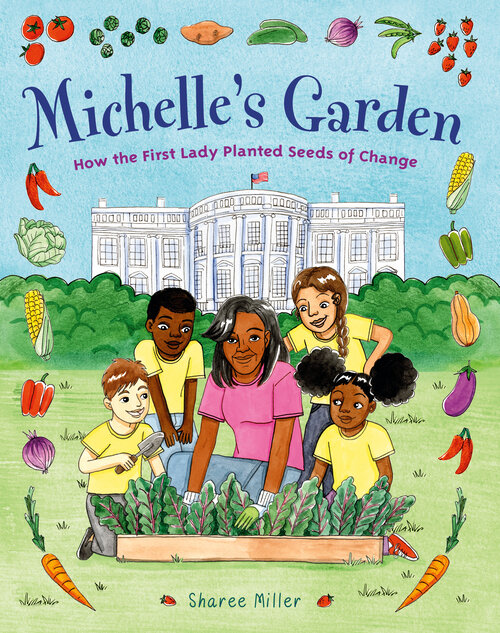
Deciding to plant a garden for producing food is no easy commitment. Digging and preparing the ground for planting is hard work, harder still if you are doing it alone with only a shovel. Depending on the soil, you might spend days and weeks getting it ready for planting. Michelle's Garden: How the First Lady Planted Seeds of Change (Little, Brown and Company, March 2, 2021) written and illustrated by Sharee Miller is a joyful exploration of the development of the largest kitchen garden at the White House.
Before Michelle Obama was the First Lady,
she was a kid just like you.
She walked to school with her brother, rode
her bike, and played outside every day.
As a child she loved to eat vegetables, and as a parent and wife she wanted to encourage the same love in her daughters and husband. They loved trying new recipes. As the First Lady, she wanted to spread the love of eating more vegetables and fruits to a greater group.
She was going to design, prepare, and plant a garden big enough to feed everyone at the White House, everyone who visited, and still have food leftover to feed others. Michelle had a huge problem, though. She had never gardened. With the help of White House staff for advice and local children, her plan started to take shape.
They collected the proper tools, the proper soil, and lots and lots of seeds. All the helpers and Michelle picked a sunny spot on the White House lawn. They dug, raked, and hauled rocks. They made special holes for each seed. They watered and watched, watered and watched. They removed harmful pests. President Obama helped, too!
It was hard to wait for tiny sprouts to grow. The day for harvesting did arrive. All the workers gathered and picked the produce. Gardeners became chefs. There was enough to give to those without food. The best part of this biggest kitchen garden ever at the White House is the idea for gardening grew just like those first seeds planted by Michelle and her helpers.
Readers will appreciate and be inspired with author Sharee Miller's approach to this narrative. She builds on Michelle Obama's youth and years as a parent and wife prior to becoming the First Lady. She uses the repetition of the words More, please to great effect along with a spare but appropriate amount of dialogue. The other helpful ingredient in this nonfiction tale is Sharee Miller includes how Michelle Obama worked through her initial problem and the steps followed toward a fruitful harvest. Here is a passage.
There was no rushing nature, but there were things they could do
to help the garden grow big and strong. They watered the plants
every day, especially when it was hot outside.
(Note: I am working on this post with an F & G.)
One of the first things you notice when looking at the open dust jacket is the vibrant colors and vibrant personalities on all the people. First Lady Michelle Obama with her gardening helpers kneeling and ready to work asks readers to join them. With the White House in the background, it places importance on Michelle Obama's achievements in this project. Framing it with individual fruits and vegetables adds a playfulness to the image and its design.
To the left, on the back, is an interior illustration. It shows the helpers wearing chef hats and preparing their fruits and vegetables for cooking. They are to the left and right of Michelle Obama in the front and back of her. This is a setting filled with happiness and a sense of success.
The opening endpapers are a vivid display of fruits and vegetables around small images of the White House. On the closing endpapers (or last two pages of the book) is a top of a wooden table. There is an eraser, several paperclips, and a writing pencil visible. On the left side is an author's note. On the right side is a photograph of Michelle Obama working with her helpers. Many of the children here, as in the book, are wearing yellow t-shirts. There is a seed packet partially shown. There are also instructions for making a paper cup garden.
On the dedication and publication page, six meals on colorful plates frame the top and the bottom. To the right, on the title page, fruits and vegetables circle the text with the White House on the bottom. These illustrations rendered with
watercolor, ink and colored pencil on 140lb cold-press paper
by Sharee Miller are highly animated, and cheerful. Points of view are altered to enhance the pacing of the narrative. We might be joining Michelle, her brother, and parents for dinner. We feel as though we are walking with President Obama and First Lady Obama as they walk on the White House lawn. Or we might be looking over the gathered tools, soil, fertilizer and seed packets spread on two pages. Most children will see themselves in these illustrations.
One of my many favorite pictures is a single page picture. It is a closeup of one of the girl gardeners. Behind her we see a row of carrot tops neatly labeled. She is on the ground with a glass jar luring a beetle inside with the promise of a favorite leaf. All we see of the child is her face two hands and a portion of her arm and shoulder. I love that she has one eye open and the other closed. I love that she is smiling.
Readers will realize the value of growing their own fruits and vegetables when and after reading Michelle's Garden: How the First Lady Planted Seeds of Change written and illustrated by Sharee Miller. First Lady Michelle Obama used her position to teach others to feed themselves. It was a powerful thing she did with this garden. In the author's note we are told the fate of the garden, another brilliant idea by our former First Lady. I highly recommend this title for your personal and professional bookshelves. Let's get gardening!
To learn more about Sharee Miller and her other work, please follow the link attached to her name to access her website. Sharee Miller has accounts on Instagram, Pinterest, Tumblr, and Twitter. At the publisher's website is a printable activity sheet.
Sharee Miller Presents MICHELLE'S GARDEN from LB School on Vimeo.


