Quote of the Month

When love and skill work together, expect a miracle. John Ruskin


Showing posts with label Emotions and feelings-Fiction. Show all posts

Monday, October 21, 2019

Correspondence Confusion

Bright and early yesterday morning after a rain shower, a discovery was made.  A soggy letter was found in the middle of the road.   It was returned to its rightful owner after a blurred address was deciphered.  What might have happened if it had not rained and it blew farther away?  Did the owner of the letter find it stashed on their porch?  Are the contents important?

Whether you find a soaked message in the middle of the road or a written note placed in an envelope and left inside your dry mailbox by the postman, there is still today, with all our advanced technology, a bit of magic attached to unexpected correspondence.  There is usually a bit of an internal conversation taking place before the envelope is opened.  Is this good news or not-so-good news?  Will this letter change my day?  The Love Letter (Harper, an imprint of HarperCollinsPublishers, October 8, 2019) written by Anika Aldamuy Denise with illustrations by Lucy Ruth Cummins is a charming combination of hopefulness, misunderstanding and truth in words and art.

Hedgehog was late.
He did not like being late.

Hedgehog's mood was the opposite of cheerful at the point when he spied something out of the ordinary on the ground.

It was a letter.

Reading the words, Hedgehog realized it was a love letter.  He believed someone loved him because the salutation read Friend.  He took the letter with him, stashing it inside his backpack.

When Hedgehog arrived in the meadow, his mood was happier than normal.  Everything he did with his friends, Bunny and Squirrel, was downright enjoyable.  He was pleased to walk Bunny home.  After she hugged him in thanks, she found something on the ground.  It was that letter.

Bunny was jubilant.  Hedgehog loved her!  At home Bunny was more helpful than normal.  When her chores were completed before and after dinner, she decided to visit Squirrel, bringing him a bundle of acorns.  Guess what she dropped as she left?  It was that letter.

Squirrel believing Bunny loved him was more carefree than normal.  Nothing was going to change the way he was feeling.  He slept long and hard until he raced to the meadow in the morning.

Each one of them, Hedgehog, Bunny and Squirrel, believed someone loved them.  Two were certain they knew who it was.  There were more than a few surprises at the meadow that day.  Wise words act as a reminder and retie the threads of friendship.


You have to admit when Hedgehog first finds the letter and reads the words, you feel a bit excited for him.  A new normal has popped into Hedgehog's day.  This is how author Anika Aldamuy Denise immediately invites us into the story.  When he voices his thoughts out loud, our heartrate picks up a little bit, too.  This is why we understand the difference in how he relates to his friends during their daily meadow visit.

With the discovery of the letter by the other two characters, we fully comprehend their joy, but we also feel a tension growing.  Who wrote this letter and for whom did they write it? For each of the characters, Anika Aldamuy Denise simply doesn't state they are more cheerful, helpful or carefree.  She gives examples.  This assists in elevating the gentle tension.    An added bit of humor by Anika Aldamuy Denise is the exclamations made by Bunny and Squirrel when they believe they are loved.  Here is a passage.

Down in the rabbit hole, Mama put her straight to work.
Normally Bunny pretended to nap at chore time, but today
she had a love letter and was feeling oddly . . . helpful.


Readers will find the limited color palette, introduced on the open dust jacket, will wrap around them like their favorite cozy clothing.  Throughout the book black, white, brown, yellow, pink and hues of gray create pleasing portraits of the characters and their surroundings.  The design on the jacket and inside the book is stunning.  Careful readers will notice something very special about the framing of the woodland scene with Hedgehog on the front.

To the left, on the back, Bunny, Squirrel and Hedgehog have arrived at the meadow, all believing they are loved.  They are bundled in their winter apparel and boots.  None of them are making eye contact.  The setting is more open expressing the shyness and vulnerability they feel.

On the book case it's night.  The darker sky highlights the falling snow, a row of birch trees from the left edge to the right edge and the ground covered with snow.  A full moon fashions shadows of the trees on the snow as it shines in the upper, left-hand corner.  A trail of tiny footprints moves from the far left to the tiny creature making them on the right.  It is our first hint.

The yellow used on the varnished title text on the front of the jacket covers the opening and closing endpapers.  Before the title page, Lucy Ruth Cummins gives readers another clue on this first page.  A typewriter with paper and envelopes is placed in the lower, right-hand corner.  The size of the chair and a teeny teacup are another hint.  With another page turn, the darker night lit only by the moon and glowing windows in a nearby home provide a place for the verso and dedication and title pages. The trees stand like silent sentinels.  A third clue is seen in the other place with glowing light, the inside of a log. (This same log happens to appear in the first narrative page in the book.)

The images rendered using

Navah Wolfe's old-timey typewriter, gouache, brush marker, colored pencil, and ink wash before finishing the illustrations digitally for this book

by Lucy Ruth Cummins are double-page pictures, smaller illustrations placed on white space, full-page pictures and several smaller images grouped together on a single page.  Every time the letter is read it's a close-up.  Lucy Ruth Cummins's double-page picture of the three friends walking in the snow to the meadow is an outstanding layout.  Her fine lines and delicate details further draw the reader into the story.  The eyes on the characters leave no doubt as to their current mood.

One of my many, many favorite illustrations is a full-page picture.  Even without the text, you know something in the story is changing.  Several leafless trees stand near two large birches against a pale gray sky.  Brown grass covers the lower half of the page.  It is slighting rounded.  Hedgehog, with his back to readers, is walking away between the two birch trees. Bunny is in the foreground bending down to pick up the dropped letter.  (At this point in a read aloud, listeners will be gasping or crying out.) Her pint sweater, bluish gray backpack and shoes and yellow polka-dot skirt are a pleasing contrast to the meadow.


If there were a huggable category for books, The Love Letter written by Anika Aldamuy Denise with illustrations by Lucy Ruth Cummins, would find a place there.  To believe you are loved is wonderful, to know it, is even better.  This book inspires us to shine love whenever we can, wherever we go.  I highly recommend a copy for your personal and professional book collections.

To read more about Anika Aldamuy Denise and Lucy Ruth Cummins and their other work, please follow the links attached to their names to access their respective websites.  Anika Aldamuy Denise has accounts on Instagram and Twitter.  Lucy Ruth Cummins has accounts on Instagram and Twitter.  At the publisher's website you can view interior illustrations.  I was honored to host the cover reveal for this book and was able to ask questions of Anika Aldamuy Denise and Lucy Ruth Cummins.  You can read the full post here.

Friday, January 11, 2019

Constantly Changing

For most beings it beats out a cadence of life.  It comes in all shapes and sizes. If broken, it may be mended.  It's capacity for collecting (or not) is far greater than its physical size would indicate.

We store many things in our hearts, some tiny and some enormous.  An attached significance determines its prominence.  My Heart (Dial Books for Young Readers, Penguin Young Readers Group, an imprint of Penguin Random House LLC, January 8, 2019) written and illustrated by Corinna Luyken (The Book of Mistakes) explores the assorted aspects of listening to, following and tending our hearts.

My heart is a window,
my heart is a slide.
My heart can be closed
or opened up wide.

At times our hearts are vast and other times, they appear as a much smaller version of the first.  They even get heavy and shrink as small as the smallest seed.  When this happens, we need to remember what happens to the smallest of the small seeds.  They can blossom into something spectacular.

Our hearts may separate us far from others.  Sometimes the sound of our hearts is a mere breath of the tiniest breeze.; only those closest to us can hear.  If our hearts should shatter, we should pick up the pieces and make it whole.

Our hearts follow us but also lead us.  They do not leave us.  We are inseparable.


Ten sentences, ten simple but profound sentences, portray and reveal how our hearts reflect us.  Corinna Luyken uses rhyming words at sentence ends to welcome us into her book and to invite us to think about our own hearts. With her use of language, she asks us to listen, learn and accept.  Take a few minutes to reread her first two sentences.  Can you think how these apply to you?


We are introduced to the limited color palette selected by Corinna Luyken when viewing the open dust jacket.  Yellow, white, and shades of gray and black elevate the impact of the carefully chosen words in the narrative.  The grassy scene peppered with tiny yellow heart-shaped flowers extends to each flap edge.  On the flaps there is a profusion of blooms.

On the book case large brush strokes of yellow on white move over the spine, left to right, only to disburse, to the right and top, like a flock of heart-shaped birds.  Strong charcoal gray, almost black, makes a large border on the bottom of the opening and closing endpapers.  A wide expanse of white and pale gray spreads above it.

On the first endpapers, a bespectacled boy squats in front of a hole, holding a heart-shaped plant.  An empty pot is next to the hole.  Two other flowers are planted.  A fourth waits.  On the closing endpapers four flowers flourish, their tiny-tendril roots visible and flowing beneath the surface.

A gorgeous double-page picture focuses on a third child, a girl, standing on steps, holding a watering can.  Spread before her on the title and verso pages is a garden cloaked in yellow.  These illustrations by Corinna Luyken rendered with

a print-making process called monotype, using water-based ink and pencil

each span two pages.  The hues of the colors blend, moving from light to dark and dark to light, accentuating the textual descriptions.  Readers will be examining each image for hearts.  Some are substantial, and others are minute.  All will be happy to see a diverse cast of characters featured.

One of my many, many favorite illustrations is for the words

my heart is a slide.

A slide arches upward, the ladder forming one side of the top of a heart.  It drops to the ground, forming the point.  The shadow, on the grass, completes the shape.  Two children are near the ladder; another is poised to slide at the top.  A faint yellow surrounds him/her.  The point of the slide/heart goes into a yellow glow.  Genius.


If you want a book offering hope, championing the right to choose and ringing out all the characteristics of our hearts, My Heart written and illustrated by Corinna Luyken is that book. It envelopes you in wisdom and calm.  You could pair it with Love and Love, Z for a thematic story time or bedtime.  I know readers will want to share examples of the workings of their hearts.  I highly recommend this title for your professional and personal collections.

To learn more about Corinna Luyken and her other work, please follow the links attached to her names to access her website and blog.  Corinna Luyken maintains accounts on Twitter and Instagram.  Corinna chats with Scholastic's Ambassador of School Libraries, John Schumacher, on his blog, Watch. Connect. Read.  Corinna is also interviewed at Brightly and Mile High Reading, a site maintained by Dylan Teut, director for the Plum Creek Children's Literacy Festival in Seward, Nebraska.

UPDATE:  Corinna Luyken is a featured guest at author, reviewer and blogger Julie Danielson, Seven Impossible Things Before Breakfast.

Tuesday, October 4, 2016

If It's Not One Thing, It's Another

problem
  • something that is difficult to deal with: something that is the source of trouble, worry, etc.
  • a feeling of not liking or wanting to do something

(Merriam-Webster's Learner's Dictionary)

Within any given twenty-four hour period most living (or probably every single living) thing will experience one or more problems of varying degrees.  Some difficulties are small blips on the road of life.  Others may leave you wondering where the road went.  There are complications you can solve alone or with help.  For some situations there is no answer.  You simply have to accept the dilemma as unsurmountable despite your attempts.  

In these circumstances where you have no control, it all comes down to attitude and perspective.  Yes, it's the old adage of looking at that glass as either half full or half empty.  If we journey to the last continent of silence (according to Admiral Richard Byrd), there will be one voice more distinct than others.  In Penguin Problems (Random House, September 27, 2016) written by Jory John with illustrations by Lane Smith, readers can't help but laugh out loud at this bird who most definitely does not have an attitude of gratitude.  

It's way too early.
My beak is cold.

A catalogue of complaints begins this tale of an Antarctica resident. Granted this continent does have the coldest recorded temperature on the entire planet, but certainly there will be a bright spot in this inhabitant's day.  Nope.  Not yet. The chatter of his companions bugs this penguin too.

As luck would have it Mother Nature has the audacity to have it snow the previous night.  Doesn't she know this is the driest place on Earth?  Hunger sends our flippered friend to the sea seeking fish.

A dive into the darkness reveals a whole new set of problems, escalating by the minute.  It seems the penguin is not the only one with a craving for breakfast.  Whew! Back on terra firma physical attributes duly noted simply don't live up to expectations.  No amount of flapping is going to see this guy soaring.  

A final frustration sends our protagonist into a total tizzy.  A wise walrus moves into the scenario and proceeds to point out, in an epic declaration, how the penguin needs to view the world.  This, as you might think, is observed with a heavy dose of annoyance.  Or is it?  As night descends a lone voice can be heard.


Pointed, perfect pacing is a result of Jory John's word choices, sentence structure and keen sense of humor.  By the third sentence, a question, readers recognize this penguin does have a problem and it's only morning!  As the narrative proceeds John increases the tension by moving from the environment to daily rituals and then to very specific physical traits.  In the sequence where the penguin is seeking his parents, readers will roll on the floor laughing if they have not already done so previously. 

With a simple greeting we are aware of the passage of time.  We easily follow the penguin toward the day's end with his continued observations.  And in a final brilliant technique Jory John brings us full circle.  Here is a single passage.

I'm not buoyant enough.
I sink like a dumb rock.


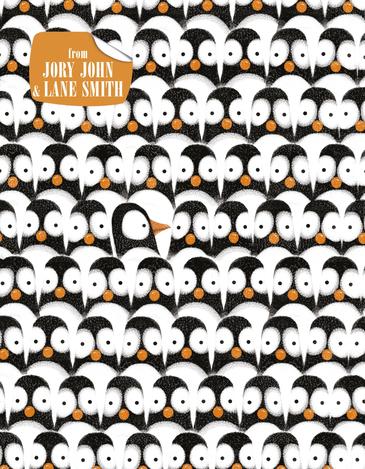
Can you spot our grumbling individual on the front of the matching dust jacket and book case?  He already stands out in the crowd without uttering a single word.  To the left, on the back, the title and Jory John's and Lane Smith's names are listed covering nearly all the space.  The use of color seen here is continued for most of the book with the exception of some of the landscape, the time of day and other inhabitants.  The differences are suitably subtle. 

The opening and closing endpapers are the blackest of black perhaps to indicate the penguin's mood. We get a further inkling of how the book will proceed on the title page. The s in problems has dropped down from the other letters, threatening to fall on the top of the penguin's head.  His eyes are looking up as opposed to straight at the reader like his pals' eyes  do.

The heavier, matte-finished paper enhances the texture seen in the artwork of Lane Smith in this title.  It appears as though the illustrations were created using a blend of traditional mediums and perhaps some digital.  Lane Smith is a master of conveying much with delicate differences.  Perspective plays heavily in his perception of the narrative; a tiny penguin with flippers covering his eyes beneath a large sun in the sky, the gaping mouths of predators in a row as the exhausted penguin climbs from the water, the close-up of the penguin frankly declaring his unfortunate appearance, or the four vertical panels when the penguin seeks his parents. 

One of my many favorite pages in the book is when Smith demonstrates the penguin's waddling.  The page is sectioned into fourths with a black line on a white background. In the first three frames penguin is rocking back and forth, left to right, eyes shifting.  In the final image in the bottom right-hand corner, flippers folded in front of his body, he looks straight at the reader proclaiming

See?


If you want hilarity no matter how many times you read a book, Penguin Problems written by Jory John with illustrations by Lane Smith is a marvelous selection.  This first collaboration by John and Smith is a triumph.  There is not a missed beat in this cadence of comedy.

To discover more about Jory John and Lane Smith and their work please visit their websites by following the links attached to their names.  You can view a few interior images at the publisher's website.  Don't miss this funnier than funny interview of Lane Smith at educator and reader advocate Colby Sharp's blog sharpread.  One of my favorite images is included along with the passage noted above.