Quote of the Month

When love and skill work together, expect a miracle. John Ruskin


Showing posts with label Ekua Holmes. Show all posts

Friday, June 17, 2022

Seeking To Understand And Spread Understanding

It was more than fifty years ago.  The year was 1969.  It was a gift to me from my mother's best lifelong friend.  It went with me wherever I went for forty-five years until it was destroyed in a flooded basement library.  Today a new copy of The Prophet by Kahlil Gibran is part of my poetry collection.  It was and still is unlike anything I have read.

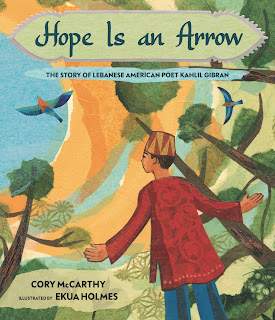
Kahlil Gibran was forty years old when The Prophet was published by Alfred A. Knopf in 1923.  In Hope Is an Arrow: The Story of Lebanese American Poet Kahlil Gibran (Candlewick Press, July 5, 2022) written by Cory McCarthy with illustrations by Ekua Holmes, readers are transported into other times and places.  Through a melodic narrative with stunning complementary artwork, we are introduced to a man's journey through two worlds, the disparities in each of them, and how he sought to affect change through his art and writing.
There once was a boy shot from a bow like an arrow.
Strong and straight, he flew across the world, connecting
many people with the power of his words.
But not right away.

Kahlil loved the country of his birth, Lebanon, but the religious strife between the Maronite and the Druze was heartbreaking to him.  He sought solitude in the forest of cedar trees.  In that silence, he felt something grow inside him.

At one point in his youth, he fell off a cliff in the woods, breaking his shoulder.  Wearing a wooden cross placed on his back by his parents, he quietly healed.  Later, Kahlil's family lost everything and his father was placed in prison.  His mother, two sisters, older brother, and Kahlil left for America.

In Boston, Kahlil attended a school for immigrants.  His name was shortened from Gibran Kahlil Gibran to Kahlil Gibran.  His mother worked carrying 

linens and lace

on her back, peddling her yard goods. She saved enough money to open a small store.  While Kahlil felt honor toward his mother for her work, others belittled her.   Here in America, Kahlil saw the strife between the rich and the poor.

Kahlil began to use his ability to draw to fuel his hope for mending differences.  His teachers noticed his skills, referring him to a photographer named Fred Holland Day.  Day became a mentor, patron, and friend.  Kahlil's drawings garnered him recognition through the sale of some as covers for books.  His mother was concerned with this early success and sent Kahlil back to Lebanon to study.

Kahlil flourished in his education, but longed for his life to take a different direction.  He went back to Boston to write his words of hope, but there he found great sadness in the loss of his older sister, brother, and mother.  Moving to New York City, Kahlil Gibran wrote and drew and wrote and drew.  He wrote for all people of the world to build bridges, bridges of hope across their differences.  His words rang true then, and still ring true today.


Each time this book is read, the words penned by Cory McCarthy vibrate beautifully on your heartstrings.  Her references throughout the narrative to arrows and their flight after being released from a bow bind significant portions of this man's life together.  She, Cory McCarthy, also weaves the word hope splendidly into the text as Kahlil harbors his desire to spread it to the world.  The nine inserted quotations pair eloquently with the portions in which they are located.  Here is a passage.

Now when he looked in the mirror, he saw two boys: Kahlil Gibran, the Arab American, and Gibran Kahlil Gibran, the Lebanese boy who missed his father and the snowy mountains of home.

"Deep is your longing for the land of your memories." 


Rendered 

in collage and acrylic on paper, 

the illustrations of Ekua Holmes will literally take your breath away.  The image on the front, right side, of the matching dust jacket and book case is similar to part of an interior illustration.  The perspective and color palette vividly portray the peace Kahlil Gibran felt among the cedar tees.  

To the left of the spine, on the back, a delicate floral print in shades of golden yellow and brown with spots of sky blue, cover the entire canvas. Perhaps, this represents the fabric Kahlil's mother might have sold in Boston.  The opening and closing endpapers are a golden yellow. 

On the title page, along the top and bottom are wide borders taken from the picture on the front of the jacket and case.  In the center of the page is a single golden leaf surrounded by four small golden circles.  This leaf could be a feather, a feather in an arrow.  Or maybe it is hope.

The pictures are either single-page images, or dramatic double-page visuals.  The manner in which the text is placed on all of them enhances the pacing.  The illustrations are breathtaking individually, but flow to the following pictures perfectly.  You find yourself repeatedly stopping first to look at the illustration as a whole, then to notice the layout and design, and finally to appreciate all the elements working together.  In a word, they are luminous.

One of my many favorite pictures is a double-page picture.  It is for the text:

His family lived in a crowded place called the South
End, where a hundred immigrant children from all over the
world often played in a single alley together like a flock of
swooping birds.

The alley is featured prominently in the center portion to the left of the gutter.  It is framed on the left side with a collage of buildings in various shades of brown and brick red.  Some blue is featured in a window.  There is a single tree in the alley.  Beneath the branches is the sun.  Above the branches in the clear blue sky are eight white birds in flight.  Over the alley hangs laundry.  To the right of the alley, on both sides of the gutter are the brick walls of other buildings with windows holding blue, gray, and green panes.  Most of the right side is a brick wall.  In this wall is a window with a lace curtain valance and flowers on the sill.  The text is placed in a faded portion of the brick.  Beautiful.


I cannot imagine a personal or professional collection without a copy of Hope Is an Arrow: The Story Of Lebanese American Poet Kahlil Gibran written by Cory McCarthy with artwork by Ekua Holmes.  It is a marvelous depiction of a life well-lived.  It is an inspiration to all who read it.  At the close of the book are three pages of Source Notes And Additional Stories From Kahlil Gibran's Life.  Included in this are notes on the quotations.  There is also a bibliography.

To discover more about Cory McCarthy and Ekua Holmes and their other work, please visit their websites by following the link attached to their names.  Cory McCarthy has an account on Instagram.  Ekua Holmes has accounts on Facebook and Instagram.  At the publisher's website, there is a teacher's guide you can download.  At Penguin Random House, there are interior images to view.  

UPDATE:  This title is highlighted by Julie Danielson on her fabulous blog, Seven Impossible Things Before Breakfast, August 9, 2022.

Cory McCarthy discusses HOPE IS AN ARROW from Candlewick Press on Vimeo.

Wednesday, December 5, 2018

Heads Turned. People Stopped And Listened.

Every single being is born with a gift.  It might not initially be noticed, but what we do with this gift defines us.  It's how we make our mark in this world.  Hopefully spirits will be lifted and the quality of life of those around us will be better.

In 1936 there was a girl child born in Texas.  What Do You Do With A Voice Like That?: The Story of Extraordinary Congresswoman Barbara Jordan (Beach Lane Books, an imprint of Simon & Schuster Children's Publishing Division, September 25, 2018) written by Chris Barton with illustrations by Ekua Holmes presents a stirring account of this child.  She understood the good her gift would (and did) bring to others.

Growing up in the Fifth Ward of Houston, Texas,
Barbara Jordan stood out.

It wasn't because of the way she looked or acted.  It was because of her voice.  Her voice commanded immediate attention from all who heard it.  She used this voice in church, school and contests.  At the age of sixteen she left Texas for the first time traveling to Chicago as the winner of an oratory competition.

Barbara received counsel from Grandpa Patten during their weekly chats.  With her voice she could do many things but first she needed to go to college.  Through hard work and long hours, she became a lawyer.  The practice of law left her wanting more so when given an opportunity, Barbara lifted her voice.  She believed the best place to create change was politics.

Did she win the first time she ran for office? No.  Did she win the second time she ran for office? No.  She won the third time!  Working as a senator for the state of Texas she knew she could make changes in laws to help those who needed it the most.  Inside and outside the legislative chambers, she spoke and other lawmakers respectively listened.

In 1972 Barbara Jordan went to work in Washington, D. C. as a congresswomen.  She spoke truths about the United States Constitution and how everyone, yes everyone, needed to obey the laws founded on this document.  President Nixon resigned. (I remember listening to her powerful speech.)

Barbara continued fighting for peoples' rights as speculation began about the next office she would hold, but there would be no more politics for her. A debilitating disease, multiple sclerosis, had her going home to Texas.  Barbara took her wondrous, wise voice to classrooms and sporting events.  Even today her words still ring out loud and strong reflected in every life she touched.


For those who have never heard the resounding voice of Barbara Jordan, author Chris Barton through his writing sends its power off the pages of this book into our minds and hearts.  Through his meticulous research he allows us to understand the impact of her influence.  Portions of her life are tied together with a question at the end of paragraphs and phrases.  These lead us to her many accomplishments. By repeating key words, connections are made and a cadence is created.  Here is a passage.

That voice.

That big, bold, booming, crisp, clear, confident voice.
It caused folks to sit right up, stand up straight, and take notice.

What do you do with a voice like that?


Just like the voice of Barbara Jordan, the image on the front of the dust jacket stops readers in their tracks. Who is this woman with this voice?  The contrast of the blue face holding many faces of Barbara on radiating yellow is bold and dynamic. To the left, on the back, a collage of swaths of color and words further describes the powerful personality of Barbara Jordan.

Like rays of sunshine, golden yellow on golden yellow, lines stretch from the spine on the book case.  White and yellow stars are scattered among words like democracy, freedom, and the great principles of right and wrong. A vivid sky blue covers the opening and closing endpapers.  The blue and yellow palette is used for the text and background on the title page.

Rendered in mixed media the illustrations of Ekua Holmes are individual portraits of an amazing woman throughout her life; each one worthy of framing.  They vary in size, sometimes spanning two pages, or nearly two pages leaving a place for the text.  Other times individual elements are outlined in large amounts of white space.

Each visual elevates the narrative and tells its own story.  The details of clothing worn by Barbara (and others) and her facial expressions in each setting bring us into the moments. The layout of every single element in each picture is superb as is the light and shadow in those items.

One of my many favorite illustrations is when Barbara stepped forward to speak when circumstances called for her help.  The picture is a full page on the right crossing the gutter and filling a third of the left page.  Triangular shapes like beams of light in yellows and oranges with a tinge of green extend from the top with square-dotted spirals in white.  Barbara's back is to us.  Her arms are outstretched on either side.  A pearl necklace circles her neck.  A paisley-print dress in pink, purple and blue drapes her frame.  A faceless audience listens in front of her.


I can't imagine a personal or professional collection of books without a copy of What Do You Do With A Voice Like That: The Story Of Extraordinary Congresswoman Barbara Jordan written by Chris Barton with illustrations by Ekua Holmes on their shelves.  This fresh, vibrant depiction in a stunning blend of words and images will promote discussions and further research.  An author's note, timeline, and recommended viewing and reading is found on the final three pages.

To learn more about Chris Barton and Ekua Holmes and their other work, please visit their respective websites by following the links attached to their names.  Chris and Ekua maintain accounts on TwitterChris and Ekua also have accounts on Instagram.  At the publisher's website you can view interior images.  Chris Barton wrote an article at the Nerdy Book Club about this title.  Chris recommends you listen to Barbara Jordan's 1974 speech during the House Judiciary Committee presidential impeachment hearings.


Please take a few minutes to visit Kid Lit Frenzy hosted by educator Alyson Beecher to enjoy the titles selected by others participating in the 2018 Nonfiction Picture Book Challenge.


Tuesday, November 13, 2018

Out Of Darkness

In the still of early morning or late-night hours, darkness yields new vistas.  One of the most breathtaking of these, depending on the phase of the moon, is when we lift our eyes to the sky.  The expanse of stars in any season is breathtaking.  To witness this and to be a part of this is both humbling and wondrous.

It's almost incomprehensible to realize the ages of stars are measured in billions of years.  The Stuff of Stars (Candlewick Press, September 4, 2018) written by Marion Dane Bauer with illustrations by Ekua Holmes is a stunning depiction in lyrical language and mesmerizing images of life and its beginnings.  It is a journey and an awakening.

In the dark,
in the dark,
in the deep, deep dark,
a speck floated,
invisible as thought,
weighty as God.

There was nothing as we know it, absolutely nothing.  In this darkness there was only this speck.  It was waiting.

BANG!

In the tiniest and quickest moment in time, time began.  Everything started and moved outward from the speck.  There were now stars, more than can be measured but there were no planets.  If there were no planets, there was no Earth.  All the things we know were yet to be.

These stars burned long and hot.  This time and this heat made some of those stars burst releasing dust; stardust.  This dust gathered and formed planets; planets like Earth circling around a star, our Sun.  Fortunate Earth was the correct distance from its star to be neither too hot nor too cold but shifting from a tolerable hot and cold as it moved.

The stardust continued its role of gathering and forming those things on Earth of which we are familiar.  There were dinosaurs.  Generations of humans came and went until . . .there is another speck

invisible as dreams,
special as Love.

As the previous speck waited, so too, did this one.  It became YOU.


Regardless of where your beliefs are on the spectrum for the origin of life, the words of Marion Dane Bauer are deeply moving.  She conveys the enormity of the beginning of the universe and the formation of each element within it.  In her words there is a fragility but also great power.  As her phrases connect one to the other, she shows us how we are all tied to the past and to the future.  Here is another passage.

And throughout the cosmos
stars caught fire.
Trillions of stars, 
but still no planets
to attend those stars.
And if no planets,

then no oceans,

no mountains,

no hippopotami.


Extending from the edge on the left, across the spine and to the edge on the right of the opened dust jacket, the swirl of deep, rich shades of blue, purple and red are pulsing with life and brimming with stars.  The two seated figures are you and me.  They are everyone.  The perspective of this image is two-fold; the beings are elements in the universe but also observing it.  The title text is silver foil.  Words amid the upper portion on the back read:

The miracle of every child
is also the miracle of our planet:
each made from stardust.

On the book case a deep midnight blue covers both the left and the right.  Marbleized hues of purple curve and blend over the opening and closing endpapers.  The verso and title pages are a reverse, black text on purple and purple text on black leading us to the time before time.

Each double-and single-page is rendered with

hand-marbled paper and collage and assembled digitally.

On the larger visuals the text is placed in an area appearing to be designed specifically for it.  For other illustrations a column is created to the left or the right for the text.  Ekua Holmes uses a full color palette reflective of the text.  With the word 

BANG!

she has shades of golden yellow radiating from a center of blues and oranges looking like fire.  This moves to peach and orange and turquoise with black for the next illustration.  When the stars burst pinwheels spread from centers in yellow, orange and red with dots of yellow, orange and turquoise.  In the background we catch glimpses of the dust jacket colors.  Every image is vibrant and lively.

One of my many favorite illustrations is for text mentioning bluebirds, butterflies, snails and giraffes.  The hues used are vivid and lavish; black, shades of gray, red, and blue.  The placement of the butterflies and the bluebird cause them to be easily seen but I guarantee when you see the giraffe arching from right to left across the gutter, you will gasp.  It is then the snail comes into view, too.


This presentation, The Stuff of Stars written by Marion Dane Bauer with illustrations by Ekua Holmes, is remarkable.  It is a beautiful symphony of words and art.  Surely it will promote discussions and extensive thinking and research.  You will want to have a copy in your professional and personal collections.

To discover more about Marion Dane Bauer and Ekua Holmes please visit their respective websites by following the links attached to their names.  Marion Dane Bauer has many resources for this title including two Pinterest boards.  Ekua Holmes has an array of artwork at her site.  Both Marion and Ekua maintain accounts on Twitter.  You can find Ekua on Instagram.  At Penguin Random House and Candlewick Press you can view interior images.  Author, reviewer and blogger Julie Danielson speaks about this title and posts one of my favorite illustrations at Seven Impossible Things Before Breakfast.  The cover is revealed at A Fuse #8 Production by Elizabeth Bird, Collection Development Manager of the Evanston Public Library system.

Friday, April 28, 2017

Honoring Wordsmith Heroes

The month of April is coming to a close but the observance of National Poetry Month need not stop.  Let's just think of this month as an introduction to a literary form allowing everyone to express themselves in a variety of writing styles every single day of the year.  If you have a flair for visualizing shapes, pen a concrete poem.  If you wish to focus on the natural world, the five-seven-five syllable haiku is the perfect kind of poem for you.  If you enjoy even more structure, the five line cinquain asking for a single noun, two adjectives, three -ing participles, a four word phrase and closing with a synonym for the first noun is what you should write.  If you like the rhythms of rhyming create a couplet.

Poetry beckons to the universal qualities found in all people.  Out of Wonder: Poems Celebrating Poets (Candlewick Press, March 14, 2017) written by Kwame Alexander with Chris Colderley and Marjory Wentworth with illustrations by Ekua Holmes expresses the admiration held by these three poets and artist for twenty other poets.  They have collaborated to inspire others as they were inspired.

In the first of three parts, Got Style?, poets are featured for creating a signature style.  With recognition and respect the poems written about them underscore their individuality.  Kwame Alexander's How To Write A Poem celebrating Naomi Shihab Nye will have you reaching for the nearest means to record your thoughts.  The same peace we find in Robert Frost's contemplations is echoed in Marjory Wentworth's In Every Season.  Gathered thoughts, separated by pauses, lyrically define poetry in a manner reminiscent of the work of Nikki Giovanni using all lower case letters.  Snapshots by Chris Colderley is a loving tribute.

In Your Shoes, the second section, focuses on poetry written by one author (us?) which reads like it was written by a favorite poet.  Beginning with basketball and continuing the analogy dreams are shared, glory days of youth are remembered and heroes of Harlem are saluted in Walter, Age Ten celebrating Walter Dean Myers by Kwame Alexander.  We travel to the private place in Chile beloved by poet Pablo Neruda in The Music Of The Earth written by Marjory Wentworth.  Calm is found in nature by a man devoted to poetry, politics and his people.  Majestic musings about those who walked before us on Tambourine Mountain pays tribute to Judith Wright.  Chris Colderley asks us in Tambourine Things to hold a found fossil in our hands, listening and watch the shadows fall as the sun sets.

In the final part, Thank You, the three contemporary poets write poems regarding those poets who affected them in a deeply personal manner.

A poem can sometimes be so powerful that it might even feel as though the poet is speaking directly to us, as if we are in the middle of a private conversation.

They showcase Gwendolyn Brooks, Sandra Cisneros, William Carlos Williams, Okot p'Bitek, Chief Dan George, Rumi and Maya Angelou.  These poems do indeed beckon but they wrap themselves around you in the glory of the words.  You cannot help but feel the love as each poet's life story is revealed.


This collection of poems written by Kwame Alexander, Marjory Wentworth and Chris Colderley not only pays homage to twenty poets but introduces readers to the particular voice of these three poets.  After reading several of their poems you sense the similarity in how they approach the poet they are showcasing.  No matter which poem you are reading, whether written by Alexander, Wentworth or Colderley, you will find yourself without conscious thought sighing or gasping as you read the last line.  They are all brilliant.  I will share a portion of a poem written by each one.

From Walter, Age Ten
celebrating Walter Dean Myers

I'd like to soar one day
like Sweetwater Clifton high above the rim---
I wanna trot the globe
grab the world in my hands and
twirl a big ball of hope
from corner to corner.  ...
     Kwame Alexander

In Every Season
celebrating Robert Frost
... I have stopped to shake the dry snow
from the branches and watched the outline

of each bare tree sharpen like stone
and considered that quite often

life is too much like a pathless wood.
Still I have lived so long and traveled so far,

and I have climbed these hills and looked
at the world and descended.
    Marjory Wentworth

Snapshots
celebrating Nikki Giovanni

people forget...poetry is not just words on a page...it is...
a snowflake on your tongue...a tattoo on the inside of your arm...a dashiki and a kaftan...
tripping down the streets of Lincoln Heights...shouting from the hills of Knoxville, Tennessee...
    Chris Colderley


The warmth of the color palette and design radiates from the front of the matching dust jacket and book case.  The figure, arms raised and fingers spread, is moving to an unseen music, the poems we have yet to read.  On the back, to the left, on a golden background with hints again of musical notes, a list of the twenty poets is shown.  The deep purple of the title words is spread across the opening and closing endpapers.  The poets being celebrated are royalty in the world of literature.  Portions of geometric golden suns are displayed on the title page.  This design is used throughout the book as accents and for each of the three parts.

The artistic technique for creating these illustrations, collage on paper, used by Ekua Holmes presents readers with unique portrayals spreading across two pages, framed on a single page, as insets on a single page or edge to edge on a single page.  Vibrant colors are woven into each one.  Various papers give a texture to each visual, inviting readers to touch the pages.  Holmes varies her perspective in keeping with the poems.

With each page turn it's as if you are walking through an art gallery.  Elements in the illustrations reference the poet and the place in which the poem is set.  As soon as you finish, you will flip the pages to see all the pictures again.  They are striking...every single one.

One of my many favorite illustrations is the two-page spread for Snapshots.  Page edge to page edge a cool shade of green (teal?) provides a canvas for large snowflake designs.  Small white dots are blended with them.  Some of the snowflakes are in the foreground, some in the background.  On the left a boy wrapped in winter clothing is leaning back tasting the flakes with his tongue.  Opposite him on the right a girl is doing the same thing.  All we see is her face peeking out of a hooded coat.  Red, a darker shade of green and a golden yellow are chosen for their clothing.


Every bookshelf needs to hold a space for one or more copies of Out of Wonder: Poems Celebrating Poets written by Kwame Alexander with Chris Colderley and Marjory Wentworth with illustrations by Ekua Holmes.  In a word this title is stunning.  Prior to Kwame Alexander's Preface is a Contents.  At the conclusion of the book six pages are dedicated to giving readers more information about the twenty selected poets.  They are also listed by Ancient And Foreign-Language Poets, Nineteenth-Century Poets, Twentieth-Century Poets and Contemporary Poets.  Short biographical paragraphs are included for Kwame Alexander, Chris Colderley and Marjory Wentworth.

To acquaint you further with Kwame Alexander, Marjory Wentworth and Ekua Holmes please follow the links attached to their names to access their websites. NPR Morning Edition features this title in an interview with Kwame Alexander.  Marjory Wentworth is highlighted at knowitall.org   The Horn Book podcast 2.8 has Ekua Holmes as a guest.  Ekua Holmes visits The Brown Bookshelf for an interview.  At Penguin Random House you can view the first ten pages.  Candlewick Press has created a teacher's guide. Teacher librarian Jennifer Reed wrote a blog post at Reederama about using this title in her school library.
Collage Artist | Ekua Holmes Video from AugustineMonica Films on Vimeo.