Quote of the Month

When love and skill work together, expect a miracle. John Ruskin


Showing posts with label Butterflies-Life cycles. Show all posts

Thursday, August 4, 2022

Distinctive Orange Marvels

Two.  Just two.  That is the number of monarchs seen this year.  An entire garden was planted to entice them to visit.  Hummingbirds, a variety of bees, and smaller butterflies do enjoy the nectar, but the absence of larger butterflies is telling.  This autumn country roads will be traveled to harvest a few milkweed seed pods to add those plants to the garden.  Nurturing nature needs to be part of our lives.

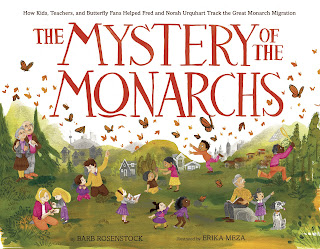
On July 21, 2022, the migratory monarch butterfly was placed on the IUCN Red List as endangered.  It has only been forty-seven short years since their annual trek from north to south and back was discovered.  This understanding began with a single individual and grew to encompass people from three countries.  The Mystery Of The Monarchs: How Kids, Teachers, and Butterfly Fans Helped Fred and Norah Urquhart Track the Great Monarch Migration (Alfred A. Knopf, May 31, 2022) written by Barb Rosenstock with illustrations by Erika Meza chronicles the human journey to solve the puzzle of these noble insects.
Fred Urquhart ate breakfast, grabbed his satchel, and started his walk to school.
Thank goodness he stopped at the marsh.

At the young age of eight, Fred was firmly attached to the study of insects.  Year after year, his collection of specimens grew.  One year, Fred was intrigued by an article he read about 

migrating butterflies.

He wondered about the monarchs, his favorite butterflies.  No one knew where they went.  Fred was determined to be the someone who found the answer.

Fred studied entomology.  He started to collect the monarchs and placed labels on their wings. (Making labels that worked was a tricky business.)  He hoped people would find the labeled butterflies and reach out to him.  Ten years later, he was no closer to a solution.

Norah, Fred's wife, was completely taken with his quest.  They developed a better label, asking those who found tagged butterflies to

SEND TO ZOOLOGY UNIVERSITY TORONTO CANADA.

They knew they needed more help tagging the monarchs.  They placed notices in magazines and newspapers in the United States (and eventually Mexico).  The response was slow but it grew.  People of all ages and from all walks of life, especially teachers and students, joined the 

Insect Migration Association.

The Urquharts plotted routes on a large map.  They drove all over the United States and into Mexico, but the mystery was still not solved.  There was another couple, a couple who lived in Mexico, that loved traveling.  In January 1975, this duo found a magnificent scene among the mountains in Mexico.  They notified the Urquharts.  When Fred and Norah arrived there the following year, more than forty years after Fred wanted to solve the puzzle, Fred found something wonderful.


Through her meticulous research, author Barb Rosenstock presents a compelling narrative of Fred and Norah Urquhart and everyone who helped them.  Layer by layer with explicit facts, this nonfiction picture book builds toward its exciting conclusion.  We become a part of each layer, turning the pages with our hope growing.  As we read the final paragraph, followed by a question and two words, our involvement is so thorough we want to stand up and shout.  Here is a passage.

It was still a mystery.
One year 13,800 monarchs were tagged and 128 were returned.  The next, 17,000 were tagged and 298 returned.  Fred, Norah, and their "butterfly family" were getting closer to an answer.  Year by year, monarch by monarch, the lines on Fred and Norah's map pointed farther south.  Ontario to Alabama, Indiana to Mississippi, New York to Florida.


The two scenes displayed on the open and matching dust jacket and book case appear to be a single image, but they are not.  On the front, right side, we see Fred and Norah near the spine watching all those people, young and old, who helped them by capturing and releasing labeled butterflies over decades.  By the landscape and architecture, we are able to determine this is in a northern region.

To the left, on the back, are more people, of all ages.  By the landscape and architecture, we realize this is a mountainous region to the south, across the border of the United States.  Here the people are welcoming the arrival of the monarchs.  In both illustrations, the individuals are taking joy in the monarchs and their flight.

On the opening and closing endpapers is an intricate pattern in orange and pink, acting as a background.  Placed on top of this are monarchs, grasses, leaves, and flowers.  There are seven separate visuals.  The verso and title pages feature monarchs in flight, a tribute to Homero Gomez Gonzalez, and an envelope with a returned monarch inside it.

These illustrations by Erika Meza rendered

using acrylic gouache, watercolor, ink, coffee splashes, and pastel pencils, before using Photoshop to tie it all up

make excellent use of white space as a way of highlighting the colorful elements and as a canvas for the text.  They are double-page pictures, single-page pictures, and sometimes several smaller images on a single page.  A variety of perspectives showcase the pacing and story.  The fine lines and delicate details fully engage readers.  These include dotted lines to indicate the flight of monarchs and origami butterflies to indicate the "flight" of correspondence and outreach.

One of my many favorite illustrations is a single page picture.  It shows Norah seated in a winged, light orange chair near a window.  Outside the window is a blue sky, several trees and two monarchs in flight.  Next to Norah on her left is a side table stacked with letters.  She is opening one of them with her dog seated next to her.  On a larger table on her right is a monarch specimen, an orange dial phone, an outgoing letter box, and a lamp.  Four origami butterflies fly above that table and Norah.


It is more important than it has ever been to be stewards of our planet.  In The Mystery Of The Monarchs: How Kids, Teachers, and Butterfly Fans Helped Fred and Norah Urquhart Track the Great Monarch Migration written by Barb Rosenstock with artwork by Erika Meza, readers will be inspired by the dream of one man which was shared by his wife and a host of people in Canada, the United States and Mexico over decades.  At the close of the book are an author's note and illustrator's note which are necessary reading.  They are followed by a page dedicated to the life cycle of the monarch butterfly.  A section on butterfly generations and the teacher and students who labeled the butterfly found by Fred Urquhart in Mexico are next.  There are several citizen monarch groups discussed and a list of selected sources on the final two pages.  I read the article in the University of Toronto Magazine, August 24, 2015 by Alec Scott titled "Where Do You Go, My Lovelies?"  It is excellent.  I know you will want a copy of this title in your professional and personal collections.  You can pair it with Winged Wonders: Solving The Monarch Migration Mystery by Meg Pincus with illustrations by Yas Imamura and Senorita Mariposa by Ben Gundersheimer with illustrations by Marcos Almada Rivero.

To learn more about Barb Rosenstock and Erika Meza and their other work, please follow the link attached to their names to access their websites.  Barb Rosenstock has extra resources on her website for this book.  Barb Rosenstock has accounts on Facebook, Instagram, Pinterest, and Twitter.  Erika Meza has accounts on Instagram and Twitter.  At the publisher's website, you can view interior images.

Wednesday, September 2, 2020

Shedding A Shape Toward Beauty

Garden spaces are dedicated to those perennials they desire.  They hold symbolic places in religions and cultures around the world.  They are studied, respected, and protected.  Entire units of study in classrooms revolve around their life cycles.  If one comes near to you, you hold your breath, hoping.  You hope in the deepest part of your heart, one will someday, however briefly, pause and rest on you.

These gloriously colored, winged insects glide, dip, flutter, and sip through our summer world in the northern hemisphere (and in other seasons around the globe).  In The Truth About Butterflies (Seriously Funny Facts About Your Favorite Animals) (Roaring Brook Press, August 11, 2020) written and illustrated by Maxwell Eaton III, the seventh book in his seriously super series, you'll learn why these beings are studied, respected, and protected.  You'll be captivated (and entertained) on every page. 

Nope. Nope.

Nope. Nope.

Yup.

These are butterflies.

Butterflies are a type of colorful

flying insect. 

And I'm going to eat one. (cat)

They're my favorite things with wings. (girl)

Wow.

Okay. (bird perched on girl's wheelchair back)

First, a match to other insect characteristics is shown for butterflies.  An array of variable sizes from locations around the globe are shown in their actual sizes.  Knowing there are more than 18,000 butterfly species is amazingly wonderful.

Details are provided about the purpose of their wings before a compare and contrast section follows about moths.  Attention focuses on their proboscis, antennae, compound eyes, and tarsi.  We then shift into how shifty they truly are.

A careful, explanatory guide shows how butterflies begin as an egg.  We get to see some of the specie butterfly eggs, side by side (magnified).  After the egg hatches, a caterpillar eats and grows, eats and grows, and molts.  Did you know they eat the old skin? Caterpillars are clever, too.  They can look like bird poop or be toxic to protect themselves.

After the caterpillar loses its final skin, it fashions a chrysalis and becomes a pupa.  In this shape, the magic begins. An adult butterfly is forming.  When the butterfly emerges it still has some steps to finish before it can fly.  The circle of their lives begins again as males and females seek each other before eggs can be laid.  

As this cycle is explained, it may seem like an easy progression, but harsh weather can interrupt the progress.  Different butterflies rely on different solutions, like hibernating or migrating.  People are a huge threat, but also can be one of their best allies.  The more we know, the better we can help in more than one way.


You may believe you have a grasp on your knowledge of a specific animal, but that all changes when you read a book penned by Maxwell Eaton III.  This author finds the facts, basic and bizarre, and presents them in a marvelous blend of easily understood statements, specific labels, and commentary from the featured animal and other animals in their realm.  This commentary supplies us with comedy, but also some truths.  Once we have completed his exploration of butterflies, he switches to several methods of butterfly preservation through gardening and raising them in meticulous order.  Here is another sample passage with a portion of the expanded facts and conversations.

Butterflies are known for their incredible wings.  Along with flying and finding mates, each species uses its wings to avoid being eaten by larger predators like birds, snakes, frogs, toads, and lizards.

But not cats, right? (cat)

Camouflage helps butterflies blend in with their surroundings.

Don't. . .

move . . . (Question mark butterfly)

Nothing around here but old leaves. (bird flying near the Question mark butterfly)


When you look at the open and matching dust jacket and book case, you see on the right, front, a beautiful display of the featured subjects with one of the butterflies making an astute comment.  They are flying among flowers more apt to hold the nectar they desire.  This sets the stage for the first five words uttered by a butterfly prior to the book's beginning.  

To the left, back, up close and personal, is the cat standing in some grass between two stalks of milkweed.  From one, a chrysalis is hanging.  The cat has just looked at its watch and says:

Any minute now.

This is the start of the hilarious attempts of the cat to consume a butterfly.

On the opening and closing endpapers is a deep rich mint green.  On both the initial and formal title pages, Maxwell Eaton III includes words uttered by a swallowtail.  In the first setting are four flowers not favored by butterflies, but the second scene holds a bounty of blossoms butterflies enjoy.

Rendered 

using pen and ink with digital coloring

these images are highly animated, informative, and humorous.  Bold black lines are filled with vibrant colors.  Diagrams are easy to understand and captioned.

Each illustration spans two pages with the exception of one full-page picture and a series of panels at the close of the book.  Readers' eyes move from one element in each visual to the next eagerly and flawlessly.  They will pause to appreciate every single detail.  Perspectives are altered to accentuate the pacing.

One of my many, many favorite illustrations is the double-page picture showcasing the contrasts between a butterfly and a moth.  It is a single setting but, on the left, it is during daylight and on the right, it is at night.  On the left is a Tiger swallowtail.  On the right is a Poplar hawkmoth. Each is accompanied by at least one other butterfly or moth of their specie.  Colorful balloons with facts point to parts on each.  They each make a statement as does an extra moth.  An extra inserted illustration focuses on the characteristics of their wings. A large sunflower in bloom is placed in the gutter. (I believe the butterfly and moth are pictured as their actual size.)


No personal or professional collection will be complete without a copy or two of The Truth About Butterflies (Seriously Funny Facts About Your Favorite Animals) written and illustrated by Maxwell Eaton III.  It is outstanding in its presentation of facts, the inclusion of humor, and the illustrations.  At the close of the book two pages are devoted to the Butterfly File.  Here we learn about body parts for a Monarch caterpillar, butterfly habitats, puddling, butterfly and moth pupa, monarch migration, caterpillar defense, and basking.  References for further research are included. The final page adds to the laughter factor. (You might want to learn more about four of his previous books highlighted in an earlier blog post here.)

To learn more about Maxwell Eaton III and his other work, please follow the link attached to his name to access his website.  Maxwell Eaton III has accounts on Instagram, and Twitter.  At the publisher's website you can view six two-page representations.