Quote of the Month

When love and skill work together, expect a miracle. John Ruskin


Showing posts with label Barb Rosenstock. Show all posts

Thursday, August 4, 2022

Distinctive Orange Marvels

Two.  Just two.  That is the number of monarchs seen this year.  An entire garden was planted to entice them to visit.  Hummingbirds, a variety of bees, and smaller butterflies do enjoy the nectar, but the absence of larger butterflies is telling.  This autumn country roads will be traveled to harvest a few milkweed seed pods to add those plants to the garden.  Nurturing nature needs to be part of our lives.

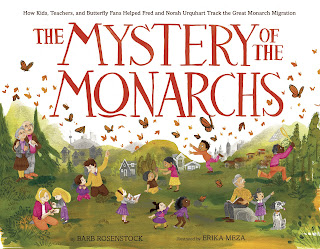
On July 21, 2022, the migratory monarch butterfly was placed on the IUCN Red List as endangered.  It has only been forty-seven short years since their annual trek from north to south and back was discovered.  This understanding began with a single individual and grew to encompass people from three countries.  The Mystery Of The Monarchs: How Kids, Teachers, and Butterfly Fans Helped Fred and Norah Urquhart Track the Great Monarch Migration (Alfred A. Knopf, May 31, 2022) written by Barb Rosenstock with illustrations by Erika Meza chronicles the human journey to solve the puzzle of these noble insects.
Fred Urquhart ate breakfast, grabbed his satchel, and started his walk to school.
Thank goodness he stopped at the marsh.

At the young age of eight, Fred was firmly attached to the study of insects.  Year after year, his collection of specimens grew.  One year, Fred was intrigued by an article he read about 

migrating butterflies.

He wondered about the monarchs, his favorite butterflies.  No one knew where they went.  Fred was determined to be the someone who found the answer.

Fred studied entomology.  He started to collect the monarchs and placed labels on their wings. (Making labels that worked was a tricky business.)  He hoped people would find the labeled butterflies and reach out to him.  Ten years later, he was no closer to a solution.

Norah, Fred's wife, was completely taken with his quest.  They developed a better label, asking those who found tagged butterflies to

SEND TO ZOOLOGY UNIVERSITY TORONTO CANADA.

They knew they needed more help tagging the monarchs.  They placed notices in magazines and newspapers in the United States (and eventually Mexico).  The response was slow but it grew.  People of all ages and from all walks of life, especially teachers and students, joined the 

Insect Migration Association.

The Urquharts plotted routes on a large map.  They drove all over the United States and into Mexico, but the mystery was still not solved.  There was another couple, a couple who lived in Mexico, that loved traveling.  In January 1975, this duo found a magnificent scene among the mountains in Mexico.  They notified the Urquharts.  When Fred and Norah arrived there the following year, more than forty years after Fred wanted to solve the puzzle, Fred found something wonderful.


Through her meticulous research, author Barb Rosenstock presents a compelling narrative of Fred and Norah Urquhart and everyone who helped them.  Layer by layer with explicit facts, this nonfiction picture book builds toward its exciting conclusion.  We become a part of each layer, turning the pages with our hope growing.  As we read the final paragraph, followed by a question and two words, our involvement is so thorough we want to stand up and shout.  Here is a passage.

It was still a mystery.
One year 13,800 monarchs were tagged and 128 were returned.  The next, 17,000 were tagged and 298 returned.  Fred, Norah, and their "butterfly family" were getting closer to an answer.  Year by year, monarch by monarch, the lines on Fred and Norah's map pointed farther south.  Ontario to Alabama, Indiana to Mississippi, New York to Florida.


The two scenes displayed on the open and matching dust jacket and book case appear to be a single image, but they are not.  On the front, right side, we see Fred and Norah near the spine watching all those people, young and old, who helped them by capturing and releasing labeled butterflies over decades.  By the landscape and architecture, we are able to determine this is in a northern region.

To the left, on the back, are more people, of all ages.  By the landscape and architecture, we realize this is a mountainous region to the south, across the border of the United States.  Here the people are welcoming the arrival of the monarchs.  In both illustrations, the individuals are taking joy in the monarchs and their flight.

On the opening and closing endpapers is an intricate pattern in orange and pink, acting as a background.  Placed on top of this are monarchs, grasses, leaves, and flowers.  There are seven separate visuals.  The verso and title pages feature monarchs in flight, a tribute to Homero Gomez Gonzalez, and an envelope with a returned monarch inside it.

These illustrations by Erika Meza rendered

using acrylic gouache, watercolor, ink, coffee splashes, and pastel pencils, before using Photoshop to tie it all up

make excellent use of white space as a way of highlighting the colorful elements and as a canvas for the text.  They are double-page pictures, single-page pictures, and sometimes several smaller images on a single page.  A variety of perspectives showcase the pacing and story.  The fine lines and delicate details fully engage readers.  These include dotted lines to indicate the flight of monarchs and origami butterflies to indicate the "flight" of correspondence and outreach.

One of my many favorite illustrations is a single page picture.  It shows Norah seated in a winged, light orange chair near a window.  Outside the window is a blue sky, several trees and two monarchs in flight.  Next to Norah on her left is a side table stacked with letters.  She is opening one of them with her dog seated next to her.  On a larger table on her right is a monarch specimen, an orange dial phone, an outgoing letter box, and a lamp.  Four origami butterflies fly above that table and Norah.


It is more important than it has ever been to be stewards of our planet.  In The Mystery Of The Monarchs: How Kids, Teachers, and Butterfly Fans Helped Fred and Norah Urquhart Track the Great Monarch Migration written by Barb Rosenstock with artwork by Erika Meza, readers will be inspired by the dream of one man which was shared by his wife and a host of people in Canada, the United States and Mexico over decades.  At the close of the book are an author's note and illustrator's note which are necessary reading.  They are followed by a page dedicated to the life cycle of the monarch butterfly.  A section on butterfly generations and the teacher and students who labeled the butterfly found by Fred Urquhart in Mexico are next.  There are several citizen monarch groups discussed and a list of selected sources on the final two pages.  I read the article in the University of Toronto Magazine, August 24, 2015 by Alec Scott titled "Where Do You Go, My Lovelies?"  It is excellent.  I know you will want a copy of this title in your professional and personal collections.  You can pair it with Winged Wonders: Solving The Monarch Migration Mystery by Meg Pincus with illustrations by Yas Imamura and Senorita Mariposa by Ben Gundersheimer with illustrations by Marcos Almada Rivero.

To learn more about Barb Rosenstock and Erika Meza and their other work, please follow the link attached to their names to access their websites.  Barb Rosenstock has extra resources on her website for this book.  Barb Rosenstock has accounts on Facebook, Instagram, Pinterest, and Twitter.  Erika Meza has accounts on Instagram and Twitter.  At the publisher's website, you can view interior images.

Wednesday, June 13, 2018

To Be Of Courage

When you think of the word brave, other synonymous meanings come to mind like courageous, heroic, bold or fearless.  If you were to ask a group of children what brave means to them, I wonder what they would say.  Would they be able to think of an individual who has exhibited the condition of being fearless?  Most of them would not think of the combined efforts of an engineer and an explorer as being particularly heroic.

Perhaps they have never heard of two bold souls who saw life in the darkest part of the sea before any others.  Otis And Will Discover The Deep: The Record-Setting Dive Of The Bathysphere (Little, Brown And Company, June 5, 2018) written by Barb Rosenstock with illustrations by Katherine Roy features two men who dared to defy the watery depths.  Their determination changed the course of our understanding of the oceans.

Otis Barton discovered the ocean early.

He splashed in the Atlantic on summer vacations, sailed Vineyard Sound.

Will Beebe discovered the ocean later.

First, he hiked northern forests on summer vacations.  He tracked woodland animals, studied snakes in his bedroom, and raised an orphaned owl.

Otis wanted to dive deeper than the sand sharks he watched.  He tried to use a garden hose to breathe.  He tried a washtub over his head to hold air.  His final invention (with the help of friends) worked!

Will was older when he first discovered the beauty of sea life on a reef near the Galapagos Islands.  This was his beginning of wanting to know what was farther below in the oceans.  Will started planning and creating a diving tank.  Otis saw the plans and knew Will needed his help but it was months before Will would agree to meet him.

Once Will saw Otis's ideas he believed a like-minded person was standing before him.  They both wanted the same thing, to go as deep as possible.  The Bathysphere was becoming a reality.  There was detail after detail which needed to be considered, being safely lifted off the deck, oxygen levels, seals and the overall design.

The 5,000-pound unit was only four and a half feet in diameter.  It was a tight squeeze for two men measuring six feet tall.  The hatch weighed 400 pounds!  Can you imagine this?!

On the day of the launch they dropped 100 feet, 200 feet, 300 feet and 400 feet.  It was getting colder and darker.  A momentary fright was resolved.  They kept going.  On this date, June 6, 1930, they reached 803 feet.  These two bold souls made unprecedented scientific history.


By supplying us with specific moments in the early years of both men's lives, Barb Rosenstock gives us an idea of the passion which fueled their desires.  She uses repeating phrases to link them together then and again when they finally meet, dive and reach their destination. Her descriptions of the physical Bathysphere start to intensify the suspense of the dive.  She builds on this with particular pieces of information.  By telling us what happens at each one hundred foot drop, the tension builds.  Her repeated use of the word stop and the phrase breathe in and breathe out helps us to experience what Otis and Will might have felt.  Here is a passage.

700 feet. Stop.
The dark ocean glowed!  Their eyes played tricks
in the mysterious inky gleam.  Will tried to read---
print disappeared on the page.  Otis examined
color charts---saw only black and white.

Creak.
Skreak.
Creak.


When you open the dust jacket of this book it's as if you are

down,
down
into 
the deep.

The dark blue hues speckled with dots of light extend over the spine and to the ends of each flap.  The light shining from the Bathysphere continues to the lower, right-hand corner of the flap.  Sea creatures are evident on the front flap, the front and the back.  The style used for the fonts and framing of Otis, Will, Barbara and Katherine replicates the edges of the windows and the hatch on the Bathysphere.

To the left, on the back, outlines of details found on the blueprints for the vessel are lightly etched in white drifting around an interior view of Otis and Will inside the Bathysphere.  The book case canvas is darker blue hues with spots of light.  The only additional element is on the front.  It's the Bathysphere suspended with the cables, looking small in the largeness of the ocean.

On the opening and closing endpapers, each set different, illustrator Katherine Roy showcases animal life found at different depths.  They are placed on a background of watercolor washes looking like sand. The twenty animals are labeled.

Exquisitely rendered using pencil, watercolor, gouache, and ink the illustrations draw you back in time into this narrative.  Extensive research brings authenticity to every image.  Perspective, the shifts in picture sizes and their placement on one or two pages (and a breathtaking four page gatefold) elevate and extend the text to the point where the visual story wraps around us.  We are jumping off a dock into the ocean. We are climbing a tree to observe birds.  We are crammed inside a vessel diving hundreds of feet below the surface wondering if we will live through this day but also exhilarated by the sights we see.

One of my many favorite pictures is when we are inside the Bathysphere with Otis and Will prior to the drop.  Neither of them is looking at us. They are focused to the left and right of the gutter.  Otis is ensuring the telephone headset is operative and checking the oxygen levels.  Will makes certain he can see at all angles through the window.  He wants to record everything he sees.  There is intensity and tension in this moment. It is perfectly depicted.


Readers will savor every word and image of Otis And Will Discover The Deep: The Record-Setting Dive Of The Bathysphere written by Barb Rosenstock with illustrations by Katherine Roy.  It's an adventure filled with mystery, anxiety and excitement and it's true!  At the close of the book there are an informative author's note, an illustrator's note, and a note from Constance Carter, Former Head, Science Reference, Library of Congress who was mentored by William Beebe.  Sources are listed, too.  As a read aloud this book is fantastic.  I highly recommend it for your personal and professional collections.

To learn more about Barb Rosenstock and Katherine Roy and their other work, please visit their websites by following the links attached to their names. Barb Rosenstock includes a five page educator's guide.  Katherine Roy has a link to her blog. Both Barb and Katherine maintain accounts on Twitter. Please enjoy this video with Barb and Katherine unboxing their book.  It's highly informative and fun.


UPDATE:  Barbara talks with Katherine at Picture Book Builders, A Deep Conversation with Illustrator and Author Katherine Roy.


Please take a few moments to visit Kid Lit Frenzy hosted by educator Alyson Beecher to view the other titles chosen by participants in the 2018 Nonfiction Picture Book Challenge this week.


Wednesday, January 7, 2015

Wonderful Watery Inspiration

If you were to stop right where you are right now, is there not at least one thing visible invented by someone?  Our lives are enhanced by the curiosity of others.  They looked and wondered if they could mimic something seen in nature.  They studied and asked themselves, why not?

If you've ever waded in a fresh water lake especially in the shallows at the right time of year, schools of minnows will swarm around your feet.  They scoot and scatter in a flash.  Unlike them we can only swim under water for a short time.   Ben Franklin's Big Splash: The Mostly True Story Of His First Invention (Calkins Creek, September 1, 2014) written by Barb Rosenstock with illustrations by S. D. Schindler introduces readers to something I'll bet they never knew about this man.  His creativity lead to making swimming on and under water more like fish for all of us.

Before the world knew the famous Doctor Benjamin Franklin, his neighbors knew him as Ben, the sturdy, saucy, smelly son of a soap-maker---the boy who, on sweltering summer days, snuck away from stirring soap vats and snipping candlewicks in his father's shop to head straight for the river.

Today no one, particularly in the northern Michigan town where I reside next to Lake Michigan, would give this activity a second thought but in Boston when Ben was a boy this was viewed as strange behavior.  Water was for water creatures and water plants not people.  Swimming was thought to contribute to illnesses.  

Contrary to popular belief Ben kept right on swimming.  He was as healthy as the proverbial horse.  There was something about being in the water, floating along, that made his thinking clearer.  His minded wandered as minds will do, daydreaming about his future and immediate circumstances.  One day young Ben asked himself,

Why can't I swim like a fish?

Perhaps he compared himself to the fish he noticed when swimming.  Sketching and working with wood at the shop, he fashioned himself a pair of fins for his hands.  I wonder what people thought when they saw Ben wearing those funny paddles as he dove into and moved around in the water.  Ben's thirst for finding the right way to move when swimming was not quenched yet, there were kinks to correct.

From the shop he walked to the river again; carrying this time four items, two paddles for his feet and two paddles for his hands.  If people thought Ben looked odd the first time, they must have shook their heads to see him the second time.  Was it a complete success?  To Ben every attempt was a success; every attempt was a chance to get better.  Lucky for all of us, he never stopped.


Barb Rosenstock is no stranger to research and familiarizing her readers with information about persons of history frequently left out of textbooks.  I've read and talked about her titles on Theodore Roosevelt and John Muir, Thomas Jefferson, Joe DiMaggio and Wassily Kandinsky.  For this book she provides us with an author's note, a timeline of Benjamin Franklin's life, extensive sources, and source notes.

Throughout the narrative we are privy to gathered original quotes of Ben Franklin; each tied directly to Rosenstock's telling of this specific invention, his first known innovation.  Her writing style here is captivating replete with the use of alliteration.  Words describing each day's swim and work in the shop begin with the letter s.  More than once words are repeated bringing a spirited cadence to the tale.  Here is a sample passage.

Ben SPRINTED straight to the river,
STOOD on the bank,
STRIPPED OFF his clothes,
STRAPPED his feet into the sandals, 
STUCK his thumbs back in the swim fins, 
SPREAD his arms wide,
STOMPED his feet, and SPLASHED IN.


Rendered in ink and watercolor S. D. Schindler compliments the effervescence found in Barb Rosenstock's words with his illustrations.  The splash seen on the front is duplicated on the back of the matching dust jacket and book case.  I really like the design of placing Ben as the letter i on the front with the duck, fish, turtle, fish and his dog as a part of the water.  On the back an otter is shown in addition to fish, a frog and a duck.  In the center of the splash is a quote.

LET THE EXPERIMENT BE MADE.
---Ben Franklin 

The golden brown of the paddles supplies the color for the opening and closing endpapers.  

To contribute further to the text Schindler alternates his illustration sizes shifting from double-page spans to single pages to a series of smaller pictures grouped together to match the story's pace.  The layout of the images with the text flows beautifully.  A color palette favoring blues, greens, and browns with fine black lines accentuates the time period and natural surroundings where Ben swims.  

Two of my favorite series of illustrations are of Ben swimming and then Ben thinking about duplicating a fish's swimming in water as he swims.  In the first Ben matches the movements of a duck seeking food, an otter gracefully swimming, and a turtle slipping from a log.  In the second he is studying each aspect of fish; their shapes, fins, bellies, tails, and noses.  


I know readers are going to enjoy learning when reading Ben Franklin's Big Splash: The Mostly True Story Of His First Invention written by Barb Rosenstock with illustrations by S. D. Schindler.  The tempo of the narrative combined with the illustrations is as buoyant as floating on a summer's day in your favorite swimming hole and as much fun as drenching everything and everyone is sight as you jump into the water.  This is definitely a book to include in your classrooms and libraries.  

Please follow the links embedded in Barb Rosenstock's and S. D. Schindler's names to access their websites.  Each has more information about their other work.  Enjoy the book trailer below.


I am well aware that technically this book is considered historical fiction but Barb Rosenstock has included a significant amount of back matter for readers.

I am thrilled to be participating in educator Alyson Beecher's 2015 Nonfiction Picture Book Challenge hosted at her blog, Kid Lit Frenzy.  More participants are featured there today.  Please stop by to see what titles they are highlighting.


Monday, March 24, 2014

Hearing Art

There is an art to discovering, creating and enhancing art...at least for me.  I have found that in slowing down, in stillness, I have been able to develop a more sensory appreciation for nearly everything.  I think you have to step away from, step outside, the normal hustle and bustle around you.

When you stand on the shore of Lake Michigan all alone and close your eyes, the sound of the waves becomes a string of notes reaching into your soul.  When you block out all sound and gaze at the star-studded sky, it lifts you up.  Have you ever reached out and touched a milkweed pod broken open with the seeds spilling out, feeling the different textures?  When cooking and then eating a favorite recipe, sometimes it's difficult to determine where taste ends and smell starts; the two are nearly blended together.

What I have never been able to do is to see color when hearing sounds or to hear sounds when seeing color.  Artist Vasily Kandinsky could.  The Noisy Paint Box: The Colors and Sounds of Kandinsky's Abstract Art (Alfred A. Knopf) written by Barb Rosenstock with illustrations by Mary GrandPre traces his creative life from his youth into adulthood.

Vasya Kandinsky spent his days learning to be a proper Russian boy.
He studied bookfuls of math, science, and history.

Everything was going along rather dully according to his parents' plan until his aunt gave him

a small wooden paint box.

It was a subject necessary for a good and decent upbringing; an appreciation for art was integral to him becoming well-rounded.  After a lesson in mixing the colors from his aunt, he tried it on his own.

He heard hissing!  Did his aunt hear it?  Did his papa hear it?  Did his mama hear it?  No, they did not.  Only Vasya could.  He mixed and painted and listened to the noise filling the air.

The results of his efforts puzzled everyone.  They failed to understand what his work represented.  Vasya was asked to attend classes so he could paint exactly as everyone else did.  When he grew older he attended law school, setting aside his box of paints.

Even though his box was closed, colors still rang out to him wherever he went.  One evening the most astonishing thing happened; at the opera Vasya saw colors as the orchestra played.  His career in law no longer held any importance but becoming a painter did.

He studied and painted conforming to the instructions of his mentors.  These pictures were not a reflection of the sounds he heard.  Vasya could no longer ignore the music coming from his noisy paint box.  He mixed and painted and people began to listen.


When you look at a Vasily Kandinsky painting, a unique energy emanates.  That same type of vitality calls out from the narrative with Barb Rosenstock's use of language.  Details reflect her meticulous research but her depiction of them is completely captivating for readers.  When she describes Kandinsky's abilities the air around you will resonate in joyful colors.  Here is a sample passage.

As the orchestra's music crashed around him, the colors of the noisy paint box twirled wildly in his mind.  Stomping lines of vermilion and coral.  Caroling triangles in pistachio and garnet. Thundering arches of aqua and ebony, with shrill points of cobalt and saffron.


You can almost reach out and touch the magic in the air from looking at the matching dust jacket and book case illustration extending over the front and back.  Mary GrandPre uses acrylic paint and collage to make this and the other pictures in this title; most spanning two pages.  A thin white line frames those and the eight single-page visuals.  The opening and closing endpapers are done in a collage of creams and a paler shade of one of the brush strokes of color pattered on them; the red, blue, green and yellow.  The final set of endpapers includes a quote of Vasily Kandinsky done in script.

The title page is a close-up view of the interior of the paint box; the text cleverly positioned as if it's supposed to be there.  With a page turn the story begins with a scene of Vasya in his room studying.  Displayed items mirror the words (with the exception of his stuffed toy rabbit).  There is an authenticity to the architecture, decor, furniture and clothing of the era in every scene.

Mary GrandPre chooses a color palette that brings the hues from Kandinsky's artwork into her illustrations with an overtone of shades of blue (almost like a base).  Her lively paintings move with a vibrancy perhaps due to her lighting, lines and layout.  My favorites, by far, are the close-ups of Vasya's face over the years as he senses colors in sounds and hears sounds in color; as a boy mixing his paints for the first time or as a young man walking down a city street or sitting at the opera house during a performance.


This picture book presentation, The Noisy Paint Box: The Colors and Sounds of Kandinsky's Abstract Art written by Barb Rosenstock with illustrations by Mary GrandPre, of Vasily Kandinsky's life is exuberant, informative and engaging.  It shines a light on one man's individuality, on his desire and determination to follow his heart.  You might want to have several paint box sets on hand after you read this book.  I know it will inspire others to do the same.  The outstanding illustrations of Mary GrandPre make this title a candidate for the Mock Caldecott 2015 list.

At the conclusion of the book are an author's note, four of Kandinsky's paintings, and a list of sources. The links embedded in Barb Rosenstock's and Mary GrandPre's names will lead to their official websites.  I urge you to visit them.  Please follow this link to an interview of Barb Rosenstock by John Schumacher at Watch. Connect. Read.  This is a link to The Noisy Paint Box Educator's Guide.


Thursday, March 20, 2014

The Summer Of 1941

All one has to do is look at human history to realize the impact a single individual can make for good.  A community is created rallying around them in support of their endeavors.  For whatever reason, sometimes, this person rises to noteworthy status when needed the most.

During the summer of 1941 baseball yielded such a person.  A sense of unease had settled over most Americans; Europe was at war.  With illustrations by Terry Widener, well-received nonfiction author, Barb Rosenstock, has written The Streak: How Joe DiMaggio Became America's Hero (Calkins Creek, an imprint of Highlights).

It all started quietly, like a conversation with Joe DiMaggio himself.  One shy single, hit to left field, smack in the middle of May, the fifteenth.

The Yankees lost that day so no one took any particular notice of that one shy single delivered by Joe.  It didn't take long though for it to come to people's attention when one week passed with Joe continuing to get hits.  Pretty soon he had hits in twenty games.  Someone might have softly suggested streak.

When Joe had hit in thirty straight games, he started to make newspaper headlines, replacing the attention given to the war.  Here was a man from a large family, generations of fishermen, raised in San Francisco, no stranger to hard work, making a name for himself in a sport Americans loved.  For each game (and for games only), Joe used a very special bat, given great care and named Betsy Ann.

Joe followed a ritual of sorts for each at bat; rubbing dirt on his hands, giving home plate a single tap and standing wide waiting for the right pitch.  With the best pitchers giving their best pitches, still nothing got by Joe.  As Joe got closer to breaking the record of a forty-one game hitting streak, the pressure really started to take its toll on him off field.

On June 29, 1941 the New York Yankees were playing the Washington Senators in Washington, D. C.  During the first of two games, Joe tied the record.  During the break between the games, the unthinkable happened.  Betsy Ann was stolen!

As the top of the seventh rolled around things looked grim for the baseball hero; three at bats, three strikeouts.  A teammate offered hope.  Joe DiMaggio proceeded to do what he did best, work hard.  The record results are unbroken to this day in baseball history.


Baseball fan or not, you will be caught up in the excitement of this retelling of Joe DiMaggio's hitting streak.  Prior to the narrative's start, Barb Rosenstock includes a quote from Joe DiMaggio to set the stage for the type of ball player he is.  Each portion of the story builds on this, creating an ever-increasing tension.  Rosenstock writes as if she is a sportscaster relaying each portion in snippets of details.

These elements are of the personal, insider, nature.  Readers are taken back in time to those ballparks; you believe you are a spectator witnessing the actual events.  Here is a sample passage.

Joe kept hitting.  A triple and a home run in the next game, one or two more every game that week.  When he hit in 20 straight games, the word "streak" whispered from the bleachers to the press box---DiMaggio was on a hitting streak.  
Joe kept the streak alive the next week and the next.


Although the matching dust jacket and book case images differ on the front and back, they extend into the flaps on the jacket. In the front we are closer watching the ball fly after a swing.  On the back Joe is standing ready at the plate with the perspective shifting, zooming back.  The turquoise shade in the upper left hand corner deepens and brightens on the endpapers, providing a background for large font quotes in white about Joe DiMaggio from Ted Williams, left fielder, Boston Red Sox and Ty Cobb, outfielder, Detroit Tigers.  

The red lettering used in the title appears repeatedly throughout the book drawing the reader's attention to the significant text within each of the two-page illustrations rendered in acrylic on bristol paper by Terry Widener.  You might be seated in the bleachers looking out at the field, seeing all stages of Joe's batting style, going in close to see only his hands sanding the handle of Betsy Ann as she rests on his lap, or getting a bird's eye view of Griffith Stadium on the fateful day in June.  The color palette is a softened, textural blend of white, gray, brown, blue, and green hues; taking us perfectly into the past.

One of my favorite illustrations is more introspective than the other action pieces.  On the right it shows Joe seated in the locker room next to his locker, head bowed in thought.  From the left newspapers with headlines of the day cross the gutter at the bottom.  Above is a cityscape, full moon shining on a saxophone player to depict the music of 1941.


Hand The Streak: How Joe DiMaggio Became America's Hero written by Barb Rosenstock with illustrations by Terry Widener to sport fans, history buffs or anyone who enjoys a well told tale.  No matter where you are or the time of year it is, you will hear the crack of the bat and the chorus of cheers from the fans as Joe DiMaggio gets another hit.  You might even be yelling out in pure joy yourself!

Please be sure to follow the links embedded in both the author's and illustrator's names to access their official websites.  At the conclusion of the book an extensive author's note, a list of records, source notes, newspaper headlines, a bibliography of books, articles, websites, and additional sources is given.  You couldn't ask for a better nonfiction picture book about America's baseball hero.


I am pleased each Wednesday to participate in the 2014 Nonfiction Picture Book Challenge hosted by Alyson Beecher at Kid Lit Frenzy.  Please take a moment to follow the other blogger links listed there to get connected to some of the best nonfiction titles available.

PLEASE NOTE:  I extend an apology to my faithful readers for this post being so late today (or early morning) as my presence was needed for a family emergency.

Wednesday, February 5, 2014

The Man Who Loved Books...And Libraries

Despite the passing of decades, the immense feeling of wonder when first entering the Library of Congress still remains vivid in my memory.  The collections of gathered words and illustrations surround you in a quiet embrace of reverence.  On April 24th of this year, the Library of Congress will have been in existence for two hundred fourteen years.

Originally kept in the Capitol in Washington, D. C. as a small library of resources for the legislators, its contents were burned in 1814 when British troops set fire to the building.  A man with a known passion for books and reading offered his extensive library as a replacement.  In January of 1815 Congress allowed compensation in the sum of $23,950 for his 6,487 books *.  This man was Thomas Jefferson.  Author Barb Rosenstock and illustrator John O'Brien chronicle the growth of this affection for the printed word in Thomas Jefferson Builds a Library (Calkins Creek, an imprint of Highlights, September 2013).


Thomas Jefferson learned to read.  And then, he never stopped.

It is said before he turned six and entered school, he read the entire contents of his father's library, all forty-nine books.  He did accomplish other requirements for a young man of his time; learning French and Latin, the proper way to dance, and playing the fiddle.  It was reading, when given the choice, which occupied hours of every day.  His method of organizing his book collections is intriguing to say the least.

Marriage, children, the building of Monticello and the writing of the Declaration of Independence did not deter this man from the importance of reading. With his encouragement his family acquired a taste for books, too. For the remainder of his life, he carried a paper with words written by him and his wife, Martha, from their favorite book wrapped in a lock of her hair.

After the untimely death of Martha, Thomas Jefferson traveled to France to act as an ambassador seeking assistance.  The libraries and booksellers feed his soul's need to not only read but further develop his personal library.

Tom bought two thousand books in five years, more than a book a day.

During his two terms as president, he tripled the number of volumes in the library at the Capitol.  Even after his retirement back at Monticello his love of books, reading and writing continued.  A special book stand in his library revolved allowing him to read five books at a time.  Like a true lover of books, he shared them with others as a loan or a gift and continued to purchase more.

Thomas Jefferson believed in the United States of America.  Thomas Jefferson believed in the power of books.  When the fire of 1814 destroyed the collection in Washington, D. C., Thomas Jefferson did the only thing he could do.


One of the truly appealing aspects of this book is the presentation of the information.  Barb Rosenstock has written two loosely connected narratives. As the first documents the life of Thomas Jefferson with reference to this love of reading, the second adds interesting, more detailed information in the form of quotes and specific facts.  Each compliments and supplements the other in a harmonious flow.  Here is a single example.

He sailed, and he read.
He bounced in fancy carriages, and he read.
He bowed to the king, charmed the court,
helped his country, and he read.

"Books were at all times his
chosen companions."
---Ellen Wayles Randolph, granddaughter of Thomas Jefferson


Upon opening up the matching jacket and book case, readers (and those loving books as much as Thomas Jefferson) will be hard pressed not to smile at the scene of him shelving books among the block letters spelling the title, as four small children, a dog and cat are reading.  An exceedingly clever title page shows Thomas Jefferson on a scaffold building a library out of books with his quotation,

"I cannot live without books."  ---Thomas Jefferson, 1815

embedded in an open book over the doorway.  Many of the added specifics appear in open books with smaller explanatory pictures on most of the other pages.  These books are tucked within the main illustration, sometimes even crossing the gutter.

The intricate lines used by John O'Brien make every single page one to savor.  His inclusion of the smallest elements add interest; small gravestones for the loss of Jefferson's children, a hand reaching in from the bottom of the page to support a quote, Napoleon serving Jefferson a shape resembling the size of the Louisiana Purchase on a plate or giving the library burning in 1814 the form of a large open book, bottom edges down, pages spread open.  The enthusiasm Jefferson brought to all his achievements is evident in facial expressions and body postures.  One of my favorite illustrations is on the final two pages.  The head of Thomas Jefferson is shown close-up as he holds an open book in his hands.  On those pages of the open book is the library full of people reading.  On the right-hand side is a younger Jefferson handing books to a woman gathering them in an open apron.


The combination of writing by Barb Rosenstock and illustrations by John O'Brien in Thomas Jefferson Builds a Library makes this a first-class addition to those books about this prominent figure in American history.  I keep reading it over and over...it's that good.  You can't resist reading books which bring the past into the present.  With Presidents' Day less than two weeks away, I highly recommend the use of this title.

The final three pages include an extensive Author's Note, Thomas Jefferson, Slaveholder, Acknowledgements, Selected Bibliography and Source Notes* and more sources notes for all the quotations.  By following the link embedded in Barb Rosenstock's name you can gather further resources for this book (Educator's Guide) plus her other titles.  The link embedded in John O'Brien's name will give you access to his website.  Enjoy the book trailer.


*The Library of Congress-About the Library-History


I am excited to be participating in Alyson Beecher's 2014 Nonfiction Picture Book Challenge hosted at her blog Kid Lit Frenzy.  Make sure you stop over there to see all the other nonfiction picture books showcased by other bloggers.

Thursday, March 8, 2012

World Read Aloud Day 2012

On February 21, 2012 I arrived home from school pretty late but I decided to check my email before going for a walk; much to Xena's disgust.  Imagine my surprise, no, my absolute glee, at seeing this in my inbox:

Dear Margie,

Congratulations! You are the winner of The Camping Trip That Saved America Prize Package! Which includes:
... The Camping Trip that Changed America: Theodore Roosevelt, John Muir and Our National Parks (Dial), autographed by Caldecott medalist Mordicai Gerstein and author Barb Rosenstock;

11x14 framed poster image of President Theodore Roosevelt and naturalist John Muir, the book's main characters, atop Glacier Point in Yosemite, 1903;


a "grow your own" Giant Sequoia kit (boxed kit includes: seeds, starter pot, growing mixture and instructions);


15-minute Skype visit with author Barb Rosenstock.
 
Author Cynthia Leitich Smith at her blog, Cynsations, hosted a post about author Barb Rosenstock and her new title, The Camping Trip That Changed America:  Theodore Roosevelt, John Muir, and our National Parks illustrated by Mordicai Gerstein (Dial Books for Young Readers).  Within that post was the giveaway package which I was fortunate enough to win.  Just the day before I had posted a review of the book on this very blog.

Yesterday all our third and fourth grade students filled the library media center to enjoy the Skype visit with Barb Rosenstock on World Read Aloud Day.  It was our first author Skype visit; so successful it will most assuredly not be the last.  What a thrill it was for all of us, students, teachers, and our principal, to hear her read aloud.

After greeting us, she donned her hat and began reading.  Her exuberance was infectious; you could tell this book was very special to her.  During the question and answer period her answers were thoughtful and informative giving all in attendance the inside scoop about this title, writing in general and reading. 


Barb Rosenstock is greeting the students.


Hat on head we hit the trail with Rosenstock,


Question and answer:  How did Rosenstock get her idea for this book?

All these students are listening, learning and reading on World Read Aloud Day.

Students asked the best questions wanting to know about her writing.


An enthusiastic Rosenstock answers questions.

Two fourth graders read a message to a school in Maine.

We here at Charlevoix Elementary School loved being a part of World Read Aloud Day; a way to show that we believe in the power of words, books, reading and writing.

Monday, February 20, 2012

Hail To The Chief

Try to picture stepping away from your life for four whole days; unplugging from all the technology and fast-paced demands of your day to day existence.  Let's take this a step further; those days will be spent in a wilderness area without the normal comforts of home and hearth.  In The Camping Trip That Changed America:  Theodore Roosevelt, John Muir and our National Parks (Dial Books, January 19, 2012) written by Barb Rosenstock and illustrated by Mordicai Gerstein appreciation develops for two visionaries who did that, so today we can too.


Teedie and Johnnie didn't have much in common---but they shared a love of the outdoors.  They both loved a good story, too.  And that was enough to change America.

Using names affectionately given to them by their families Rosenstock introduces readers to Theodore Roosevelt and John Muir.  Theodore Roosevelt was the 26th president of the United States living in Washington, D.C. at the White House with his family, having grown up as a member of one of the wealthiest, well-established families in New York City.  John Muir, a world-renowned environmentalist with a deep love for the Yosemite wilderness in California, living in a farmhouse near that area grew up as the son of immigrant farmers in the Midwest. Observations during his many solitary travels appear in volumes illustrated with his drawings.

In March of 1903 the President picked up one of Muir's books to relax and read in the evening.  Muir's plea to preserve the wilderness at the book's end caught the attention of Roosevelt.  It prompted him to pen a letter to the naturalist asking that they go camping in Yosemite. 

Ever the politician Roosevelt's train moved toward its western destination making stops in cities and towns along the way until it reached Raymond, California on May 15, 1903.  He made several other stops to speak before crowds with Muir before the two rode off on horseback together.

"I feel like a runaway schoolboy!" Teedie laughed as his horse galloped along.

Over the course of the next several days the two explored the vast untouched areas of the giant sequoias in Mariposa Grove camping near the Grizzly Giant, rode up to Glacier Point, Muir explaining to his companion how glaciers cut through the rock to form the valley spread before them, awoke with five inches of new snow covering them and the mountaintop, and traveled down through the Yosemite Valley viewing its rock formations such as the Half Dome and El Capitan.  Impressed with Muir and what he had seen President Roosevelt returned to Washington, D. C. determined to preserve all for all time.  Creating additional national forests and parks and wildlife sanctuaries, Roosevelt

 saved more wild land than any president in history.

Interestingly enough the two were never together again but continued to correspond with personal letters until Muir's death.  Rosenstock concludes with the naming of the final resting place of both beneath the trees in areas they loved so well.

Barb Rosenstock unfolds the story of this historic meeting as if we are gathered about a campfire in the woods of Yosemite, she explaining how these two prominent men, each experts in their own arenas, came together united by their love of our natural world.  In an author's note she begins with defining quotes from each followed by what is true and the conversations between the two which she believes might have taken place.  Source notes are included.

Mordicai Gerstein, winner of the 2004 Caldecott Medal for his book, The Man Who Walked Between the Towers, recreates this segment in American history with paintings in a style that is all his own; lively animated vignettes of an event with a far-reaching, timeless impact.  Capturing the unending exuberance of Roosevelt and the passionate guardianship of Muir readers can enjoy the exhilaration of the days they spent together camping.  On the first page portraits of both as well as a scene from Yosemite are framed in red, white and blue banners signifying the importance to America of not only this meeting but of how both men's lives enriched our national heritage.

The illustration on the cover is repeated within the narrative to accompany Roosevelt's quote noted above; a single two page spread that captures the soul of this story.  This is followed by another two page spread; readers turning the book to view a vertical scene of the giant sequoias, the two horseback riders tiny at the base of the trees.  Having been to see these trees myself, Gerstein completely conveys their majesty.

During their evenings camping out in the open the imagined conversations around a crackling, campfire are illustrated with an intimacy; a camaraderie evident in the facial expressions, hand gestures, and play of shadows.  What they may have said are shown as smoke clouds coming from the fire above their heads, small pictures illustrating their words.  The final evening they are together is a powerful image, the two sitting face to face deep in discussion united by their common goal of protecting our flora and fauna from progress gone unchecked.

Author Barb Rosenstock and illustrator Mordicai Gerstein illuminate a portion of our history in The Camping Trip That Changed America:  Theodore Roosevelt, John Muir, and our National Parks informing and captivating readers.

I've lost count of the number of times I've read this title so far but I continue to marvel at the gifts displayed by authors and illustrators such as Rosenstock and Gerstein that breathe life into the past making it accessible and real, not just dry words on the printed page of a history textbook, for any age.  I, personally, have pursued further research based upon this title marveling at the accomplishments of these two men.  And is that not what we want our students to do?  While the driving idea behind this title is the camping trip you have to wonder if the two would have ever even met if Roosevelt had not read Muir's book; the power of the printed word.  On this Presidents' Day 2012, I thank these two gifted artists.  I love this book.