Quote of the Month

When love and skill work together, expect a miracle. John Ruskin


Showing posts with label Beavers-Fiction. Show all posts

Monday, December 23, 2019

It's Beginning To Look A Lot Like . . . 2019 #7

The anticipation in the air at the beginning of December has increased daily as the hours seem to speed by faster and faster.  Some of the dates planned and longed for have arrived.  For those celebrating Christmas, there is less than forty-eight hours until it officially begins.  Social media is brimming with people sharing their cooking, decorating, gift wrapping, travels and fun with family and friends.

Three characters from the woodlands who have brought us thoughtful stories and loads of laughter are together again.  One Wild Christmas (Kids Can Press, September 3, 2019) written and illustrated by Nicholas Oldland features the bear, the moose and the beaver who previously appeared in Big Bear Hug, Making The Moose Out Of Life, The Busy Beaver, Up The Creek and Walk On The Wild Side.  As we have come to expect, there is a problem, a big problem.

There was once a bear, a moose and a beaver whose very favorite time of year was Christmas.

Together for their first Christmas Eve, they were busy, making the most of their time.  There was cooking, hanging of stockings, stringing lights and gift wrapping.  They wanted this to be a perfect celebration.

When it came time to decorate the tree, they discovered they had no tree!  The trio set off outside.  Each tree they found did not satisfy their expectations until alone in a clearing was a splendidly shaped pine tree.  Now the friends were faced with their second problem.  

The beaver and moose wanted to cut it down.  The bear was aghast.  How could they destroy a living thing?!  There was a fight, but it did not last long.  Bear was the biggest of the three.  The tree was spared but their perfect celebration was currently flawed.

An idea courtesy of a tiny red presence in these books had the bear swiftly returning home on his red sled.  It was a rather difficult journey there and back to the pine tree, but the bear was determined.  As soon as the moose and the beaver (tied to the pine tree) saw their friend, they knew this was going to be the best Christmas any of them had ever experienced.  And it was.


The straightforward, simple structure of the sentences in this narrative speak to a wide range of readers.  Nicholas Oldland leaves plenty of room for us to bring our own life events into this story.  It's a marvelous manner in which to connect with the characters.  This technique also allows for his images to expand the tale, for the inclusion of dialogue and for his humor to soar.  Here is a passage.

First they came across
a maple tree . . .

TOO SMALL (the moose)

Next they saw
a birch tree . . .

TOO WHITE (the beaver)

Then they bumped into a towering
cedar tree . . .

TOO BIG (the bear)

None were quite right.


Looking at the matching and open dust jacket and book case, readers first focus on the airborne red sled with our three characters holding on tight to each other and the sled rope.  It's amazing to see the range of emotions in their eyes.  Is that excitement, fear and determination?  This entire scene certainly adds emphasis to the word wild in the title.

To the left, on the back, the image from the front crosses over the spine and extends to the left edge.  The snowy hill begins in the upper, left-hand corner and is dotted with several clusters of evergreen trees.  When you see how steep it is, it's easy to understand how the trio is speeding down the slope.

A lovely spring green covers the opening and closing endpapers.  On the initial title page, the three friends, wearing their Santa hats, are engaged in a snowball fight.  On the verso and title pages, two snowy hills create a blue-sky valley for the text on the right.

Rendered in Photoshop the illustrations by Nicholas Oldland span two pages, are grouped together to show multiple tasks at the same time or are placed on single pages.  Both the double-page pictures and the full-page pictures are shown with altered perspectives to elevate the mood and the hilarity.  Careful readers will enjoy the details included in the images. Our favorite little red bird makes an appearance, too.

One of my many, many favorite illustrations is the first one, a double-page picture.  It is an outdoor setting with snow on the bottom, blue sky on the top and a staggered row of evergreens between the two.  On the left, the beaver, the moose and the bear are standing together, wearing their Santa hats, and looking directly at the reader.  They have their arms around each other.  To the right are three snow personalities.  First is the bear, next the beaver and then the moose. The nose on the bear, the teeth on the beaver and the antlers on the moose are spot-on to their living counterparts.  You simply can't look at this without smiling or giggling.


Anytime a book makes you laugh, tells a good story and leaves you thinking about a profound truth, it's a book you'll read again.  One Wild Christmas written and illustrated by Nicholas Oldland is meant to be read aloud and shared as often as possible.  This is one title you'll want to add to your professional and personal collections.

To learn more about Nicholas Oldland and his other work, please follow the link attached to his name to access the information provided by his publisher.  At the publisher's website you can view multiple interior pages.  Be prepared for Christmas cheer.

Sunday, May 20, 2018

All Toes On Deck

Every culture has its own legends and lingo.  A particular group of people within a separate culture understand every nuance of their spoken words and individualistic body language.  To step into a culture without understanding the separate parts which make it a significant whole is like entering a foreign country.

Members of the surfing community know an A-frame is not a type of home, a Barney is not a purple dinosaur or Fred Flintstone's best friend or in the soup does not mean you are an ingredient in something to eat.  Author Aaron Reynolds (Nerdy Birdy A Neal Porter Book, Roaring Brook Press, September 22, 2015) and Caldecott Medalist (The Adventures of Beekle: The Unimaginary Friend Little, Brown and Company, April 8, 2014) Dan Santat have partnered to create a rollicking, riotous masterpiece.  DUDE! (A Neal Porter Book, Roaring Brook Press, April 24, 2018) will have you laughing out loud as soon as you read the title.  Surfing and one word take on a whole new meaning.

DUDE!

DUDE!

Two friends, both having a love of surfing, have just greeted each other at the beach.  They can hardly wait to ride the waves.  Running across the sand with their boards firmly grasped in their hands, they yell the familiar word in unison at the top of their lungs.

As they paddle away from the shore to find a wave, they marvel at a pelican scooping up a fish for lunch.  One roars with laughter as the other shrieks with disgust when the pelican strikes again.  Then one of the dangers surfers fear glides toward them.  Beaver utters dude with an entirely different tone.

They are now swimming for their very lives on their boards.  A deep, quiet, tearful voice speaks as a shark towers over them.  Neither of them expects what happens next.

Two bright ideas on the part of the beaver and platypus bridge a frightening gap.  A gigantic wave carries friends having fun, fast and furiously toward . . . DISASTER!  A third brilliant thought solves a problem.  You'll be giggling and grinning louder and louder at the results of the final two scenes.

DUDE! 


With what can only be described as sheer genius Aaron Reynolds imagines and writes an entire narrative using a single word.  He asks his readers to use their best voices to give emphasis to the word based on the situation.  A word most definitely changes in meaning based upon the emotional charge given to it.  There is an art to this form of storytelling.  


As soon as readers look at the front of the dust jacket exclamations will be forthcoming.  The platypus and beaver are happy as can be.  They are doing what they love to do best.  The shark is also grinning. Given the tendency of sharks to be attracted to movement in the water, readers will not be expecting the narrative to unfold as it does.  The water and sky cross the spine to continue to the far edge of the back of the dust jacket.  This leads us to believe the two pals are far from shore.

The bold, bright colors and distinguishing shapes and lines of Dan Santat continue on the book case in red, cream and black.  The three characters, surfboards in hand are crossing the beach as a large sun sets on the red skied-horizon.  It's a stunning display.  Golden yellow covers the opening and closing endpapers.

Dan Santat alters between single page pictures and double-page illustrations depending on the impact needed for the scene and the word, dude!  In several of the settings an animated crab appears adding to the humor.  The color, size and shape of the letters are indicative of the emotional state of the characters.  Elevating the comedy even higher, the facial expressions on the characters and their body postures are absolutely wonderful, 

One of my many favorite illustrations is actually a series of four pictures grouped over two pages.  In the first one the beaver, platypus and shark are frozen in place wondering what to do.  Clearly the two friends can see this is no ordinary shark.  In the next picture the beaver says Dude! as a light bulb appears over his head.  In the next two visuals the platypus and shark are alone.  In the first the platypus is whistling as the shark splashes water.  In the final picture both are starting to think the beaver is not coming back.


This over-the-top funnier than funny book, DUDE! written by Aaron Reynolds with illustrations by Dan Santat, is also a sharp and skillful study in inflection and the power of pictures without words.  It is without a doubt, read aloud gold.  I highly recommend this for your personal and professional collections.  I can hear the laughter already along with requests for read it again.  

To discover more about Aaron Reynolds and Dan Santat please follow the links attached to their names to access their websites.  Aaron maintains a Tumblr site also.  Both Aaron and Dan have accounts on Twitter.  At the publisher's website you can view several interior pages.

Monday, August 21, 2017

Constructing A Tree-ific Collaboration

It was decades ago.  There were four of us working; three had their own chainsaws.  We cleared more than twenty-five mature trees in order to build a home in the middle of the woods.  The use of a chainsaw is no easy task.

The weight of the saw and speed of the chain can cause injury in a matter of seconds, but when handled with care and skill it is much faster and more efficient than an axe.  It's handy to have so additional wood can be cut to fuel a stove in the middle of a bitter cold winter.  There is a certain sense of confidence in being able to use a tool to help you build a home and then heat that home.  I know this to be true.

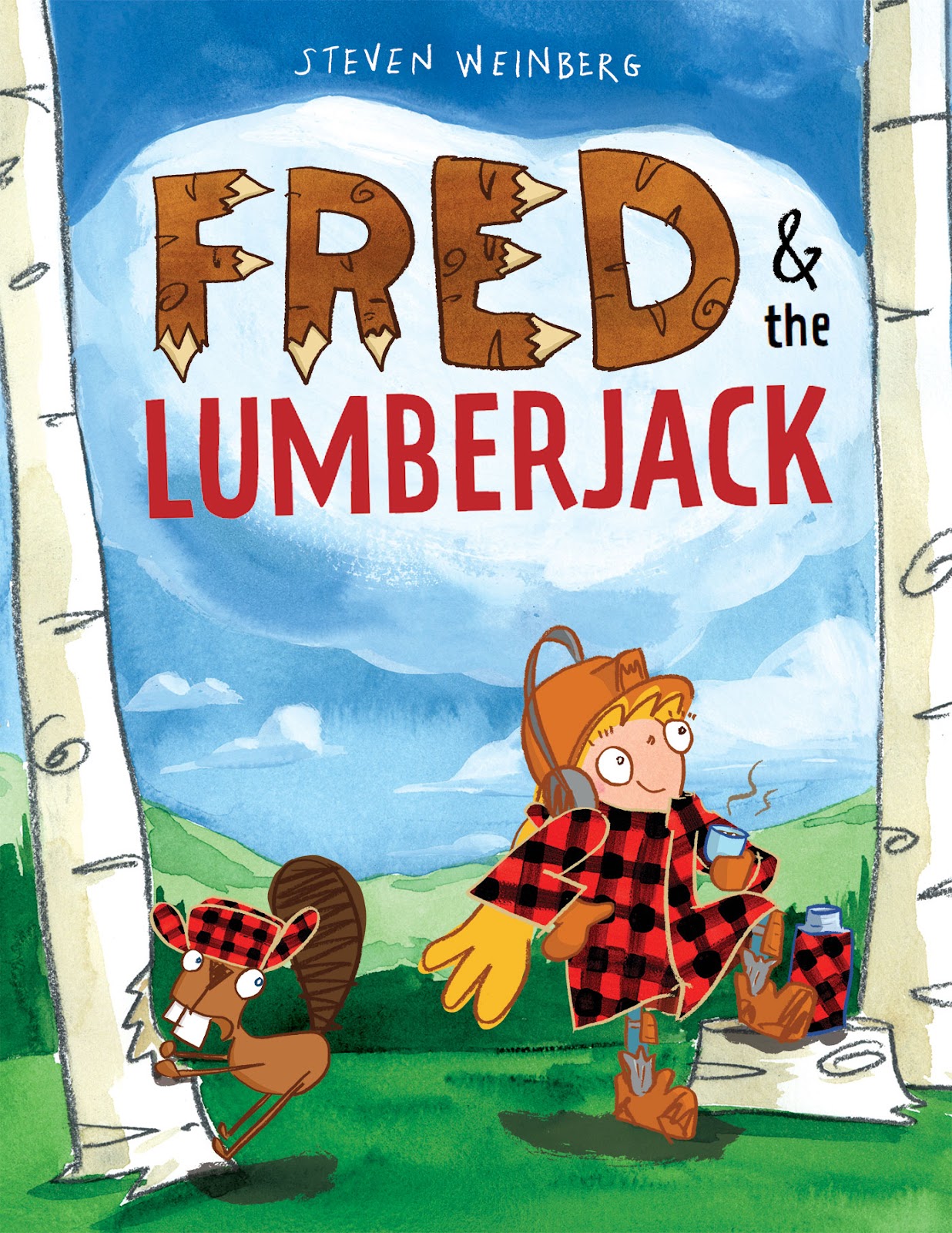
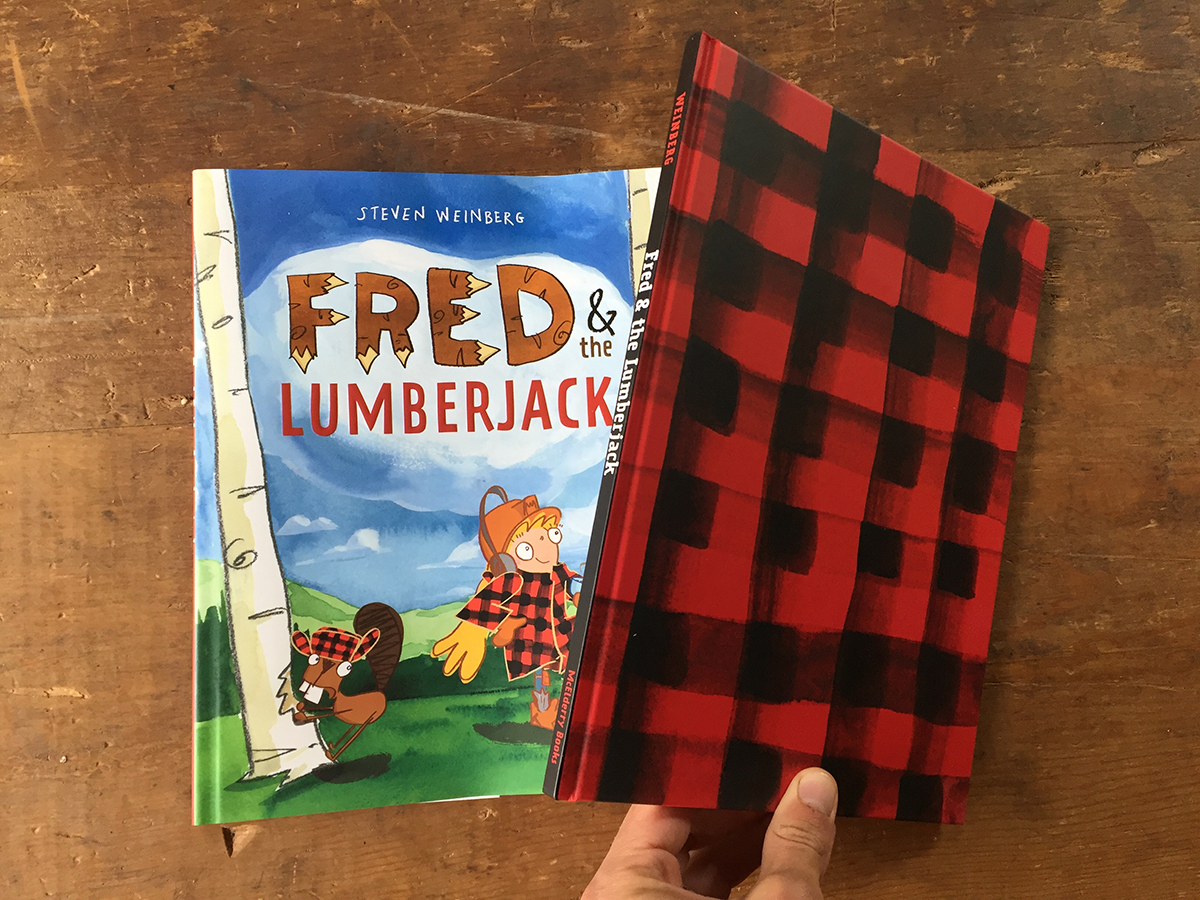
Recently I was reminded of the dexterity necessary to fell trees.  The purchase of a new house required the removal of sixteen, one nearly fifty feet tall.  Watching the lumberman climb and cut and climb and cut and lower limbs down by rope generates respect for these people and their accomplishments.  Mother Nature has her version of adept loggers, too.  In Fred & the Lumberjack (Margaret K. McElderry Books, an imprint of Simon & Schuster Children's Publishing Division, September 12, 2017) written and illustrated by Steven Weinberg (Rex Finds an Egg! Egg! Egg! and You Must Be This Tall) we are introduced to a beaver who is assuredly the Frank Lloyd Wright of streams and forests.

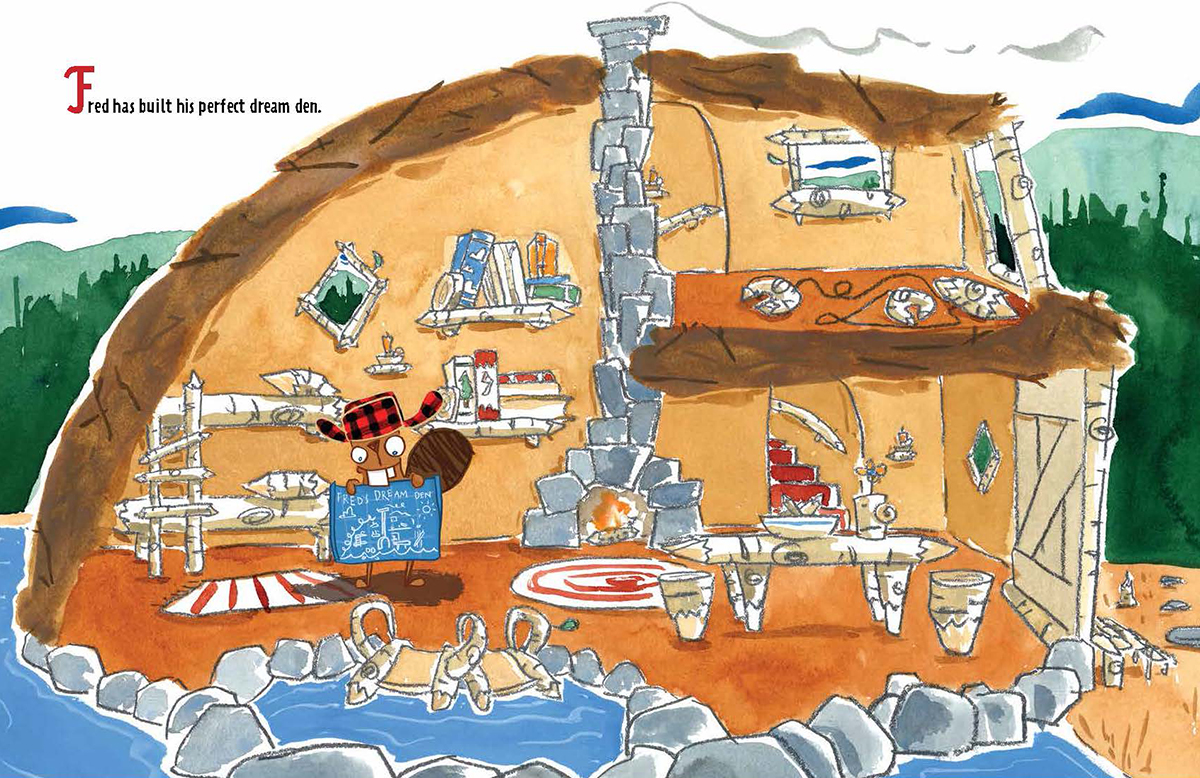
Fred has built his perfect dream den.

It has two stories with a staircase leading to a loft, hand-crafted furniture, a stone fireplace and an indoor swimming pool.  Every square inch is built according to the blueprint he designed, but something is missing.  Fred goes through his den, checking and re-checking everything.

RRRRRRRRROOAARRRRR 

His musings are interrupted by a mighty loud noise in the woods.  Fred has to discover what is causing all this ruckus.  He finds multiple trees cut with smooth edges and stacked in piles.  There are even large carvings and sculptures.

Another resounding roar rips through the air.  Fred finds himself staring at a lumberjack dressed in plaid, carrying a chainsaw and building Sophia's Dream Den.  Yes, readers Fred is totally and overwhelmingly smitten with this gal and her notable abilities.

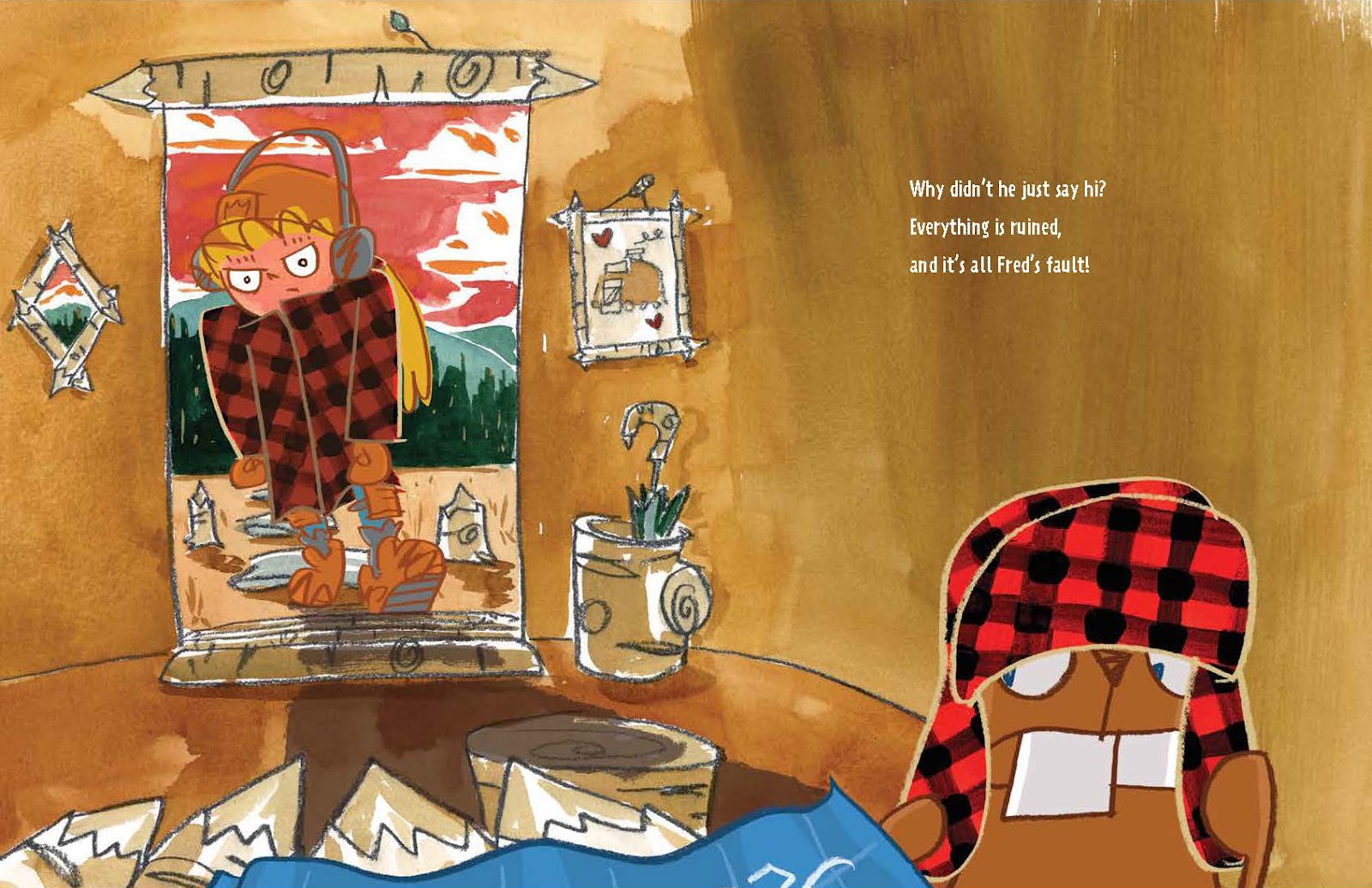
There is only one thing to do.  Fred has to get her attention using his equally excellent gifts.  OH! NO!  That's a major fail for Fred.  He runs in humiliation (and a little fear) back to his den knowing he literally made a mess of everything.  She is too furious to be his friend.

Now she's standing in his doorway.  She stops and stares.  Hope surges in an apologetic heart. It is a blueprint for dynamic duo dreams.


With his first sentence, a declaration, Steven Weinberg sets the stage for his exuberant tale with one word, perfect.  This opens the storytelling door for how things might not be quite perfect.  It's fascinating how Steven spins the narrative so in Fred's search for one thing he discovers what (who) he needs most.  The humorous touch with his play on words,

sink his teeth into,

the rhythm supplied with Fred's hunting at home, what he finds in the woods and what Sophie notices in his den along with the strategic use of the word roar all contribute to this spirited story.  Here is another sample passage.

What creature did this?
It's so precise,
so powerful
so talented!


As soon as readers see the opened dust jacket they have to grin.  The buck-toothed beaver looking with adoration at the lumberjack pausing in her daily efforts and both of them attired in traditional red and black plaid is classic.  Still looking at the front, on the right, it's in keeping with Fred's skills to have his name depicted in chewed logs.  To the left, on the back, the beautiful blue sky with clouds, the mountains, forest and birch trees continue.  One of the trees is close to the reader, making us feel as though we are stepping into the story.

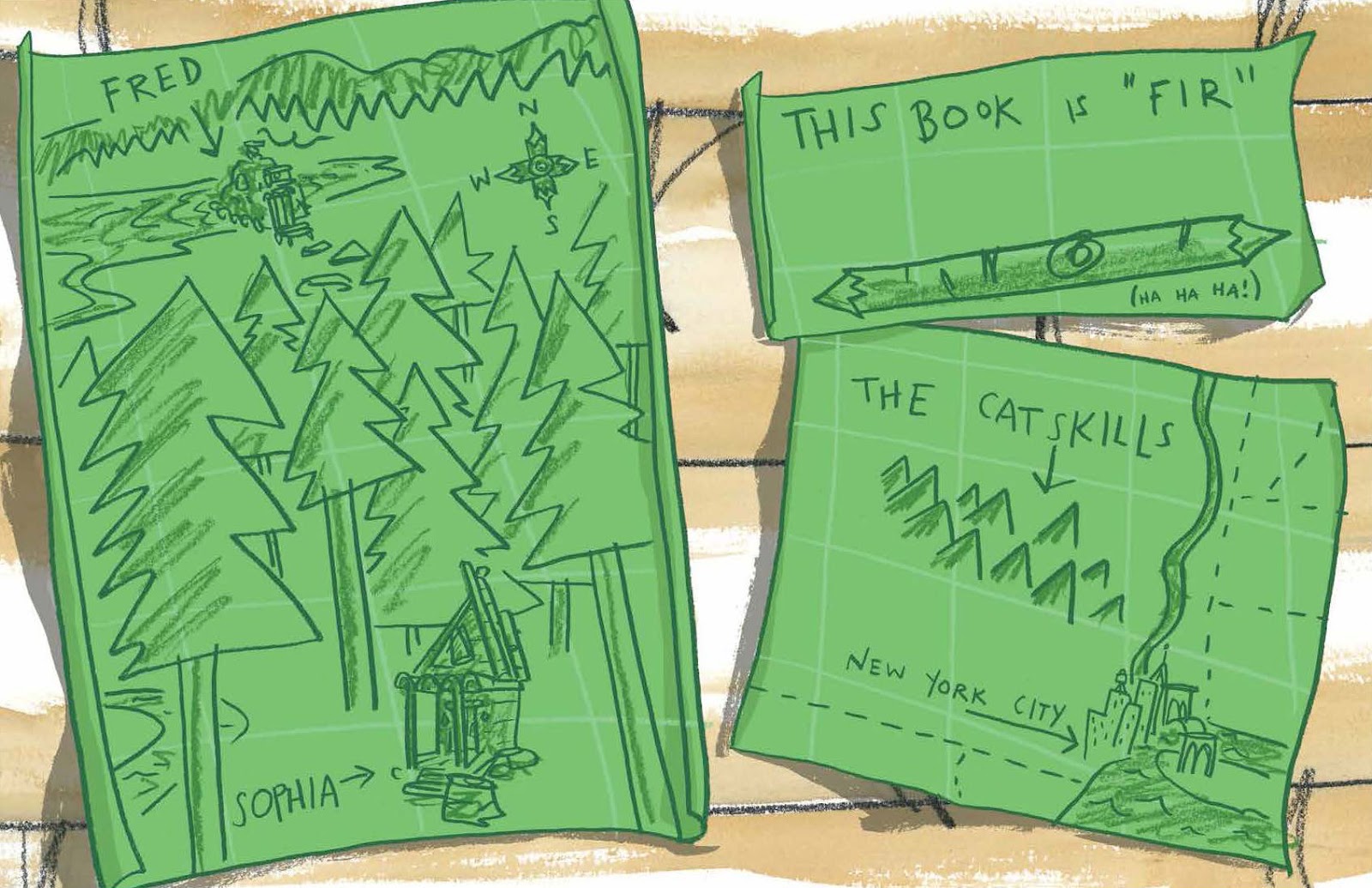
On the opening endpapers are three map images on log walls.  One is from Fred's den to Sophie's den, the other is from New York City to The Catskills and the third invites readers to write down their name,

This Book is "Fir".
     (HA HA HA!)

The closing endpapers continue the tale of Fred and Sophie.  They give readers a peek at their future endeavors....blueprint style.

Rendered using a collage of watercolor, pencil, and digital elements most of the illustrations in this title span two pages.  This mixture of styles creates a pleasing texture and contrast between the background, other items on the pages and the characters and their clothing. Multiple smaller images are grouped together to designate pacing.  A shift in perspective and font size generates a dramatic effect several times.  Readers will find themselves smiling at the wide-eyed looks on the characters, their facial expressions (although please note the color of Sophie's plaid after Fred makes his mistake), the details in Fred's den's furnishings, and the items used by Sophie.

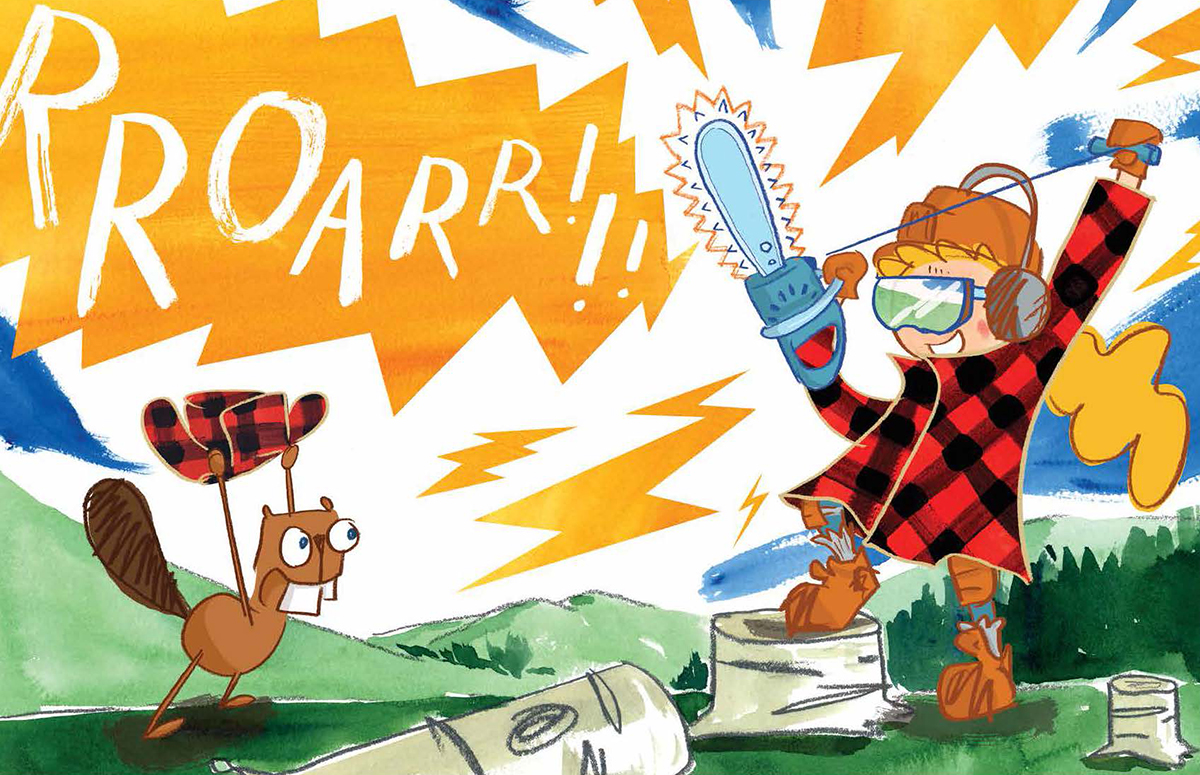
One of my many favorite illustrations is when Fred first sees Sophie.  It spans two pages.  On the left Fred is standing with his legs spread.  Both his arms are raised as he lifts his hat off his head.  His eyes look like they are ready to pop out of his head.  His mouth is wide open.  On the right Sophie has one boot on a stump with the other behind her for support.  Her plaid coat is closed.  She is wearing her gloves, ear muffs and protective goggles.  Her pony-tail is waving behind her.  In her right hand she holds the chainsaw as the left hand grips and pulls the power chord.  There is a gigantic roar.  Sophie is grinning in total joy.


Fred & the Lumberjack written and illustrated by Steven Weinberg is pure fun from beginning to end.  When you think about it, a beaver and a lumberjack have quite a bit in common with their adept and creative use of wood.  In this title, their tools are different but their love of plaid, blueprints and dreams coming true is the perfect foundation on which to construct a lasting friendship.  You will want copies of this on your professional and personal bookshelves.

To learn more about Steven Weinberg and his other work, please follow the link attached to his name to access his website.  To view interior illustrations please follow this link to the publisher's website.  I am absolutely thrilled that Steven agreed to answer some of my questions.  I know you will love his answers as much as I do.


Was there a single incident or a series of events which helped to form the story of Fred & the Lumberjack?  Are the characters based upon real life individuals?


A little over three years ago my wife Casey Scieszka and I moved from Brooklyn to the Catskills to open a boutique hotel and bar called the Spruceton Inn. So, I mean, that basically threw me deep into the woods, changed my life forever, and has delightfully inspired a whole new way of working. (The opening endpapers include a detailed map to my house.)


But specifically, the beaver in the story is my immediate neighbor across a field from my house. In the scope of time my wife and I have renovated our spot, this beaver has been just as busy. Den, pond, landscaping, etc. It’s really amazing living this close to nature. Keeping tabs on it reminded me of how much I loved to just build with blocks or legos as a kid. So I wanted to find a story about a beaver that BUILDS.


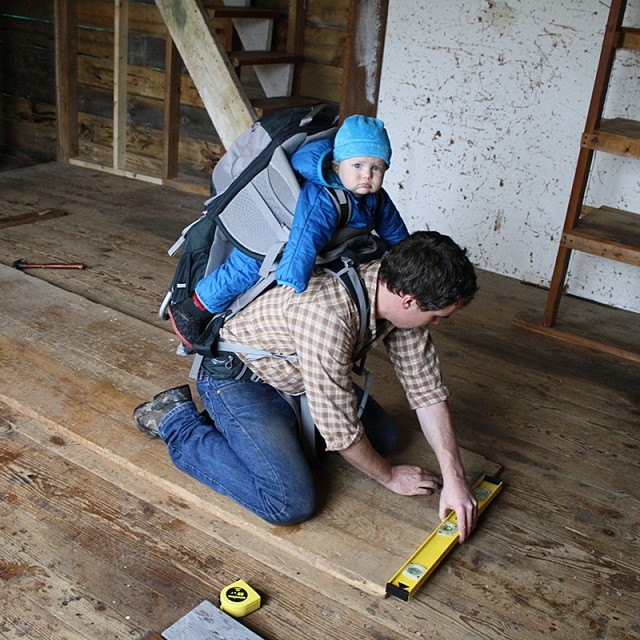
But that’s only half of it. The other half comes from our friends who have two little girls (now ages 4 and 3) who have been coming to visit since we moved. We’ve put them work! The elder Sophia especially. I’ve seen the girl play with a hammer nearly as much as her favorite stuffed owl. I mean here she is three years ago with her dad helping us with the early renovations:


Now I wish I could say one day I saw little Sophia pick up a chainsaw and was like EUREKA! But it’s probably more accurate to say she slowly built the character in my head in between grabbing piles of kindling and screaming in terror that she couldn’t have another s’more.


I read in another interview Steven you have been drawing, originally with crayons, for most of your life.  Do you have any formal art training?  If so, is there something special from one of your teachers (a favorite saying, technique or style) which still serves to inspire you?


I studied oil painting at Colby College in Maine under a professor who had me working harder (and taking art more seriously) than I had ever thought possible. She was a very intense disciple of the Josef Albers and Bauhaus color schools. Which, to maybe a non-art-nerd, means she had us painting color wheels, and color squares, and color fields, and NOTHING BUT COLOR!


It was infuriating at first, but now I realize it was an amazing education. Because everything starts with knowing how color works. So when I’m doing things like painting an insanely pink sunset I can still hear her whispering over my shoulder and asking questions like “have you really truly thought about that color choice?” And in my head I can tell her: “YES. The sunsets really are that crazy here!”


In this third title you have authored and illustrated you used a collage of watercolor, pencil and digital elements to create the images.  Is watercolor your favorite medium?  Why do you favor one medium (or not) over another?


I had been using watercolor for some elements in my work for years, but saw a show of John Singer Sargent’s watercolors at the Brooklyn Museum right before moving upstate. I’ve always been a huge fan of Sargent’s, but never got the time to really study those paintings. They’re so physical! So bold! So unpredictable! It made me take a fresh look at the medium. I haven’t really looked back since.


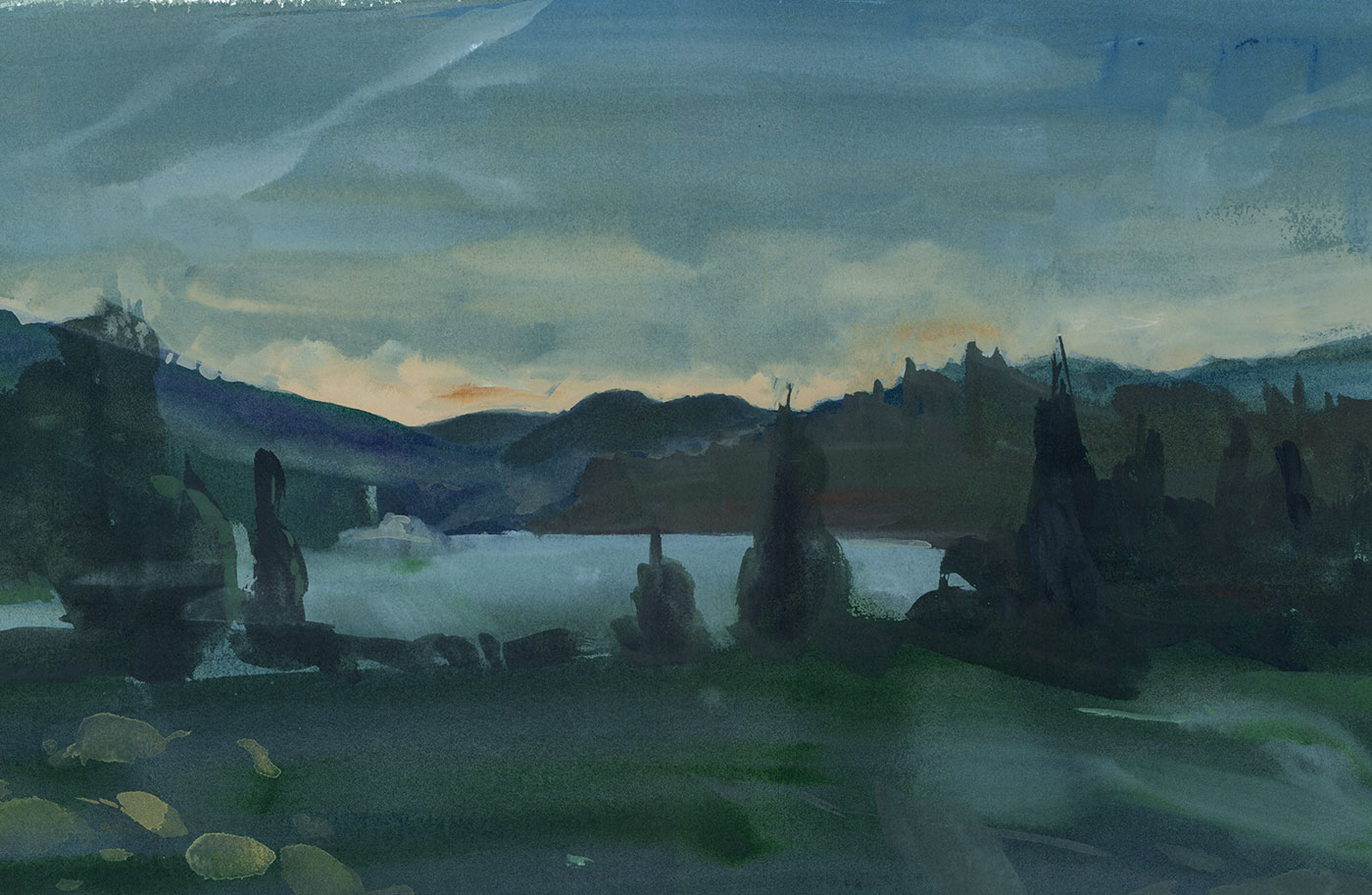
I’m basically painting watercolors landscapes constantly up here. This is a sunrise view of the mountains seen a lot in the book I painted thinking it could be an endpaper. But art’s funny. I love it, and it sits now above the bar at the Inn, but it seemed maybe too spooky for this story.


You, your wife and your dog Waldo live in the Catskills.  How is it you moved there from Brooklyn?  Did you always live in Brooklyn before moving upstate?  


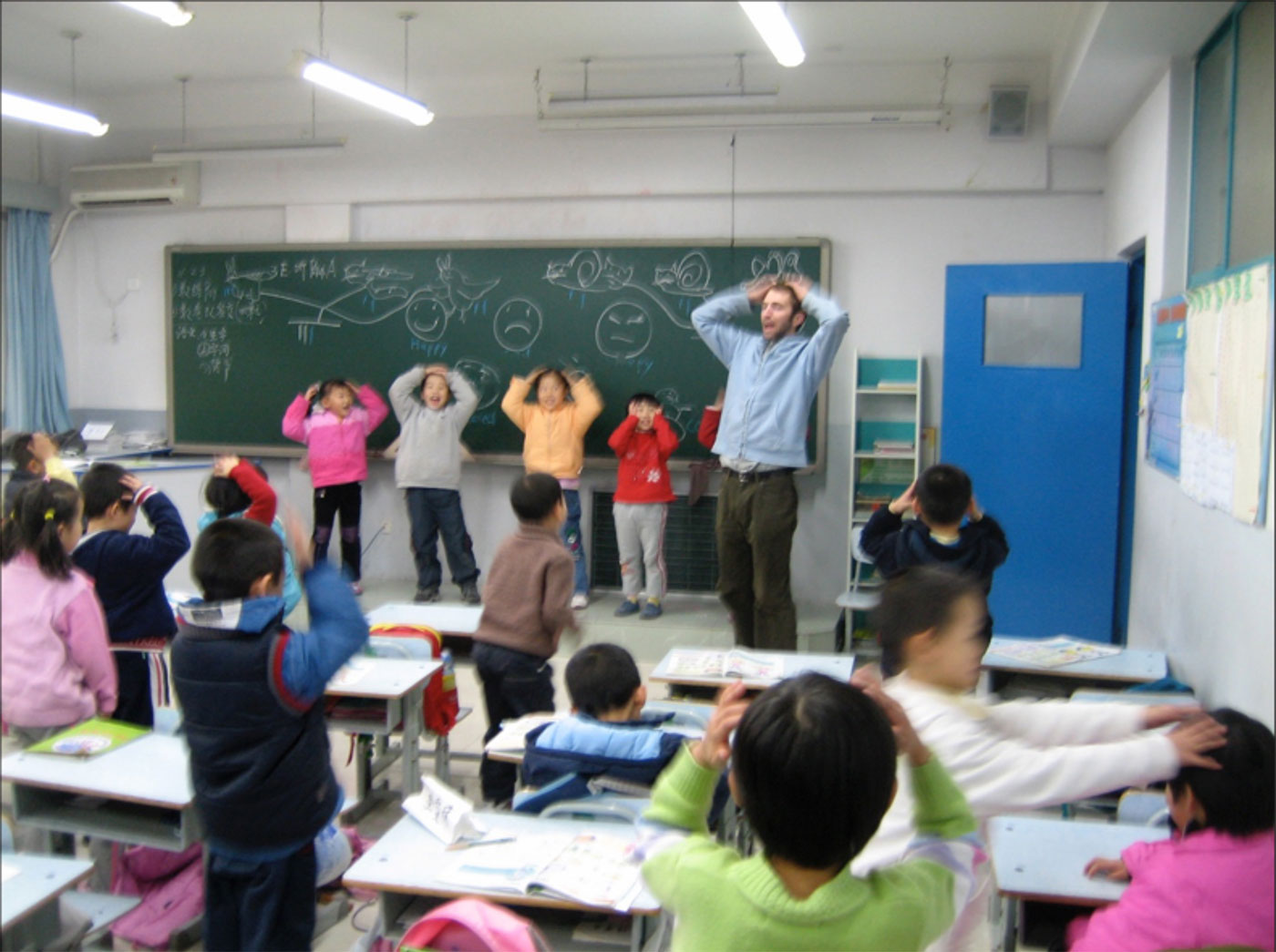
I’ve been quite a vagabond. I grew up in Bethesda, MD and after college in Maine my wife Casey and I lived all over the world: Beijing, Morocco, Timbuktu, then San Francisco for awhile. Living abroad was amazing for a ton of reasons, but probably most because when I taught English in China and Mali, I realized I wanted to make books for kids. Because no one is a crazy as kids. Especially 1st graders. Here’s a blurry photo of me singing Heads, Shoulders, Knees, and Toes with students in Beijing:


All that said, I’ve loved settling into the Catskills for LUMBERJACK. It’s where this book takes place and I can’t really describe how cool it is to see a sunset one night and paint it into your book the next morning.


I remembering reading your Mom is a youth librarian.  Do you have a favorite book she would read to you or another favorite childhood book?


Alexander and the Terrible, Horrible, No Good, Very Bad Day. Because I’m the younger brother and was basically Alexander all of the time. It just perfectly encapsulates the complete lack of agency kids have. So I felt for Alexander. And maybe with each reading I hoped the book would change and he would get to move to Australia where apparently nothing bad ever happens.


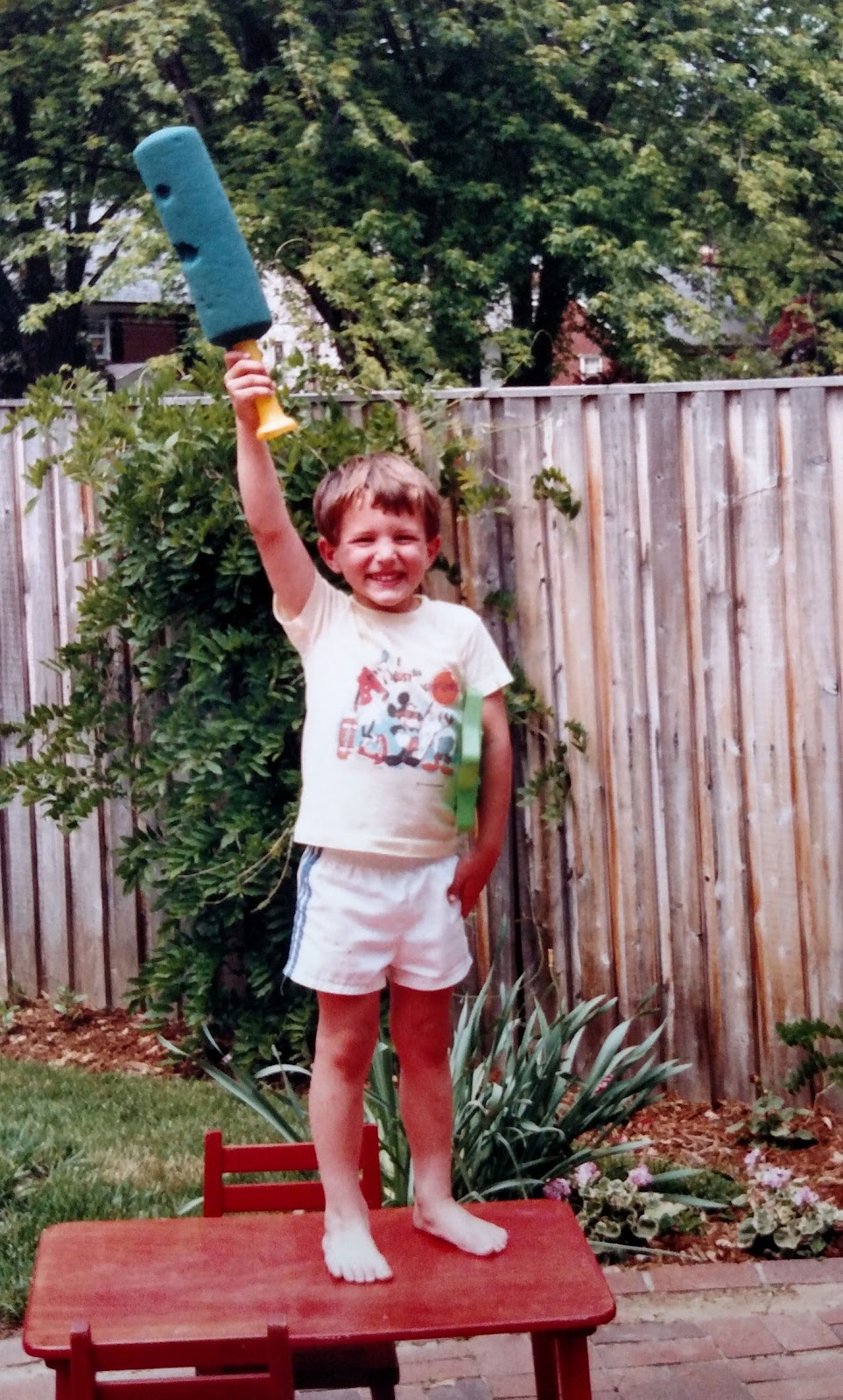
Now that I know I’ll be a dad soon (my wife is due at the end of August!!) it dawns on me how much of a terror I was. So maybe my mom just loved shoving Alexander back in my face to say: get with it! I mean, why was I standing on this table? In bare feet?


You post wonderful paintings of Waldo (dogs) on your Instagram account.  My canine companion Mulan is wondering if there are any plans in your future to write and illustrate a book featuring a dog?


Waldo is named after one of my other favorite characters growing up, the Waldo in the red and white striped shirt. This seemed like a great idea and homage, until we discovered he loves to run away. Yep, just classic. Here’s him where he seems most calm, in my studio:


So I really want to make a book called... “Where’s Waldo?”


But instead of having to find a dog or tall dude in some incredibly complicated jampacked scene, you’d see my Waldo at first running away from me. Then he’s just out in nature doing his thing, heeding the call of the wild, and having a total ball. On every spread the only words would be WHERE’S WALDO? I’d like to think it’d irritate kids just the right amount because they’d be like HE’S RIGHT THERE! Again, and again and again. I also imagine this book would really irritate Martin Hanford. But considering Hanford is one of my favorite kids’ book people ever, I’d be pretty honored to just have him mad at me at all.


If there is anything else you would like readers to know Steven?


Here’s some more images from the book!


AND I’m really excited about the case. It’s just plaid. So fun and simple.


And last last - here’s a new author photo my friend a photographer just took.
In case it wasn’t clear I was living deep in the woods...



Thank you so much for taking the time to answer my questions Steven and for including the images.  I simply can't wait for readers to enjoy your newest book.  I think we will be hearing more laughter. 

Friday, September 20, 2013

Paddle Cooperation

There are portions of the Jordan River in northern Michigan where it's easy to imagine you are drifting along a waterway in another time.  Civilization has left no mark.  Owning my own canoe, smaller than the average size, made trips here frequent and relaxing.

When going with a group in larger canoes, the journey takes on a whole new dimension.  With more than one canoeist in the boat, holding the paddle correctly, reading the water, weight distribution and teamwork, can make the difference between a fun-filled, smooth ride or an unexpected dip in the swiftly, moving, and often chilly, river.  Nicholas Oldland, author illustrator of Big Bear Hug, The Busy Beaver and Making The Moose Out Of Life, brings the friends, previously introduced to readers, together in a new title, Up The Creek (Kids Can Press, September 1, 2013).  It's definitely a canoe ride not soon to be forgotten, especially for this woodland threesome.

There was once a bear, a moose and a beaver who were the best of friends, though they often disagreed.

What they did agree upon was to spend time canoeing together.  The first problem makes an appearance when they all want to be in charge of navigation.  All the weight in the back of the boat makes it flip, dumping them into the water.  A game of Eeny-Meeny-Miny-Moe quickly ends that dilemma.

When the three adventurers are next seen the canoe is not going down the stream but in circles.  They all prefer to paddle on the left side of the canoe. Exhaustion and sore muscles solve this predicament; switching sides being the key.  A beaver dam provides an obstacle which almost stops the voyage until bear's suggestion, the third suggestion, works.

An enjoyable ride is short-lived when their raised voices, quibbling about every little thing (and beaver's hunger) covers the sound of their approach to the biggest difficulty yet, white-water rapids.  Tumbling, tossing, in and out of the swirling, dangerous descent into doom, the terrified trio finally manage to land on a rock with their canoe intact.  As darkness falls, they are still discussing, with less and less civility, how to get out of this mess.

In the light of a new day, a decision is made.  It's not easy by any means but they've discovered the secret to success.  Destination reached, a nap, a meal, a moment of thankfulness and yet another wise determination is reached, one sure to cause a knowing smile from readers.


As this tale of adventure and mishap unfolds, the narrator simply states the facts, sentence by sentence.  This writing technique used by Nicholas Oldland sets the stage for the added character dialogue and illustrations which elevate the comical nature of the whole ordeal.  Each time bear, moose and beaver face a decision, Oldland discloses more about their characteristics through the storyline.  Here is a single example.

But it wasn't long before they began to argue.
Moose: Stop Splashing
Bear: Keep Paddling
Beaver: I'm Hungry

It's the illustrations created in Photoshop by Nicholas Oldland that will bring on the giggles.  When looking at the matching jacket and cover, the trio facing forward in the moving canoe, it's all I can do to contain my laughter.  The expression on the beaver's face with those over-sized teeth is priceless.  What you can't see, without opening up the jacket and cover, is the continuation of the picture with a small red bird doing a backstroke down the river.  The small red bird appears throughout the book as a constant witness and participant in this canoe trip gone wrong. (He even has his own teeny, tiny paddle on the last page.)

The title page and verso show a winding waterway through a few forest trees on a white background.  The pictures alternate between double-page spreads, full single page, edge-to-edge visuals, smaller pictures with lots of white space on an individual page and several vignettes across two pages.  It's the details, the enhancement of the text, which adds mirth to the mayhem; moose covering his eyes, bear's paddle in the water and beaver yelling AHHHHHHH!  as they go over the falls or when they cook lunch over an open fire, moose holds grass, bear holds a fish he caught with a pole and line and beaver is roasting a stick.

My favorite illustration is when they first run the rapids.  The canoe upends three times in the air, with each holding on (or not) at different angles.  It ends with the bear sitting upright, paddle in paw with the canoe upside down, and moose and beaver riding the underside like a surfboard.


First and foremost, Up The Creek written and illustrated by Nicholas Oldland is a delightful day gone wrong solely due to the inability of the friends to cooperate.  Fortunately for them, this is resolved but not before readers have been treated to a first-class humorous escapade.  This is one of those books that would be loads of fun as a reader's theater with a minimum number of props or as a puppet show.

Follow this link to the publisher's website to take a peek at some more illustrations from the book.  For more information about Nicholas Oldland follow the link embedded in his name above to the publisher's website.

Monday, July 15, 2013

Bedtime Bedlam

Sleep is a tricky thing; evading you when you crave it, pouncing on you without mercy when you really want to stay awake.  There is nothing worse than tossing and turning for hours or waking up suddenly to find the lights on and an open book in your hand.  There are times when it seems as if inside and outside noises or a particular person are conspiring to make sure a good night's sleep is not in your future.

If you've ever shared a bedroom with a sibling growing up, then you are well aware of the problems they can cause when it comes to falling asleep. The chatter, giggles, snorts, noises with a distinct animal quality, not to mention talking in their sleep or snoring, will chase away any chance you have of sweet dreams.  Debut author Heather Long and her husband Ethan Long (Stick Dog, Up! Tall! and High! (but not necessarily in that order), Chamelia) have combined their talents and shared experiences to bring readers the hilarity of  Max & Milo Go to Sleep! (Aladdin, a imprint of Simon & Schuster Children's Publishing Division).

Good night, Max.
Good night, Milo.

What begins as a simple end-of-the-day salutation is the prelude to a series of laugh-out-loud conversational exchanges between the beaver brothers.  Milo is clearly exhausted, asleep on his feet.  Max is wide awake and ready to take on the world.

After about two seconds Max loudly proclaims to Milo his inability to sleep.  Being the kindly brother, Milo suggests he read a book.  After about six rejections Max finds a favorite title only to discover his bed lamp is not working.

The ever patient Milo advises Max to use a flashlight. This works so well peals of laughter echo around the room making it rather difficult for the non-reader to get his much needed rest.  Believe it or not the flashlight causes another problem for the energetic brother.

Milo always has a logical solution for each of Max's troubles which are many, following him like stick-tights.  If it's not one thing it's another until Milo looses his cool.  Frustration accomplishes what nothing else has; leaving another insomniac.


Given the upbeat, true-to-life verbal exchanges between the duo, Heather Long understands and knows the interplay of brotherly relationships, particularly those at bedtime.  The humor is generated between the annoying exuberance of Max, the drowsy, obvious common sense of Milo and the precise pacing. Readers feel as though they are actively "watching and listening" to the complete episode.


You know laughter is not far behind when you look at the matching jacket and cover of this title; superhero-costume, bouncing Max on the right with mostly asleep, droopy-eyed Milo on the left is a pictorial statement of comedic opposites.  On the back a polka-dotted yellow and red paper airplane loop-de-loops toward the front.  Nathan Long's digitally rendered illustrations continue the story on the title page and verso.  Looking at these two pictures leaves no doubt in readers' minds as to who is the night owl and who simply wants to call it a day.

Long makes it clear in his illustrations there are more differences between Max and Milo than shown at bedtime.  Milo's side of the room is as neat as the proverbial pin but Max's side is a touch more creative, open drawer, pieces of origami paper on his bedspread, books scattered on the floor and a lava lamp on his night stand.  The gizmo Max rigs up for holding the flashlight will fill readers with glee.

 The color palette shown on the cover is continued throughout the title in a variety of layout combinations, two page, one page, panels on a single page and a circle inset of Max exclaiming Good idea!  You can feel every emotion through the facial expressions.  With every turn of page it is hard to miss Milo's growing frustration.  Careful readers will notice extra details like a copy of The Legend of Sleepy Hollow next of Milo's bed.


As I mentioned earlier this weekend in conversation, when you are in a book store reading a book and you suddenly laugh out loud, that title will quickly have a place in your home and school library.  Max & Milo Go to Sleep! written by Heather Long with illustrations by Ethan Long is such a book.  I highly recommend it as a bedtime or storytime choice.  Get ready for the pleas of read it again.

Please follow the link embedded in Ethan Long's name to access his website.  By following this link you can see several illustrative spreads inside the book at the publisher website.