Quote of the Month

When love and skill work together, expect a miracle. John Ruskin


Showing posts with label Joyce Sidman. Show all posts

Thursday, July 15, 2021

Noticing Nature

We know each season has unique characteristics.  Some of those seasons are more favorable than others to us for those very reasons.  One thing about summer, though, is the abundance of everything.  Colors are more vibrant, contrasting with other hues.  There are more animals of every shape and size, birds, insects, mammals, large and small, amphibians, and reptiles.  There are more flowers and blossoms on those flowers.  There are all kinds of seeds being formed and dropped.  And the trees are resplendent in all their leafy glory.

We cannot get so caught up in the shimmering grandeur of the varied green treetops against a clear, startling blue sky that we miss the existence of smaller, more fragile members of the natural community.  Dear Treefrog (Houghton Mifflin Harcourt, May 25, 2021) written by Joyce Sidman with illustrations by Diana Sudyka explores the transformation in a girl's thinking as her attention focuses on a discovered friend.  Nature offers us lessons when we realign perspectives and time.

SUMMER

I See You
suddenly
among the tangled green
a tiny dollop of
frog
where before
there was only leaf . . .

Recently moved into a new home and neighborhood, the girl starts to watch the treefrog.  She mirrors its actions.  It stays in silence.  She does, too.  It climbs and moves with care.

The girl realizes in watching the treefrog, she is becoming more a part of the natural world instead of only an observer.  The treefrog offers security and steadfastness when the girl is feeling adrift.  She wonders about the treefrog's past and breathes a sigh of relief when it hides from rambunctious newcomers.

She worries about its safety before and after a storm.  She finds solace in other insect creatures when the treefrog cannot be found.  Autumn brings about changes for the treefrog and the child, colder weather and school.  There is one more surprise, a new friend for the girl.

The newly formed duo are kindred spirits.  They walk through the world in much the same manner.  They are more than willing to wait and watch through the seasonal shifts.  Oh, there you are . . . dearest treefrog.


In a series of poetic letters, Joyce Sidman reveals, through a first-person narrative, the contemplations and conclusions of our young protagonist.  We are privy to her thoughts about her circumstances and those of the treefrog.  Opposite each poem are one, two, three, or four sentences providing information about treefrogs in reference to something mentioned in the phrases.  Here are two passages.

Dear Treefrog
here
you are!

Against the window glass
we see more of you
     than ever

Your pale belly
and gummy toes
Your half-moon throat
that flutters
silently

Your breath
     so close
     to ours


Treefrogs often climb windows, and walls with their sticky
toe pads, looking for insects.  They hide in unexpected
places: on a hose, on top of a faucet, under a flowerpot.
You never know when you might run into a treefrog.


The images in this book, 

rendered in gouache watercolor on paper,

are resplendent when first seen on the open and matching dust jacket and book case.  The full-leafed, green shades of flora and striking bursts of yellow, orange, and pink supply a comforting environment for a lonely little girl and a treefrog friend.  The raindrops shown on both the front and the back help readers to understand the lushness of the scene spread, left to right, flap edge to flap edge.  A treefrog is nestled on a leaf on the front and the back.  A bee is ready to land on a pink flower on the back.

Illustrator Diana Sudyka in green on a white canvas has created a pleasing pattern on the opening and closing endpapers.  There are raindrops falling among flowers, leaves, ferns, stumps, branches, moss, treefrog eggs, dragonflies, tadpoles, beetles, butterflies, and mushrooms.  The raindrops are larger as we turn to the title page, now their blue adds to the brilliance of the green atmosphere around the leaf where the treefrog rests.

Another page turn brings us to the dedication and publication information pages.  Here Diana Sudyka begins her visual interpretation of the story.  The girl, holding her stuffie cat stands among the green flora and flowers.  Behind her a moving truck and mover bring things to her home on the right.  Snug on a leaf on the right is the treefrog.

All the illustrations, double-page pictures, offer us gorgeous visuals in varying perspectives of the girl and the treefrog.  Many times we move close to the treefrog in stunning scenes.   Other times we transition from one moment to another flawlessly.  Tiny labels appear in some of the pictures, denoting flowers, insects, birds, and frog information.  The wide eyes on the girl and her new human friend offer insights into their moods.

One of my many, many favorite illustrations is when the girl is shown as the same size as the treefrog.  There are fewer colors in this pictures, greens, blues, black, and white.  The girl and the treefrog are black, as if in silhouette.  She is holding a spyglass as the treefrog's first mate on the sailboat (leaf).  It is an eloquent portrait.


You are transported to a special perspective in Dear Treefrog written by Joyce Sidman with illustrations by Diana Sudyka.  It informs us about the connections between humans and other creatures and treefrogs.  This book reminds us of the importance of our natural world.  A final single page, More About Treefrogs and How to Welcome Them, answers four important questions.  This title belongs on your personal and professional bookshelves.

To learn more about Joyce Sidman and Diana Sudyka and their other work, please follow the link attached to their names to access their respective websites.  Joyce Sidman has accounts on Facebook, Instagram, and YouTube.  Diana Sudyka has accounts on Instagram and Twitter.  At The TeachingBooks Blog, Joyce Sidman talks about this book.


With all the blossoms blooming and warmer weather, day and night, butterflies and moths are frequent visitors to our backyards, neighborhoods, and surrounding meadows and woodlands.  Of the two, moths seem to be more patient with human observation.  In Moth & Butterfly: Ta-Da! (Nancy Paulsen Books, an imprint of Penguin Random House LLC, June 8, 2021) written by Dev Petty with illustrations by Ana Aranda, readers get an up-close-and-personal view of the two.  Differences and similarities are explored with wit and truth.  We witness seemingly miraculous changes.  Are you ready?

In a corner of the lush, green garden,
two caterpillars share a leaf.

They share other things, too.  They both have multiple legs and loads of spots.  Their appetites for leaves are voracious.  They are about to experience a natural phenomenon, metamorphosis.

Both are being wrapped in a new material.  This enclosure is hiding a complete change.  Weeks pass and then . . .

POP!

The caterpillars are now a moth and a butterfly.  They still enjoy familiar activities, but one does them more often in daylight and the other does them more often at night.  Physical differences have developed.  They both have wings, less legs, and antennae, but they move specific to their needs.

The duo is destined to be companions celebrating each other.  One day, they notice another caterpillar twosome.  They greet them as only those in-the-know can do.


With carefully chose words, Dev Petty fashions a friendship story filled with facts.  Her spare text and upbeat dialogue will have readers turning the pages as fast as the caterpillars gobble up leaves.  The beginning of the story is tied to the conclusion with two key words, cementing the shared affection between moth and butterfly.  Here is a passage.

And look!  Both are champions
at chewing leaves into funny shapes.

AMAZING!

TA-DA!

OOPS!


Looking at the open dust jacket, readers know they are in for a treat.  The color choices and the layout and design focus on the differences and the similarities.  Moth stands out in the night, his hues coordinating against the evening tones and the moon.  Butterfly glows in the sunny daylight, brilliantly colored.  Even though they prefer opposite parts of a twenty-four-hour period, they are still high fiving each other and cheering.  

To the left, on the back, the night sky is on the top and the sunny day is on the bottom.  Flying beneath the moon and standing on a fern, Moth chats with Butterfly resting in the opposite corner.  Both insects and celestial bodies are smiling.

On the open book case, left to right, a loop of yellow begins in the upper, left-hand corner enlarging as it moves to the lower right side.  Beneath it, a larger canvas of dusky blue begins on the left and decreases in size as it moves to the right.  On the left side, Moth and Butterfly hover over a large pink flower sipping nectar.  On the right side, the duo is munching on a shared leaf as caterpillars.  Leaves, ferns, and flowers add to the joy of these shared moments.

On the opening endpapers, in a luminous blue and green, butterfly as a caterpillar is featured on the left.  Another flying insect passes Butterfly among numerous leaves.  On the right side, colors reversed (blue on green), Moth happily frolics among an equal number of leaves. A ladybug stops to chat.  On the closing endpapers a bright yellow highlights Butterfly in blue.  The same flying insect zooms from right to left across the gutter.  On the left, Moth in yellow enjoys the night, mingling among leaves and flowers, and an old shoe.

The artwork of Ana Aranda rendered

in watercolor, inks, gouache, and lime on watercolor paper

is in a word---joy.  Beginning on the title page, we are introduced to Moth and Butterfly as their silhouette forms fly above a planter (yellow-painted bathtub) filled with flowers and leaves.  With a page turn, we are taken outside to an expansive garden setting, the bathtub sitting among other flowers, plants, and a fountain in front of a cheerfully painted home.  As caterpillars, Moth and Butterfly, in yellow, are on large leaves.

Each double-page picture, single-page image with large white frames, and single-page pictures, edge to edge, are bursting with color and animation.  Whether we are shown a more panoramic view or a close-up, we are aware of the informative details Ana Aranda includes.  We notice the antennae.  We notice the time of day and passing of weeks. We notice the complete happiness of Moth and Butterfly within their garden home.

One of my many, many favorite pictures is a double-page picture.  The duo has completed metamorphosis.  They are flying above the garden.  They are enthusiastically remarking on their wing colors.  They and their observations are framed by the grass and flowers below them.  Several bees watch the twosome.  


This book, Moth & Butterfly: Ta-Da! written by Dev Petty with illustrations by Ana Aranda, is filled with fun and facts.  This book is about friendship, new beginnings, things which are the same and those that are not.  It asks us to notice the little things.  It asks us to look for things in common while respecting distinctness.  And it invites us to look for more information. At the close of the book a last page, Is it a moth or a butterfly?, supplies readers with more facts. For its upbeat presentation and as a springboard for further discussions, you'll want a copy in both your personal and professional collections.

To learn more about Dev Petty and Ana Aranda and their other work, please access their websites by following the link attached to their names.  Dev Petty has accounts on Facebook, Instagram, and Twitter.  Ana Aranda has accounts on Facebook, Instagram, and Twitter. At the publisher's website you can view the title page.  This book is showcased by John Schumacher, author, lecturer, and teacher librarian, on his site, Watch. Connect. Read.  You will enjoy his chat with Dev Petty.  This book and illustrator Ana Aranda are featured at Let's Talk Picture Books by Mel Schuit.  You'll love Dev Petty's post at the Nerdy Book Club about change and this title.  Here is a link to a virtual chat about this book hosted by Parnassus Books.  


Tuesday, April 20, 2021

Earth Week 2021 #1

While those who champion for our planet's preservation, our preservation, are grateful for the establishment of Earth Day in 1970, there is still much to be done.  Time is literally running out.  It is more important than ever; each day should be dedicated to our Earth.  

One book at a time, change happens.  Words are powerful, reader to reader. Hello, Earth!: Poems To Our Planet (Eerdmans Books For Young Readers, February 9, 2021) written by Joyce Sidman with illustrations by Miren Asiain Lora is a conversation through a collection of twenty-two poems between human voices and this big beautiful Blue Planet.  Listen.

HELLO, EARTH!
It's your children.
Some of your children---
the human ones.
We have been studying you, Earth,
but we long to learn more.  . . .

So begins the first poem.  It's a greeting and a request.  It respectfully concludes with the first of many questions and comments.  There is a large curiosity including many topics needing to be satisfied in this narrative.  How is it that we and Earth spin among the stars together?  It is perplexing to comprehend Earth's size when there are things on this planet so large, we are tiny next to them.

Compared to us, Earth is ancient.  Nevertheless, she is still changing.  Volcanoes and earthquakes signal her shifts.  We hope Earth enjoys the benefits of both the sun and moon.

We acknowledge Earth's ingenuity in giving us clean air through the bounty of plants.  We are astounded by her places of bitter cold and ice and intense heat, wind, and sand.  High tides and low tides tug at her watery masses.  We recognize the vast expanses of water on this place and the life that dwells there; all of it marvelous regardless of its size or shape or abilities.  Knowing what we know about these watery realms, no wonder we continue to explore.  

An apology is given for the constant chaotic commotion humans supply to this planet.  It is known Earth communicates with us other than through words.  Her weather speaks volumes, sometimes loudly and other times in a whisper.  It is humbling.  Even though we do not always show it, we dwell on Earth, our precious planet, with grateful hearts.  


With each reading of the poems in this book, you cannot help but be moved by their sincerity and veracity.  Many different aspects of the planet are covered in the praises penned by Joyce Sidman.  The poems are connected, like us, flowing from one to the other.  They also, like us, can stand alone distinctly.  Here is another partial poem, its beginning and its ending.

SUNLIGHT, MOONLIGHT
What is it like
to spin

and feel the sun
warm all your
beautiful places,
          one by one? . . .


One so close,
a silver sister.

One so far,
a burning star.


The dark endless space covers both the front and back of the open book case.   It is peppered with dots of starlight.  To the left, on the back, is the entire first poem.  The full moon supplies a point for placing the title text.  The swirl of currents and clouds reinforces the constant motion of our planet.  Notice the different animals and people and their activities.

On the opening and closing endpapers is a camel shade.  It is the background for a multitude of tiny blue birds.  It gives the appearance of an endless migration.

Another view of the entire planet is beneath the text on the title page.  A single engine plane flies above it.  A schooner sails below it.

Each double-page picture rendered by Miren Asiain Lora, like the poems, is fascinating and unique.  You need to pause at each one to study the elements and the people.  The intricate details are amazing.  The perspectives in these images are designed to depict the magnificence of Earth and its immense size.

One of my many favorite pictures is for the poem, SUNLIGHT, MOONLIGHT.  It expertly conveys the feeling one gets when standing alone or nearly alone outside on a full moon night.  Most of the two pages are the night sky speckled with a few stars.  Along the bottom of both pages are evergreens.  On the left is a mountain peak, glowing in the moonlight.  Another mountain begins to the left of the gutter and rises on the right in shadow.  At the top of this peak is a single person garbed in clothing for a bit of a chill in the air.  Their left arm is reaching and touching one edge of the glowing full moon.  How many times have you seen a full moon, believing it was so close you could touch it?


This book, Hello, Earth!: Poems To Our Planet written by Joyce Sidman with artwork by Miren Asiain Lora is stunning.  At the close of the book is extensive back matter, More About How The Earth Works (Earth's Age, Earth's Size, Earth's History, Earth's Layers, Plate Tectonics, Continental Drift, Rotation and Orbit, Powerhouse Plants, Altitude, Ecosystems, Gravity, Oceans, Water Cycles And Currents, Human Impact, Messages From The Earth, New Species, and Living With The Earth), and To Find Out More, Explore The Resources Below (Understanding Climate Change, Ways Kids Can Help, Citizen Science Projects and For Further Reading).  I can't imagine a collection, personal or professional, without a copy of this book.

To learn more about Joyce Sidman and Miren Asiain Lora, please access their respective websites by following the link attached to their names.  Be sure to check out the additional resources linked at Joyce Sidman's website for this book.  Joyce Sidman has accounts on Facebook and Instagram.  Miren Asiain Lora has accounts on Facebook and Instagram.  You can get a peek at some interior images at the blog for Eerdmans Books For Young Readers.


It is a fact that our sea ice and polar glaciers are melting faster than is safe for our planet.  Most of our glaciers are in Antarctica (90%) and Greenland (10%). 


A clever portrayal on the change our glaciers experience is presented in Blue Floats Away (Abrams Books for Young Readers, March 23, 2021) with words by Travis Jonker and pictures by Grant Snider.  As if we are side-by-side with Blue, we navigate the unknown.  We learn about the transformative power of being different.

Little Blue lived near the North Pole with his parents.

They were close. 

You could say they were three peas in the proverbial pod until suddenly with a resounding loud noise, Blue broke apart from his parents.  He was floating away from everything and everyone he knew.  He reassured his mom and dad he would return soon.  Would he?

In short order, Blue could not see his parents.  He could see nothing but sky, sea, and snow, lots of snow.  He was alone for a long time, until he wasn't.  He saw something new and something beautiful.  These two somethings became Blue's best buddies.

From these two companions Blue learned how he might return home.  Wind and ocean currents controlled a lot.  Another thing, an unexpected thing, altered all of Blue's ideas.  It was getting warmer and warmer and warmer.  Blue vanished.  Did he?

Through a continuing and constant process, Blue rose above the water.  He was floating away in the sky.  Again, Blue saw two things.  They taught Blue.  Blue was headed home.  Four fascinating friends stuck with Blue as he grew larger and larger as it got colder and colder.  There were his parents!  And Blue . . . well, Blue was developing into something else again. 


It takes a special kind of author to create affection for an iceberg in readers, but Travis Jonker does it with considerable skill.  And if you don't burst out laughing after reading those first two sentences, you might want to check for a pulse.  With spare text infused with humor and informative insight, we willingly embark with Blue.  Travis ties the two portions of Blue's travels together with repetitive phrases, inviting reader participation.  (I said them aloud the second time.  I woke up my dog.)  Here are three consecutive sentences.

Blue learned things
from his new friends.

About the directions:
East, West, South . . .
and North.
Blue set a course for home. 


One of the first things you notice when you open the dust jacket is the different hues of blue for the water and the shades used for the sky.  On the left, including the spine the water is dark turquoise or teal or a combination of the two and the sky is a vibrant dark pink.  White birds soar in that pink sky.  Shark fins cruise in the water.  On the right the sky is pale orange with paler orange clouds.  The water is ocean blue.  The rock on which the lighthouse sits extends over the spine to the back.  The bold color palette here is used throughout the book, attracting readers of all ages.

On the open book case a deeper royal blue is given to the water which fills nearly all the space.  At the top of the page, for the sky, is a muted steel blue.  Separating the water and sky is a white wavy line.  Blue's parents are placed in the upper, left-hand corner.  Blue moves slowly away in the lower, right-hand corner.

Bright purple covers the opening and closing endpapers.  On the title page, Blue's portrait is in a circle with blue water and orange sky.  This picture is above the text.

These remarkable illustrations by Grant Snider 

made with cut paper, colored pencil, and white ink

are brilliant in their simplicity and characteristics.  (You want to reach out and touch them.)  They take the idea of less-is-more and turn it into an art form.  The facial features on Blue's parents and on Blue, three dots or marks, display a range of emotions.

The color compositions, blues with orange, blues with blue, blues with red, blues with orange and red and bold golden yellow with crisp white are fabulous.  A huge clue is given to careful readers with the unexpected use of green.  The appearance of Blue's new form will have readers smiling.  Most of the illustrations span two pages with the exception of Blue's two major alterations.  Here Grant Snider uses four vertical panels across two pages.

One of my many favorite visuals is after Blue has learned several things from his first two new friends.  Most of the double-page picture is water, a deep dark royal blue.  Above the jagged edge of the wavy water is a peach sky.  On the left, the black rock juts into the water.  From the lighthouse, a golden yellow beam enlarges as it moves off the right side.  Blue floats on the right, a slight smile filled with hope on his face.  His two friends, a sailboat and shark, are on either side and in front of him.  White lines signify wind and currents.


As a read aloud, Blue Floats Away with words by Travis Jonker and pictures by Grant Snider is perfect.  Readers and listeners will be loving Blue so much, they won't realize they are learning about the water cycle.  They will also come to understand change is life and change does not mean gone.  At the close of the book to the left of the Author's Note are four pictures with arrows explaining the water cycle courtesy of Blue.  Travis clarifies the water cycle, polar ice troubles, climate change, and what simple things we can do to help.  Each personal and professional collection needs a copy of this book.

To discover more about Travis Jonker and Grant Snider and their other work, please follow the link attached to their names to access their websites.  Travis Jonker has accounts on Facebook, Instagram, and Twitter.  Grant Snider has accounts on Facebook, Instagram, Tumblr, and Twitter.  At the publisher's website you can view interior images.  On his blog, 100 Scope Notes, School Library Journal, Travis reveals the cover.  Here he interviews Grant Snider about his illustrative process for this book, including different cover ideas.  At The Yarn, School Library Journal, Travis talks about how this book, his second book, came into being.

If you are interested in a bit more information about sea ice, glaciers, and icebergs check out articles/information at the World Wildlife Fund, the National Snow & Ice Data Center and The Washington Post.

Tuesday, March 7, 2017

Senses And Spheres

When you hold a fresh picked cherry or apple in your hands, the silky surface of their skin is a prelude to perfection, a sweet first bite into taste grown by months of sun and rain.  In picking up the hard blue ball, a new addition to my puppy's toys, the rough outer cover shows signs of hours of play, bonding over throw and fetch.  A handful of marbles is more than a handful of marbles.  It represents weeks of recesses on the school playground spent in endless games with lines and circles drawn in the dirt and small holes as evidence of classic wins and losses.  Round is not simply a shape, it's memories too numerous to count.

When you begin to focus your gaze literally and mentally on a specific element, you start to see it everywhere.  Round (Houghton Mifflin Harcourt, March 7, 2017) written by Joyce Sidman with illustrations by Taeeun Yoo draws our attention to this very real phenomenon.  If you stop where you are right this minute and look around you, how much round is there?

I love round things.

There are curves to enjoy in round things.  Hold one in your hand.  How does it make you feel?  From round things other things, some round and some not, grow.

Some round things start out small but get bigger and bigger and bigger.  We can watch them bloom, taste them or smell them.  If we live for hundreds of years, we can see shapes not round at all, worn to roundness.

We all know the miracle of something round moving.  It puts squares, rectangles and triangles to shame.  Can you think of places where something round is hidden from view?  Can you think of round things with surprises hidden inside?

When you throw a pebble in a pond, round spreads out.  When you stop to think about it, sometimes the presence of round is fleeting or lasts longer than we can imagine.  Wherever you go, at any hour, round is there.  Sense it.  Remember it.


The four words we read written by Joyce Sidman in the first sentence are also used to close this title, giving us a circle story about the shape round.  She makes this narrative personal by using words like I and my.  Each remark is based upon sensory perceptions of those things noticed in nature.  She broadens her focus by including motion and mathematics.  She makes the shape comforting in her final poetic descriptions.  Here is a sample passage.

I love how water can be round,
gathered in beads of silver...
or falling in wet splats,
leaving circles of ripples behind.


Opening the matching dust jacket and book case you can feel the round reaching out to envelope you.  The large glowing yellow moon contrasting with the blues and blacks of night spreads off the page as do the crystal clear blown bubbles against the circular sunset sky to the left on the back.  The father, little girl, dog and duck found on the front are a part of nearly all the images.  The bright sky blue from the front becomes the color for the opening and closing endpapers.

Rendered in

mixed media with printed texture

the illustrations heighten the text and exalt the shape round.  Let's look at the first picture as an example.  The girl is bending over to pick up an orange.  She is outside beneath a bright sun.  The hat on her head is round.  She is wearing overalls with polka-dots, white on green.  On her pink boots are circular flowers.

Taeeun Yoo seamlessly shifts her points of view bringing us close to the objects or giving us a more expanded scene.  She has us standing back to watch the girl drop seeds in a hole with the duck watching but on the next page we move in closer as the girl and her dog quietly watch through parted grasses as a turtle walks away from a hole where eggs have been laid.  Her image sizes change from single page to double page depending on the text.  All are edge to edge.  To add interest Taeeun places the characters in different seasons.

One of my favorite of many illustrations spans two pages.  Across the top we see, on the left, the bare feet of the girl among plants.  To the right her dog is looking very closely at the objects of attention.  Along the bottom four balls of dung are being rolled from left to right by beetles.  This illustrates the remarkable characteristics of round and our ability to find it everywhere.


This poetic approach to a shape will have readers of all ages looking at the world around them with a different set of senses.  Round written by Joyce Sidman with illustrations by Taeeun Yoo is a tribute and an invitation.  Two pages at the conclusion expand with more detail on round is...cozy, sturdy, spreads out, rolls, is balanced and is beautiful.  I know you all will want this wonderful book in your professional and personal collections.  You could pair it with The Wing On A Flea by Ed Emberley, Color Zoo and Color Farm by Lois Ehlert, or Perfect Square and My Heart Is Like A Zoo by Michael Hall.  I am already thinking of starting a Pinterest board on shape books or linking to previously created ones here.

To discover more about Joyce Sidman and Taeeun Yoo and their work please follow the links attached to their names to access their respective web sites.  They both maintain blogs here and here.  At this publisher's site you can view interior images.

Thursday, October 20, 2016

Sending Out Hope

You are ready with all appropriate preparations completed.  Taking no chances you decide to wear your lucky jewelry, favorite underwear, shoes, socks, pants and sweater all day.   You have placed logic aside letting superstitions rule the day.  That night you wait for the first star and make a wish.  You put on your pajamas inside out and backward.  You slip a spoon under your pillow.  As you try to fall asleep you sincerely desire, for the eleventy-hundredth time, the skills of Dumbledore.

We attribute this routine to children alone but you might be surprised by the number of adults longing for the very same thing who would consider, or have done, one or more of these particular actions.  Before Morning (Houghton Mifflin Harcourt, October 4, 2016) written by Joyce Sidman with illustrations by Beth Krommes is a plea.  It's a petition for one very special something.

In the deep woolen dark, ...

The day is done and a city and its people are sleeping.  As they dream, Mother Nature works her own kind of marvels with clouds and wind.  The swirling leaves are being replaced with others, no two alike.

As softly as milkweed pods releasing seeds, it falls.  It covers and coats and comforts.  To the touch it's like the fur on a lamb, duckling, kitten or puppy.

Quiet descends.  Everything stops.  It's morning.


Four eloquent lines in a single poem read like a prayer when the writer is Joyce Sidman.  Taken as a whole it flows as we wait for the word which rhymes at the end of each line.  In the first three phrases a gentle cadence is supplied with the use of commas, dividing each one into thirds.  We wait in anticipation for the final sentence, hoping.  In this one the use of other punctuation mirrors the requested results.  It's not written but there will be an audible sigh from readers.


Appealing to all our senses the matching dust jacket and book case create warmth where it is cold, quiet within noise, brightness over dullness, and new and clean in place of old and used.  On the front they tell us of a sleeping child nestled in coziness cuddled by their cat.  We might wonder about the globe, Amelia Earhart book and toy airplane on the floor.  To the left, on the back, is a scene from the city as horses draw carriages through a park with drivers and passengers bundled against the chilly night air as in the distance travelers await transportation.

On the opening endpapers more than two-thirds are covered in dark, gray clouds threatening a change in the weather.  They hang over the expanse of a large city and the surrounding tree-covered hillsides. On the closing endpapers the scene is similar but with a significant difference.   With a page turn at the beginning illustrator Beth Krommes expands the visual story with her signature scratchboard and watercolors images. On the left, the verso, pigeons are gathered on cobblestones.  On the right, the title page, the feet and legs of an adult and child are shown as they walk a dog.  The dedication page is a two-page picture of people, the adult, child and dog included, sitting, walking and leaving a park. Before them is a street filled with cars, a bicycle, a scooter and a bus with all their lights shining. People on the opposite side of the street stroll, window shopping.

Four single page visuals follow framed in white borders.  This is Krommes leading us into the interpretation of Sidman's words.  The child pauses in front of a bakery window, the trio climbs steps into an apartment building, a father has prepared dinner and a mother dressed as an airplane pilot sits on the bed of a child who does not want her to go.  For the words quoted above the scene is early in the morning, the father and daughter are asleep.  The cat, dog and pilot are awake; she is folding laundry on the kitchen table.

For those pages with Joyce Sidman's words we are given double-page illustrations.  On the wordless pages, seven in total, they are single images on one page.  The experience of viewing illustrations created using this artistic technique is astounding.  Krommes includes the tiniest details enhancing what is taking place in the moment inside the apartment, on the streets of the city, within the park, at the airport and over the entire area.  You are invited to pause at each picture.  This is in keeping with the peaceful pace of the poem.  You will notice the dog barking at squirrels in the park, a single snowflake falling as they enter the building, a pie cooling on the kitchen counter, the street sign indicating airport ahead, a book of poems in the living room and a key on the table as the pilot returns home to embrace the child.  

One of my favorite pictures (They're all my favorite pictures.) is looking inside the apartment windows in the evening as the pilot leaves for the airport.  On the left the child is in bed in a scene nearly identical to the front of the jacket and case.  To the right we peer into the living room.  The father has fallen asleep wearing his glasses with the newspaper draped across his body and a mug on the nearby table.  The dog is curled up on the couch.  Snowflakes are starting to fall more frequently outside the windows. Pigeon feet and a very slight portion of their lower bodies are shown above the left window.  This gives us an idea of perspective.


This collaborative team, poet and author Joyce Sidman and illustrator Beth Krommes, have given us another treasure in Before Morning.  As Joyce Sidman talks to us in her author's note, this is indeed about wishes and invocations. On the opposite page Krommes illustrates it appropriately with two kinds of angels.  It does not get better than this.  To date this title has received five starred reviews in School Library Journal, Booklist, The Horn Book, Kirkus and Publishers Weekly.

To learn more about author and poet Joyce Sidman and illustrator Beth Krommes and their other work please visit their websites by following the links attached to their names.  You might be interested in reading Five questions for Joyce Sidman at The Horn Book.  Jama Rattigan features Joyce Sidman in her hotTeas of Children's Poetry: Joyce Sidman at Jama's Alphabet Soup.  Beth Krommes is highlighted at artistsnetwork.  Beth Krommes is highlighted by author, reviewer, and blogger Julie Danielson at Seven Impossible Things Before Breakfast.  Process art is shared.

I wrote about their other work Swirl by Swirl: Spirals in Nature here.

Monday, November 24, 2014

Solstice Sleep, Solstice Sights

The winter solstice signals the shortest day and the longest night of the year in the Northern Hemisphere.  Bare branches wave in the winds.  Only the cawing of crows, the honking of migrating geese or chirping of chickadees breaks the silence.  The snow reveals those beings still awake; footprints betraying their nocturnal travels.

Mother Nature demands this rest, this sleep of renewal.  Winter Bees & Other Poems of the Cold (Houghton Mifflin Harcourt, November 4, 2014) written by Joyce Sidman with illustrations by Rick Allen recreates this natural interlude in all it's fascinating elegance.  We listen. We read. We marvel. And we grow in understanding.

Dusk fell
and the cold came creeping,
came prickling into our hearts.

This is the first sentence in the first poem of twelve titled Dream Of The Tundra Swan; transporting us into the residents' realm.  Not only can we claim a clear vision of white wings shaking off gathered flakes of ivory but to know these creatures soar up to 5,000 feet in the air is astounding.

Readers may shiver not from cold but from the thought of thousands of garter snakes gathering to slumber together in the same spot year after year.  Water drops drop from clouds gathering vapor on formed crystals moving without direction, each one different, and each one adding to the growing crowd to layer the ground with snow.  A moose moves with its mother from one spring season to the next weathering winter depths on tall thin legs built for its bulk.

Did you know busy honey makers huddle around their queen, a living buzzing ball?  Beavers hide beneath the ice all winter never seeing the light of day unless it dimly shines through the walls of their mound of sticks and chips.  Ravens and wolves work together in the air and on land, not in complete harmony, to find food.

If voles are fortunate snows will fall deep enough so tunnels can offer protection and passage.  Clever predators are always ready to listen, dig and capture them. Those sentinels, standing silent except for the creaking and cracking on bitter windy days, those trees survive through the ages.

Chickadees cheerfully maneuver from point to point seeking food until the shift in seasons.  Tiny arthropods gather by the thousands as winter weakens and those early floral harbingers send out their skunky scent.  A change is coming.


Poetic master, Joyce Sidman, creates amazingly realistic images with her words. Reading her poetry is an experience for our senses bringing us into the essence of her subject.  Free verse, rhyming patterns, repetition, and two voices speaking surround us with their pulse, Nature's heartbeat in rhythm to our own. Here are two examples from this title.

In the fat white wigwam
made of ripped chips and thrashing twigs
is a heart of fur, curled and cozy,
far beneath the winter sunshine.
(Under Ice; a pantoum)

From dawn to dusk in darkling air
we glean and gulp and pluck and snare,
then find a roost that's snug and tight
to brave the long and frozen night.
(Chickadee's Song)

To the left of each poem are short informative paragraphs offering intriguing details about each subject.  They are the types of facts which get to the heart of each.  They are the types of facts which will garner even more appreciation for each animal, snowflakes, first flowers and trees.


Unfolding the matching dust jacket and book case, readers are greeted by the first of fifteen illustrations spanning across two pages.  With a color palette as icy as the temperature except for the warmth of the featured beings, we are moved to the woodland as surely as if we walked through a door.  Many parts of this world sleep and slow but others are as animated as the foxes moving over the snow.  A steely blue-gray covers both the opening and closing endpapers.  After the turn of the title page highlighting a moose deep in the snow facing readers, a tree branch spans from left to right, final clinging autumn leaves falling, shifting to bare twigs and huge snowflakes drifting downward.  At the book's close the branch is there again.  Snowflakes leave to reveal new buds.

Rick Allen rendered these artistic pieces as stated in this portion taken from the verso.

The individual elements of each picture (the animals, trees, snowflakes, etc.) were cut, inked, and printed from linoleum blocks (nearly two hundred of them), and then hand-colored.  Those prints were then digitally scanned, composed, and layered to create the illustrations for the poems.  

You want to pause at each visual to gaze in wonder at the details, the movement, the background and the texture.  You can hear wings being lifted in flight, the soft fall of snowflakes and crunching and tearing of moose teeth on willow.  Every scene is a study in the marvels of animal and plant adaptation shown in varied perspectives.  In every double-page image but three the fox can be seen.

Several of my favorite illustrations are of the moose and its mother foraging and resting together to sleep. The shades of color in the background are a striking contrast to the warm browns of their fur.  The beavers moving beneath the ice, gathering sticks, swimming and curling up inside their lodge is fantastically portrayed; the shadows of being near the bottom of the stream against the clarity of the room.  Having walked the woods for many years in the early spring to see the first flower, skunk cabbage, I know this close-up view is perfect.  The reflection of the fox drinking in the pool of water is stunning.


Winter Bees & Other Poems of the Cold written by Joyce Sidman with illustrations by Rick Allen is a beautifully conceived and executed work.  The poetry literally sings off the pages, elevated by breathtaking art.  This title would be a welcome addition to a personal or professional collection.  Reading it aloud is mesmerizing.  A single page glossary is included on the final page.

To learn more about Joyce Sidman and Rick Allen please follow the links embedded in their names to visit their personal websites.  Joyce Sidman has several extra items for her titles including videos.  Here is a link to an educator's guide for this book.  Author and blogger at Seven Impossible Things Before Breakfast, Julie Danielson, interviewed Rick Allen recently.  The questions and his answers along with the pictures and artwork are wonderful.

Friday, January 20, 2012

It's All Around Us

In a discussion with a class of fourth grade students last week during our Mock Caldecott election process, I pointed out that if we have eyes to see, shapes are to be found everywhere in the world around us.  We need to be more aware; excellence, as they say, is in the details and a shift in perspective.

The collaborative talents of Newbery Award winning author Joyce Sidman and Caldecott Award winning illustrator Beth Krommes, previously exhibited in Butterfly Eyes and Other Secrets of the Meadow, have delivered another title, Swirl by Swirl:  Spirals in Nature (Houghton Mifflin Books for Children, October 4, 2011) that holds up for our pleasurable examination the mysteries and miracles of design in nature.


A spiral is a snuggling shape. 
It fits neatly
in small places.
Coiled tight,
warm and safe,
it waits...

Using expressive, deliberate free verse Sidman takes readers on a poetic walk beneath the ground, beneath the sea, across a forest floor, in fields of green, on jungle paths, peering in corners, over the ocean's expanse, through a garden's glory, in water and air, reaching to the stars and back again to where we began.

A spiral is a snuggling shape.

Whether a harvest mouse curled in repose, a chambered nautilus nestled on a sandy bed, fern fronds unfurling, a clinging sea horse tail, a grasping elephant trunk, a spider web woven among branches, cresting waves, a spinning tornado or a cluster of stars, each, large or small, repeats this shape with uncanny precision.  With thoughtful phrases meant to educate but also in admiration, Sidman describes all that spirals are.

What Sidman has alluded to in words, Beth Krommes elaborates on in illustrations.  Eloquent scratchboard in bold, vibrant colors greet readers on endpapers picturing spirals in every size from the varied vistas covered within the pages of the book. Throughout no detail is overlooked; dandelion fluff, millipede legs, and mouse whiskers are given intimate care.  Sweeping panoramic scenes defy the limitations of the page edges. 

Large type highlights Sidman's verse, small lettering labels spirals, tiny and immense, as Krommes's visuals warmly bid readers to enjoy what is there for them to see not only in this title but in their own backyards.  At the book's end each characteristic of a spiral, snuggling, growing, strong, reaching, clever, beautiful and moving, is further detailed.  To fully experience the extent of their writing and art visit the web sites of Sidman and Krommes by following the links attached to their names.  They have much to offer educators and those interested in children's books and art.

For Joyce Sidman, wordsmith extraordinaire, the less-is-more ideal has been polished to perfection in this title, Swirl by Swirl:  Spirals in Nature as Beth Krommes's striking scratchboard art depicts these patterns in a breathtaking array.  Beth Krommes states on her web site:

 My mission is to create artwork that is joyful in spirit, universal in nature, and accessible and affordable to others.

Well done, Beth Krommes, mission accomplished.

Thursday, April 21, 2011

Snow Day+National Poetry Month=Time For Good Reads

After ten years of writing for advertising Bob Raczka's first son was born.  This reintroduced him to the world of children's books.  Loving the creativity that this venue offered him, he was able to publish his first book five years later.  Most of his books deal with art perhaps because of his love of drawing which began as a boy. But I truly believe that there is a poet sharing a part of his heart with his love of art. Then again, is not one the other?


In an earlier post, December 27, 2010, I reviewed his outstanding book, Guyku: A Year of Haiku for Boys (HMH Books for Young Readers, October 28, 2010.  This spring he further extends his gift of writing poetry with Lemonade and other Poems Squeezed from a Single Word (Roaring Brook Press, March 15, 2011).  Twenty-two puzzling poems with a punch can be found within the pages of this slim volume.

What Raczka has done, using only the letters in the title of each poem, is to string combinations of those letters down the page which refer back to or describe a scene relative to that word.  So his readers can measure their creativity to his, on the following page he puts the letters in order revealing those words he combined to complete his thought.  What we have is pure poetic pleasure!

No matter how much fun Rob Raczka had piecing these together, readers will have just as much or more.  And without a doubt pen and paper in hand they will begin to compose their own.  The simple, light, red, black and gray graphics of  Nancy Doniger distinctly compliment each poem hinting at the final solution while never detracting from the readers' quest.


Not wanting to seem partial to the canine corner of the world  (despite the fact that Dogku written by Andrew Clements and illustrated by Tim Bowers occupies Xena's Pick of the Month spot on the circulation desk in our elementary media center) it seems appropriate that Won Ton; A Cat Tale Told in Haiku (Henry Holt & Co., February 15, 2011) should be highlighted.

Lee Wardlaw using one of the most ancient forms of poetry tells the story of a shelter cat that finds himself a boy and a home.  These thirty-three haiku poems cleverly convey the reluctant but hopeful yearning of being chosen, the give and take adjustment in a different environment and the mutual love between the new friends.  Wardlaw is no stranger to the finickiness of felines as her precise selection of text captures the essence of all things cat; aloofness, casual interest, and reluctant insecurity.  Readers are brought full circle with the closing poem which will have them softly as cat's fur whispering, "Oh."


Coupled with this verse are illustrations by Eugene Yelchin that truly heighten the attitude of this cat.  Using graphite and gouache on watercolor paper Yelchin had me laughing out loud at the antics, emotions and facial expressions displayed by this creature.  As a pair Lee Wardlaw and Eugene Yelchin are purr-fectly matched.

Two of my favorite poems are:

What do you mean "Ewww"?
How is my tuna breath worse
than peanut butter?

Your tummy, soft as
warm dough.  I knead and knead, then
bake it with a nap. 


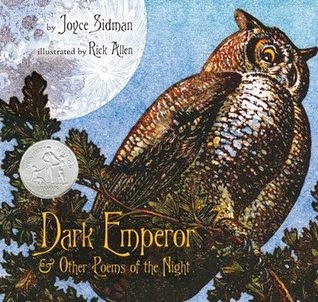
One of the Newbery Honor Medalists for 2011 was Joyce Sidman's Dark Emperor & Other Poems of the Night (HMH Books for Young Readers, September 6, 2010)  Sidman is no stranger to awards.  Two previous books, Song of the Water Boatman and Other Pond Poems and Red Sings from Treetops were Caldecott Honor winners, illustrated by Beckie Prange and Pamela Zagarensky respectively.


Twelve beautifully executed poems grace the pages of this mystical volume.  Readers feel as though they are quietly walking through the hours of inky, velvet shadow seeing it with new eyes.  To start a rhyming, lyrical verse invites all those inhabitants of the dark to come forth and be who they are.

...Come feel the cool and shadowed breeze,
come smell your way among the trees,
come touch rough bark and leathered leaves:
Welcome to the night....

 Each subsequent poem features those creatures of the nighttime as well as the flora that surrounds them bringing strangers, that we are, into their world.  Through a variety of poetic forms and techniques, song, rhyme, free verse, or concrete, Sidman illuminates those particular qualities that make each subject unique.

Whether the pacing and placing of text is that of the poet or the illustrator it contributes to the overall richness of this work.  As if the poems are not enough readers are treated to concise sidebars on the far right of each two page spread giving further details about each dweller of the dark. 

As stated on the back of the title page,

The prints in this book were made by the process of relief printing.  A drawing or sketch is transferred onto a block of wood or, in this instance, a sheet of linoleum mounted on wood, and the drawing is then cut and carved away using a variety of tools.  The areas left uncut are covered with ink and printed on paper by hand or on a press; a number of blocks can be cut and then successively printed in different colors, with the different blocks being "registered" or aligned to create a multicolored print.  The prints for Dark Emperor were each printed from at least three blocks (and in some instances as many as six) and then hand-colored with a strongly pigmented watercolor called gouache.

Rick Allen is an extraordinary artisan in his particular medium.  Extending the illustrations beyond the intended borders tempts readers to venture further noticing the subtle nuances of particular scenes.  Smaller graphics within the poems either highlight the intended subject or lend a bit of humor.  Careful viewers can follow one creature as it meanders through each poem among all the midnight magic acting as our guide.

Do yourself a favor by following Allen's link to his web site.  When considering the process of completing each piece, the results are amazing.