Quote of the Month

When love and skill work together, expect a miracle. John Ruskin


Showing posts with label Bob Raczka. Show all posts

Saturday, April 30, 2016

A Parade Of Poetry

It's hard to believe the 20th anniversary celebration of National Poetry Month has nearly come to a close.  It's been twenty-nine days of showcasing poetry, reading and writing poems, creating spine poetry thanks to promoter teacher librarian Travis Jonker, blogger at 100 Scope Notes, and the true-blue fun of Poem in Your Pocket Day.  Although any day of the year is a great day for poetry, this month's focus wins more readers and writers to this literary form.

It's a time to direct attention to beloved favorite poems, classic collections and spotlight wonderful new titles. On March 8, 2016 three books were released.  The first of these, Wet Cement: A Mix Of Concrete Poems (Roaring Brook Press) is written by Bob Raczka.

In the introduction Raczka explains concrete poetry to readers with an emphasis on using words to literally paint a picture on a page.  The words in a concrete poem form the item being described in the poem.  In this collection he takes it further by using the letters in the poem's title to depict that word.

Twenty-one poems, shown in black on white and white on black, help us to soar if only for twelve seconds, play games, search the night skies and peer into our closets. We pause at the baseball diamond, run after tiny creatures of the night and marvel at the miracle of our planet in the cosmos.  We enjoy the best of two seasons, gasp at a summer storm's display and let a possession sail the air waves.

Bob Raczka asks us to vary our pattern of reading.  We find ourselves not only reading left to right but in a circle, bottom to top, connecting words as if in a puzzle, around curves, holding the pages in front of a mirror, right to left and sideways and following a maze.  The poems' titles, as well as the poem itself, are placed to coordinate a complete image.  Here is a sample poem with a title.


For younger readers and those young at heart Guess Who, Haiku (Abrams Appleseed) with words by Deanna Caswell and pictures by Bob Shea is a lively look at the ancient Japanese poetic technique. Using the five syllables, seven syllables and five syllables format for three lines of poetry, readers are invited to guess the animal being described.  Ten poems playfully portray creatures of all sizes.

Here's a haiku just for you!

new day on the farm
muffled mooing announces
a fresh pail of milk

Can you guess who from this haiku?

With a page turn we discover the answer in two words.  For the next poem the previous animal sends out the request for us to use our thinking skills.  This pattern continues until the final poem.

With this repetitive sequence Deanna Caswell supplies a pleasing, beckoning rhythm.  In an author's note at the back she defines a portion of the word haiku as an explanation for her particular poems.  She cheerfully requests readers to try reading the lines of the poems with one of the lines removed, asking us how or if this will change the results.


Using a palette of pastel colors with bright accents, Bob Shea's images charmingly enhance this gathering of haiku fun. Portions of some of the animals appear on the front book case.  On the opening and closing endpapers small circular hues feature black drawings of nine of the animals in a repeating design.

The text for each haiku poem is displayed in a different colored font on white with a pictorial clue pictured below.  With a page turn Shea has placed the animal on a vivid canvas usually including something from the clues in this illustration.  You can't help but smile at these pictures.


In their third collaboration (Step Gently Out and Sweep Up the Sun) poet Helen Frost and photographer, painter and illustrator Rick Lieder explore another marvelous aspect of our natural world. Among a Thousand Fireflies (Candlewick Press) takes us to an evening when two beetles seek to find each other.  The combination of these two artists' talents creates a breathtaking illuminating view.

In a summer meadow
near the river,
as night's first stars
blink on,
a firefly
steps
into a flower.

She waits and watches surrounded by more lights blinking on and off than would be possible to count.  She is searching for one particular cadence, a secret code.  It hardly seems possible she will find it.  But she does.

She answers with her own series of glowing beats, matching what she has seen.  She seeks acknowledgment.  He approaches.

Helen Frost with word choices and punctuation replicates the flashing of fireflies with her phrases.  If you read the text aloud, it's almost as if you are seated outside on a balmy summer's night, watching these tiny creatures work their mating magic.  You hardly dare breathe for the beauty her words carry.


When you open the dust jacket two photographs, on the back across the spine to the front, blend to become a single moment.  So exquisite is the detail and lighting you wonder how many pictures were taken to capture these exact visuals. A single shade of blue covers the book case.  On the front a pair of fireflies is embossed in the center.  On the opening and closing endpapers two more photographs reveal the intricacies of these delicate beings.

You will find yourself gasping at the splendor seen on every new page.  Rick Lieder varies his perspectives bringing us close to the fireflies and then stepping back to show us how they move and light the night.  The style of softening the background leaving only certain portions highly focused is a highly sensory experience for readers.


These three titles, representative of three distinctive types of poetry, Wet Cement: A Mix Of Concrete Poems written by Bob Raczka, Guess Who, Haiku written by Deanna Caswell with illustrations by Bob Shea and Among a Thousand Fireflies written by Helen Frost with photographs by Rick Lieder have one thing in common.  They are all brilliant.  I highly recommend adding them to your personal and professional collections.  Pause on every page.  Read them aloud.  Repeatedly.

To learn more about Bob Raczka, Bob Shea, Helen Frost and Rick Lieder please follow the links attached to their names to access their websites.  At the Candlewick Press website you can view an interior image from Among a Thousand Fireflies.  Enjoy the book trailer.

Friday, December 5, 2014

From His Jolly Old Self

You may have heard Nicholas was born in a country know as Turkey today.  Even as a child he was well-known for his generous spirit and care for others.  At the time of his parents' deaths due to a plague, he became a very wealthy man.

You may have read prior to his becoming known as Saint Nicholas a story about him using his wealth to aid a nobleman, now living in poverty, by providing dowries for his three daughters.  On individual nights he tossed a sack filled with coins through the girls' bedroom window.  On the final evening the sack is said to have landed in the youngest girl's stocking.

You may have discovered a tale about him becoming the youngest bishop to ever serve; being so named in the town of Myra near his birthplace.  During his time as bishop (and even after his death) there are several miracles attributed to him regarding his saving children by bringing them back to life.  It is believed Nicholas died on December 6, 342 or 343.

You may have learned this date was a well-celebrated feast day in Europe during the Middle Ages.  The goodness of Saint Nicholas began to be associated with gift giving during Christmas in certain countries.  In time this custom crossed the ocean as colonists settled in America.

You may be familiar with a particular visit by St. Nick as recounted in Clement C. Moore's The Night Before Christmas vividly describing the man, his sleigh and reindeer.  But I'll bet you didn't know Santa Claus is quite the poet, specializing in haiku.  Santa Clauses:  Short Poems from the North Pole (Carolrhoda Books, a division of Lerner Publishing Group, Inc., September 1, 2014) written by Bob Raczka with illustrations by Chuck Groenink reveals this beloved figure's literary genius.

December 1st
Wishes blowing in
from my overfilled mailbox---
December's first storm.

This first poem and the twenty-four others are inspired by a bookish gift of haiku poetry given to him by his wife.  Word by word, syllable by syllable, and line by line, Santa writes each one on his faithful typewriter for our reading pleasure.  We get an insider view of life at the North Pole during this busiest month of the year.

Walking outside we might see the effects of a snow hare's hunger on a snow elf or see Mrs. Claus enjoying the delights of first snow.  Santa, keeping his pathways safe, is thinking of treats waiting inside for him.  Tying and untying bows and knots are pleasant or not so pleasant tasks.

One of the reindeer does more than guide his sleigh offering assistance under the stars.  Moonlight and shadows cast their own spell.  A workshop is filled with a symphony of noise.  Stolen kisses under mistletoe add cheer to work.

Trees are trimmed inside by one jolly old elf and outside by the frozen weather.  Nighttime visits with the reindeer, strings of light around a home and spread across an Arctic sky and the fragrance of baking cookies fill the hours with sensory delight.  Stories read by a fire in a darkened room end the day.

Candy canes are consumed, sawdust is swept and wolves sing at the moon.  Christmas Eve and Christmas Day are getting closer.  Reindeer listen, elves sleep and Santa dresses in his suit of red. From high in the sky a landscape spreads below.  Now we know how it goes at the North Pole.


How I wish I could have been privy to the thoughts swirling around in Bob Raczka's mind as he formed these poems.  It's as if he walked with Santa for these twenty-five days.  I can see him standing still in a moment; watching, listening, touching and smelling. His depiction of the everyday is simple but profoundly beautiful.  At all times a touch of humor, lightness in his words can be felt as well as a reverence for the outside world.  Here is one more poem.

December 22nd
Reading the reindeer's
favorite bedtime story,
my cold nose glows red.


Rendered in pencil, gouache and Photoshop each image lifts the words in companionable warmth.  The two page spread across the matching dust jacket and book case invites you into Santa's world at the North Pole.  You can hear the silence, understand the awe he and his dog feel looking at the stars and feel the crisp, clear air.  Carrying over the shade of blue from the night sky on the opening and closing endpapers for a background, Chuck Groenink has placed a pattern of snowflakes, bells, Christmas trees, candy canes, a wrapped package, holly, stars, mistletoe, a glowing candle, a Santa hat, Christmas ornaments, and gingerbread boys; no two are alike with the exception of the cookies.  The colors used are hues of red, green and white.

Opposite the title page is Santa's desk.  I would love to sit in the solitude portrayed in that picture; a window showing snowflakes falling, a chair at a tidy desk displaying a cat on a book, a typewriter, paper, a mug and a vase holding a spring of evergreen with a single ornament.  Subsequently Bob Raczka's introduction is shown on a piece of paper nearly rolled out of an old manual typewriter.

Every page turn reveals a different image size with the text displayed as if written on a typewriter; the dates in red, the poems in black.  The larger font size is not a distraction but a welcome addition to each scene.  Groenink might extend elements from one illustration to the next page displaying a smaller visual framed with a liberal amount of white space.  In turn this is followed by several two page pictures, a single page image and a smaller one framed again in white.

There is an old world, cozy quality to each scene, the details bringing readers into this alternate North Pole world inhabited by Santa, Mrs. Claus, the elves and reindeer within Mother Nature's realm.  Santa's mailbox has a grinning mouth painted on the side giving the impression the letters are coming from this animal.  An old wood stove warms the workshop with a pot and kettle sitting on top.  Santa's residence is a log home several stories high.  The light over the kitchen table is filled with candles; drying herbs hang from a pole nearby and a cuckoo clock is seen on the wall.

One of my favorite illustrations is the one for the second quoted poem.  Groenink uses the beams in the barn to frame Santa dressed in a wooly coat, sky cap on his head, hot pot next to him on a bale of straw as he holds a book reading to the reindeer.  The reindeer are gathered around him, eyes watching and ears up listening.  A single lantern hangs above Santa's head.  Outside the tiny window snow is falling.


Every collection, every book shelf needs to have at least one copy of Santa Clauses:  Short Poems from the North Pole written by Bob Raczka with illustrations by Chuck Groenink.  It is sure to become one of those classic books to be read year after year welcoming the Christmas holiday.  It has my highest recommendation.

To learn more about Bob Raczka and Chuck Groenink please visit their websites by following the links embedded in their names.  If you select this title at Groenink's site you can see several illustrations from the book, including one of my favorites.  UPDATE:  Please visit this page at Kirkus. Author Julie Danielson interviews Bob Raczka.

Thursday, April 21, 2011

Snow Day+National Poetry Month=Time For Good Reads

After ten years of writing for advertising Bob Raczka's first son was born.  This reintroduced him to the world of children's books.  Loving the creativity that this venue offered him, he was able to publish his first book five years later.  Most of his books deal with art perhaps because of his love of drawing which began as a boy. But I truly believe that there is a poet sharing a part of his heart with his love of art. Then again, is not one the other?


In an earlier post, December 27, 2010, I reviewed his outstanding book, Guyku: A Year of Haiku for Boys (HMH Books for Young Readers, October 28, 2010.  This spring he further extends his gift of writing poetry with Lemonade and other Poems Squeezed from a Single Word (Roaring Brook Press, March 15, 2011).  Twenty-two puzzling poems with a punch can be found within the pages of this slim volume.

What Raczka has done, using only the letters in the title of each poem, is to string combinations of those letters down the page which refer back to or describe a scene relative to that word.  So his readers can measure their creativity to his, on the following page he puts the letters in order revealing those words he combined to complete his thought.  What we have is pure poetic pleasure!

No matter how much fun Rob Raczka had piecing these together, readers will have just as much or more.  And without a doubt pen and paper in hand they will begin to compose their own.  The simple, light, red, black and gray graphics of  Nancy Doniger distinctly compliment each poem hinting at the final solution while never detracting from the readers' quest.


Not wanting to seem partial to the canine corner of the world  (despite the fact that Dogku written by Andrew Clements and illustrated by Tim Bowers occupies Xena's Pick of the Month spot on the circulation desk in our elementary media center) it seems appropriate that Won Ton; A Cat Tale Told in Haiku (Henry Holt & Co., February 15, 2011) should be highlighted.

Lee Wardlaw using one of the most ancient forms of poetry tells the story of a shelter cat that finds himself a boy and a home.  These thirty-three haiku poems cleverly convey the reluctant but hopeful yearning of being chosen, the give and take adjustment in a different environment and the mutual love between the new friends.  Wardlaw is no stranger to the finickiness of felines as her precise selection of text captures the essence of all things cat; aloofness, casual interest, and reluctant insecurity.  Readers are brought full circle with the closing poem which will have them softly as cat's fur whispering, "Oh."


Coupled with this verse are illustrations by Eugene Yelchin that truly heighten the attitude of this cat.  Using graphite and gouache on watercolor paper Yelchin had me laughing out loud at the antics, emotions and facial expressions displayed by this creature.  As a pair Lee Wardlaw and Eugene Yelchin are purr-fectly matched.

Two of my favorite poems are:

What do you mean "Ewww"?
How is my tuna breath worse
than peanut butter?

Your tummy, soft as
warm dough.  I knead and knead, then
bake it with a nap. 


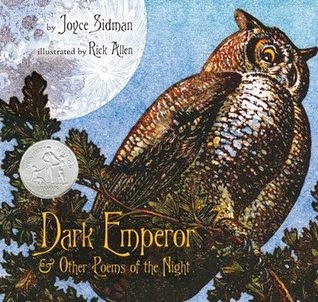
One of the Newbery Honor Medalists for 2011 was Joyce Sidman's Dark Emperor & Other Poems of the Night (HMH Books for Young Readers, September 6, 2010)  Sidman is no stranger to awards.  Two previous books, Song of the Water Boatman and Other Pond Poems and Red Sings from Treetops were Caldecott Honor winners, illustrated by Beckie Prange and Pamela Zagarensky respectively.


Twelve beautifully executed poems grace the pages of this mystical volume.  Readers feel as though they are quietly walking through the hours of inky, velvet shadow seeing it with new eyes.  To start a rhyming, lyrical verse invites all those inhabitants of the dark to come forth and be who they are.

...Come feel the cool and shadowed breeze,
come smell your way among the trees,
come touch rough bark and leathered leaves:
Welcome to the night....

 Each subsequent poem features those creatures of the nighttime as well as the flora that surrounds them bringing strangers, that we are, into their world.  Through a variety of poetic forms and techniques, song, rhyme, free verse, or concrete, Sidman illuminates those particular qualities that make each subject unique.

Whether the pacing and placing of text is that of the poet or the illustrator it contributes to the overall richness of this work.  As if the poems are not enough readers are treated to concise sidebars on the far right of each two page spread giving further details about each dweller of the dark. 

As stated on the back of the title page,

The prints in this book were made by the process of relief printing.  A drawing or sketch is transferred onto a block of wood or, in this instance, a sheet of linoleum mounted on wood, and the drawing is then cut and carved away using a variety of tools.  The areas left uncut are covered with ink and printed on paper by hand or on a press; a number of blocks can be cut and then successively printed in different colors, with the different blocks being "registered" or aligned to create a multicolored print.  The prints for Dark Emperor were each printed from at least three blocks (and in some instances as many as six) and then hand-colored with a strongly pigmented watercolor called gouache.

Rick Allen is an extraordinary artisan in his particular medium.  Extending the illustrations beyond the intended borders tempts readers to venture further noticing the subtle nuances of particular scenes.  Smaller graphics within the poems either highlight the intended subject or lend a bit of humor.  Careful viewers can follow one creature as it meanders through each poem among all the midnight magic acting as our guide.

Do yourself a favor by following Allen's link to his web site.  When considering the process of completing each piece, the results are amazing.

Monday, December 27, 2010

Is It April Yet?

No, the snow and cold have not gotten to me yet; I love winter as much as the other seasons.  But April brings National Poetry Month and this year my students and I will be celebrating with another delightful offering.  Guyku: a year of haiku for boys written by Bob Raczka with art by Peter H. Reynolds is a winning collaboration on numerous levels.  Raczka's use of this poetic art form captures, via six poems for each season, the essence of simply enjoying activities offered by the changes in our outside world throughout the year.

For spring--In a rushing stream,
                  we turn rocks into a dam.
                  Hours flow by us.

Reading this brought to mind  the seemingly endless amount of time the neighborhood kids and I spent making a multitude of waterways with sticks and stones to create whole new water kingdoms during a rainstorm.

Or for summer---Lying on the lawn,
                          we study the blackboard sky,
                          connecting the dots.

To this day I still love to spread out a blanket on a summer night counting the number of falling stars, eating Oreo cookies, slathered in bug spray lying next to my dog.

And who does not do this in winter---How many million
                                                         flakes will it take to make a
                                                        snow day tomorrow?

In reading these haiku adults are taken back to the joys of remembered youth and the readers of today are given the opportunity to unplug, get outside and use their imaginations to appreciate what is theirs for the taking.  It's important to point out that Raczka not only describes the actions of these boys but he takes it a step further by getting to the heart or soul, if you will, of what is happening in the moment.  Although Bob Raczka states in his author's note that all of the things mentioned in his poetry he did as a boy or his own boys have done, girls do and will like the very same things.

What really makes these poems pop is the art of Peter H. Reynolds whose work has been previously described in a post here in September.  His color selection for each of the seasons, green, yellow, brown and blue, is carefully maintained within the pages of this book from the title page to the closing illustration where all are blended together.  His watercolor renderings reveal the perfect facial expressions, the mood of the boys and the uncomplicated beauty of each passing season.  Whether done by the author or the illustrator each haiku is handwritten adding to the allure of making the reader a willing and comfortable participant.

As Reynolds states in his note at the book's end he believes in creativity and art that inspires everyone to make their mark especially when it comes to boys and poetry.  Readers are invited to visit Guyku Haiku for further fun projects, activities, free stuff, and more!  Haiku has always been a favorite of my students but this year it is going to be a whole lot better.

Page by page boys romp
Seasons pass as seasons will
Uplifting---Guyku!