Quote of the Month

When love and skill work together, expect a miracle. John Ruskin


Showing posts with label Miren Asiain Lora. Show all posts

Tuesday, September 6, 2022

When Darkness Settles

There is no sleep.  Dreams are not dreamed.  Wishes are not made.  No day is complete or concludes without it.  What is this priceless phenomenon?

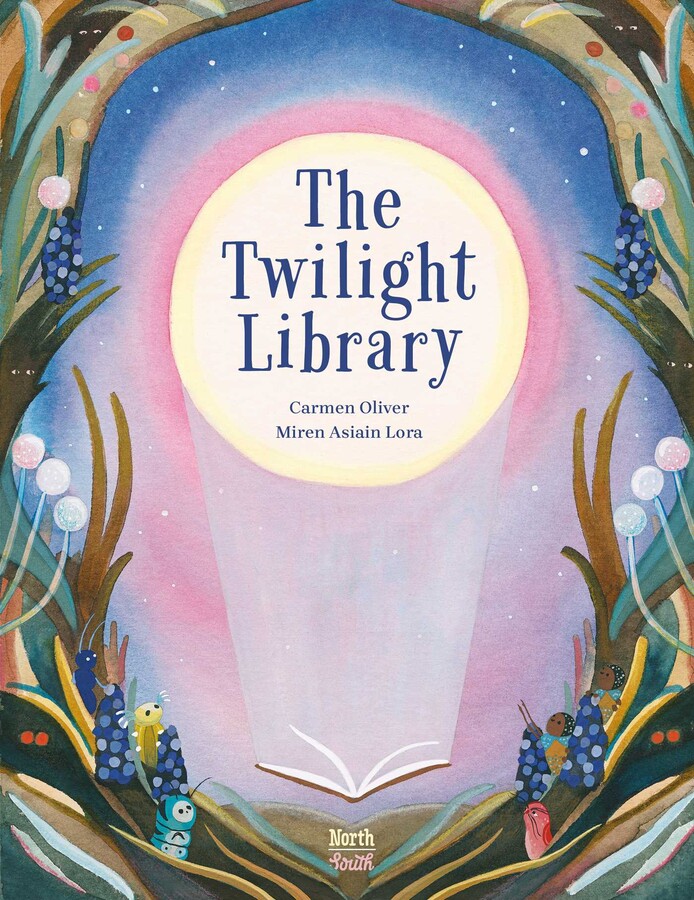
It is the need for story.  It is the longing to hear or read that which another believes is important for us to hear or read.  The Twilight Library (North|South Books, September 6, 2022) written by Carmen Oliver with illustrations by Miren Asiain Lora takes readers into an enchanting world.  In this world, a special being in a special space uses the power of words to take listeners on a sensory journey to places their hearts desire.
The sun slips behind the horizon;
the creatures of the night awaken.
Someone is calling them.

This voice implores them to come.  This voice wants to tell a tale.  Do the creatures of the night listen?  They do.

Some step lively to a rhythm.  Others start, stop, and go again.  Still more glide through the darkening skies, some lower to the ground and others high above the treetops.

Fireflies glow off and on and off and on.  A soothing breeze whispers through stems and leaves.  All these 

creatures of the night

gather at The Twilight Library, anticipation filling their souls. The Night Librarian, a weaver of webs and words, moves closer to her listeners.

She takes them to a place alive with color.  There, their hunger is satisfied by an array of food the likes royalty has never seen.  They are enveloped by thoughts of their most beloved sanctuaries.  They are asked to breathe wondrous odors and listen to nature's notable melodies.  They, together as one, are transported to realms fashioned by their imaginations.  All too soon dawn arrives.  But . . .


These phrases penned by Carmen Oliver calm readers like a lullaby.  Her blend of narrative and the words of the Night Librarian take us to one place before magic lifts us to another.  Repetition of key words fashions a cadence.  Alliteration draws us deeper into the spell cast by The Twilight Library and the storyteller residing there.  We, like the 

creatures of the night,

are completely captivated.  Here is a passage.

Nighthawks wind through the canopy,
hunting for the voice that beckons.

"Come, come, come, my friends,
let me spin, spin you a story."


Readers get their first peek at the marvelous color palette used by artist Miren Asiain Lora for this book on the open dust jacket.  Her hues depict the display of light prevalent when day is leaving and night is descending.  The framing by leaves, stems and flowers on the front, right side, of the jacket is the same on the back, the side to the left of the spine.

On the front, notice the tiny creatures looking at the light of a moon rising from the pages of a book.  Do you see the eyes shining from darkened nooks?  On the back, the creatures are absent.  Between the branches and stems, a single string of webbing is stretched.  Hanging in the webbing are books, spines out.  Two fireflies are moving left to right.

The book case presents two scenes.  On the back, to the left of the spine, is a starlit sky with a crescent moon in the upper, right-hand corner.  Two small trees rise above the ground along the bottom.  The sky is immense.  To the right of the spine, the sun is still above the horizon in a sky of peaches and pinks.  Above this, a deepening blue and purple with a few stars indicate the coming of dusk.

The opening endpapers present us with a rolling dip in a meadow.  A few butterflies make their way to the right.  The sun is slowly heading toward the horizon.  On the closing endpapers we have moved to the entrance/exit of The Twilight Library and the Night Librarian hanging there.  Her storytelling is over for tonight.  To the right, the crescent moon and a few lingering stars dot the sky.  Along the horizon, a pink glow begins.

These illustrations were rendered using watercolor, gouache, and crayon.  On the title page, a few strands of webbing are strung toward the title text along the bottom.  The remainder of the double-page image is an eloquent sky as the sun sets.  Each two-page picture throughout this title gives us either a panoramic view of a setting or brings us close to the 

creatures of the night.

Readers will be fascinated by the details, looking for the tiny inhabitants of forest and field with each page turn.  The plant life on close inspection appears somewhat exotic.  The first view of The Twilight Library is gasp-worthy.  When the Night Librarian begins the stories, we are shown a mix of reality and imagination in the visuals.  Will readers notice the added detail to the appearance of the forest and field beings as the stories are told?

One of my many favorite illustrations is when we are very close to two fireflies going to The Twilight Library.  The flowers, leaves and stems are enlarged, filling all of the right side and along the bottom on the left portion of the picture.  Above the flowers, leaves, and stems on the left are a wide array of shimmering dots.  Above them are the fireflies surrounded by glowing balls.  There is a deep blue sky with a few seeds drifting on the breeze.


After reading this book, The Twilight Library written by Carmen Oliver with illustrations by Miren Asiain Lora, readers will wonder how many such libraries are hidden in the gardens, parks, fields, and forests surrounding their homes.  If they allow themselves to truly imagine, perhaps they might believe there are Twilight Libraries everywhere around the world.  The beauty of the words and images in this title recognize and uplift the power of story.  You will want a copy of this book in your professional and personal Twilight Libraries.

To learn more about Carmen Oliver and Miren Asiain Lora and their other work, please access their websites by following the link attached to their names.  On Carmen Oliver's website are downloadable resources for this book.  Carmen Oliver has accounts on Facebook, Instagram, Pinterest, and Twitter.  Miren Asiain Lora has an account on Instagram. Carmen Oliver wrote a guest post including the cover reveal for this book on author Cynthia Leitch Smith's Cynsations.  You can view interior images at the publisher's website and at Simon & Schuster.  At the publisher's website is a conversation with the illustrator about her work on this book.

The Twilight Library by Carmen Oliver and Miren Asiain Lora from Let's Talk Picture Books on Vimeo.

Tuesday, April 20, 2021

Earth Week 2021 #1

While those who champion for our planet's preservation, our preservation, are grateful for the establishment of Earth Day in 1970, there is still much to be done.  Time is literally running out.  It is more important than ever; each day should be dedicated to our Earth.  

One book at a time, change happens.  Words are powerful, reader to reader. Hello, Earth!: Poems To Our Planet (Eerdmans Books For Young Readers, February 9, 2021) written by Joyce Sidman with illustrations by Miren Asiain Lora is a conversation through a collection of twenty-two poems between human voices and this big beautiful Blue Planet.  Listen.

HELLO, EARTH!
It's your children.
Some of your children---
the human ones.
We have been studying you, Earth,
but we long to learn more.  . . .

So begins the first poem.  It's a greeting and a request.  It respectfully concludes with the first of many questions and comments.  There is a large curiosity including many topics needing to be satisfied in this narrative.  How is it that we and Earth spin among the stars together?  It is perplexing to comprehend Earth's size when there are things on this planet so large, we are tiny next to them.

Compared to us, Earth is ancient.  Nevertheless, she is still changing.  Volcanoes and earthquakes signal her shifts.  We hope Earth enjoys the benefits of both the sun and moon.

We acknowledge Earth's ingenuity in giving us clean air through the bounty of plants.  We are astounded by her places of bitter cold and ice and intense heat, wind, and sand.  High tides and low tides tug at her watery masses.  We recognize the vast expanses of water on this place and the life that dwells there; all of it marvelous regardless of its size or shape or abilities.  Knowing what we know about these watery realms, no wonder we continue to explore.  

An apology is given for the constant chaotic commotion humans supply to this planet.  It is known Earth communicates with us other than through words.  Her weather speaks volumes, sometimes loudly and other times in a whisper.  It is humbling.  Even though we do not always show it, we dwell on Earth, our precious planet, with grateful hearts.  


With each reading of the poems in this book, you cannot help but be moved by their sincerity and veracity.  Many different aspects of the planet are covered in the praises penned by Joyce Sidman.  The poems are connected, like us, flowing from one to the other.  They also, like us, can stand alone distinctly.  Here is another partial poem, its beginning and its ending.

SUNLIGHT, MOONLIGHT
What is it like
to spin

and feel the sun
warm all your
beautiful places,
          one by one? . . .


One so close,
a silver sister.

One so far,
a burning star.


The dark endless space covers both the front and back of the open book case.   It is peppered with dots of starlight.  To the left, on the back, is the entire first poem.  The full moon supplies a point for placing the title text.  The swirl of currents and clouds reinforces the constant motion of our planet.  Notice the different animals and people and their activities.

On the opening and closing endpapers is a camel shade.  It is the background for a multitude of tiny blue birds.  It gives the appearance of an endless migration.

Another view of the entire planet is beneath the text on the title page.  A single engine plane flies above it.  A schooner sails below it.

Each double-page picture rendered by Miren Asiain Lora, like the poems, is fascinating and unique.  You need to pause at each one to study the elements and the people.  The intricate details are amazing.  The perspectives in these images are designed to depict the magnificence of Earth and its immense size.

One of my many favorite pictures is for the poem, SUNLIGHT, MOONLIGHT.  It expertly conveys the feeling one gets when standing alone or nearly alone outside on a full moon night.  Most of the two pages are the night sky speckled with a few stars.  Along the bottom of both pages are evergreens.  On the left is a mountain peak, glowing in the moonlight.  Another mountain begins to the left of the gutter and rises on the right in shadow.  At the top of this peak is a single person garbed in clothing for a bit of a chill in the air.  Their left arm is reaching and touching one edge of the glowing full moon.  How many times have you seen a full moon, believing it was so close you could touch it?


This book, Hello, Earth!: Poems To Our Planet written by Joyce Sidman with artwork by Miren Asiain Lora is stunning.  At the close of the book is extensive back matter, More About How The Earth Works (Earth's Age, Earth's Size, Earth's History, Earth's Layers, Plate Tectonics, Continental Drift, Rotation and Orbit, Powerhouse Plants, Altitude, Ecosystems, Gravity, Oceans, Water Cycles And Currents, Human Impact, Messages From The Earth, New Species, and Living With The Earth), and To Find Out More, Explore The Resources Below (Understanding Climate Change, Ways Kids Can Help, Citizen Science Projects and For Further Reading).  I can't imagine a collection, personal or professional, without a copy of this book.

To learn more about Joyce Sidman and Miren Asiain Lora, please access their respective websites by following the link attached to their names.  Be sure to check out the additional resources linked at Joyce Sidman's website for this book.  Joyce Sidman has accounts on Facebook and Instagram.  Miren Asiain Lora has accounts on Facebook and Instagram.  You can get a peek at some interior images at the blog for Eerdmans Books For Young Readers.


It is a fact that our sea ice and polar glaciers are melting faster than is safe for our planet.  Most of our glaciers are in Antarctica (90%) and Greenland (10%). 


A clever portrayal on the change our glaciers experience is presented in Blue Floats Away (Abrams Books for Young Readers, March 23, 2021) with words by Travis Jonker and pictures by Grant Snider.  As if we are side-by-side with Blue, we navigate the unknown.  We learn about the transformative power of being different.

Little Blue lived near the North Pole with his parents.

They were close. 

You could say they were three peas in the proverbial pod until suddenly with a resounding loud noise, Blue broke apart from his parents.  He was floating away from everything and everyone he knew.  He reassured his mom and dad he would return soon.  Would he?

In short order, Blue could not see his parents.  He could see nothing but sky, sea, and snow, lots of snow.  He was alone for a long time, until he wasn't.  He saw something new and something beautiful.  These two somethings became Blue's best buddies.

From these two companions Blue learned how he might return home.  Wind and ocean currents controlled a lot.  Another thing, an unexpected thing, altered all of Blue's ideas.  It was getting warmer and warmer and warmer.  Blue vanished.  Did he?

Through a continuing and constant process, Blue rose above the water.  He was floating away in the sky.  Again, Blue saw two things.  They taught Blue.  Blue was headed home.  Four fascinating friends stuck with Blue as he grew larger and larger as it got colder and colder.  There were his parents!  And Blue . . . well, Blue was developing into something else again. 


It takes a special kind of author to create affection for an iceberg in readers, but Travis Jonker does it with considerable skill.  And if you don't burst out laughing after reading those first two sentences, you might want to check for a pulse.  With spare text infused with humor and informative insight, we willingly embark with Blue.  Travis ties the two portions of Blue's travels together with repetitive phrases, inviting reader participation.  (I said them aloud the second time.  I woke up my dog.)  Here are three consecutive sentences.

Blue learned things
from his new friends.

About the directions:
East, West, South . . .
and North.
Blue set a course for home. 


One of the first things you notice when you open the dust jacket is the different hues of blue for the water and the shades used for the sky.  On the left, including the spine the water is dark turquoise or teal or a combination of the two and the sky is a vibrant dark pink.  White birds soar in that pink sky.  Shark fins cruise in the water.  On the right the sky is pale orange with paler orange clouds.  The water is ocean blue.  The rock on which the lighthouse sits extends over the spine to the back.  The bold color palette here is used throughout the book, attracting readers of all ages.

On the open book case a deeper royal blue is given to the water which fills nearly all the space.  At the top of the page, for the sky, is a muted steel blue.  Separating the water and sky is a white wavy line.  Blue's parents are placed in the upper, left-hand corner.  Blue moves slowly away in the lower, right-hand corner.

Bright purple covers the opening and closing endpapers.  On the title page, Blue's portrait is in a circle with blue water and orange sky.  This picture is above the text.

These remarkable illustrations by Grant Snider 

made with cut paper, colored pencil, and white ink

are brilliant in their simplicity and characteristics.  (You want to reach out and touch them.)  They take the idea of less-is-more and turn it into an art form.  The facial features on Blue's parents and on Blue, three dots or marks, display a range of emotions.

The color compositions, blues with orange, blues with blue, blues with red, blues with orange and red and bold golden yellow with crisp white are fabulous.  A huge clue is given to careful readers with the unexpected use of green.  The appearance of Blue's new form will have readers smiling.  Most of the illustrations span two pages with the exception of Blue's two major alterations.  Here Grant Snider uses four vertical panels across two pages.

One of my many favorite visuals is after Blue has learned several things from his first two new friends.  Most of the double-page picture is water, a deep dark royal blue.  Above the jagged edge of the wavy water is a peach sky.  On the left, the black rock juts into the water.  From the lighthouse, a golden yellow beam enlarges as it moves off the right side.  Blue floats on the right, a slight smile filled with hope on his face.  His two friends, a sailboat and shark, are on either side and in front of him.  White lines signify wind and currents.


As a read aloud, Blue Floats Away with words by Travis Jonker and pictures by Grant Snider is perfect.  Readers and listeners will be loving Blue so much, they won't realize they are learning about the water cycle.  They will also come to understand change is life and change does not mean gone.  At the close of the book to the left of the Author's Note are four pictures with arrows explaining the water cycle courtesy of Blue.  Travis clarifies the water cycle, polar ice troubles, climate change, and what simple things we can do to help.  Each personal and professional collection needs a copy of this book.

To discover more about Travis Jonker and Grant Snider and their other work, please follow the link attached to their names to access their websites.  Travis Jonker has accounts on Facebook, Instagram, and Twitter.  Grant Snider has accounts on Facebook, Instagram, Tumblr, and Twitter.  At the publisher's website you can view interior images.  On his blog, 100 Scope Notes, School Library Journal, Travis reveals the cover.  Here he interviews Grant Snider about his illustrative process for this book, including different cover ideas.  At The Yarn, School Library Journal, Travis talks about how this book, his second book, came into being.

If you are interested in a bit more information about sea ice, glaciers, and icebergs check out articles/information at the World Wildlife Fund, the National Snow & Ice Data Center and The Washington Post.