Quote of the Month

When love and skill work together, expect a miracle. John Ruskin


Showing posts with label Geology. Show all posts

Wednesday, December 27, 2017

Deep Down Underground

Twice this winter we've had a good five-inch layer of snow covering our ground.  Despite the depth my canine companion leaps and dives, nose first, attempting to smell what is buried beneath all those snowflakes.  If a particular scent captures her interest her paws become eager diggers, like a four-footed, furry archeologist intent on a goal.  She is not alone in her endeavors to discover what can be found underground.

Shortly before our ground was frozen a series of raised loops and zig-zags covered my front yard.  It looks like a group of moles engaged in merry mayhem.  There are whole worlds waiting to be explored.  The Street Beneath My Feet (Quarto Knows, March 1, 2017) written by Charlotte Guillain with illustrations by Yuval Zommer is a unique, fascinating approach to earth science.

When you're walking along the city streets
there's always so much to see and hear.

Most of the time we are either so focused on our own destination or captivated by the buzz of activity around us, we fail to think about what is below the ground. (Also, if your mom was like mine, she was always saying, "Stand up straight with your shoulders back and hold your head high as you walk.") We don't have to go very deep to find an entire network of pipes, wires and cables.  Water is carried through a system of gutters and drains.

In each layer of dirt there is living breathing beings.  If we go farther we might find the community sewer.  As we keep traveling down there will be more signs of life, most of it from the past.  Underground tunnels with tracks provide transportation.  We go through bedrock into sedimentary rock.  Seemingly magical wonders await us here in caves.

The farther we go the rocks reveal more gifts, peat, coal and granite.  As we get to the crust the earth's plates shift.  If they clash, we may have an earthquake.  As we travel deeper and deeper toward the core, it gets hotter and hotter; it's like liquid fire.  In the very center it is solid with temperatures near 11,000 degrees Fahrenheit. Now it's time to go back up.

Each step of the journey, each section, presents new surprises; precious and semi-precious rock, minerals and gems.  We learn about metamorphic rock.  Fossils appear.  As we get closer to the surface roots branch into the dirt.  Animal burrows, setts and dens and insect nests come into view.  As we finish, standing on the ground again, a forested meadow replete with flora and fauna spreads before us.


From page to page Charlotte Guillain takes us on marvelous voyage through our earth with her words.  She enhances our knowledge about those things in which we might be familiar but shares details with us about those things we never thought about before but are glad we now know.  In the conversational tone of a learned tour guide, she invites us to looks closer, to notice the smallest items, and asks questions of us about those things we encounter.  Here are four passages which follow her description of sedimentary rock.

If you're lucky,
you might find
an underground
cave.  This 
one formed
when water 
wore away
the rock
and made
holes 
in it.

Watch you head!
There are stalactites
hanging down from
the roof of this
limestone 
cave.

Psst!  Limestone 
is a type of
sedimentary rock
that formed 
in the
sea.

Spiky stalactites form when water moves
down through sedimentary rock.


I think it's safe to say this book has been designed in a remarkable manner completely in keeping with the subject matter.  When you open the book case on the right is what you might encounter beneath a city.  On the left the image depicts what you might find beneath a forested meadow.  Yuval Zommer cleverly takes the tree on the front extending it over the spine to the back.  You will be compelled to stop and look closely at every single element.  On the front many of the details are raised and varnished heightening the tactile experience.

When you open the front cover, the book needs to be turned to read the text and enjoy all the artwork.  This is a vertical accordion book with eleven pages fully illustrated on both sides on durable, heavier matte finished paper.  It is brilliant!

Yuval Zommer's images are spectacular in their intricate and delicate details done in full color.  It's as if he literally went beneath the surface to add as much as he could in each layer.  When he shows us the storm drain, not only is water running down but leaves are swirling in it.  His inclusion of a human skeleton is as if we have unearthed a grave.  Mementos of the person's life are included with the bones. In another illustration from right to left he shows the progression of the development of coal and how it is mined.  On the final page, on the inside of the back cover, a circular slice of our planet shows the Earth's layers.

One of my many favorite illustrations is when we are climbing back up to the surface. In two separate images which appear as one, Yuval Zommer shows us a fox family in their den, individual badgers in setts and rabbits running in tunnels and nestled in their burrows.  He includes possible flora used in their abodes.  Careful readers will see a tiny mouse curled in its own home.  Worms squirm in the dirt.


This book, whether you place it in your professional collections in your libraries or classrooms or in your personal collections at home, will be a huge hit with readers.  The Street Beneath My Feet written by Charlotte Guillain with illustrations by Yuval Zommer has been created to inform in a singular, outstanding style.  This title has been selected by the National Science Teachers Association as one of the Outstanding Science Trade Books for Students K-12: 2018.

To learn more about Charlotte Guillain and Yuval Zommer and their other work, please follow the links attached to their names to access their websites.


I hope you will take a few moments to visit Kid Lit Frenzy hosted by educator Alyson Beecher to view the titles selected this week by others participating in the 2017 Nonfiction Picture Book Challenge.  This completes my fourth year participating in Alyson's challenge.  My life is far richer for being a participant, expanding my respect for this beautiful planet and those who have or are inhabiting it.  I thank you Alyson and other participants.


Friday, July 29, 2016

Digging Deep

There are those books which command the attention of everyone regardless of whether you are a science geek, fact finder or seeker of trivia. These books are brimming with interest on every page turn.  These books add depth and breadth to our understanding of the world in which we live.

On October 8, 2013 Maps (Big Picture Press) written and illustrated by Aleksandra Mizielinska and Daniel Mizielinski was released.  The size, 10 5/8 by 14 9/16, is indicative of the quality and quantity of the contents. Printed on heavy matte-finished paper with a sepia-toned finish on cream, the text and pictures take readers around the world. Each two-page spread is framed in an intricately rendered border varying in design.

We are treated to a world map, maps of the continents and individual countries.  We see political borders, flora, fauna, cultural foods, activities, natural and man-made wonders, housing, clothing, famous persons and specific place names. Significant bodies of water and mountains are featured.  Famous works of art and literary and historical milestones are included.  Creatures which may be found in the oceans and seas surrounding the land masses are duly noted.

Each element in the images is carefully labeled.  Sometimes one or two sentences offer further explanation.  This book of maps, this atlas, combines the best part of political, resource, and physical maps.


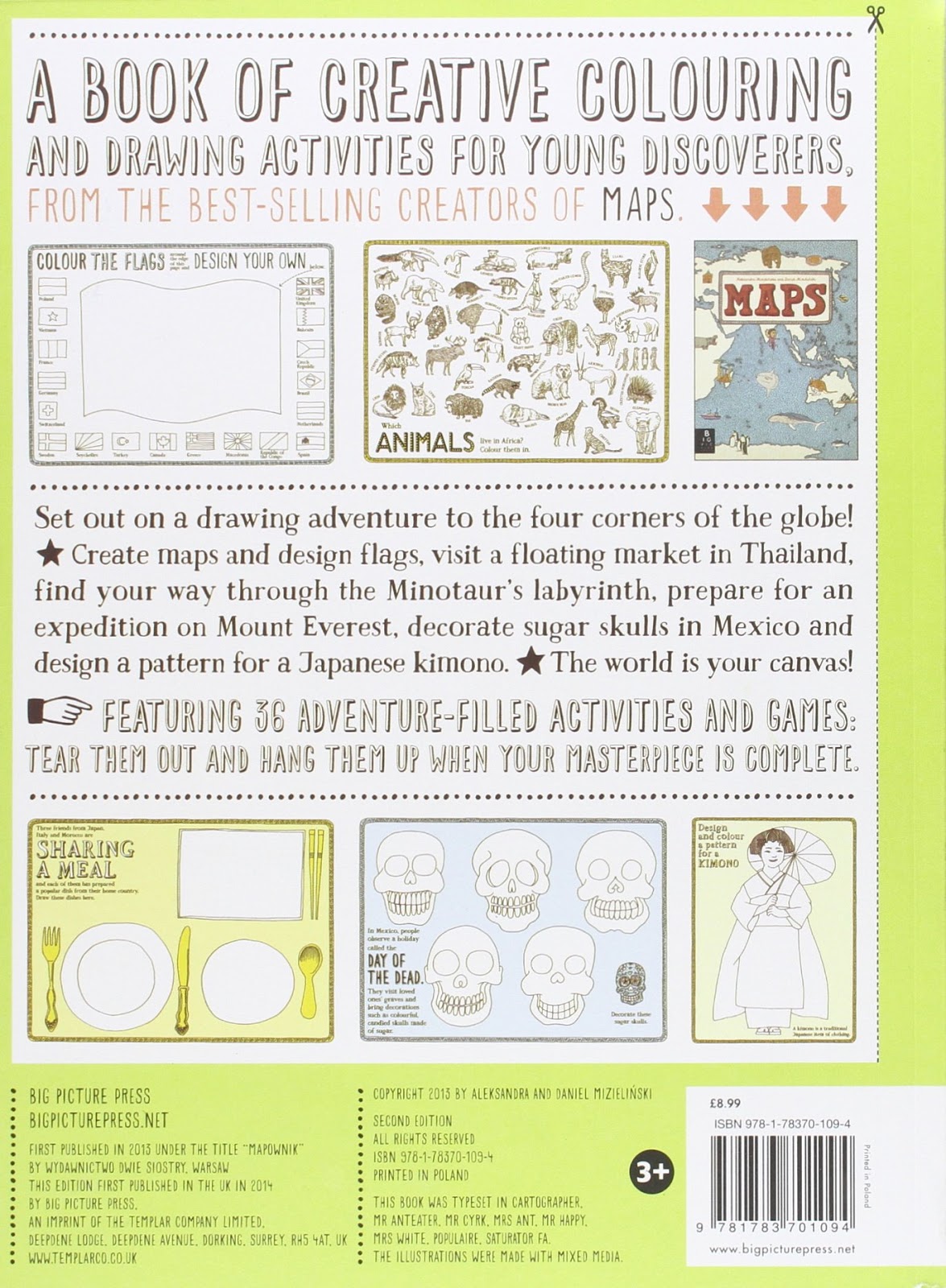
As an enhancement to the original publication Big Picture Press published the Maps Activity Book written and illustrated by Aleksandra Mizielinska and Daniel Mizielinski on July 1, 2014.  Smaller in size, 12 by 8 4/5, this paperback with special binding for ease of  page removal delivers interesting challenges involving drawing, coloring, research, and creative imagining and thinking.  On the back of each of the thirty-six activities a tiny character, children from around the world, impart more fascinating facts in a single speech balloon.


Users might be asked to draw a map of an imaginary country, pretend to be an explorer in the Amazon and draw animals, plants and people they might find there, invent another glyph to add to the ancient Mayan language, color flags from countries and design your own, select which animals on a given page actually live in a specific place or create a pattern for a kimono.  Each of these activities invites readers to discover more than they originally know. The fantastic facts on the back of the activity pages might tell us where the largest active volcano is located, its size and the number of times it has erupted or who designed the updated U. S. flag after Alaska and Hawaii became states or supply readers with information about the original inhabitants of Australia.  The pages can be used for single individuals or as a guide for the generation of more related educational adventures.


The most recent title in this trio, Maps Poster Book (Big Picture Press, February 23, 2016) written and illustrated by Aleksandra Mizielinska and Daniel Mizielinski is twenty-seven maps plus the world map found in the first volume, condensed in size to 11 3/8 by13 9/16.  On one side of the poster is the exact replica of either a country, a continent or a large area, the Arctic.  On the other side the highlighted map is shown in color within a larger two-tone map.  All of the pages are perforated for removal.


The newest book by the collaborative duo of Aleksandra Mizielinska and Daniel Mizielinski, which again demonstrates their talents in exploring our world exquisitely, is Under Earth Under Water (Big Picture Press, March 1, 2016 UK, October 11, 2016 US).  For sixty-three pages we peer into the ground until we strike the core of our planet.  In the following forty-five pages we work our way to the surface but through the seas or oceans.  A clever design allows you to begin with either the earth or the water.


If we look just beneath the dirt all kinds of creatures seen with the naked eye or under a microscope can be found.  Discovering the giant Gippsland earthworm in Australia would be rather startling as it can grow to be nearly ten feet long.  Anthills are far most vast and sophisticated beneath the surface than what we find above ground.  Did you know there can be more than one queen in one anthill?

Intriguing information about borrowing animals, moles, naked-mole rats, prairie dogs, badgers, and red foxes are revealed in greater depth.  Plants with edible and medicinal portions growing under the surface are explained as other pages showcase majestic trees.  Man-made cables stretched below the surface, the vast networks used to transport natural gas, electricity and water used in homes as well as waste disposal are presented.   Travel by tunnels, general and specific, and how tunnels are made is a fascinating section.

Archaeology, paleontology, speleology, and mining are explained.  Pages are devoted to those products made from the riches, natural resources, taken from the earth.  Information about The Pacific Ring of Fire and plate tectonics are pictorially displayed.  The deeper we go volcanoes, hot water springs, geysers, layers of the earth and the center itself are discussed.

From here we start to head upward learning of vessels like the Deepsea Challenger used to explore the bottom of the sea.  Trenches and their strange inhabitants fill several pages.  Did you know that the glow seen at the tip of the triplewart seadevil's rod is actually other tiny lifeforms?  Have you ever heard of underwater chimneys? Some of those chimneys are found as far below the surface as sixteen thousand feet!

We have studied the Titanic, other sunken ships and an array of places using submersibles specially furnished with scientific equipment.   We have drilled into the seabeds using unique platforms to extract oil and gas.  (I wonder if any of those human workers have ever seen a colossal squid or blue whale showcased in several pages.)  A history of the development of diving suits and submarines will astound readers.  Many forms of diving and famous divers are disclosed.  

As we continue to move toward the surface we learn of water pressure, sinkholes, coral reefs, and the properties necessary for something to float.  To further our knowledge a comparison is made between the residents of an ocean and a freshwater lake.  As we come to the top, seeing the sky above, we can make the choice to dive down beneath the waves again or head to terra firma and start digging once more.


As in the Maps title the authors have meticulously labeled every item in the illustrations, inviting further research by readers.  Each two-page illustration, top to bottom horizontally, places informative text in rounded boxes blending into the image.  Each of these boxes contains one to five sentences written in an easy, conversational style.  (Readers should note the measurements are given using the metric system.)  Here are some sample passages.

The roots that reach deepest are of plants that grow in deserts.  The plants send them deeper and deeper underground in search of water.

In the far north of Russia, beyond the Arctic Circle, scientists drilled the world's deepest hole to gain a better understanding of the Earth's structure.  The borehole took 22 years to create and was more than 12km deep.

The Great Lakes are the Earth's biggest bodies of fresh water.  The most extensive freshwater lake, Lake Superior-on the border of the United States and Canada-is bigger than the Czech Republic.  The world's deepest lake is Lake Baikal in Russia, which reaches a depth of up to 1642m.

At the bottom of the ocean, hundreds, or even thousands of metres underwater, unusual places lie hidden that resemble fields of smoking chimneys.  The clouds that emerge there are not smoke, but hot water full of minerals.


When the book case is opened readers can view the table of contents for each section, earth and water, laid before them like a path to follow, with small images, page numbers and titles given.  Shades of blue are used as the background in the portion on water.  Once we begin to delve into the section on the earth a more varied color palette is used.  

The fine line work, layers of complex aspects, layout and design represent painstaking planning and implementation.  Within each illustration and from picture to picture everything flows flawlessly.  You might think the large amount of elements would be a distraction but that is simply not true.  They are an invitation to explore, discover and learn.

Two of my favorite illustrations of many are one from the water and one from the earth.  The Carmagnolle brothers' diving suit is featured in a single visual stretching from top to bottom.  It is standing in a bed of seaweed entirely submerged.  Seven labels containing facts are attached to it as is an important date.  Bubbles rise from the bottom in several hues of blue.  As a gardener the six horizontal rows highlighting roots, rhizomes, tubers and bulbs are fascinating.  Each is named with most containing special uses and locations where they are found.  Realistic colors are employed.  Gals and guys will be absorbed in the cross-sections devoted to moles, naked-mole rats, prairie dogs, badgers and red foxes.  


Under Earth Under Water written and illustrated by Aleksandra Mizielinska and Daniel Mizielinski is a marvelous, mesmerizing look at our planet's earth and water characteristics, the flora and fauna residing there and the secrets they have revealed to us.  This team has also added people and scientific advancements of significance relative to both.  The sturdy book case and heavy paper make this a lasting worthwhile addition to personal and professional collections.  Your patrons and students are going to love it.  I advise getting several copies.  

I was unable to locate any information on Aleksandra Mizielinska and Daniel Mizielinski but more information about this title and the others by this team can be viewed at Candlewick Press, Big Picture Press, and Templar Publishing. Enjoy the book trailer.


 To enjoy the other titles selected by participants in the 2016 Nonfiction Picture Book Challenge please access Kid Lit Frenzy hosted by educator Alyson Beecher.