Quote of the Month

When love and skill work together, expect a miracle. John Ruskin


Showing posts with label Yuval Zommer. Show all posts

Tuesday, December 6, 2022

Seasonal Celebrations

In cultures and countries around the world, especially in the northern hemisphere, this time of year represents a pause.  Mother Nature is at rest, so perhaps it is a time for us to reflect on the past seasons and celebrate.  Possibly, there are small, everyday things to honor, elevating the ordinary to extraordinary.  There are centuries-old traditions to commemorate; many steeped in religious beliefs or holiday observances.  Cold, snow, and wind bring their own special events.  For many, a new year is welcomed.

Following are six titles (with one more to arrive soon), which you might consider for reading during these several months.  The first book, Season of Light (Farrar Straus Giroux, September 13, 2022) written by Jess Redman with illustrations by Ramona Kaulitzki, takes eight single words and wraps them in activities and elements, defining those words for those who participate and for those who wish to understand.  From beginning to end, this book is uplifting.

After red and green dreams,
We wake up before the sun.
We're counting down December days
But savoring each one.

Joy, wonder, together, giving, song, story, faith, and light are featured through observing three families residing in a community.  We see them making snowflakes, hanging ornaments and stockings.  Relatives are welcomed and visited.

Kindness is presented through the giving of gifts and food. Caroling sends music throughout the town, bringing happiness to families, businesses, and those now residing in communal spaces.  Stories of Christmases past and present are shared.  Together the children in the three families participate in a Christmas play before they and their parents step outside into the snowy night for a final gathering.


Author Jess Redman focuses on people preparing and participating with an emphasis on placing others first.  Her four-line rhyming text supplies a rhythm readers enjoy and anticipate as the pages are turned.  For each of the eight words, they are preceded by the same phrase---

This is a season of . . .

This technique binds all the portions of the narrative together and references the title of the book which is also the final thought.  Here is another passage.

Our voices ring out
Silver bells and midnights clear

First noels and glorious morns
Offerings of goodwill and cheer.


On the right side, front, of the dust jacket readers can see the three families circling the community tree.  Windows, tree lights, and handheld candles are alight amid the snow falling at night.  The title text is embossed in gold.  On the back, to the left of the spine, on a crisp white canvas are four of the children from the families.  Above them the words read:

This is a season of joy . . .
of faith . . .
of light.

On the book case the image from the back of the jacket is moved to the front beneath the title text.  The same words are used on the back of the case, but they are set in a bird's eye view of the city as snow falls on the hills, road, and homes.  A snowman is featured on the right side on the top of a hill.

The opening and closing endpapers in a muted red highlight a pattern of reindeer, a branch of berries, a pine bough, and snowflakes all done in muted brown and cream.  A double-page picture of a glowing sky, snowy landscape and bare trees provides a place for the title and verso pages.  

These illustrations by Ramona Kaulitzkidigitally rendered, are colorful and embrace the emotions of the holiday. They are full-page pictures, smaller visuals grouped together, and two-page images for the single sentence text announcing the next word. The use of light in each scene elevates the narrative.

One of my many favorite illustrations is a two-page picture.  The sky, near the horizon, is glowing.  Buildings, windows lighted, line the background on the left, crossing the gutter.  Another building stands alone on the right.  In the distance is the church and another building.  In the town center is the Christmas tree.  Gathered around it are shoppers, dog walkers, children and families.  They are listening to the three musicians.  Snowflakes gently swirl in the air.


Warmth flows throughout Season of Light written by Jess Redman with artwork by Ramona Kaulitzki.  This title is both a reminder and a nod to tradition.  You will want to add this title to your personal and professional holiday collections.

To learn more about Jess Redman and Ramona Kaulitzki and their other work, please access their websites by following the link attached to their names.  Jess Redman has accounts on Facebook, Instagram, and Twitter.  Ramona Kaulitzki has accounts on Behance, Facebook, Instagram, and Twitter.  At the publisher's website, you can view interior images.


Back in 2002, author illustrator Matt Tavares illustrated 'Twas the Night Before Christmas Or Account Of A Visit From St. Nicholas (Candlewick Press).  This volume measures seven and one-half inches by eight and three-quarters inches.  Along the spine is a deep cranberry cloth binding which sets off the sage green border around St. Nicholas as he visits a home.  There are delicate gold elements in that sage green border.  That same green shade is featured within the book, outlining text and pictures with a fine line frame.  The opening and closing endpapers are patterned in shades of red, somewhat like wallpaper in homes during the time period in which the poem was penned.  The exquisite and highly detailed artwork done in pencil elevates this pictorial interpretation of the poem to spectacular.  

This year 'Twas the Night Before Christmas Or Account Of A Visit From St. Nicholas (Candlewick Press, September 13, 2022) written by Clement C. Moore with illustrations by Matt Tavares has been recreated in a larger volume measuring just under ten by twelve inches.  On the front of the book's dust jacket and book case, we can see a close-up of St. Nicholas driving his reindeer-pulled sleigh off into the Christmas night as he calls out his famous exclamation.  The golden text is embossed.  On the back, to the left of a bright red spine, the same bright red color provides a border for an interior picture.  It is Papa looking out the bedroom window  

to see what was the matter.

The same A Note from the Illustrator appears prior to the beginning of the poem with a few alterations.  The dedication to his wife, Sarah, remains in this edition.  The title page is artwork depicting town buildings glowing from snow covered objects and a full moon just as in the prior edition.  We look between those buildings, their shadows stretching from one side of the street to the other side.

In this stunning book, the artwork extends to each page edge, whether it is a single-page picture or a dramatic double-page visual.  The illustrations are darker, still as detailed, but have a slight grainy effect.  In this book the text is framed on the top and bottom with an intricate leafy border in red and white.  If the picture is a two-page illustration the border is only along the bottom.  On some of the pages of text, just as in the original book, there are smaller images representing a moment in time, like a candle just blown out or a jack-in-the-box jumping up.

One of my many favorite illustrations spans two pages.  It is if we are standing outside in the street at night.  Two different fence styles border the sidewalk, close to us as we look left to right down the street.  Behind the fences are trees and landscaping in front of magnificent homes.  When we can see the sky above those structures there are some clouds among the stars.  Santa and his sleigh are landing on one of the housetops on the right side.  It is the variety of perspectives which I find wonderful.


This volume of 'Twas the Night Before Christmas Or Account of A Visit From St. Nicholas by Clement C. Moore with artwork by Matt Tavares is a title to have in every collection, personal and professional.  It is one to compare with other artwork by other artists.  Some versions change the text, but this book keeps the text the same as it was originally published 200 years ago in 1823.

To learn more about Matt Tavares and his other work, please follow the link attached to his name to access his website.  There is a page dedicated to this book where you can view interior illustrations.  Matt Tavares has accounts on Facebook, Instagram, and Twitter.


For fans of the one-of-a-kind, buttered-toast loving pig, a new title takes readers to Deckawoo Drive for a Christmas journey.  One of the residents has a deep desire to go caroling, but not one other person wishes to join her.  They all have excuses, but our carol-loving child is not deterred.  A Very Mercy Christmas (Candlewick Press, September 27, 2022) written by Kate DiCamillo with artwork by Chris Van Dusen is a faith-restoring, miracle-believing, and soul-brightening tale which is utterly charming.

Stella Endicott felt joyful.  She felt like something
miraculous might happen.  She wanted to sing.

Frank, Stella's brother, was not ready to go caroling at the drop of a hat.  Mr. and Mrs. Watson were in the middle of a fruitcake disaster.  However, Mrs. Watson suggested Stella take Mercy with her.  Mercy was happy to accompany Stella.  They headed to the Lincoln sisters' house.  

There grumpy Eugenia Lincoln refused to go caroling with a pig and her happy sister, Baby, was told no one was at the door.  At this point, Stella is feeling a wee bit less happy.  General Washington, the Lincoln sisters' cat joins Stella and Mercy.

Horace Broom is too attached to celestial gazing to carol, so Stella, Mercy and General Washington decide to do it on their own.  The trio sing out Joy to the World, and are surprisingly joined by Maybelline, LeRoy Ninker's horse.  

As dusk descends, Stella, Mercy, General Washington, and Maybelline are greeted with new sounds, joyful sounds.  Each voice chimes in to affirm the personalities we know and love.  As they travel for a feast of buttered toast, a true miracle quietly surrounds each person.  


With her beloved skill of blending narrative and dialogue, Kate DiCamillo tells a tale of neighbors realizing the truest definition of the word, neighbor.  Each time Stella stops at a neighbor's home, another layer is built into the story.  Although Stella's original spirit is dampened, she believes that Mercy and General Washington are the best kind of pals to go caroling.  Adding in Maybelline is a stroke of genius.  In this story, Kate DiCamillo uses Stella, (and Mercy, General Washington, and Maybelline) to remind all of us miracles are possible when joy is involved. (It is guaranteed the final sentence will give you goosebumps of happiness.)  Here is a passage.

The pig looked over at Stella, and then she put her
snout up to the stars and let out a strange sound.
It wasn't an oink.  It wasn't a squeal.

It was a noise full of hope and wonder and longing.
It was---almost---melodious.


Words like bright, colorful, and bold come to mind when you look at the open dust jacket made by Chris Van Dusen.  The snow-covered landscape of Deckawoo Drive with lights and wreaths sends out a holiday hello to readers.  Mercy and Stella are looking their Christmas best.  The title text is embossed in silver.  To the left of the spine, framed in a star-studded scalloped sky, is an interior image.  It shows the neighborhood group gathered around a table as Mrs. Watson approaches with a huge stack of buttered toast.

The book case is done in a hue of blue with thin lines fashioning stripes.  Tiny diamonds make a pattern in these stripes.  A wide red cloth band covers the spine.  On the front of the case is Mercy Watson looking at an open box or ornaments.  The opening and closing endpapers are yellow and white check.  With a page turn, we see a snowpig, Mercy, alone in a white setting with a blue scalloped border.  It is the attention to details that sets the work of Chris Van Dusen apart.  Above the dedication is Mercy's Christmas stocking with a piece of buttered toast peeking out the top.

Single page images opposite text framed in the blue scalloped border followed by brilliant double-page visuals encourage readers to turn the pages as fast as they can.  What will happen to Stella, Mercy and General Washington next?  It is the final double-page picture with the final sentence that will have readers releasing a long and satisfied sigh.

One of my many favorite illustrations is a single-page picture.  Here Stella, Mercy, General Washington, and Maybelline are standing and sitting together on the sidewalk.  Snow covers the nearby lawns.  Lights twinkle in outside trees.  Windows glow with lights inside the homes.  The sky is studded with stars as the horizon shows the sun recently set.  Stella, Mercy, General Washington, and Maybelline have their heads raised and are singing Deck the Halls.


Regardless of how you feel when you first start reading A Very Mercy Christmas written by Kate DiCamillo with illustrations by Chris Van Dusen, you will feel much more joyful when you finish it.  In fact, you'll probably read it again right then and there.  Your personal and professional collections won't be complete without a copy of this title.

To discover more about Kate DiCamillo and Chris Van Dusen and their other work, please follow the link attached to their names to access their websites.  Kate DiCamillo has another site linked here.  Kate DiCamillo has an account on Facebook.  Chris Van Dusen has accounts on Facebook and Instagram.  Mercy Watson has a site linked here.  At Penguin Random House, you can view interior images.


One of the best parts of this season is discovering something new done by a person, a family or an entire country.  How wonderful it is to encounter an Icelandic tradition presented in The Christmas Book Flood (Farrar Straus Giroux, November 1, 2022) written by Emily Kilgore with pictures by Kitty Moss.  Once you've read this book, you'll agree this is a tradition to spread around the world.

Darkness blankets the land,
covering forests and homes,
mountains and bookshops.

Northern lights shine down on a village with people trying to stay warm inside and outside their homes.  Snow is coming.  So is the Book Flood.  Book Flood?

On December 24th, people give books to those they love.  

Reading is magic when you have the right book.

People shop in earnest for the perfect book for each person in their lives.  There are so many choices it is hard to select a title.  

Snow has started to fall as people hurry to make their purchases.  Each heart is happy as they move within the shops.  It is mere hours until the gift giving begins.  A final treasure is located!

Now wrapped, the waiting is nearly over. It's time!  Each present is opened.  Each book is a new beginning.  Hot chocolate is savored as are all the different books.  Reading throughout the night, stories travel throughout a community and beyond its borders.


With each sentence, author Emily Kilgore paints a picture as deftly as an artist.  She supplies us with a place and time rich in descriptive words.  We cannot help but join with the townspeople as they get ready for the Book Flood.  We feel the anticipation growing until we, like those in this town, can hardly wait.  Happiness flows from the pages as people seek the right book.  And then, satisfaction settles like a warm blanket as the reading commences.  Here is a passage.

There's laughter and hope
and holiday cheer:
bright twinkling lights,
hot cocoa, soft music,

Clouds of warm breath,
tight hugs of hello,
the soft crunch under boots
as they trudge through fresh snow.


When opening the dust jacket, the reader will first notice the city scene extends flap edge to flap edge.  The brightness of the setting sends out merriment along with the falling snowflakes and airborne books, moving like birds through the night.  The tree in the town center, made of books, draws our eyes to the main character, a child longing for the Book Flood and also seeking the right book to give.  Her furry friend is eager to start their next adventure.  The title text is embossed in gold.

On the book case, some of the shops are still the same.  The sky is darker with fewer snowflakes but books still fly.  The ground is covered in snow.  Our protagonist rides her bike down the street with her dog running alongside her.  The tree in the town center is now an evergreen trimmed in lights and ornaments.  There are so many small details on the book case and dust jacket, readers will spend hours looking at all of them.

The opening and closing endpapers feature the town before and after the Book Flood.  One shows the end of autumn with a crescent moon in the upper right-hand corner.  The other shows a snowy landscape with northern lights, flying books, and magic in the air.  The moon, still in the right-hand corner, is full.  The verso and title pages highlight a single image with the girl riding through town with her pup in the bike's basket.  It is as if they are riding inside a book.

Rendered by Kitty Moss, the illustrations appear to be alive.  The layers in each collage are intricate and well-defined covering single and double pages and once, a smaller one wrapped in white space.  They ask us to pause, and we do.  Her choice of colors mirror the time, place and mood of the narrative.

One of my many favorite illustrations is a two-page picture.  The sky is now very dark with hints of snow and stars.  On the left side, buildings in the community are a backdrop for bustling people trying to make final selections.  A couple walks up a snowy hill outside of town on the left.  On the right side, our young girl rides her bike up a large snowy hill.  She appears as a silhouette with a long shadow.  The skeletons of several trees are visible.  An owl carrying a book in its beak flies over the town.


In case you've ever wondered why some people say books make the best gifts, this title makes it abundantly clear as to why this is a truth.  The Christmas Book Flood written by Emily Kilgore with artwork by Kitty Moss is a gift.  In an Author's Note more is explained about this tradition.  Be sure to place a copy of this title in your personal and professional collections.  Let the Book Flood begin!

To learn more about Emily Kilgore and Kitty Moss and their other work, please access their websites by following the link attached to their names.  Emily Kilgore has accounts on Facebook, Instagram, and Twitter.  Kitty Moss has accounts on Instagram and Pinterest.  This title is highlighted by John Schu at Watch. Connect. Read.  At the publisher's website, you can view interior images.


In my humble opinion, you will never forget the first time you see the northern lights.  For me it was very late one night, nearly very early in the morning.  I was traveling home after an event as my school's junior class advisor.  At the time, I was living in a community in northern Michigan, less than an hour away from the top of the Mitt.  As I turned off a major highway onto my road, I was stuck speechless by the sight before me.  The entire sky was pulsating in pinks and greens, in a wide arc from horizon to horizon.  It was incredible!

In his newest title, The Lights That Dance In The Night (Doubleday Books for Young Readers, November 1, 2022), author illustrator Yuval Zommer brings his considerable talents to bear in showcasing the natural spectacle known as the aurora borealis.  In this book, we follow the beginning and journey of these lights.  Through the words and artwork of Yuval Zommer, we experience this phenomenon as if we are standing beneath them.

We are the lights
that dance in the night.

We started our journey as specks
of dust blown to Earth
from the Sun.

The lights traveled to the far reaches of the north.  They cast a colorful, shimmering glow to animals below them.  Polar bears, Arctic hares, seals and puffins all noticed their presence.  They shone on boats traversing the seas and on whales beneath the water.  

Arctic foxes, musk oxen, wolves and wild cats played under and called out to the lights.  Birds flew and gathered.  Reindeer looked up at the skies.  Animals were not the only ones to marvel at this display of dancing lights.

People paused and stared.  Storytellers told tales.  All animals and all people regardless of their size or age wondered at this natural magic.  Piercing the darkness, this magic offered something for all.  


Whether you read the words penned by Yuval Zommer to yourself or aloud, they convey an extraordinary truth of the northern lights.  We know the science behind them, but they still reveal themselves as enchanting and otherworldly.  The rhythm supplied by the words mirrors the movement of the lights, rhyming beautifully like a melody.  Here are two separate passages.

Our dancing lights made whales sing 
and bells on boats began to ring.

We lit the skies for forest birds,
we sparkled over reindeer herds.


The signature artwork of Yuval Zommer begins to shimmer on the open dust jacket.  Here, on the front, animals and people are drawn to the lights in the night sky.  Different colored glitter covers most of the elements in this scene.  On the back, to the left of the spine, swirls of color cross the sky as white birds glide upward through the glow of the lights and stars.  Text describes the book above the snowy landscape.  

On the book case, a single polar bear stands amid hues of blue above the title text in white on the right side.  A few stars are positioned above the bear.  On the left side, we are brought close to puffins who fly and play and seals who clap beneath the lights that dance in the night.

A pale dusty lavender covers the opening and closing endpapers.  A trio of white stars and a single star with a tail above them makes a pattern across these pages.  Yuval Zommer's dedication reads:

Dedicated to all
light seekers.

A two-page picture covers the verso, dedication and title pages.  A boat, puffins, northern birds, reindeer, a polar bear and whales are together here.

Two-page visuals or a series of three panels fill the pages of this volume. The intricate elements in each illustration beckon us to look and wonder.  We feel as though we are in a northern forest or near the shores of an Arctic sea.  Which animal are we?  Or are we only observers?  As humans gather, will we listen to the tales told by tellers or stand outside and watch the lights?  Or perhaps, we will do both.  

One of my many favorite illustrations is a two-page image.  Across the blue-hued sky, the northern lights pulse in yellow, purple, and green.  Forest trees are shown in white, standing among a landscape in blue and snowy white.  A reindeer on the left and a reindeer on the right face each other.  They wear traditional domestic blankets and harnesses.  Birds fly above them and rest in their antlers.


No matter how many times you read The Lights That Dance In The Night written and illustrated by Yuval Zommer, you are mesmerized by the marriage of the words and illustrations each time.  You cannot help but yearn for your next sighting of the northern lights.  Maybe it will be this year.  I highly recommend you place this title in all your collections and gift it to those you love.

To learn more about Yuval Zommer and his other work, please follow the link attached to his name which takes you to his agency's website.  Yuval Zommer has accounts on Instagram and Twitter.  Yuval Zommer frequently posts pictures from his books on both platforms, as well as artwork done by readers of his books.


After the December rest amid the celebration of holidays, families, and friends, January heralds in a new year, the start of something unlike the past filled with potential and possibilities, but typing the final entry in this post, my eyes fill with tears.  Carols, now Silent Night, are playing on an Ambient Worlds music video.  When I enter in the title, and author and illustrator names, I find it hard to believe Patricia MacLachlan is no longer with us.  In this book, Snow Horses: A First Night Story (Margaret K. McElderry Books, an imprint of Simon & Schuster Children's Publishing Division, November 8, 2022), she is collaborating again with artist Micha Archer.  Together they have created a vision of beauty, a story of tradition and hope.  This is both a memory and a captured moment.

SNOW FALLING
all day---
all night.
Drifting over
meadows
and gardens
and roads. 

In a nearby barn, sheep, covered in snow, gather inside.  Patiently waiting in their stalls are two horses, Tim and Tom.  They long to pull the large sleigh outside.  Jenny, their driver, takes them from the barn, putting on their bell-decked bridles and turns on the lights on the sleigh.  Horses and driver leave the barn gleaming with tiny white lights.

Happily, the horses move toward town.  They love this time of year.  In the town's market, horns blare.  Children climb into the sleigh, their laughter and chatter filling the air.  A golden dog races alongside the sleigh.

Children, Jenny, Tim, Tom and the golden dog move through the streets with houses lit with white lights.  After the children go home to sleep, the sleigh again fills with riders.  These are the grandparents, uncles and aunts, and old friends who were once children riding in the sleigh on this last night of the old year.  They, too, fill the air with laughter and chatter and memories.  The golden dog runs with them, too.

Finally, Jenny, Tim and Tom go home. The sheep are fast asleep.  Soon the horses rest.  And the little golden dog . . .


Patricia MacLachlan was an author with the ability to bring readers into a specific time and space through her descriptive, lyrical language.  In this book, her characters, human and animal, are fully realized.  We want to be with them.  We want to know them. We understand what it is to be the sheep on a snowy winter night and the horses who can hardly wait to pull the sleigh.  Regardless of our ages, we experience the joy of both the children and the older adults.  This is the gift of Patricia MacLachlan's writing.  Here is a passage.

Tim and Tom pull the sleigh past the
library with a light in every window,
across the old stone bridge,
along the icy river,
up the hill,
and down the hill,
where in every window
of every house
there are little lights.
The town sparkles. 


Rendered in collage with homemade papers and ink by Micha Archer, the illustrations we first see on the dust jacket and book case are an introduction to the wonder waiting inside the pages of this book.  On the right side of the jacket, children in the town come to pet Tim and Tom, standing patiently amid the falling snow.  This visual continues over the spine and to the left edge of the back of the jacket.  The author, illustrator, and title text are varnished.  You can almost hear the jingle of the bells on the horses' harnesses.

On the book case is another two-page picture.  Here we are privy to a vast country landscape as the sun sets in the background behind a grove of trees and rolling, snowy hills.  In the foreground Jenny is in the sleigh with Tim and Tom pulling.  The little golden dog runs behind the wagon.

The opening endpapers are also the dedication and verso pages.  This showcases an even more vast pastoral panoramic view.  Lines of trees, etched in darker colors line rolling hills.  We see the barn on the far right side and in the distance is the town.  A full moon hangs in the sky with a frosty circle of light around it.  This is a bird's eye perspective.  On the closing endpapers, everything is colored in hues of blue now.  Snow is heavily falling.  Lights dot the path to the barn and light windows in the town.  Anticipation hangs in the air.

Readers will study each illustration, noting the details Micha Archer brings to each scene.  On the title page, a double-page picture brings us near to the barn amid lines of trees, groves of trees, rolling hills and a fenced area for the horses, now wearing blankets. (Be sure to study the branches of the trees and the materials used to form them.)  Each of the following two-page illustrations or one and one half page pictures with varying perspectives takes us on an exploration of this New Year's Eve festivity.  You will have to remind yourself to keep breathing after seeing the sheer loveliness before you.

One of my many favorite illustrations is for the above-quoted text.  The sky and landscape are done in shades of turquoise.  The homes are varied in color with snow on their rooftops.  Some of the houses are in the foreground and others are on the other side of the river in the background.  The streetlights cast large glowing balls of light.  Each window is glowing with light.  Snowflakes fill the air and cover the tree branches.  The children ride in the sleigh driven by Jenny and pulled by Tim and Tom.  The little golden dog runs next to the sleigh.  (A portion of this image appears on the cover of the November/December issue of The Horn Book Magazine.) 


This work by Patricia MacLachlan and Micha Archer is certain to become a seasonal and holiday classic.  Readers of all ages will find themselves in the pages of Snow Horses: A First Night Story.  You cannot help longing for a sleigh ride on New Year's Eve.  Do yourself a favor and make sure a copy of this book is on your personal bookshelves in case the sleigh does not appear in your town.  Your learners will enjoy reading a copy hopefully found on your professional shelves, too.

Here is a link to the obituary for Patricia MacLachlan appearing in Publishers Weekly on April 5, 2022.  To learn more about Micha Archer and her other work, please follow the link attached to her name to access her website.  Micha Archer has an account on Instagram.  At the publisher's website, you can view interior images including the entire dust jacket and book case.


Wednesday, May 27, 2020

Fabulous Florals

They embellish our world, inside and outside, with a distinctive array of color.  They represent the continuation of life, bold and subtle elegance, and silently convey meaning when spoken words are absent.  (It is said they have their own language.)  We look for one or more as harbingers of seasonal shifts.  Sometimes their presence is fleeting, and other times it lasts against all odds, returning year after year.

These living beings, flowers, burst forth in affirmation.  In the fifth book in the Big Book series, The Big Book Of Blooms (Thames & Hudson, in association with Royal Botanic Gardens KEW, May 5, 2020) written and illustrated by Yuval Zommer, readers are introduced to flower families, flower anatomy, pollinators, specific flower groups, seeds and seed travel, flowers to treat with care, professional gardeners and how we relate to and garden flowers. Reading this book is like strolling through a botanical bed of beauty.

Can you find . . .
. . .the golden bulb hidden 15 times in
this book?  Watch out for imposters . . .

Including an index and a key to the positions of the fifteen golden bulbs, this superb title covers twenty-nine topics.  Two pages are dedicated to each item with explanatory sentences, labels, and glorious images.  For the first section

FLOWER FAMILIES

a question begins the discussion.

Do flowers have families?

We are offered an explanation of what a flower family is compared to a human family.  Six of the numerous families are named, appearing on leaves of a large plant extending from the bottom to the topic of a vertical image requiring a turn of the book to view it.  For

FLOWER ANATOMY

an entire flower is shown including a cut-away of the roots underground.  Did you know sepals are the green part of a flower underneath it?  They are vital to both buds and open flowers as supporters and protectors.

The colors of flowers attract pollinators.  Lines on the flower petals act as guides for landing and paths to nectar for the pollinators.  Flowers have medicinal purposes but can also contribute to increased allergies.

Venus flytraps are only found in the United States naturally.  After capturing prey a few times, a trap falls and is replaced.  Did you know roses have been grown in outer space by astronauts?  You'll never guess how much water they need to make one flower.

One plant family existed during the time of dinosaurs.  Many of the specific flowers in this family only grow in one spot in the world.  They are called proteas.  Giant water lilies are found in the Amazon River.  They are sturdy enough to hold fifty-five pounds!  There is a cactus that waits thirty-five years for its first flower to bloom.  Sunflower heads turn to follow the path of the sun during the day.

Flowers may be named for their physical characteristics, like the bleeding heart vine.  Some flowers use smell, revolting odors, to attract their food.  Other flowers, like the bird of paradise, only allow a single pollinator near them.  Did you know cut tulips will seek out light by shifting their position in a vase?

As the book closes readers are warned about flowers with poisonous properties, informed about Kew Gardeners, how plants need our help to survive before they go extinct, and where we can grow the smallest of gardens.  Six special words related to flowers are explained prior to the index.  Informative images accompany each one.


Equally evident in this title, as in the other books, is Yuval Zommer's respect and affection for the natural world.  He endeavors and succeeds in giving us a basic knowledge about this topic.  He gathers facts, vetted by experts, guaranteed to astonish, and fascinate.  Supplying a question at the beginning of each section not only piques our curiosity but allows for more in-depth answers.  The playful nature of titles and of portions of the narrative are an indication of his keen sense of humor.  Here are several passages.

A pretty price
The world's most expensive rose
is the Juliet rose.  It took famous rose
breeder David Austin 15 years and
$3.7 million to develop this beautiful bloom.

Batty about bats
A pitcher plant in Borneo is shaped
to give bats a cosy place to snooze
during the day.

Fang-tastic!
The Dracula orchid was named after the famous
vampire because its petals are blood red and the
long, thin ends of its sepals look just like fangs.


The dark canvas on the book case allows for the resplendence of the flowers to shine.  The collection of colors and flowers from diverse families capture our attention.  Readers will notice the buggy companions among the blossoms.  The text and most of the elements are varnished here and on the back.  Text usually seen on the front flap of a dust jacket is framed by flowers on the back.  Thumbnails of the previous books are shown along the bottom.

On the opening and closing endpapers whorls of white are placed on a canvas of sandy cream.  On the first set three blossoms are placed in the lower, left-hand corner.  One has opened and the seeds are scattering across both pages among other seeds caught by the breeze.  On the second set in the upper, right-hand portion of the pages are flowers reaching upward with their roots included.

On the initial title page, the text is in black on a white background with flowers all around it.  A full sun and insects are also present.  On the formal title page, the background is black.  A cluster of all kinds of flowers spans across both pages.  Other blooms grow from the top left-hand and right-hand corners.  Other living creatures are featured.  With a page turn we see the

WHAT'S INSIDE

heading with section titles and page numbers on the left and right.  In between them is a gorgeous floral display, stretching to the left and right along the bottom.  This is growing from the pages of an open book.

Within the book, Yuval Zommer has placed three vertical, two-page pictures.  Each page turn reveals a different shade used for the background, alternating them to highlight the blooms Yuval Zommer is showcasing.  The images invite readers to study the elements, noticing the textures, flowers, and the other inhabitants of the area.  There is a multitude of details.  As you look at each illustration, it's as if it could spring to life in an instant.

One of my many, many favorite pictures is for the portion titled

FLOWER POWER.

A large hand, palm facing readers, extends from the bottom to nearly the top.  A huge bouquet of blooms spreads around it like a floral fan.  As the four separate topics are discussed other smaller images are included, medicine, a cup of herbal tea, enlarged pollen and a faucet filling a tub perfumed with lavender.  Butterflies, beetles, a snail, and a dragonfly are there, also.  This illustration is placed on a lighter golden, yellow-green background.


This book, The Big Book Of Blooms written and illustrated by Yuval Zommer, is an outstanding addition to the series.  Flower lovers will slowly pause at every page turn.  For those unfamiliar with flowers in general or these particular blooms, it is safe to say, they will be inspired to begin their own gardens.  You'll want to include this book on your personal and professional bookshelves along with the four previous titles, The Big Book Of Bugs, The Big Book Of Beasts, The Big Book Of The Blue, and The Big Book Of Birds.

You can find a bit more about Yuval Zommer by following the link attached to his name to access a website.  Yuval Zommer has accounts on Instagram and Twitter.  His posts are full of his artwork.  At the publisher's websiteyou can view several interior images.  At Let's Talk Picture Books, you can view the endpapers.


Be sure to take a few moments to visit Kid Lit Frenzy hosted by educator Alyson Beecher to read about the titles chosen this week by participants in the 2020 Nonfiction Picture Book Challenge.


Friday, December 13, 2019

It's Beginning To Look A Lot Like . . . 2019 #6

It started as a memorial.  It was a single tree; a gift from two author friends to honor my sweet Xena after she passed.  For each year since her death, I added a tree.  On the hilltop, there are now five dwarf Alberta spruce.

The hill and surrounding land prior to the development was filled with trees.  It's now a mission to replace that which was removed.  This summer two redbud trees, a poplar, and twelve cedar trees, of varying varieties, were planted.

These trees will be nurtured but also allowed to grow and bloom as naturally as possible.  This means their perfection will be defined differently than the meaning found in a dictionary.  The Tree That's Meant To Be (Oxford University Press, October 3, 2019 and Doubleday Books for Young Readers, September 24, 2019) written and illustrated by Yuval Zommer honors the beauty and importance of all trees (all individuals).


I
am
the tree
that's meant to be.

Narrating this story, the tree laments its growth, or lack thereof, from the tiniest of seeds.  Its branches on either side are not symmetrically aligned.  Its height is diminished compared to the other surrounding trees.  

The seasons, spring, summer and autumn arrive and leave in their allotted time, until one night, everything is coated in 

snowy white.

People start to enter the forest.  They are carrying tools in order to complete their task.  It seems they are seeking their perfect Christmas tree.  Soon all that's there are clusters of stumps.  The little fir is alone.

In the cold silence of the woodland, the tiny tree cries out for company.  There is no reply.  A question of worth works its way into the little fir's soul. 

The next morning as daylight washes over the wintry scene, one by one, animals creep from the safety of the woods.  They bring decorations found on branches, boughs and blooms.  Carefully they are placed on the little fir.  That night as stars twinkle in the clear cold air, another gift descends, not from the animals, but from the wonder Christmas brings. 

The seasons, spring, summer, autumn and winter, arrive and leave in their allotted time.  Years pass.  It ends as it began, only better. 


Read the words of this narrative aloud.  They, as written by Yuval Zommer, sing with a gentle cadence through the use of alliteration and rhyme. By giving voice to the fir in a first-person narrative, readers are drawn to the plight of the tree.  (There is always a time when we compare ourselves to others and feel less than we should.)  By including some conversation, the story becomes more personal.  Here is a passage.

But who would hear my cry?
Who could speak the language of tree?
And understand me?


The happiness known at the end of the book shines on the front of the dust jacket as readers note all the delicate details in Yuval Zommer's signature artwork.  The animals are gathering around the fir and some are bringing decorations.  Natural and seasonal colors blend beautifully.  Many of the elements are varnished and shine with embedded glitter. 

To the left, on the back, the fir, at the bottom, is framed by larger evergreens.  A flurry of forest animals is placed on the sides and birds fly at the top.  Clouds release rain and snow.  Several stars shine in clearing skies.  It's a scene paying tribute to the majesty found in our forests.

On the book case, on the right or front, a marbleized red is the canvas for the little fir tree, standing all alone.  Beneath it, in white, is the text.  On the back, to the left, is a lush forest setting replete with all kinds of trees.  Birds fly among the leafy branches.

On the opening and closing endpapers a diagonal pattern of white fir trees, this little fir tree, is placed on a darker spring green.  An initial title page highlights the text and the fir on a white background.  On the verso and formal title pages intricate items from the forest border the words.  The fir is the center of attention on the title page.

Each double-page picture portrays the splendor found in our forests.  These illustrations are a study in beauty, different kinds of beauty.  Twice, Yuval Zommer, uses those double pages by featuring three horizontal pictures first and then three vertical visuals, second.  His final single-page picture brings readers directly into the narrative.

Readers find themselves pausing at each page turn to seek out all the living things in each illustration.  The eyes on the animals draw our focus to what is happening in each image.  Each picture asks us to step into the scene.  Each picture asks us to respect and appreciate our forests and their inhabitants.

One of my many, many favorite illustrations is a bird's eye view.  The air is filled with falling snow.  Green and blue are prevalent in the color palette.  Clouds are layered above the trees.  Single leaves fall in the breeze.  A few night birds fly from tree to tree. Others huddle in tree foliage.  The tiny tree, the fir, stands alone in a small clearing near the center on the right side.  If you've ever walked at night when the snow is falling, this scene, as portrayed by Yuval Zommer, is perfection.


As a representation of the wonder of our forests, of the special magic found during this season and as a tribute to individuality, The Tree That's Meant To Be written and illustrated by Yuval Zommer is excellent.  These words in the dedication

Dedicated to the forest

are obvious in every syllable and line written and painted by Yuval Zommer.  I am happy to add this title to my personal collection and you'll want it on the shelves of your professional collection.

To learn more about Yuval Zommer and his other work, please visit the website found by following the link attached to his name.  Yuval Zommer has accounts on Instagram and Twitter.  At the World Book Day site, you can download an associated activity.

Wednesday, May 15, 2019

Winged Wonders

It is a welcome sound after the lengthy winter months cloaked in snow, chill and silence.  It is so loud, it penetrates the walls of the house.  It's barely warm enough to open a window, but the melodious notes implore a listener to do this very thing.  On a gentle breeze blowing through the now opened window, it's a soul-soothing concert free to all who can hear.

For the past several days in the early morning hours, a single bird sings with piercing sweetness.  Not only does this bird and its companion species provide us with songs but they are essential to Earth's ecology.  Their physical characteristics, habits and habitats are varied and fascinating.  The Big Book of Birds (Thames & Hudson, June 4, 2019) is the fourth book in an engaging series written and illustrated by Yuval Zommer.  It is as captivating as The Big Book of Bugs, The Big Book of Beasts and The Big Book of the Blue.

Can you find . . .
. . .exactly the same egg
15 times in this book?
Watch out for imposters.

With these words, readers are challenged and eager to turn the next page.  We are greeted with a phrase

WHO'S INSIDE?

asking us to look at the titles for the twenty-six, two-page chapters.  To begin birds are grouped into seven families based on their features, abilities in hunting, the strength of their senses, places of residence, and navigation techniques.  We are then acquainted with best practices in observing birds; most important is to remember we are visitors in their realms.

Five short sections advise us on facts about feathers.  Do you know birds share the same protein as humans for our hair and nails in the composition of their feathers?  Migration is addressed disclosing the number of birds who do this annually, how they know when to go, the time of day they prefer to move, how they align themselves with the Earth's magnetic field and what some birds do if they can't fly.

Throughout the title along with more general topics, focus turns to specific birds.  The first bird discussed is the Great Gray Owl.  Of its many distinctive physical capabilities it has an astonishing range of vision.  While you might know why flamingos are pink (their food), it's certain you are unaware how they keep cool.  It's not by standing in water.  Kingfishers tend to swallow their fish whole, head first.

Birds unable to fly make up for this by being fast runners, or hiding underground.  The speed at which an emu can run is unbelievable.  You won't find secretary birds working for or with anyone, but you will notice them for their crest, their height and their consumption of snakes.  Guess which bird can fly as high as nearly seven Empire State Buildings stacked top to bottom?  Although puffins are speedy flyers, their landings leave a lot to be desired.  Look out!

We learn about architectural nests, eggs and hatching, beaks and feeding, bird calls and songs, city birds and how we can make our gardens more bird friendly.  Interspersed among these chapters are facts about the albatross, hummingbirds, peacocks, robins, swans, hoopoes and red-crowned cranes.  Which one rids itself of the salt in water through a hole above its eye?  Which one has to eat seven times in an hour?  Or which one puts its nest on a platform of weeds?  With each chapter, like layers forming a beautiful whole, our respect and fascination with these winged wonders grows.


As in the three previous titles, Yuval Zommer has a masterful knack for selecting those facts sure to entertain and educate readers.  Within the more common traits of a bird, he points out those things which distinguishes it from other birds.  You will constantly and consistently find yourself surprised at what you don't know but glad you now know.  The format of presenting a question at the beginning of each chapter allows Yuval Zommer to supply appropriate and easily understood answers.  Readers will also get a feel for the sense of humor he has in the section headings.  Here are some passages.

Magnetic attraction
A bird finds its way by spotting familiar
mountains and rivers along the way.  It also looks
at where the sun and stars are in the sky.  Birds 
can even sense the magnetic fields in the Earth
to work out which way is north.

Turn that frown upside down
A parrot has a top bill that curves downwards
and a bottom bill that curves upwards.  Parrots
like the scarlet macaw look happy all the time!

Cozy commute
A city is often 9 (degrees F) warmer than the
surrounding countryside.  Millions of
starlings fly into London every night
to get a toasty night's sleep.


When you open the book case an array of birds, their feathers and their activities are depicted among the title text and framing a blurb to the left on the back.  The realistic, colorful birds and the white text on green (wonderful design choice) are varnished to further attract readers' attentions.  Most notable here and within the body of the book are the birds' eyes.  They are either looking at us; as if they are as curious about us as we are about them or both eyes are focused on a specific element in the visual.

On the opening and closing endpapers, in a swirl of light, white clouds on a pale blue sky, are circles indicative of wind patterns.  On the first scene cranes are flying from the lower, left-hand corner.  At the conclusion they are flying off the upper, right-hand corner.  This background pattern is continued on the initial title page with more birds flying.  On the formal title page, birds on the ground among plants and birds in trees provide a border for the text with the exception of the flamingo hanging from the top of the page.

The whimsical, intricately detailed artwork of Yuval Zommer is highly appealing.  The birds are showcased in an attractive manner.  As you would expect for the Bird Family Tree chapter, a large tree supplies perches for most of the birds.  This page and three others are displayed vertically.  Feathers cascade behind birds in flight for Feathers And Flying.  A variety of sea scenes highlight the chapter on Albatrosses.

With each section image are other stories.  Insects, amphibians and reptiles roam among the birds and their habitats.  Who sailed the boat into the puffin picture?  Why is all the plastic debris in one of the ocean illustrations?  Do you think a courageous cat prowling on a rooftop will get the bird?  Background colors are altered due to habitat but also to generate interest.

One of my many, many favorite illustrations is for the chapter Birds On The Move.  It's a night scene probably early when the sky is first darkening.  Only a few stars are showing; it's a full moon night.  The moon is placed in the upper, right-hand corner of this double-page picture. (All the illustrations are double-page pictures.)  Clouds, in shades of white and gray are on the far left; one drops rain.  Cranes soar across the top from left to right.  Beneath them, two lines of smaller birds fly.  A small cloud under them has snowflakes falling.  A final line of birds travels in an arcing line from left to right.  All of this is above a series of mountains with a river between them.  In the lower, right-hand corner a group of emus are walking the first steps of their 300-mile journey.  The perspectives on this page are wonderful.


For science-loving folk, bird watchers or anyone who likes to learn at least one, but probably more, new thing every day, The Big Book of Birds written and illustrated by Yuval Zommer is an excellent choice.  Barbara Taylor acts as a consultant for Yuval Zommer in this title.  At the close of the book thumbnails of the chapters highlighting the hidden egg are provided.  After this six words are defined for those wanting to further improve their bird knowledge.  A complete index closes out the book.

To learn more about Yuval Zommer and his other work, please follow the link attached to his name to access a website.  Yuval Zommer has accounts on Instagram and Twitter.  You can read more about Yuval Zommer through interviews at Acorn Books and The Children's Book Review.


Please take a few moments to view the titles selected this week by participants in the 2019 Nonfiction Picture Book Challenge hosted by educator Alyson Beecher at Kid Lit Frenzy.


Thursday, November 1, 2018

Lift Your Head And Look

When you step outside, depending on your reason for doing this, your senses are usually directed to something in particular.  Whether you remain in your own yard, city block or roam on country roads, you tend to look down, or to the left or right.  Unless a noisy flock of birds, curious cloud formation or startling sunrise or sunset grabs your attention, you usually tend to not look up.

The creative collaborative team giving readers, The Street Beneath My Feet, has returned in another brilliant endeavor.  The Skies Above My Eyes (Quarto Knows, August 28, 2018) written by Charlotte Guillain with illustrations by Yuval Zommer asks us to lift our eyes to the sky, note what we see and informs us of what lies beyond our natural sight.  We travel from the ground to beyond our solar system and back down.

As you go about your daily
life, there is so much going
on around you.  It's easy to
stop and stare at the sights in
the busy city street.  But how
often do you look upward?
So much more is going on in
the sky above you!

Let's take a look . . . 

First we are directed to notice all the street signs and signals giving us as drivers and pedestrians important information.  We can see small pieces of others' lives and workplaces by glancing in windows.  We appreciate the bravery of window washers scaling the side of towering buildings.  Next we take a trip to those able to fly.

Helicopters, airplanes, weather balloons and rockets soar; each having a purpose.  Did you know there's a line called the Karman line which marks the start of space?  Look!  There is the Soyuz capsule journeying toward the International Space Station.  We are now 250 miles above the Earth.  Astronauts and cosmonauts repair the space station by being tethered to the station.  If we go another 234,750 miles where will we be? 

Neil Armstrong was the first human to walk on its surface.

Each of the other seven planets in our solar system orbits the sun.  They are all millions of miles from planet Earth.  Which planet has at least 62 moons?  Which planet has a single day as long as 243 Earth days?  If we travel higher than our solar system there are galaxies numbering beyond our imagination loaded with stars and planets. 

Moving back to Earth we pass through the familiar Milky Way galaxy as comets and asteroids traverse through space.  Different cloud formations produce varying kinds of weather.  Birds with special physical characteristics glide at astounding heights.  Have you ever heard of the Ruppell's griffon vulture?  Yikes!  What are those spiders doing three miles above the ground?

I wonder how close skydivers and hang gliders can get to bighorn sheep and bald eagles. As we drift back to terra firma our eyes still look higher than normal.  We see birds and butterflies who might originally escape our attention.  If we stay outside until dusk we might even see bats leaving trees to hunt for food.  Let's remember to look toward the skies and know and dream about what lies farther than we can fathom.


As our guide author Charlotte Guillain not only leads us upward (and back again) layer by layer but informs us with fascinating facts.  She encourages us to be aware, make observations and expand our thinking.  Using a conversational approach she includes requests and questions in the narrative.  It's as if we are together with her in a special vehicle experiencing everything she explains with her words.  Here are several passages about comets.

Look out!
Here comes a comet!

A comet is a massive
ball of frozen rock, ice, dust,
and gases, hurtling through
space.  When a comet gets close to
a star, it warms up and develops
its own atmosphere,
called a coma.

Dust and gases trail far behind the comet to form
a long tail that shines in the night sky.

Halley's Comet takes 76 years to orbit our Sun---
we should be able to see it from Earth again in 2061.


The first thing readers might do with The Skies Above My Eyes is run their hands over the opened book case.  They will discover on the right, front, embossed and raised portions.  Many of these are glazed or varnished, sparkling in the light.  The scene we see on the front crosses over the spine to the left, back.  We move from the city to snow-capped mountain peaks.  Swirling leaves, paper airplanes, bats, dandelions, and umbrellas, inside out, are replaced with high-flying birds, spacecraft, airplanes, more planets and wait . . . are those aliens?  The wide-eyed girl on the cover explores with us from the beginning to the end.

On the inside of the book case, on the left, is publication information, creator information and an introductory paragraph about the right side.  This right side depicts the planet Earth, troposphere, ozone layer, stratosphere, mesosphere, thermosphere and the Karman line.  On the left these layers are labeled in miles.  This diagram is framed in elements of art by Yuval seen throughout the book.  The background for most of this is black. 

Upon opening the cover we realize the design asks us to turn the book to view the pages, attached like an accordion, vertically.  Extending more than eight feet beyond the book case on both sides of sturdy, matte-finished paper, these images in full color are a stunning display of creative layout.    Illustrator Yuval Zommer continues his intricate, playful and enlightening artwork viewed on the case with every interior double-page illustration.

Each one demands we pause, captivated by the numerous details.  Cutaways welcome further inspection.  Every time this book is read new discoveries will be seen.  Is the cat on the roof ledge going to leap at the pigeons?  Is that a flying saucer? What does the owl see?  Yuval Zommer's visuals heighten this text but also urge us to dream of places beyond our own.

One of my many, many favorite illustrations is when we are descending back to the ground.  The text discusses a variety of clouds and birds.  The many shades of sky blue in the background provide an excellent canvas for the clouds and birds.  At the top, five miles above the Earth, darker clouds gather as whooper swans fly in v-formation through cirrus clouds.  Beneath these altocumulus and altostratus clouds dot the sky. Tiny snowflakes fall from these. Delicate spiders cascade near another flock of birds, white storks.  It's now raining in earnest and snowing.  We are at one mile.  This is a breathtaking portrait.


All readers will happily open The Skies Above My Eyes written by Charlotte Guillain with illustrations by Yuval Zommer repeatedly.  It increases our respect for the manner in which nature and the universe works.  Further research is embraced willingly with a title like The Skies Above My Eyes.  I highly recommended this book for your personal and professional book collections.

To learn more about Charlotte Guillain and Yuval Zommer and their other work, please follow the links attached to their names to visit the appropriate sites. Both Charlotte and Yuval maintain accounts on Twitter. Yuval is on Instagram.

Be sure to visit Kit Lit Frenzy hosted by educator Alyson Beecher to enjoy the titles selected by others participating in the 2018 Nonfiction Picture Book Challenge.


Wednesday, July 18, 2018

Ocean Occupants

Many of us when speaking of the large bodies of water covering our planet refer to them as oceans or seas interchangeably.  Geographically seas are smaller and considered a part of oceans.  Usually seas are partially enclosed by land.  Even for someone spending most of their life able to walk along the shores of Lake Michigan, to step on the sandy beach of a sea or of an ocean is stunning.  As far as you can see there's water.  If you venture in a vessel for enough time on this water, you suddenly realize the land has vanished.  There is nothing but ocean.

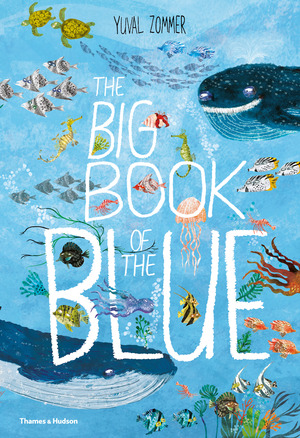
To be out in a boat on the ocean with no terra firma in sight is a lesson in perspective.  Who are we compared to this expanse?  What lies beneath our boat?  In his third title (The Big Book Of Bugs and The Big Book Of Beasts) author illustrator Yuval Zommer presents a multitude of answers in The Big Book Of The Blue (Thames & Hudson, June 5, 2018).

Can you find . . .
. . . exactly the same sardine
15 times in this book?
Watch out for imposters.

In twenty-seven separate sections following this challenge it's a given readers will be actively looking for the sardine among the flow of creatures moving on each page.  They will certainly stop at the first two-page picture dedicated to Who's Inside?  Here they receive an overview of the contents with the corresponding page numbers.

Five Ocean Families are presented based upon specific characteristics such as having gills or lungs, being cold-blooded or warm-blooded or living with a particular type of skeletal structure.  Whether you realize it or not, Fins and Flippers are not the only form of motion for these residents of the watery realm.  Seahorses are the only fish with fins swimming upright.  By gathering water into its body and blasting it out, an octopus wastes no time getting from one point to the other.  All these animals, like us, need air to survive.  How they acquire oxygen varies.  Did you know a sperm whale can go for two hours without taking a breath?

The lack of teeth does not deter sea turtles from cutting their food; knifelike jaws work very well.  In order to leap out of the water a flying fish needs to be speeding at 37 miles per hour.  Like a human's fingerprint, a seahorse's crown is unique.  You won't believe the missing parts on a jellyfish.  One of them is a heart.  Perhaps there's a folktale explaining this and the three hearts found in an octopus.

They are not vegetables but whales are grouped in pods.  Have you ever wished you could look in two different directions at the same time?  Ask a crab how this works.  There are sharks that have to keep swimming or they will suffocate.  It's been said krill form groups large enough to be seen from space.  This is amazing when you realize they are about two inches long.

It's fascinating when you learn why sea snakes shed their skin multiple times (between nine and twenty) during a given year.  Did you know a swordfish can poke a hole through a boat? The facts about tuna will make your head spin especially the number of tuna tins one blue fin tuna can fill.  The colors on a penguin protect it when it's in the water mimicking water and sky.

The second most poisonous animal in the world is the only fish that blinks.  Even tide pools are tiny kingdoms of amazing life.  You probably won't have any luck grabbing a butterfish; they're actually greasy.  We are shown what creatures live at 450 feet all the way down to 20,000 feet and beyond.  Two pages address how large vessels, overfishing and global warming are harming the oceans as well as the danger of plastic.  Thumbnails help readers locate those sardines they could not find.  Six paragraphs on two pages address terms used most often when talking about our oceans.  The title closes with sea creatures bordering a two-page index, white print on a black background.  It's an informative and striking depiction.


Yuval Zommer takes his skill as a researcher and writer and uses it to gather and present the best kind of information about each topic.  He has this childlike curiosity of wanting to know as much as possible but particularly those weird and wonderful tidbits of knowledge.  You are unlikely to forget what he tells you in this book.  His sentences are succinct but entirely conversational.  He has the gift of awakening the seeker in all of us.  Here are some of his enticing words.

Swim goggles
A sea turtle has see-through eyelids that it
uses like a pair of goggles to see underwater. 

Not half bad!
If a jellyfish is cut in half,
it becomes two living jellyfish.

Half-asleep
A dolphin sleeps by resting one
half of its brain at a time.


Opening the book case allows you to see the vast and exquisitely detailed sea creatures swimming around the text on the back (speaking about the book) and among the title text on the front.  The letters on the front and all the animals are varnished on the case.  This is a captivating introduction of what the book holds for readers.

On the opening and closing endpapers a pale-blue, nearly marbleized, canvas extends from edge to edge.  Several schools of small fish are featured in the background.  White lines circle and swirl indicating currents.  More brightly colored fish swim in from the upper left-hand corner on the opening endpapers.  On the closing endpapers this group appears in the center.  The smaller schools have moved also.

On the title page, table of contents, and index pages Yuval Zommer uses his ocean residents to frame his text. You are never quite sure the shade of the ocean you will see when turning a page but it's guaranteed you will be intrigued and entertained.  The intricacy of each scene and the elements you find there are certain to have you returning to pages repeatedly.

The illustrations are completely realistic but in Yuval Zommer's signature style.  It's as if he has lived among the animals he draws so they and their habitats are portrayed fully animated.  A seagull turns its head in curiosity at a crab on the sand.  Seals swim through a variety of fish but also lounge on rocks partially covered in seaweed.  Dragonets glide past sea fans, seaweed, octopuses, jellyfish and other inhabitants.

One of my many favorite illustrations is for the two pages dedicated to krill.  Along the top of the two pages a ship moves through the waves.  A night sky with a full moon and a few stars is partially covered in clouds.  On the right two other boats move in and out of the scene. The water color is deeper reflecting the darkness of the sky.  Krill move in swarms on the sea.  Creatures who feed on them are present.  On the left a large, hand-held magnifying glass focuses on several krill so readers can see their shape and size.


Without a doubt this title, The Big Book Of The Blue written and illustrated by Yuval Zommer, like its predecessors, will rarely be on the shelves.  Readers of all ages can't resist the illustrations and the facts found in these pages.  I highly recommend this book for your professional and personal book collections.

To learn a bit more about Yuval Zommer please follow the link attached to his name.  Yuval is a guest at the World Book Day site.  You will enjoy the Q & A.  He also has an account on Twitter where he frequently posts artwork.  You can see interior views from this book there.


Please remember to visit Kid Lit Frenzy hosted by educator Alyson Beecher to view the titles selected this week by other participants in the 2018 Nonfiction Picture Book Challenge.