If you are fortunate to stand on the shore of a sea or of an ocean, the memory of being there for the first time will remain with you for the rest of your life. A range of emotions washes over you. You are amazed. You are humbled. You are intrigued. In your mind, this boundless body of water before you generates a multitude of questions. It has answers, some more easily found than others.
By careful observation certain discoveries are disclosed. If you seek other answers, The Sea Knows (A Paula Wiseman Book, Simon & Schuster Books For Young Readers, May 5, 2020) written by Alice B. McGinty and Alan B. Havis with illustrations by Stephanie Laberis is a marvelous introductory volume revealing many mysteries. It's like taking a tour beneath the blue-green expanse.
We are young. The sea is old. The sea has secrets to unfold. The sea knows.
The sea is home to the largest mammal on our planet. It its depths reside some of the tiniest creatures. The size of the plant life ranges in height. The patterns on the fish are varied as is their texture.
In the sea there are creatures who are more powerful than others. Some are clever enough to hide, but equally there are those who know how to find them. Just like our night sky, the sea harbors stars, and glowing lights.
There is a range of color under the sea. Their vibrancy calls our attention as does their contrasts. One thing is constantly true. No matter where you look or how deep you go, there are many hues of blue.
Some things float upon the sea and others plunge into its deep, dark places. If you listen and look, the sea shares sensory sensations like splashing and bubbles. During the sunniest of days or during storms, the sea shows us many sides. It exhibits high winds and steep waves. It is a majestic power which can just as quickly subside into serenity. The sea does know.
Using the final word in a sentence or phrase as a rhyming connection, authors Alice B. McGinty and Alan B. Havis invite readers to join them on a spectacular adventure. Repetition of key words enhances the tempo. Opposites inform and challenge readers to speculate. Each window into this world encourages reflection, further research and welcomes visual interpretation. Here is a passage.
The sea knows short. The sea knows tall. The sea knows spots, the sea knows shiny. The sea knows smooth, the sea knows spiny.
When you open the matching dust jacket and book case, you are greeted with two lovely vivid visions of life beneath the waters of the sea. On the front, right, light from the sun filters to creatures, coral, and plant life as a lone seagull glides above them. To the left, on the back, a brilliant octopus lounges on a ledge as a sea turtle slides through the water overhead. The shades of blue and green in both these illustrations display the many varied physical qualities of the sea. The text and several of the larger fish on the front of the jacket are raised and varnished.
On the opening and closing endpapers, in reverse directions, a school of yellow longnose butterflyfish swim in turquoise waters. A few fish and seaweed are placed on the verso page. Another sea scene holds the text for the title page.
Each page turn supplies readers with wondrous insights into the sea through the artwork of Stephanie Laberis. Digitally rendered, each one, either a double-page picture, edge to edge, a full-page image, edge to edge, or a full-page visual with loose framing and elements breaking that framing, presents various perspectives. At times we are close enough to the subjects to be among them. At other times we are silent witnesses to enchanting seascapes. The appealing and numerous details inspire further investigation.
One of my many favorite illustrations is a single-page picture for the words
the sea knows spiny.
Rich tones of blue surround the main being. To the right and left are other animals and structures in contrasting colors. Front and center is a puffer fish, blown up in defense. Its spines stick out around its body. It is looking wide-eyed at readers.
When through the text and images in a book you can travel flawlessly to a place you've never or rarely seen, it is something special. The Sea Knows by Alice B. McGinty and Alan B. Havis with illustrations by Stephanie Laberis is an attractive and informative title certain to engage readers. Its rhythm is as varied as the sea, ever-changing and alluring. At the close of the book, further facts about each specific quality are presented. You will want to have this title in your professional and personal collections.
To discover more about author Alice B. McGinty and illustrator Stephanie Laberis, please visit their websites by following the links attached to their names. At Alice B. McGinty's website there are two videos I know you will enjoy, including a read aloud of the book. Alice B. McGinty has accounts on Facebook, Instagram, and Twitter. Stephanie Laberis has accounts on Instagram, and Twitter. At the publisher's website you can view interior images. At PictureBookBuilders this book is discussed in a Q & A. In this post mention is made of the authors' website titled News From The Happy Side. At Kathleen Temean's Writing and Illustrating Stephanie Laberis is interviewed.
When you stand on the shore of a large body of water, gazing across its expanse, something happens deep inside you. Being in the presence of this greatness is humbling but soothing. It helps you to realize as small as you may be, you are a part of something greater than your eyes can see. This water spread before you is alive. It sustains life on our planet.
We wade and swim in it. We walk along its sandy or stony beaches looking for treasure. If we are fortunate one of the creatures living in this water will reveal itself to us. That's a memory to cherish. Ocean! Waves For All (Henry Holt and Company, May 5, 2020) written by Stacy McAnulty with illustrations by David Litchfield is the latest entry in the Our Universe series. Ocean has a lot to tell us, so let's listen and learn.
Dude, I am OCEAN. You know my many names: Atlantic, Pacific, Arctic, Indian, Southern. It's all excellent me.
Even though we've given Ocean many names, it is one large body of saltwater covering our entire planet. Seventy-one percent of Earth is covered by Ocean. Ocean represents no country but welcomes everyone. Did you know Ocean is older than the air we breathe? Ocean was here before any land masses.
First life, so tiny a human eye cannot see it, began in Ocean. Today the largest animal on the planet lives in Ocean. Do you know what it is? Ocean is home to the largest landform found anywhere in the world. Ocean is a super liquid highway, boasting ships numbering in the tens of thousands using it every day.
Like our atmosphere has layers, so does Ocean. There's one named the Twilight Zone. It is 656 to 3,281 feet deep.The pull of the moon creates tides, high and low, on Ocean.
Ocean has several messages for us. We need to get serious about exploring all Ocean has to offer. Comparisons are made between how we've made more discoveries about Mars than we have about Ocean. Ocean is disturbed about all the plastic pollution and the melting of glaciers. Ocean's closing words are a hopeful request, and a reminder.
Readers will find themselves smiling at the first word, Dude. Throughout the narrative, author Stacy McAnulty uses words from the 1980s heightening the entertaining delivery of the information Ocean tells us. Each placement of these words is as natural as the voice using them. The facts shared by Ocean (Stacy McAnulty) are exactly what we need to know, but they also invite us to further educate ourselves. We learn history, world records, basic facts, the role of the ocean in our lives, the wonders to be found and a plea for protection. This is all done in a highly engaging conversational style. Here is a passage.
And more humans have visited outer space than my deepest spots. Awesome for outer space.Bummer for me. Ninety percent of my waters are completely dark, cold, and yet totally rad. Come explore my secrets.
The beautiful underwater world seen on the front of the dust jacket continues on the other side of the spine when it is opened. There the fish, and plants are darker and more pronounced than on the front. On the back on the surface of the ocean, a cargo ship heads toward the left edge. When we met Ocean on the front, he seems eager to see us. His eyes and mouth indicate he can hardly wait to speak. His hands beckon to us.
The image on the book case is a reverse of the introductory image when the narrative begins. It's done in hues of blue, pink, and purple. Ocean is waving to us with one hand and pointing to himself with the other hand. Among the ocean plants is a turtle, a shark, several jellyfish, and schools of smaller fish. Around Ocean's face the colors are lighter, but on the edges, they are darker, richer.
On the opening and closing endpapers we are treated to two different dazzling displays of the multitude of life to be found in the ocean. On the closing endpapers we are much deeper in the ocean. Divers are exploring the depths and the unusual creatures.
created with pencils, ink, watercolor paints, and digital art tools
the illustrations for this book. They are a stunning array of double-page pictures, vertical panels, a book super-imposed on Ocean, and single-page images framed in white. In all of them we see Ocean's eyes and mouth and usually his hands. One time he is holding a magnifying glass. The size of his face varies according to the illustrative interpretation of the text. Readers will find themselves pausing at every page to savor the included details. It's fun to see which residents can be identified.
One of my many, many favorite illustrations is when Ocean is reminding us of his importance. He mentions his role in climate and his vital importance to all life. In this double-page picture Ocean is spread across most of the two pages. His face is on the left along with one of his hands. Here icebergs are featured along the top with two whales. On the bottom is a sandy beach with people enjoying the water. As our eyes cross the gutter a thunderstorm rages on a portion of the top and a moon rises among stars on the far right. Ocean's second hand seems to be holding up the thunder clouds with lightning zigzagging down and rain falling. Along the shore here is a woodland scene with a male and female deer standing on the water's edge.
This book, Ocean! Waves For All written by Stacy McAnulty with illustrations by David Litchfield, is wonderful for the facts, the words used to inform readers and the images. This book, like Earth! My First 4.54 Billion Years, Sun! One In A Billion and Moon! Earth's Best Friend, is upbeat, captivating, and inspiring. At the close of the book Stacy McAnulty chats with readers, offers more items of information, challenges us, and provides sources. You will want to add this title to your personal and professional collections.
To learn more about Stacy McAnulty and David Litchfield and their other work, please follow the links attached to their names to access their websites. David has interior images on his website. Stacy McAnulty has accounts on Facebook, Instagram and Twitter. David Litchfield has accounts on Facebook, Instagram, TumblrandTwitter. This series has its own website. Here is a link to activity kits from the publisher. At the publisher's website you can view interior images. You will really enjoy this conversation between the two creators.
Be sure to visit Kid Lit Frenzy hosted by educator Alyson Beecher to view the other titles selected this week for the 2020 Nonfiction Picture Book Challenge.
While it's important when developing collections to center our focus on those readers we primarily serve, it's also worth remembering they have members of their immediate or extended families who need to read. For this reason, there was never any hesitation to place picture books in a middle or high school library (or board books in an elementary school library). Picture books are powerful whether the narrative comes from someone's imagination or gathered information.
On the release date of picture books, sometimes the same titles are available in board book format. Nerdy Babies: Ocean and Nerdy Babies: Space (Roaring Brook Press, May 7, 2019) written and illustrated by Emmy Kastner are two such books. With cheerful, informative and humorous text and images our youngest readers (and those who read to them) are invited to travel the oceans and into outer space. Let's first see what the watery realms reveal.
Off the coasts, swirling between each continent on our planet . . . you'll find the ocean.
Although most of our planet is covered by ocean water, we can't drink it. It's salt water. Animals live on shore and hunt for food in the ocean like birds. Some ocean dwellers show themselves on the surface of the ocean when they need to breathe or sleep.
The sun not only warms the ocean but helps plants and animals who live there. Ocean life, like blue marlins and leatherback sea turtles, migrate just as birds do. Animals in and around the ocean stay warm because of their blood, fur, feathers or blubber. Do you know how many miles deep the ocean is? Do you know which ocean animal is kin to elephants? You can be as curious as a marine biologist no matter your age.
We need to look up, farther than our eyes can see, to explore outer space. As big as the oceans are outer space stretches on and on and on. What can we find there?
Hello, Nerdy Babies! Do you ever wonder about SPACE? You probably do. You're curious.
It's home to countless stars. The temperature is cold. You'll float up there because of the absence of gravity. It's quieter than quiet; there is no sound.
In our solar system planets spin in orbit around the hot, hot, hot sun. It takes Earth 365 days to go around the sun. Our moon spins along the orbit too. Did you know footprints made on the moon will always stay there?
Each of the eight planets has unique characteristics. One of them is the smallest. Another one spins backward. And still another is home to the tallest mountain in the solar system. Neptune is so far from the sun; it can't complete one orbit in any recorded human's lifespan. Astronauts are as eager to learn about outer space as anyone else of any age; especially a nerdy baby.
The spare narrative of Emmy Kastner peaks readers' interest. It provides answers to questions they might have about oceans or outer space. They will be fascinated by all the topics she covers in the limited pages. Her additional text in speech bubbles and captions supplies facts and humor. Here are two more passages.
Most of the ocean is cold.
AREN'T YOU COLD?
Since fish are cold-blooded, their bodies adjust to match warm and cold water.
Do you love the moon? Earth sure does!
They travel around together.
LIKE PEAS AND CARROTS!
Sturdy case covers with expandable binding, durable pages and vibrant colors give immediate appeal for the intended audience. Four babies wearing eyeglasses and appropriate attire appear throughout the books. Two different ones introduce the topics on the front but all of them are shown on the back of the book cases.
When the case cover is opened the narrative and illustrations begin. They continue until the final page. Definitive lines, delicate details and easily identified shapes permeate the images. Readers will enjoy identifying all the elements in each picture; a tiny hermit crab coming out of a shell, baby turtles heading to the water, a teddy bear wearing a pair of water goggles, or a beverage bottle drifting inside a space capsule.
The pictures are either double-page, full-page or several small illustrations are loosely framed on a single page. The backgrounds vary according to the location. The text, speech bubbles and captions are placed in a manner to promote participatory reading. All the creatures and space objects are animated
Two of my many favorite illustrations are on a double page and a full page. On the first a white canvas is used to highlight an array of colorful ocean creatures. Some of the animals are put in an ocean setting which frames them. In the lower right-hand corner, the child seen on the front of the book case has changed his gear. His teddy bear is diving with him. He asks DO YOU HAVE A FAVORITE?
The second picture is placed on a white background which acts as a wide border. One of the children is running across our moon, wearing a white space suit. The footprints remain. The moon is smiling with closed eyes. A few stars can be seen in the darkened background.
Whoever reads Nerdy Babies: Ocean and Nerdy Babies: Space written and illustrated by Emmy Kastner will find themselves smiling at the author's use of imagination, information and art. Trust me. I've been smiling for hours. I recommend these for both your professional and personal collections. They will work wonderfully for one-on-one reading or with small groups. They are certain to prompt further research, discussions and learning.
There are those books which command the attention of everyone regardless of whether you are a science geek, fact finder or seeker of trivia. These books are brimming with interest on every page turn. These books add depth and breadth to our understanding of the world in which we live.
On October 8, 2013 Maps (Big Picture Press) written and illustrated by Aleksandra Mizielinska and Daniel Mizielinski was released. The size, 10 5/8 by 14 9/16, is indicative of the quality and quantity of the contents. Printed on heavy matte-finished paper with a sepia-toned finish on cream, the text and pictures take readers around the world. Each two-page spread is framed in an intricately rendered border varying in design.
We are treated to a world map, maps of the continents and individual countries. We see political borders, flora, fauna, cultural foods, activities, natural and man-made wonders, housing, clothing, famous persons and specific place names. Significant bodies of water and mountains are featured. Famous works of art and literary and historical milestones are included. Creatures which may be found in the oceans and seas surrounding the land masses are duly noted.
Each element in the images is carefully labeled. Sometimes one or two sentences offer further explanation. This book of maps, this atlas, combines the best part of political, resource, and physical maps.
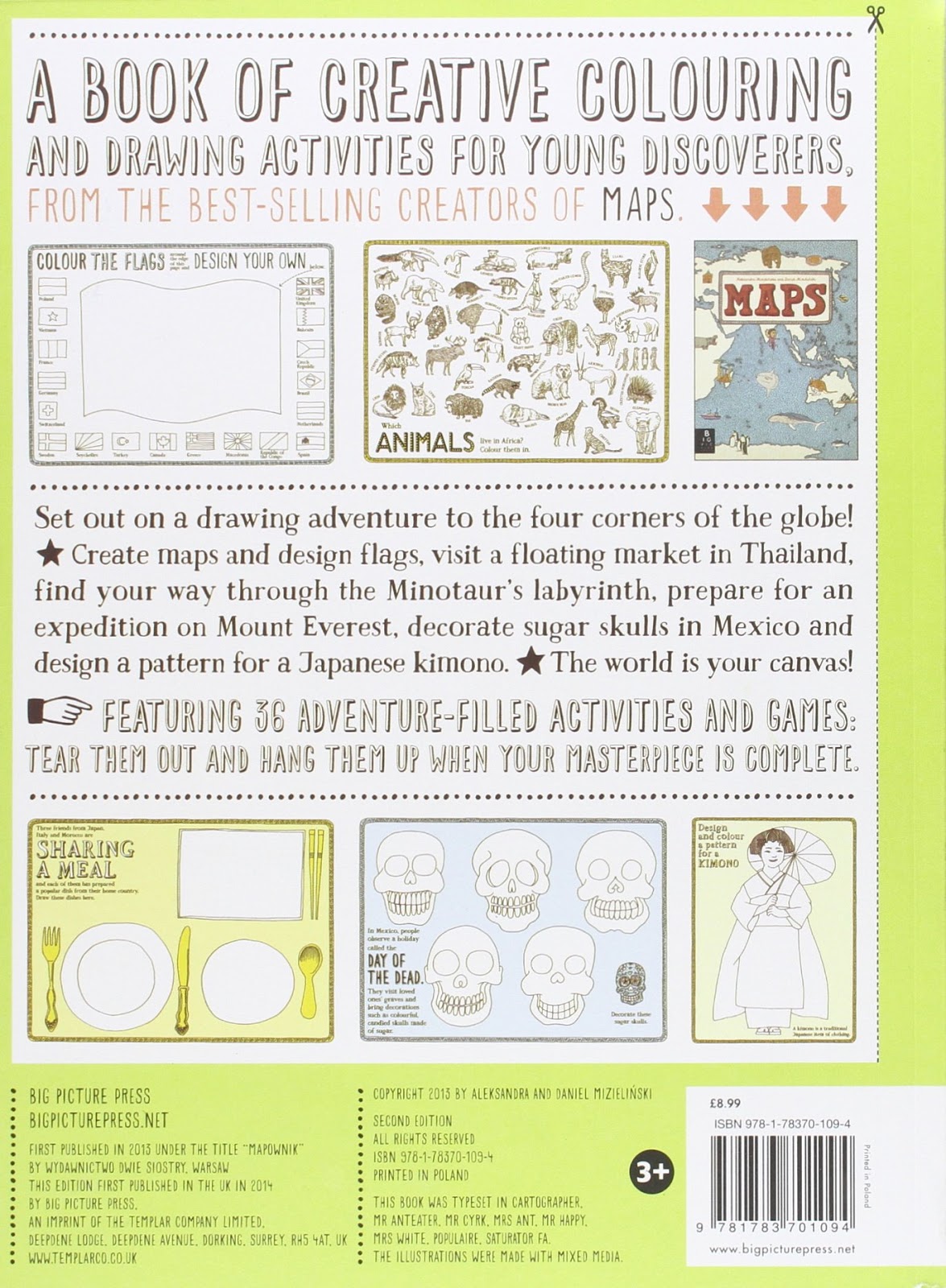
As an enhancement to the original publication Big Picture Press published the Maps Activity Book written and illustrated by Aleksandra Mizielinska and Daniel Mizielinski on July 1, 2014. Smaller in size, 12 by 8 4/5, this paperback with special binding for ease of page removal delivers interesting challenges involving drawing, coloring, research, and creative imagining and thinking. On the back of each of the thirty-six activities a tiny character, children from around the world, impart more fascinating facts in a single speech balloon.
Users might be asked to draw a map of an imaginary country, pretend to be an explorer in the Amazon and draw animals, plants and people they might find there, invent another glyph to add to the ancient Mayan language, color flags from countries and design your own, select which animals on a given page actually live in a specific place or create a pattern for a kimono. Each of these activities invites readers to discover more than they originally know. The fantastic facts on the back of the activity pages might tell us where the largest active volcano is located, its size and the number of times it has erupted or who designed the updated U. S. flag after Alaska and Hawaii became states or supply readers with information about the original inhabitants of Australia. The pages can be used for single individuals or as a guide for the generation of more related educational adventures.
The most recent title in this trio, Maps Poster Book (Big Picture Press, February 23, 2016) written and illustrated by Aleksandra Mizielinska and Daniel Mizielinski is twenty-seven maps plus the world map found in the first volume, condensed in size to 11 3/8 by13 9/16. On one side of the poster is the exact replica of either a country, a continent or a large area, the Arctic. On the other side the highlighted map is shown in color within a larger two-tone map. All of the pages are perforated for removal.
The newest book by the collaborative duo of Aleksandra Mizielinska and Daniel Mizielinski, which again demonstrates their talents in exploring our world exquisitely, is Under Earth Under Water (Big Picture Press, March 1, 2016 UK, October 11, 2016 US). For sixty-three pages we peer into the ground until we strike the core of our planet. In the following forty-five pages we work our way to the surface but through the seas or oceans. A clever design allows you to begin with either the earth or the water.
If we look just beneath the dirt all kinds of creatures seen with the naked eye or under a microscope can be found. Discovering the giant Gippsland earthworm in Australia would be rather startling as it can grow to be nearly ten feet long. Anthills are far most vast and sophisticated beneath the surface than what we find above ground. Did you know there can be more than one queen in one anthill?
Intriguing information about borrowing animals, moles, naked-mole rats, prairie dogs, badgers, and red foxes are revealed in greater depth. Plants with edible and medicinal portions growing under the surface are explained as other pages showcase majestic trees. Man-made cables stretched below the surface, the vast networks used to transport natural gas, electricity and water used in homes as well as waste disposal are presented. Travel by tunnels, general and specific, and how tunnels are made is a fascinating section.
Archaeology, paleontology, speleology, and mining are explained. Pages are devoted to those products made from the riches, natural resources, taken from the earth. Information about ThePacific Ring of Fire and plate tectonics are pictorially displayed. The deeper we go volcanoes, hot water springs, geysers, layers of the earth and the center itself are discussed.
From here we start to head upward learning of vessels like the Deepsea Challenger used to explore the bottom of the sea. Trenches and their strange inhabitants fill several pages. Did you know that the glow seen at the tip of the triplewart seadevil's rod is actually other tiny lifeforms? Have you ever heard of underwater chimneys? Some of those chimneys are found as far below the surface as sixteen thousand feet!
We have studied the Titanic, other sunken shipsand an array of places using submersibles specially furnished with scientific equipment. We have drilled into the seabeds using unique platforms to extract oil and gas. (I wonder if any of those human workers have ever seen a colossal squid or blue whale showcased in several pages.) A history of the development of diving suits and submarines will astound readers. Many forms of diving and famous divers are disclosed.
As we continue to move toward the surface we learn of water pressure, sinkholes, coral reefs, and the properties necessary for something to float. To further our knowledge a comparison is made between the residents of an ocean and a freshwater lake. As we come to the top, seeing the sky above, we can make the choice to dive down beneath the waves again or head to terra firma and start digging once more.
As in the Maps title the authors have meticulously labeled every item in the illustrations, inviting further research by readers. Each two-page illustration, top to bottom horizontally, places informative text in rounded boxes blending into the image. Each of these boxes contains one to five sentences written in an easy, conversational style. (Readers should note the measurements are given using the metric system.) Here are some sample passages.
The roots that reach deepest are of plants that grow in deserts. The plants send them deeper and deeper underground in search of water.
In the far north of Russia, beyond the Arctic Circle, scientists drilled the world's deepest hole to gain a better understanding of the Earth's structure. The borehole took 22 years to create and was more than 12km deep.
The Great Lakes are the Earth's biggest bodies of fresh water. The most extensive freshwater lake, Lake Superior-on the border of the United States and Canada-is bigger than the Czech Republic. The world's deepest lake is Lake Baikal in Russia, which reaches a depth of up to 1642m.
At the bottom of the ocean, hundreds, or even thousands of metres underwater, unusual places lie hidden that resemble fields of smoking chimneys. The clouds that emerge there are not smoke, but hot water full of minerals.
When the book case is opened readers can view the table of contents for each section, earth and water, laid before them like a path to follow, with small images, page numbers and titles given. Shades of blue are used as the background in the portion on water. Once we begin to delve into the section on the earth a more varied color palette is used.
The fine line work, layers of complex aspects, layout and design represent painstaking planning and implementation. Within each illustration and from picture to picture everything flows flawlessly. You might think the large amount of elements would be a distraction but that is simply not true. They are an invitation to explore, discover and learn.
Two of my favorite illustrations of many are one from the water and one from the earth. The Carmagnolle brothers' diving suit is featured in a single visual stretching from top to bottom. It is standing in a bed of seaweed entirely submerged. Seven labels containing facts are attached to it as is an important date. Bubbles rise from the bottom in several hues of blue. As a gardener the six horizontal rows highlighting roots, rhizomes, tubers and bulbs are fascinating. Each is named with most containing special uses and locations where they are found. Realistic colors are employed. Gals and guys will be absorbed in the cross-sections devoted to moles, naked-mole rats, prairie dogs, badgers and red foxes.
Under Earth Under Water written and illustrated by Aleksandra Mizielinska and Daniel Mizielinski is a marvelous, mesmerizing look at our planet's earth and water characteristics, the flora and fauna residing there and the secrets they have revealed to us. This team has also added people and scientific advancements of significance relative to both. The sturdy book case and heavy paper make this a lasting worthwhile addition to personal and professional collections. Your patrons and students are going to love it. I advise getting several copies.
I was unable to locate any information on Aleksandra Mizielinska and Daniel Mizielinski but more information about this title and the others by this team can be viewed at Candlewick Press, Big Picture Press, and Templar Publishing. Enjoy the book trailer.
To enjoy the other titles selected by participants in the 2016 Nonfiction Picture Book Challenge please access Kid Lit Frenzy hosted by educator Alyson Beecher.
 By careful observation certain discoveries are disclosed. If you seek other answers, The Sea Knows (A Paula Wiseman Book, Simon & Schuster Books For Young Readers, May 5, 2020) written by Alice B. McGinty and Alan B. Havis with illustrations by Stephanie Laberis is a marvelous introductory volume revealing many mysteries. It's like taking a tour beneath the blue-green expanse.