Quote of the Month

When love and skill work together, expect a miracle. John Ruskin


Showing posts with label mathematics. Show all posts

Wednesday, December 8, 2021

One Is Never Lonely

When you define one according to Merriam Webster, it is being a single unit or thing.  So, this morning one school librarian walked her dog along one route in one town.  If you really think about it, is that the whole truth?

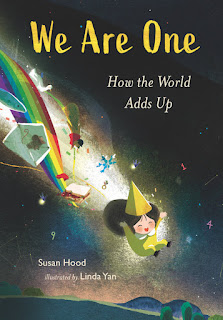
Is there more to the one school librarian, her one dog, their one route, and the one town in which they reside? Author Susan Hood and illustrator Linda Yan believe there is.  We Are One: How the World Adds Up (Candlewick Press, November 2, 2021) introduces a variety of mathematical concepts and expands our perspectives at the same time.  This is what makes our world so marvelous!
One can be one thing
all on its own---
one star,
one stream,
one stick,
one stone.

But those on their toes, those using their smarts,
know one can be more than the sum of its parts.

Our views are broadened one number at a time.  How many combinations of two can you imagine that equal one?  How many slices of bread make one sandwich?

Number by number, three, four, and five allow us to see how combinations of each can make one.  A haiku poem is formed with three lines.  How many points are there on a single compass?  Famous author Williams Shakespeare determined each of his plays would have five acts.

A way for the blind to see incorporates the number six.  The next time you look at a rainbow what number will come to mind?  What geometric shape has eight sides?

This numerical journey ends with nine and ten, but there is more to consider.  We know we are one individual human being, but are we not part of an ever expanding number beyond ten?  Numbers grow larger and larger when we go beyond our family, our workplace (school), our community, our country and our Earth.  And yet, that greatness, that vastness, comes back to the beginning.


We are joyfully welcomed into this counting realm with rhyming couplets meticulously penned by Susan Hood. We are skillfully presented with multiple parts that equal one.  On each page recounting these truths is more information.  Along the bottom like a conversational aside, Susan Hood supplies us with fascinating facts relative to the number being discussed. (These are in a golden yellow band.)  Here is a passage.

Three letters together spell out the word you!

Letters add up to words.  Words add up to sentences.  Many stories and poems follow the rule of
three, a writing principle that suggests characters and events are more satisfying when they come in
threes.  Just think of "The Three Little Pigs" and "Three Billy Goats Gruff."  From a three-ring circus to
the three primary colors, the rule of three (omne trium perfectum in Latin) says trios equal perfection. 


The digitally rendered illustrations by Linda Yan first seen on the matching dust jacket and book case elevate the happiness radiating from the text.  The image on the jacket and case stretches from the far left edge on the back to the far right edge on the front.  Multiple elements mentioned in the narrative and pictorially interpreted page by page spill from the top of the far-left corner in a trail of stardust behind our guide dressed in yellow.  Numbers tumble down from this pathway, falling to the rounded horizon.  Those elements and the main character are varnished on the jacket; making a stunning contrast to the dark atmosphere.

The opening and closing endpapers are covered in a bright sea green.  On the title page, the child wearing their yellow suit and pointed hat is standing on a stool on a rounded surface.  Colored building blocks are scattered about them.  A tripod holding a telescope is directly in front of them.  The dark sky holds tiny colored numbers like stars.

Two-page pictures and full-page visuals flawlessly flow from beginning to end.  Careful readers will see elements in one illustration appear in the next one or two or three or four.  The sandwich mentioned in the number two sequence is next to the child in the first image.  That sandwich is carried away by two mice into their hole.  It is the food for their wedding reception.

Linda Yan, complementing the text, brings us close to a particular scene when necessary or moves back to give us a larger view.  We see the mice carrying the sandwich to their hole from a distance, back with the child.  In the next image, she is peeking through the mouse hole.  We are brought close to the mice as they marry.

Readers will delight in seeking the child in each picture.  Sometimes she is larger than life, and other times you have to search for her.  Toward the end of the book, the child is joined by other children of diverse ethnicity and genders.  Total bliss resonates.

One of my many favorite illustrations is for the number five and the reference to five moves central to ballet.  We are inside a dance studio.  Light beams in three arched windows along the upper portion of the picture.  In front of the windows are a bluebird (large), a giraffe, a fictional character, a red squid, and pig.  They are all wearing ballet slippers and tutus as they demonstrate the five poses.  Our guide, still wearing her signature yellow, also has a tutu.  A musical score with notes is behind her as she runs across the wooden floor.


As soon as you understand the rhythm of the words written by Susan Hood and the accompanying artwork by Linda Yan, you will find yourself wondering what will be revealed with the next page turn in We Are One: How the World Adds Up.  You won't be able to stop thinking of other numbers.  How much fun is that?!  At the close of the book are Source Notes, Sources and Resources, Especially for Kids (sections expanding on the facts given in most of the numerical discussions), and More About How the World Adds Up:  Here are some other things that come in groups of . . . Under each number beginning with ten are lists to get you thinking.  I know you'll want to have a copy of this book in both your personal and professional collections.

By accessing their respective websites, following the link attached to their names, you can discover more about Susan Hood and Linda Yan and their other work.  Susan Hood has accounts on Facebook, Instagram, and Twitter.  Linda Yan has an account on Twitter.  At Penguin Random House, you can view interior images.

Thursday, May 15, 2014

Fun-Filled Fraction Action

Every time we divide a whole into parts our mathematical skills are put to use.  Without even being aware we are constantly fractionizing our day and many things in it.  We know it takes forty-five minutes to get from point A to point B; every fifteen minutes we are a third of the way closer.  The last two brownies are cut in half to share between four family members.  It takes ten pails of water to fill the kiddie pool one quarter full.

While we may not be consciously aware of these numerical nuances, there are those thrilled with any opportunity to practice their expertise in this area.  In fact there are even people who collect fractions. I know it's hard to believe it's true but in Fractions in Disguise: A Mathematical Adventure (Charlesbridge) written by Edward Einhorn with illustrations by David Clark, three people are victims of an evil mind.

Some kids collect baseball cards.  Some collect action figures.  Me?  I collect fractions.  I've been collecting them for exactly 2/3 of my life.  In my bedroom, shelves full of fractions cover 3/4 of the walls. 

As you may have surmised George Cornelius Factor is a walking, talking fraction fanatic.  He is joined in this love by Baron von Mathematik and Madame de Geometrique.  The three are in attendance at an auction for a beautiful object, a brand new 5/9.  A rather sinister figure, Dr. Brok, is lurking in the background.

Bids are reaching the one million dollar amount when the room suddenly goes dark.  All eyes land on the empty pedestal when the lights are turned on once more.  The valuable 5/9 piece is missing; so is Dr. Brok.

As the Baron and Madame are lamenting its disappearance, GCF has a plan.  Dr. Brok may have met his match.  Dr. Brok thinks he's pretty clever with turning 1/2 into 4/8 or 3/6 attempting to hide a fraction's true essence but GCF goes to work spending the entire night creating his own device, the Reducer.

This gizmo has the ability to take a fraction down to its lowest terms.  A number is dialed before it shoots.  If the fraction is divisible by it, an immediate change can be witnessed; otherwise either the numerator or denominator simply struggle to shift but remain the same.

George Cornelius Factor goes to Dr. Brok's mansion demanding entrance and accusing him of the theft. The shifty swindler loses some of his oily charm when he sees the Reducer in action.  Up, down and all around GCF goes but the missing 5/9 is nowhere to be found in the piles of fractions...or is it?


Cleverly inserting numbers into the narrative and dialogue Edward Einhorn manages to entertain while informing in a flawless flow.  Engaged in the puzzling mystery and humorous action, readers will accept the mathematical terms like any other descriptive words in a story.  His use of word play supplies the final elements in the formula for fractional fun.  Here is a short sample from the book.

Dr. Brok lived in a mansion that had to be 1/10 of a mile tall.  When I rang the bell, he opened the door halfway.  


The colorful comic cartoon figure (none other than George Cornelius Factor) on the matching dust jacket and book case, piles of circles (fractions) within a larger circle, the Reducer resting on his knees, is the type of scene on every page in this title.  All the pictures are set on a white background with the exception of one spanning a single or double page.  Using ink and watercolor David Clark inserts exaggerated personality traits in his character portrayals giving an academic, old-world feel to the surrounding items in each illustration.

His details add an extra dimension; the 4/8 spike on the Baron's helmet, the complicated machine Dr. Brok uses to disguise the fractions, the paper scroll coming from the Reducer with the mathematical fraction action on it and the mouse looking a bit scared as it gnaws on a broken fraction. The larger than life eyes, hairstyles (including bald), noses and lips along with the attire worn by the characters will definitely raise the smileage level they bring to the story.  Splashes of red, hues of red, add warmth and zing to the pictures.

One of my favorite two page spreads is when George Cornelius Factor holds up the ultimate clue to trapping Dr. Brok in his deception.  The look of triumph on GCF's face contrasts nicely with the look of pure guilt on Dr. Brok's face.  George's arm extending from his body on the left grows larger in perception as he grips the object between two fingers in front of Dr. Brok.  Readers will be thinking "Ah-Ha" when they see this.


Fractions in Disguise written by Edward Einhorn with illustrations by David Clark is one of those fun-filled books about math adults will want to have because their children will enjoy the story completely.  Even after several readings I still find myself grinning at the exclamations made by the characters.  I recommend reading this with a separate voice for each one.  George Cornelius Factor and fractions are the heroes of the day.

Back matter on the final page further explains reducing fractions.  For more information about Edward Einhorn please follow the link embedded in his name above.  This is one of many books in the Adventures in Math series found at the publisher's website.

Wednesdays are a terrific day for nonfiction books.  I am pleased to be a part of Alyson Beecher's 2014 Nonfiction Picture Book Challenge highlighted on her blog, Kid Lit Frenzy.  There are many excellent titles listed there by other bloggers.


Tuesday, October 1, 2013

Numbering The Years

Do you remember playing hide and seek with the neighborhood kids as it started to get dark?  Whether you were "it" or running toward the ultimate hiding spot, the sounds of counting rang out.  Using a well-known, tuneful chant, our group reached one hundred by fives.  When the top number was reached you could hear those familiar words, "Here I come, ready or not."  It was like a rite of passage when you were old enough to play by counting correctly.

The act of counting is such a part of our lives, once accomplished, we are unaware of the actual amount of times it is used during our day.  In an enlightening and uncommon take on numbers, author, Lola M. Schaefer with illustrator, Christopher Silas Neal, has created Lifetime: The Amazing Numbers in Animal Lives (Chronicle Books).  Let's explore their world with a mathematical eye.

In one lifetime,
this spider will spin
1 papery egg sac.

Fragile. Don't touch.

From cover to cover we read about eleven animals, five mammals, one arachnid, one insect, two reptiles, one fish and one bird, eleven fascinating facts, and eleven ways to count those intriguing details. Within these pages we think, look and tally.  We pause and ponder about what we might notice if we stopped to look more carefully.

Each animal's life is not measured in days so much as it is measured in physical changes, cycles and instinctive habits.  An individual caribou gets not one, not two, not even three but ten sets of antlers during their life.  I know that Xena sheds her coat twice a year but an alpaca does so much less.

Whenever I hear a woodpecker I'll be thinking to myself, is that the second, fourth, sixth or thirtieth house they are carving out of a tree?  The louder a rattlesnake's rattle might mean it has more beads.  How can forty beads fit on the tip of its tail?

Can you guess which Australian marsupial has fifty babies in a lifetime?  I'll bet you'll be surprised not only at the sea mammal who never gets a new tooth but how many teeth they actually have.  Roaming the African savannas is an animal whose adult height and number of spots are a match.

Alligator eggs, butterfly visits to flowers and seahorse births leap from 550 to 1,000.  As the numbers climb our eyes wander from leaf tips to tree trunks, forests to barns and under the sea.  We travel the world number by number, animal by animal.


Lola M. Schaefer begins her book with an introductory explanation of her numerical estimations. She includes factors which might affect these numbers and the experts whose advice she sought.  For each animal she begins with In one lifetime...  Using this phrase repeatedly ties each animal to the one before and after it.  For most she provides a conversational aside.  It's like she is speaking with her readers instead of at them.

At the conclusion of the title, The Animals, the common and scientific name of each are given along with several informative paragraphs.  A computation including the average adult life span further instructs on how Schaefer got her numbers.  In What is an average?  she defines average with an example and how she used averages in this book.  Finally, in a special section, Lola M. Schaefer reveals I love math.  She provides readers with an opportunity to quiz themselves with story problems.

Gazing among the rows of trees on the matching jacket and cover, woodpeckers busy making homes, each hollow numbered, readers realize they're about to take a walk into the world of counting among nature.  Opening and closing endpapers in black feature an alligator with numbers like air coming from its mouth.  Matte-finished paper increases the tactile experience.

Rendered in mixed media, the two page illustrations for each animal by Christoper Silas Neal showcase the individual behavior.  It won't take readers long to discover (second animal for me) that for every number listed Silas pictures the exact amount.  Yes, I did count the 100 spots on the giraffe but not all the teeny-weeny, squiggly-wiggly baby seahorses.

How he chose to illuminate each animal, using a solid background, black, white, green, blue or a combination of two, draws the reader's eye immediately to the intended feature.  His technique of including delicate, intricate details with simple bold elements is appealing in design and layout.  I would not hesitate to hang my favorite illustration, the swallowtail butterfly on black among flowers colored white, blue and yellow, on the walls in my home.

I have been turning the pages again and again of Lifetime: The Amazing Numbers in Animal Lives written by Lola M. Schaefer with illustrations by Christopher Silas Neal for several days.  The pairing of Schaefer's information with Neal's illustrations is completely captivating.  This title could serve as a means of presenting mathematical averages to students or for the beginning of a research project.

Wouldn't it be fun for students to make pages like these? ...to make their own book?  To learn more about the author and illustrator follow the links to their websites embedded in their names above.  If you click on Christopher Silas Neal's link to his blog, you can see more pictures found in this book.   I would pair this with Bugs by the Numbers: facts and figures for multiple types of bugbeasties by Sharon Werner and Sarah Forss. Recently Jen reviewed at Teach Mentor Texts: Using Mentor Texts to Promote Literacy, Million, Billions & Trillions: Understanding Big Numbers by David A. Adler, which would also be a good match.

Monday, March 18, 2013

Finding Your Way...

It's there.  Every single time you open the cover of a book, whether it's new or you're revisiting a favorite.  You may not even be aware of it's presence.   Then again, anticipation, for a few moments may be flowing in your veins instead of blood; you can feel it so strongly.

The hope one experiences in beginning a book by a known author, a preferred genre or in a title already receiving accolades from professional reviewers, is for a lover of books like receiving the greatest of gifts.  If an author decides to heighten this sense of wonder with an enticing beginning word, sentence or paragraph, we readers know a treasure is being offered.  In her second title, Navigating Early, Clare Vanderpool, winner of the 2011 Newbery Medal for Moon Over Manifest, sets the stage for what will be an unforgettable, life-affirming and life-changing adventure with a paragraph on the first page plucked from within the book itself.


The great black bear, awesome as Ursa Major, wagged her head from side to side, and her bellow shook the nearby passage of the Appalachian Trail. ...

It's not the end of World War II that brings Jack Baker's dad, a captain in the Navy home, but his mother's sudden death.  In true shipshape fashion he removes all evidence of Jack's mom's life in their home.  He then takes Jack away from all he knows in Kansas, placing him in a boarding school in Maine along the ocean.  

What neither Jack nor his dad could have foreseen is the strange boy, living and attending Morton Hill Academy, Early Auden.  Early needs quiet so he lives in custodial quarters in the basement.  He plays specific musical records on certain days, lines up rows of colored jelly beans when he's upset, believes his brother killed in action overseas is alive, is obsessed with the mathematical constant pi (even using the numbers to create a story of a man named Pi), knows there are still timber rattlesnakes in Maine and is on a quest to track down the largest black bear on record on the Appalachian Trail... and to find the lost Pi of his story.

Both Jack and Early are left alone on the campus during a fall break (not intentionally).  Rather than allow Early to set off down the Kennebec River alone, the two having developed a tenuous friendship, Jack agrees to what he considers a crazy scheme.  Jack cannot see this journey with the same eyes as Early; numbers as story not simply as mathematics.  

"...For me, they are purple and sand and ocean and rough and smooth and loud and whispering, all at the same time." He paused for breath.
I wished I could see what he saw---color and landscape, texture and voice.

Before long the fictional story of Pi parallels the real story of Jack and Early.  Encounters with pirates, a volcano, a whale, the Ancient One and wandering in the Catacombs like separate balls of yarn are knit together to form heart-pounding suspense.  Loss and fate woven into the pattern like strong, fine golden threads deliver a conclusion, stunning and ultimately satisfying.


Clare Vanderpool's writing immediately draws the reader into the story with her characterizations.  Through dialogue and point of view we are intimately aware of the personalities of the primary and secondary characters; identifying with their wants and needs.  The technique of inserting several pages, chapters, of Early's Pi story within the narrative further invests readers in the boys' endeavors. We are also keenly conscious of the surroundings in which Vanderpool's characters are placed through her descriptions; the Appalachian Trail, the Morton Hill Academy.  Her skill, needles in hand, at fashioning all the threads into an astonishing whole at the end, is the work of a master.  Here are a couple of excerpts from the book.

My mother was like sand. The kind that warms you on a beach when you come shivering out of the cold water.  The kind that clings to your body, leaving its impression on your skin to remind you where you've been and where you've come from.  The kind you keep finding in your shoes and your pockets long after you've left the beach.

Early and I stared at this ghost of a camp, looking for any signs of life, half-dead or otherwise.
"This has to be it," said Early. "This is just the way it's described in the numbers.  They have to be here. The lost souls."
"There's nobody here, Early.  Just look at this place.  This must have been abandoned years ago.  Maybe they moved the camp farther north, where there are more trees."
But just as I was saying this, there was a noise inside one of the shacks. A soft plink, plink, plinking sound, as if some ghostly person were stirring a metal spoon in a pot. 


Words like risky and rescued, perilous and planned, death-defying leaps of faith and sure-footed paths from the past, all come to mind when thinking of Navigating Early written by Clare Vanderpool.  It's one of those books the more you read the faster you have to go; wanting and needing to know.  It's one of those books you'll finish and go back to reread those passages you've underlined or marked.  It's one of those books, memorable books, to cherish...always.

Please follow the link to Clare Vanderpool's official website embedded in her name above.  Clare Vanderpool was also a guest writer at the Nerdy Book Club this year.  Below the publisher offers fifty plus pages of the book for your enjoyment.

Monday, July 23, 2012

Game On!

Most people like games.  Children love games.  Games in some form or other have been around for...well, when haven't they been around?  Whether with a group or as an individual, as a contest or just for fun, people like to play.

Two well-known members of the children's book community, author, Amy Krouse Rosenthal, and illustrator, Tom Lichtenheld, have combined their significant gifts to bring forth an original book, Wumbers (Chronicle Books) that challenges in a most delightful way. I can almost imagine a whispered conversation with numbers going over to letters and saying, "Hey guys, we love the magic you create with words.  Can we try too?"  Obviously the letters responded in the affirmative.

As the pooch confirms on the front cover--

It's words cre8ed with numbers!

Covers, endpapers and all the pages in-between spell out phrases displaying a fresh way at looking at words and the way we use them.  Children making cozy domains, pretend tea parties, picnic boo-boos, music class, friendly tussles, under-the-sea and up with the angels, even penguins parading, all are part and parcel to the challenge.  Rosenthal's depiction of characters, their everyday activities (some straight out of her fruitful mind's eye) and what might be said, moves the narrative at a cheerful tempo giving each reader an opportunity to participate.

Right away the cover catches the reader's eye with its use of primary colors and slight variations with an occasional blast of purple.  Tom Lichtenheld's bold, black ink outlines are softened with his use of PanPastels throughout.  Endpapers are awash in red with colorful speech bubbles in blue, yellow and white displaying Wumber questions?

What is the lati2ude and longi2ude of where you live?

Readers will not be able to contain smiles at his illustrative interpretation of the text Rosenthal has fashioned; characters are usually grinning or at the very least exuberant in the display of their emotions.  Every illustration spreads across two pages capturing a special moment.  It's hard but my favorites are the children on the swings, shoes aloft,  a freckle-faced boy, huge grin displaying a missing tooth and a boy, arm hugging his dog, both curled in sleep.

Wumbers wri10 by Amy Krouse Rosenthal and illustr8ed by Tom Lichtenheld is a huge success on all counts.  The best part is this volume offers possibilities other than the norm. As a read aloud-splendid but for generating writing and reading activities-superb.

This is the link to a nine page activity kit at Chronicle Books. A very useful four page teacher's guide also at the Chronicle Books site is linked here.  Be sure to visit each of the artists's websites for information; Lichtenheld has more illustrations from the book posted at his.

Monday, July 9, 2012

Mysterious Marvelous Mathematics

I like authors who consistently see the world with different eyes; having a perception expanding wider and deeper than the obvious.  Doing so with joy and playfulness is a positive plus for their readers. Repeatedly author Amy Krouse Rosenthal will take something simple but conscious like planting a seed in the ground; adding wonder to create something new as she did in Plant A Kiss. 

In her title, This Plus That: Life's Little Equations (Harper), with illustrations by Jen Corace, she devises her own unique take on mathematical functions; viewing what is and offering how it came to be.  With a lighthearted look at what defines the everyday lives of her characters she invites readers to do the same.  Words are her numbers.

Beginning with two little girls:

1+1=us

we follow them and another boy into a world of words that can be seen or touched to those that can not.  We discover activities with an end result.  From the silly to serious, through the seasons, looking at opposites and into our hearts we read, listen and learn.

Two words with another added starts with hello and finishes with the sandy shore.  Substituting one word for another takes us from the classroom to the playground.  Repetition gives us a feeling or a goal.

The beauty of this volume is in the simplicity of a single word or short phrase; when combined the results give readers pause, causing an "ah-ha" moment or "I never thought of that before."  Rosenthal's sense of getting to the heart of a definition through the eyes of a child or for the eyes of a child is perfectly perfect.  This is my kind of math.

soul+color=art
soul+words=literature
soul+sound=music
soul+movement=dance

Artist Jen Corace brings her own special talents, her ability to isolate a single setting, event or emotion, using pen and ink with watercolor and some acrylic to this title.  Her front endpapers feature a blue-green sky filled with puffy clouds, a singular smiling cloud nestled next to a grinning sun.  A dusty purple sky sprinkled with stars and hearts with a happy moon presiding covers the closing endpapers.

Using lots of white space but also altering her image sizes, placement on the page or even bleeding them off the edges of a page, Corace extends the narrative.  The rosy, rounded checks on her characters, small expressive eyes and animated movements pair with Rosenthal's perspective.  Color palette, boldness and a lighter touch for background or mood are delightful.  My favorite illustration is the two page spread depicting symphony.

Amy Krouse Rosenthal's This Plus That: Life's Little Equations coupled with the artwork of Jen Corace adds, divides, subtracts and multiplies life's moments with immeasurable bliss and insight.  This title + students x creativity = reading + writing.  It might be fun to design an activity or extension using Tomorrow's Alphabet by George Shannon with illustrations by Donald Crew along with this book.
Follow the links to the author and illustrator websites by selecting their names above.  Follow this link for a podcast interview of Jen Corace.  To browse inside the book at HarperCollins follow this link.