Quote of the Month

When love and skill work together, expect a miracle. John Ruskin


Showing posts with label friendship. Show all posts

Tuesday, February 3, 2015

Positive Power Of A Pal

With storms like Juno and Linus dropping record amounts of snow in the Midwest, East and Northeast this winter and temperatures dipping daily into the negative numbers without the wind chill, words like cozy, cuddle and snuggle are being freely exchanged in conversations.  Personally I can think of no better companion for comfort in these cold winter months than a furry friend.  Thankful for being chosen by my chocolate Labrador Xena especially with her body temperature of over one hundred degrees and her rhythmic breathing when curled up next to me gives me the courage to say, "Bring it on winter.  We are good to go here in northern Michigan."

The value of dogs in our society as companions, for search and rescue, as modes of delivery and transportation and for use in therapy continues to grow.  We learn far more from them than they do from us.  Regardless, as we seek the perfect pal, over and over again they single us out as their forever friend.  In 2013 a family sought a puppy for their home.  One decided their son was the human for him.  Naptime for Theo & Beau (Feiwel and Friends, an imprint of Macmillan, February 3, 2015) written and illustrated by Jessica Shyba will spread a warmth throughout your body and soul from the top of your head to the tips of your toes.

Beau is sleepy.
Theo is sleepy.

When Beau, the little boy, and Theo, the little pup, start to get dozy, it's clear their internal clocks are saying it's naptime.  No more playing, romping or running.  It's time to sleep and sleep deeply.

Will their dreams be filled with fun?  I'll bet there is lots of laughing and barking.  Which position is the most satisfying?  As long as they are together it does not matter whether they are on their backs or bellies.

Skin to skin they breath out and in.  Their bodies aligned bind them.  One becomes the pillow for the other.

Total trust allows for this kind of companionable slumber; boy and pup moving in sync as they shift in sleep.  Nose to nose, hand to fur, and paw to body, nothing can separate these two.  This calm and quiet, between a boy and a dog, is measured in love.


Simple phrases, no more than four words each, define the experience shared by Theo and Beau.  Jessica Shyba frames her ideas so the youngest of readers can match the text with the illustrations.  A comparison, a naming of opposites, creates a peaceful pulse, like two heartbeats, page by page.  She brings the narrative full circle beginning with the introduction of Beau and Theo and concluding with words of love not spoken but seen.  Here are two short phrases.

Sleeping right-side up.
Or upside down.


In an article written for Huffington Post, How Theo And Beau's Naptime Love Story Changed Our Lives, Jessica Shyba explains how the first photograph of Theo and Beau was sent to her husband in a text message and then posted to Instagram.  This image and others quickly went viral. The picture seen on the cover, the close-up of Theo and Beau, is reversed on the back of the dust jacket showing them on their side and stomach respectively, farther away from the reader. (I am working from an F & G sent to me by friend, school librarian extraordinaire John Schumacher and blogger at Watch. Connect. Read.)  The opening and closing endpapers are a series of snapshots of Beau and Theo sleeping, framed in various colors overlapping one another.  The title page illustration extends across the gutter to the left.  The boy and his pup are sleeping on their backs as close together as they can get.

All of the photographs span across both pages, most of them zooming in on the faces of the dozing duo.  I know from experience how many pictures of sleeping people or dogs need to be taken to capture what Jessica Shyba presents to her readers.  She skillfully conveys the bliss of rest between two treasured friends.  The play of light and shadow, the variety of positions between the boy and the dog and the expressions on their faces are beautiful. Several times the looks are nearly identical.  I wonder if they were sharing a dream.

Picking a favorite image from this title is next to impossible for me.  The picture for the words

Cheek to cheek

is so sweet you feel as though you could melt from the sheer cuteness.  Beau is lying on his back, arms stretched out to his sides.  Theo's head is resting on Beau's cheek with his little puppy body stretched out perpendicular.  His one ear is flopped out on top of Beau's T-shirt.  Shyba chose to bring us close to the two.


I can already hear the sighs, ohs and ahs as this title is read to guys and gals no matter their age.  Naptime with Theo & Beau written and illustrated by Jessica Shyba is one of those books taking readers to an everyday pleasure in life which often gets overlooked but is meaningful.  It's hard to top the true grace of a sleeping child with their puppy friend.  I would plan on multiple copies of this little gem.  You could pair this title with SnoozeFEST by Samantha Berger with illustrations by Kristyna Litten,  Goodnight Songs by Margaret Wise Brown, or All The Awake Animals Are Almost Asleep by Crescent Dragonwagon with illustrations by David McPhail.

To learn more about Jessica Shyba please follow the link to her website, Momma's Gone City, attached to her name.  This link takes you to her Tumblr site to view additional images.  This link is to the publisher's website.  Eight portions of eight illustrations are shared. Enjoy the book trailer.


Monday, April 8, 2013

Bee-Ginnings Of The Bear-y Best Kind

Out walking in April seeing the first robin after a long, chilly, snowy winter never fails to make me feel like dancing.  It's a sure sign that soon the air will be filled with more than birdsong, the gentle, almost imperceptible, hum of awakening insects will gradually fill the silence.  The telling perfume of skunks, and tracks of turkeys, rabbits and squirrels left in the receding snow are indications spring is coming and coming soon.

With spring comes renewal.  With renewal comes growth.  It has always seemed to make sense for growth to be most successful, understanding needs to be present.  

But if you're a bear whose winter nap is drawing to a close, renewal, growth and understanding are the last things on your mind.  Your big bear belly is telling your brain to find some food and find it fast.  Bridging the gap between hunger and honey Bear and Bee (Disney Hyperion), penned and pictured by Sergio Ruzzier, shows how the right amount of understanding can fill more than an empty stomach.


Moving about as the snow melts, putting on his red sandals, Bear gets ready to venture out.  By the time he leaves his cozy den, stretching to greet the sunny day, flowers are blooming among the green grasses. A treat is hanging from a nearby tree branch.

"I'm hungry," says Bear.

Bear's nose gives him the news a hive filled with honey is ready to be enjoyed.  A tiny being asks him if he would like some of this sweet delectable delight.  Of course he wants some but his fear of the bee stops him.

His reply when asked if he has ever seen a bee is a hearty no and he never wants to either. He believes them to be frightful, big with large teeth and sharp claws.  His small companion points out he is big...he has large teeth...and...sharp claws.

At these revelations Bear exclaims in despair,

"I AM A BEE!"

The ensuing conversation clears up the identity of each.  With that issue resolved Bear's big belly's emptiness prompts a query.  The answer is exactly what Bear and Bee need and want.


Told entirely in dialogue between the two characters, the spare text moves the narrative forward flawlessly.  Pausing at the precise point prior to a turn of page, Sergio Ruzzier elevates interest and ignites humor; knowing what to say and when.  The progression of Bear's befuddlement to bliss contrasted with Bee's complete kindness and knowledge makes this story simply charming.


A nearly matching jacket and cover introduce, in a two-page visual, the characters and color palette. (The cover includes the text from the front jacket flap in the cloud on the back.) Opening endpapers done in a steely navy feature a pattern of snowflakes, each one different.  The next six pages, introductory, title, dedication and copyright, immediately invite readers to the story as they show a passage of time from winter into spring.  It's as if we've heard once a upon a time and we get to begin right away; as it should be.

Ruzzier's expressive pen and ink drawings colored digitally on the heavier matte paper span across both pages in all the illustrations in this title.  The looks on his character's faces and their body movements conveying mood and mannerisms are priceless.  As the day moves toward night the background reflects the peaches and oranges of a setting sun.  Stars are sprinkled across the rich, bluish-purple evening-sky color on the closing endpapers.


If you are looking for a huggable, lovable tale, then Bear and Bee written and illustrated by Sergio Ruzzier is the perfect choice; fear is erased with sweetness, literally and figuratively.  Please follow the link embedded in Ruzzier's name above to his official web site.  He has generously provided downloadable activity sheets for this title.

Follow this link to TeachingBooks. net to hear how he pronounces his name.  These two links are to interviews and highlights courtesy of Julie Danielson at Kirkus and Seven Impossible Things Before Breakfast.  On both of these blog posts at Pen & Oink (here and here) more information is shared about the process of creating this book.

"Sergio Ruzzier, we're glad you are an illustrator and an author."

Friday, March 1, 2013

But I'm Not A...

At first glance what we think may be, might be something else entirely if given a chance to look more slowly and with intention.  Then, too, there is the case of looking at something which closely resembles another to the point we think they are one and the same.  The classic comic example of this is a small child spying a skunk and crying out, "Kitty!"

There are those moments when desire seems to completely alter perception; where what we see and what is, are total opposites.  In Carin Bramsen's debut book as both author and illustrator, Hey, Duck! (Random House, January 22, 2013) a little duck is looking and...hoping.  When you view life as a glass half full, as does Duck, good things might be right around the corner...er...puddle.


Hey, duck!
Why do you walk like that?
I slink because I am a cat.

Yes, a duck thinks a cat is a duck. Through a series of questions and thoughts we sense duck's possible puzzlement but determination.  The cat's tail length is compared to the duck's.  Fur is thought of as feathers; to the chagrin of the cat.

Duck invites and coaxes needing a partner in the puddle stomp.  Irritation on the rise the cat tells the duck to skedaddle, preferring solitude.   A raspberries match ensues between the two.

Duck decides one can have fun as cat settles into a snooze.  A refrain of duck's startles the cranky cat to wakefulness.  Now who's calling, Hey, duck?

A change of heart is a start as is the sound cat makes.  Duck feels a dance coming into those webbed feet.  You know what that means.  But a surprise is in store for cat and every reader.


Told entirely in dialogue readers are treated to a rhyming tale of upbeat persistence.  The contrast between duck's cheerfulness and cat's crabbiness creates humorous tension. The recurring refrain, Hey, duck! provides added rhythm. With careful word selection Bramsen has given readers very distinct voices for each of her characters.


Upon opening up the jacket and cover (a single illustration spanning both pages) you can't help but be attracted to the colorful, charming portrayal of cat and duck; the cute quotient is sky-high. Opening and closing endpapers in pale yellow resemble the downy feathers of a duckling due to the tiniest of lines and shading.  Teeny little duck footprints with drops of water are placed in a loop around the dedication extending from the left page to the right where duck sits in his "pond" beneath the title.

For most of the illustrations a vivid sky blue is the background whether they are two page, a single page or grouped by twos or threes on a page.  When smaller visuals are used white space provides a frame of alternating shapes; rectangle, circle or oval.  The texture and detail of each picture is exquisite; at the very least you'll want to reach out and touch them expecting to feel fur, feather, grass, tree bark or water.  Facial expressions, eyes many times looking right at the reader, and body movements convey each and every emotion and personality trait with perfection; cat hanging onto the tree with claws extended and arms spread, the wordless spat, duck splashing in the water with complete abandon, or cat's startled looks.


Carin Bramsen's debut work as both author and illustrator, Hey, Duck!, is a delightful exploration of compromise in the forging of friendships; of how goodness is many times not recognized until it's gone.  It would make a wonderful read aloud using appropriate voices for the two characters or a bedtime pick for just a few.  I predict multiple readings. (I've read it again and again, myself.)  I can see pairing this with Leeza Hernandez's Dog Gone! or Dog in Charge written by K. L. Going with illustrations by Dan Santat.

Thursday, February 21, 2013

To See...To Be...

What I see in the natural world, from the tiniest raindrop to the ferocious approach of a thunderstorm, from a tiny tree toad making his home on my front porch to walking near a bull elk in a snow-covered meadow, hearing his bugle, is what prompted me to pursue a hobby in photography from the earliest days of printing in my own darkroom to the marvels of digital today.  From color schemes to patterns to design and layout we humans use Mother Nature's marvels in our lives capturing and creating to decorate, cloth and imitate.  We liken ourselves to her creatures; fly like an eagle, swim like a fish.

Indeed one of Charles Caleb Colton's more well-known quotes is "Imitation is the sincerest form of flattery".  In the case of Molly Idle's new title, Flora and the Flamingo (Chronicle Books, February 5, 2013), imitation is depicted as perhaps, flattery, but more importantly as an overture.  In this case it is an invitation to a lasting, mutual respect; friendship.

Without a single word in the entire volume, we are introduced first to a flamingo as part of a double spread for the title.  With a turn of page the same flamingo has changed from a graceful landing to a one-legged pose, straight as an arrow. We see a hint of Flora in the lower, far-right corner, one brown flipper and part of a leg.

To our delight on the next set of pages there are two flaps; one on the left page, the other on the right.  On the left the flamingo is still at attention.  On the right Flora is mimicking his stance.

When the flaps are lowered we see the flamingo turn to sharply glance at Flora.  She turns away whistling, hands behind her back in a pose of nonchalance, when her flap is lowered.  It is beginning, that loveliest of dances, the getting to know one another, step by step.

As the flamingo moves through a series of elegant positions, Flora carefully copies as best as she can until they stop, heads bent and covered. Then the two new flaps are lowered.  Quick peeks are exchanged.

 Both are giving the other a backward-through-the-legs look when unexpectedly the flamingo airs his frustration at Flora's presence; the force tumbling her in a backward roll.  Eventually re-thinking his emotional outburst, the flamingo extends a wing but Flora is reluctant to accept the request.  Her ultimate decision leads to a succession of brilliantly beautiful ballet movements by two beings perfectly in tune with each other.


The front and back jacket and cover allude to the friendship which will be forged within the pages of this wordless title.  Buttercup yellow opening and closing endpapers mirror the shades on Flora's bathing cap.  The color palette of pink, brown and yellow with hints of gray on large expanses of white space combined with the refined, slightly old-fashioned feeling of the illustrations (Flora's bathing suit, cap and flippers) define the overall emotional impact of this title.  Without a single sound being stated we still hear hope, bewilderment, acceptance and sheer, pure joy through the soft visuals created by Molly Idle.

The delicate branches covered in pale pink blossoms which frame the top of all the pages add balance to the figures.  In the beginning a single blossom sits near the two characters until it lands on Flora's head, petals broken. As Flora and the flamingo come together first one larger, then a smaller blossom gently float down from the branches; one becomes two.

The shape and form of wings, arms, and legs with the expressive eyes, mouth and beak conveys the subtle shifts in mood and dance with amazing clarity.  Altering the size of the flaps increases the impact of the actions taken by the two characters.  Using heavier stock for the pages provides for a richness in addition to being more durable.


You can't help but be mesmerized with every page turn in Flora and the Flamingo created by Molly Idle.  Her illustrations full of warmth and humor, dance and a blossoming friendship are absolutely glorious.  One reading will not suffice. No, not at all. Get ready for repeated readings. Who wouldn't want to share or experience this joy again and again?


Friday, January 25, 2013

Dogged Dogs

For anyone who follows this blog it's a given I not only love dogs, especially my chocolate lab, Xena, but I am fascinated with reading and reviewing books about dogs.  I've often thought maybe I should have a separate space for talking about the many fiction and nonfiction titles with canine characters, real or imagined, released for readers each year.  In May 2012 a title was sent out into the world which immediately captured my heart but I wanted to wait, until the right moment presented itself, before posting my thoughts here.

Bright and early yesterday morning, I visited teacher-librarian (and 2011 Library Journal Movers & Shakers) John Schumacher's blog, Watch. Connect. Read.  His post, Video of the Day:  Remembering to be a Child, was a TEDx Beacon Street talk given by the winner of the National Book Award for Young People's Literature, The Penderwicks: A Summer Tale of Four Sisters, Two Rabbits, and A Very Interesting Boy, author Jeanne Birdsall.  I was captivated for every second of the fourteen plus minutes; her soft spoken words weaving a marvelous spell around her listeners.  The right moment had arrived.

Jeanne Birdsall is the author of Lucky and Squash (Harper) with illustrations by her good friend Jane Dyer.  The title characters are based on two real-life canine companions, Scuppers (Tibetan terrier) who lives with Jane Dyer and Cagney (Boston terrier) who lives with Jeanne Birdsall.  Their friendship since puppyhood is the basis for this fictional story about two dogs who will do anything to spend the rest of their doggy lives as brothers.


Lucky and Squash were next-door neighbors and best friends.  

The friendship between the two is limited though, by a locked gate separating their two properties.  Lucky's human is Mr. Bernard and Squash's human is Miss Violet.  Unlike their dogs the people are so shy they've never spoken to each other.  What are the odds of them falling in love and getting married?  The howling of the pup pals is the answer.

With Squash's brains and Lucky's daring they devise a surefire plan, running away to the ocean scattering clues along the way.  Without a doubt when they are found together, Mr. Bernard and Miss Violet will instantly be attracted to one another.  Alas, barely a glance is exchanged and not a word is said.

Hmmm...it's time for scheme two, a visit to the city with another trail of hints.  Hooray, they discover them playing together again!  Do they speak?  Was that a smile?

Well, a dog's gotta' do what a dog's gotta' do.  Another adventure is devised.  Spreading signs to lead Miss Violet and Mr. Bernard right to them, the duo head off to the forest.

Oh, no!  This forest is not a nice place, not a nice place at all.  Lucky and Squash may have hatched their final escapade unless their people arrive immediately.  Love and friendship seek and find...finally.


There is a gentle rhythm to the telling of this tale.  Jeanne Birdsall, as she said in her TEDx talk, has watched, listened and remembered getting to the heart of how dogs might carry on a conversation with one another; an underlying humor is present in their persistence.  As they journey to the beach, the city and the forest, a phrase is repeated each time,

...they escaped and traveled for a day and a night, carefully leaving clues along the way.

For readers this connects each of their attempts but it also sprinkles a wee bit of magic into the narrative.  And that makes all the difference.


On the back jacket and cover readers can see the real Scuppers and Cagney sitting side by side in a garden looking right at them.  As their eyes shift to the right the two happy friends are running down the beach, side by side, looking at the readers.  Perhaps as foreshadowing Squash and Lucky are running along the fence, on the same side, on the title page.

Jane Dyer's watercolor pictures rendered in full color convey an welcoming warmth and charm.  She, too, captures the essence of dog showing them diligently digging under the fence time and time again or peeking between the slats.  When they make their escapes their activities mirror those of humans; building sand castles, snorkeling, a carriage ride in New York City or a visit to the Statue of Liberty.

Alternating between  double page, full page, or partial page pictures or small insets on a single page adds interest and invitation.  While the expressions on all the characters leave no doubt as to their personalities or current state of emotion, the close-ups of Lucky and Squash are total canine cuteness.  For an added touch of humor I particularly like the appearance of an "Absolutely No Digging" sign on the fence when they escape underneath for the third time.


What's not to love about Lucky and Squash written by Jeanne Birdsall with pictures painted by Jane Dyer?  This happily-ever-after modern day tale with match-making dogs will warm the hearts of readers of all ages; expect requests for repeat readings.

Embedded in Jeanne Birdsall's name is a link to her web page for this title.  By following this link you can browse inside the book at the publisher's website.  Just in case Mr. Bernard looks familiar to you, check out this blog post.

Thursday, January 17, 2013

Gazing Goodness

When connections are made between characters and readers it's sometimes hard to let them go when a book reaches its conclusion.  In fact, once my students (or I) get hooked on a series, the wait for the next book is almost unbearable.  Eventually when the new titles arrive names are drawn to see who gets to check them out first.

Fans of the nearly wordless five graphic novels which introduced readers to Owly were thrilled with the first all color picture book, Owly & Wormy:  Friends All Aflutter! (reviewed here).  Jumping with joy is going to be an understatement when they see the latest title, Owly & Wormy: Bright Lights and Starry Nights!(Atheneun Books For Young Readers)  Author/illustrator Andy Runton has penned and pictured another tender tale shared by two of the most unlikely but devoted friends.


With grins all around the story begins even before the title page with the arrival of a package containing a telescope.  As the sun sets Owly reveals his plans for a nighttime adventure although Wormy is a tad bit scared by the dark and the mysterious

CLICKITY SKREEEEE

emitting from the surrounding forest.  Like the true friend he is, Owly has the answer, a lantern and candles.

Problem number one strikes when the leafy branches of their home block any sight of the stars.  But not to worry, Owly has a plan.  Tomorrow they will trek to the hill with a clear view.  Packed for the hike the two drift off to sleep no doubt dreaming of their adventure tomorrow.

Midway through their hilltop lunch the next day, problem number two rolls in with dark clouds and rain.  If he had a middle name it would be prepared, Owly has packed rain gear and finds a cave not too far away.  Ooooo...what's that sound?

CLICKITY...SKREEEEEE......

Yikes!  They scurry out of there in a hurry.  Whew...after the rain stops they set up their tiny tent on the hill, lantern and candles are lit and they're ready to look toward the night sky only to discover...problem number three...the telescope has fallen from Owly's backpack.

Wormy quickly volunteers to stay and guard the encampment (there's no way he's going back toward "those" sounds).  Now clearly lost in the darkened woods, needing to locate the telescope, Owly is starting to get spooked by the noises too.  Silence broken by eerie notes, peering eyes, creatures of the night are coming into sight.

Saddened Owly longs to return to Wormy.  Frightened, Wormy is wondering about shadows and the whereabouts of Owly.  Owly and Wormy realize, as do readers, the darkness can reveal much if we have the eyes and minds to understand.


When you look at the jacket and cover opened, it is impossible not to get caught up in the smiles worn by Owly, Wormy, the bats, chipmunk, opossum, raccoon, snail and fireflies.  This crew of forest creatures are clearly enjoying their nighttime escapade.  After the soft purple endpapers (opening and closing), a turn of page shows Owly's telescope delivered by a snail wearing a MAIL pouch.  You have to love the humor and joy portrayed in this sunny, opening illustration.

Following with the publication data carefully tucked into the tip top branches in the left-hand corner, the title arching like the sunset on the right-hand page, standing on the platform of their tree house (spread across two pages) our two pals are ready to greet their next adventure. Given that most of this story takes place at night Runton uses velvety shades of purple, deep blues, gray and black within and around his pictures drawn and inked by hand with digital pastels for coloring.  As in the previous title he alters his visual sizes and placement to punctuate and enhance pauses, pace and the storyline.  There is a pleasing balance to the flow of the tale.

Rebus-like speech bubbles clarify the "dialogue" between the two friends as well as the newest members of the tale.  The expressions depicted on all the characters are compelling and brimming with emotion; the widening of eyes, the curve of mouth or the lifting of an eyebrow leave no doubt as to what they are feeling.  One of my favorite two page spreads is when Owly brings out the lantern and candles to light up the night for Wormy.


Written and illustrated by Andy Runton Owly & Wormy: Bright Lights and Starry Nights entertains in the best possible way; tucking in the message about embracing the night and what it has to offer within a wonderful story of friendship enduring the ups and downs of life's events.  Publishers, Simon & Schuster offer a glimpse of eleven images from the story at a link here.  Andy and Patty Runton have designed a 30 page lesson plan packet which can be downloaded in .pdf format here.  Be sure you head over to the website linked to Andy Runton's name above for even more graphic goodies plus an Owly T-shirt, hat and plush toy.

Check out this adorable short animated video about Owly & Wormy.

Friday, December 28, 2012

Don't Look Now But It's The...

Even before all the scientific studies, we knew in our deepest selves the power of laughter; feeling an overall sense of well-being the harder and longer we laughed.  Shared laughter with children, students, is the best of the best; the sound of their immediate joy, heavenly.  Having a sense of humor fine-tuned to the slightest nuance in a narrative or picture makes them the perfect candidates for the enjoyment found in a good story.

The popularity of graphic novels has thankfully grown by proverbial leaps and bounds in the past several years.  Their ability to hook those reluctant to read, with tightly woven narratives (some wordless) and artwork stunning in layout, design and detail, is a source of pleasure for all who want to bring more members into the reading community.  When looking through the nominations for the 2012 Nerdy Book Club Award for graphic novels, Bird & Squirrel On The Run! (Graphix, an imprint of Scholastic) written and illustrated by James Burks caught my eye; a title already on my TBR pile.


WHAT A...
...PERFECT...
...DAY...
...FOR...
...FLYING!

Zooming through the trees the delight of Bird is obvious as he extends joyous greetings to one and all.  Nearby Squirrel is on a mission scurrying with infinite care from point to point, ever alert to danger, to get one final acorn for his winter stash.  All is well until Bird swoops down and nearly scares him to death.

Speaking of death...Squirrel is sure vigilance is necessary to:  1. keep the Cat from enjoying him as a meal and  2. make sure he has enough acorns stored to fend off starvation during the winter. Squirrel turns down all invitations to fly with Bird determined to make it home with his last load.  But Bird flies back into his life much sooner than he thought he would.

Due to his devil-may-care curiosity Cat is now hot on Bird's tail.  Squirrel becomes a reluctant hero but looses all his food.  Circumstances have left Squirrel with no choice.  He has to travel south with Bird.

Neither the raging waters of a river and waterfall, the thunder and lightning of a ferocious storm, the deepest dark of an underground home, the vicious attack by a swarm of bees, the sudden cold of snow showers, the dangers of a slithering snake nor the horrors of a hungry hawk can dissuade Bird from his over-the-top optimism.  Squirrel, on the other hand, is nearly paralyzed by his persistent pessimism.  Of course Cat, in possession of at least some of those nine lives, is constantly prowling ready to pounce when they least expect it.

This clash of personalities with danger lurking around every corner leads to a humorous adventure that's an action bonanza.  The tenuous friendship of Bird and Squirrel (more on Squirrel's part than Bird's) is tested again and again.  Readers will be on the edge of their seats wondering if the two can, however briefly, assume some of the other's personality traits in order to complete their trip.  Will they be able to plunge with pleasure into the Great Unknown?


Within the first few pages the stark contrast of descriptive dialogue written by James Burks for his characters leaves no doubt in the reader's mind as to how each views life.  The non-speaking role (except for some loud meows) of Cat as an adversary heightens the differences between the two.  The playful, sometimes taunting, even sarcastic, verbal exchanges provide for laugh-out-loud moments.

Here is a single example after they've driven off a bridge into the river.  Bird begins the conversation.

WOOHOO!
HIGH FIVE!
WE LOST
THE CAT.

ARE YOU INSANE?
WE ALMOST DIED.
AND NOW WE HAVE
NO SUPPLIES.

BUT WE GET TO
FLOAT DOWN THE
RIVER ON A LOG,
AND THAT'S
PRETTY COOL.
JUST LISTEN TO
THE SOOTHING
SOUND OF THE
RUNNING WATER.

ACORNS
TO OAKS!
IT'S A WATERFALLLL!

WOOOHOOOOOO!


Using bright realistic colors Burks brings us panel by panel, page by page, into the madcap escapades of these two seemingly mismatched pals.  The first two pages with the goggle-clad yellow Bird zipping up and down and around the trees zooming in and out on his flight pattern sets the stage for the ensuing events. Following his pure delight is the furtive, frightened, overly cautious movements of the blue acorn-helmet wearing Squirrel intent on reaching his goal undetected.  Their squarish body shapes (not to mention Squirrel's head looking like a nut when he wears the helmet) add to the comedic effect.  When the plump feline enters the scene with the exaggerated mouth size, an emotional impact is guaranteed.

The looks on all the characters faces, the combination of eyes, mouths and general body language, are hilarious.  Extra details endear readers to the duo; Squirrel having a red bike with a cart attached for hauling nuts, Bird wearing a sink plunger as a hat when they begin their journey.  Then too, there's the faint trail of smoke coming from the Cat's tail hours after he's struck by lightning.  Lucky for Bird and Squirrel, without their knowledge, Burks has given him troubles of his own.


Who doesn't love to laugh?  Written and illustrated by James Burks Bird & Squirrel On The Run! is pure fun; perfect for readers of any age.  Shared troubles on the road south bring about changes, all for the good of a friendship founded and forged on differences.  This is one graphic novel not to be missed.

For more information about James Burks follow the link to his website embedded in his name above.  Here is a link to a page on his blog for drawing Bird.  I thought Bird's idea of a theme song for the friends was pretty cute, so here is a link to my version of his tune.

Thursday, November 29, 2012

An Unlikely Pair

In the animal kingdom there is no lack of unusual friendships.  After a tsunami struck in December of 2004, a rescued baby hippo was placed in Haller Park, Kenya where he quickly sought out the company of an 130-year-old tortoise. Owen and Mzee were inseparable for more than three years.   At the Elephant Sanctuary in Tennessee a stray dog wandered onto the 2,000 acre property.  For more than a decade until her untimely death, Bella and Tara, an elephant, were fast friends.

Even more unexpected is the bonding of animals who are part of each others food chain.  Acclaimed author James Howe has penned a tender tale, Otter and Odder: A Love Story (Candlewick), of a curious attachment formed by an otter and a fish.  Caldecott Medalist, Chris Raschka provides luminous illustrations for the title.


The river sparkled 
the day Otter found love.

As with many living beings love happens when it is least expected; certainly not when one is looking for their next meal.  But to Otter's utter surprise staring into those starry eyes, he knew something out of the ordinary had happened.  He asked her (he hoped it was a girl) name.

Gurgling a reply (after all they were under water) Otter heard Myrtle, a fitting name for such a lovely fish.  Her only thought was of gaining freedom from his firm hold on her scaly body.  But looking deeply into his eyes, Myrtle was overcome with an emotion new to her, love.  How could this be?

Oh, the joy of finding such a companion.  Swimming, playing, storytelling, feeling the sun shining on them and star watching filled their days and nights.  Together they felt whole.

As is the way of the world such a relationship raised a ruckus with the river folk.  The talk began and escalated until the seed of self-doubt was planted and well tended.  Otter and Myrtle knew the way of the otter would only end badly for her and her kind.

The tone of the chit-chat changed as everyone but Otter felt good about his abandonment of such a ridiculous affection. Just as he had not been looking for love, Otter did not know he was looking for wisdom.  But it found him.  Would wisdom find Myrtle too?


There is a simple, poignant beauty to the use of language by James Howe in this story moving us along like the current on the river where his characters reside.  He captures us as love captured Otter, swift and sure, and we are glad, no eager, to see and experience every high and low this flow presents to us.  His words are like a breeze through the reeds, water tumbling over rocks, or a sudden splash.  Here is a single passage.

But then in his eyes
she saw the sparkling river reflected
and a tender and lonely heart revealed.


How is it that the seemingly childlike illustrations by Chris Raschka glow with the sophistication of a master?  Every line, every subtle shade of color, every brush stroke is full of purpose and...magic.  Watercolor and pencil in his hands fashion a soft, inviting warmth.

The jacket, cover, opening and closing endpapers, title, publication and dedication pages introduce readers to the watery wonderland and its occupants.  Two-page spreads bleeding to the edges, single pages framed in white and a final two-page spread framed in white enhance the pace of the narrative.  Eyes and mouths convey every shift in emotion.  Design and layout beckon to the reader at each turn of page.


Otter and Odder: A Love Story written by James Howe with illustrations by Chris Raschka is a story to be read and read again.  The melding of words and art is full of heart with the feel of a classic.  I love this book as much as Otter and Myrtle love each other; more than anything else or despite what anyone says.

This is a link to the publisher's website with a picture of the first page. (Click on view an inside spread.)  By following this link you can read James Howe's Author's Note.  It's well worth your time to read it.
 

Tuesday, October 9, 2012

How High Can You Go?

Growing up I spent many an hour in a small aluminum boat fishing with my Dad.  It was always a marvel to me (and still is today) how something as thin, fine, as fishing line could be so strong.  Sometimes if the light were just right, it was invisible until the gentle breeze would shift our boat.

The thread that binds friends together is somewhat like fishing line; strong but mostly invisible.  Depending on the situation the line will loop down when all is well or grow taut almost to the breaking point when trust or affection are tested.  Gianna Marino, author of Meet Me at the Moon (Viking, March 2012)(reviewed here) has written and illustrated a brand new title, Too Tall Houses (Viking), released September 2012.

Rabbit and Owl lived in two small houses on top of a hill.

With their houses side by side Rabbit and Owl are more than neighbors, they are friends.  Rabbit gardens filling his space with sun-loving vegetables.  Owl takes great pleasure in gazing into the distance at the forest.

All is well day and night until Rabbit's crops grow a bit too tall, blocking the vista Owl so loves.  Rabbit doesn't know what to do.  After all, he needs to eat.

Owl flies in with more branches and more branches building his house taller, so when he sits on top he can see what he wants to see. He's one happy bird now but Rabbit is a tad bit peeved.  His sun-loving vegetables are in the shadow of the newly heightened abode.

Not only does Rabbit build his house taller but he plants more food on his roof.  Oops!  When he waters, it goes on Owl's head.  Guess who builds his house even taller?  Yes, the feathered friend is  farther up.

Not to be outdone, the harried hare hauls in more dirt, putting a fence around the garden on what is now the tallest house.  And so it goes, there is no more tending of the garden or looking at the woodlands.  These two are in a competition until their homes are towering above the earth.

Swaying in the strong breezy atmosphere they both express their dismay at no longer being able to do that which they love most.  The wily wind takes matters into its hands.  Brought down to earth they realize they have exactly what they need.


Simple words build simple sentences but it's the word choices which give depth to this story.  Gianna Marino spins a narrative using expressive verbs that most definitely set the tone for this rivalry gone wild.  She even gives voice to the wind,

Way up high,
the wind roared and bellowed, 
Whoosh!
Crreeeaaakkkkk...


Using Fabriano Artistico paper, gouache and pencil, Marino creates illustrations with intricate detail, a subtle softness engaging readers at every turn of page.  Beginning and closing endpapers portray changes seen within the story.  Pacing is perfected through the use of two-page spreads to single page and then back to double-page visuals.

An overlying glow radiates from her choice of colors, subdued and earthly.  Close inspection by readers sees Rabbit drying peppers on a "clothesline" with each vegetable in his garden carefully labeled with tiny markers.  As his house grows so does the elaborate gardens built into his structure.

Both of the characters, Rabbit and Owl, speak volumes with their eyes.  Readers will laugh aloud at the total disgust on Owl's face when water is poured on his head or when Rabbit has a tantrum jumping up and down.  Gianna Marino's illustrations truly compliment and enhance the text.  When she extends the final sentence across the final five pages, it is masterful, a marriage made in heaven between words and pictures.


Too Tall Houses written and illustrated by Gianna Marino is a marvelous story of friendship tested and found true.  It's about not knowing when to stop and the beauty of second chances.  The truly exquisite illustrations have garnered this title a spot on my Mock Caldecott list.

Tuesday, September 18, 2012

Wishes? Tears? Friendship Found

Sometimes when you read a book and the final page is turned, you flip the front cover back and read it all over again.  You read the words aloud instead of in your head.  You study all the little extra details in the pictures.  You do this because there was a connection, a combination of the two, that drew you into the story.

Finding a true-blue friend can be difficult especially if you're a girl longing for a dragon or a dragon longing for a girl.  When one lives in an isolated castle and the other a cave in the snowy mountains, what are the chances of the two ever meeting?   Author Barbara Joosse and illustrator Randy Cecil tell readers exactly how it's done in their new collaboration, Lovabye Dragon (Candlewick Press).

Once there was a girl
an all-alone girl
in her own little bed
in her own little room
in her own little castle
who didn't have 
a dragon
for a friend.

What this little girl cannot know is a dragon asleep in his mountain haven has the exact wish for friendship.  In her loneliness the girl cries and cries and cries.  Her tears become a stream leaving her room, winding through the castle.


Past the mouse, past the moat, past the bog, past the glen and yes, readers, right to the mountain, the very mountain where the dragon lay dreaming, those tears do flow.  Special tears from a special girl wake her longed for friend. The watery trail leads him to his heart's desire.

Oh, the joy of them finding one another knows no bounds.  These two are unstoppable now.  Marching, singing, hiding, comparing and sharing their day passes into evening.

Having a dragon for a pal has its benefits in the chilly darkness, warmth and protection.  Having a little girl for a companion has its benefits as quiet wraps around the two, little songs to shepherd in sleep.  On the next starry night look upward, you might (because wishes do come true) see a shadow pass overhead, a shadow with a rider singing sweetly.

Lilting, lyrical language tells the tale of desires fulfilled.  Barbara Joosse employs the technique of repetition of words to invite readers into the characters' realm, zooming out with her descriptions and taking them on the trail.  Mixed in with the repeated phrases are rhyming words adding to the song quality of the narrative.  Like the silver stream bringing the friends together, the text gently moves through the pages.

Dusty plum front and back endpapers set the tone for the regal setting.  Four times within the story artist, Randy Cecil, frames his illustrations in golden scrollwork, reminiscent of medieval times, to begin, end and introduce.  His oil paintings in shadowy shades of blues, browns, purples, grays and greens give readers, despite the wanting of the two characters, a sense of peace.

The size of the pictures vary to accommodate the storyline, using oval or circular insets to heighten interest, to instill a sense of comfort.  The shapes of his faces, the body proportions, are interesting, funny, lovable and huggable, especially the bug-eyed, thin-necked plump dragon with the toothy grin.  Including tiny details provides a certain symmetry to the story; there are three castle guard toy figures on the girl's bedroom floor, three live castle guards search for her and the dragon.

Lovabye Dragon written by Barbara Joosse with illustrations done in oil by Randy Cecil is an ode to single lonely hearts becoming one in unbridled happiness, soaring among the stars.  This would make the best bedtime story with a snuggly stuffed dragon on hand or as a group read aloud anytime of the day.  Howling winds and pounding rain have been on hand here all night.  I'm taking this with me to bed, reading it for the...hmmm...fourth time.

Thursday, September 13, 2012

She's One of a Kind

Every child is unique.  Each is remembered for those subtle, or not so subtle, little details that make them who they are; a physical trait, a personality distinction, a phrase only they would utter.  There are also those children who are like fingernails on a chalkboard; so obnoxious they're funny as long as they're characters in a work of fiction.

In 2010 readers were introduced to one such child, a little girl about to have her birthday.  She is, in the words of the author,

...a pain.  She wasn't a pain in the elbow.  She wasn't a pain in the knee.  She was a pain---a very big pain---in the b u t t.

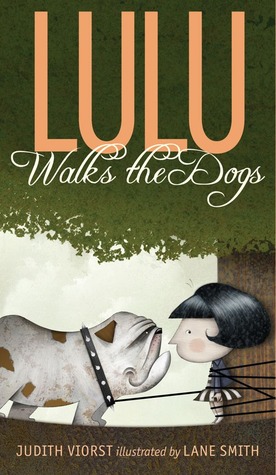
Lulu and the Brontosaurus written by Judith Viorst with illustrations by Lane Smith showed us one persistent, persnickety gal who would do anything to get her way, having a brontosaurus for a pet.  It did not end as she anticipated or as readers might have predicted.

This little bundle of feistiness has returned in all her glory.  In Lulu Walks the Dogs (Atheneum Books for Young Readers) she has her sights set on gaining a possession her parents refuse to fund.    Even parents who give their child nearly everything they want, have to draw the line at ridiculously expensive.

Lulu is aghast her parents would recommend earning the money herself.  Furthermore it irritates her to no end when they make reference to the boy down the street, Fleischman.  Fleischman is the bane of Lulu's existence.

He is kind, courteous, ever so helpful, hardworking, an expert flutist, a straight "A" student and neat as a pin.  His uncanny ability to know something about everything drives her absolutely nuts.  She makes it plain in her no nonsense way, he is to stay clear of any of her money-making enterprises.

Ultimately, Lulu believes walking dogs to be the easiest way to make the extra cash.  To her delight three neighbors respond to her promotional flyers.  Brutus, Pookie, and Cordelia will be her new four-legged morning walking buddies.

Of course, Brutus won't budge, Pookie must have her name pronounced correctly or else and Cordelia...where is Cordelia anyway?  Who should saunter into the midst of Lulu's problems?  It's Mr. Perfect Kid, Fleischman.

Fleishchman being his usual sweet self (almost too good to be true) offers his assistance which Lulu grudgingly accepts.  And so it begins, the trials and tribulations of dog walking this trio and the un-easy (mostly on the part of Lulu) sort of partnership that is formed.  And if you think there is smooth strolling ahead, think again.  After all, this is a story about Lulu.

Judith Viorst's voice, as the narrator, in this title as in the first, is just plain sassy.  Her listen-to-me-I'm-the-boss-of-this-book tone is splendid for the intended audience and anyone else who loves to burst out laughing.  It's not hard to visualize her staring intently into your eyes, demanding your undivided attention as she tells the tale.

Dialogue between Lulu and the rest of the characters, her parents, Fleischman and the dogs' humans could not be funnier.  The pacing is impeccable.  To accentuate a point or pause, a chapter might only contain a single paragraph, sentence or a question and answer time-out section.  But the added treat in this episode is the Money songs.

Here is a single passage from the book.

She was about to add that Brutus was among the everyones she didn't like when his owner said, "You're hired. You're hired. You're definitely hired. And furthermore, because Brutus is on the large side, I'm going to pay you fifty cents extra a day."
(On the LARGE side? Brutus was GIGANTIC---a mountain, a whale, an SUV of a dog!)

Pencil on pastel paper illustrations rendered by award winning illustrator, Lane Smith, make frequent appearances throughout the story.  Their placement as full page spreads, small insets or across two pages add to the emotional flavor of the story; reinforcing the hilarity.  Personalities, dogs' and humans', are emphasized through the definitive facial expressions on their prominent round heads.

If you're looking for a fantastic read aloud or a book that will have an individual reader giggling uncontrollably, then Lulu Walks the Dogs written by Judith Viorst with illustrations by Lane Smith  is the title for you.  Viorst and Smith combining their talents for another slice of Lulu's life is a major plus for readers.  I most certainly hope another volume is in the works.

If you wish to browse inside this title head over to the Simon & Schuster site linked here.


Monday, June 25, 2012

Performance Criteria Rated High...Affirmative

Back in 2001 I discovered a poster by Rick Ruggles titled Love is where you find it...  From that time forward I have tried to slow down to notice heart shapes appearing everywhere, especially when Xena and I take our walks; discovering those special stones on the beach is like finding a priceless possession.  But sometimes you don't find the heart, the love, unexpectedly, it finds you.

First time author, Ame Dyckman, teams with illustrator, Dan Yaccarino, to bring readers, Boy + Bot (Alfred A. Knopf), an endearing story of a normal day turned extraordinary.  Remarkable use of text and visuals, make this book a stunning example of the beauty to be found in simplicity.  You never know what a day spent gathering will reveal.

A boy was collecting pinecones in his wagon when he met a robot.

Can you imagine the wonder of having a big red robot appear behind you ?  Trusting in spirit, quick to see a potential playmate, the boy asks him to play.  The robot's reply is, of course, in the affirmative.

Finding fun in the great outdoors, their adventures are cut short when a rock and the robot meet.  With no power supply, to the boy, the robot is in need of help; believing him to be ill. Packing him up in his wagon they set off for the boy's home.

Doing what he knows should make the silent Bot better, the two finally settle in for the night.  Peeping in to check on Boy, his parents, not knowing Bot is behind the door, trigger his switch to on.  Now it's Bot's turn to deduce that Boy, sleeping soundly, is malfunctioning.

Carrying Boy back to his home Bot is likewise seeking to fix the problem.  In the nick of time the Inventor steps in, startles Boy into wakefulness and makes an important phone call.  The two fast friends make plans for the next day to play and...they do so with great joy.

Ame Dyckman has discovered a very special place were readers' affections wish to reside.  Her narrative guides us down the beloved path of finding friendship with those unlike ourselves; of caring despite differences.  With clarity, using short sentences, Dyckman depicts in both Boy and Bot the characteristics found in best buddies.

On watercolor paper with gouache Dan Yaccarino fashions illustrations from a primary color palette with added greens and purples; bold and radiant, eliciting a smile from readers.  Endpapers picture both the Boy's and Bot's typical "toys".  The title page begins the story with Boy pulling his red wagon past an evergreen with Bot peering from behind.

Freckles sprinkled across Boy's nose and cheeks, smiles playing about Boy's and Bot's mouths, bright-eyed admiration, the one for the other, and a one-eyed light bulb figure walking about on legs in Bot's home, are little extra details readers will notice and appreciate.  Yaccarino has chosen to vary his image sizes; double page, single page or several on one page all framed by the appearance of a casual brush stroke.  But the way he depicts Dyckman's final sentence,

And the friends did.

is masterful; over the final three pages a series of images clearly showing the cementing of a bond not to be broken.

Boy + Bot written by Ame Dyckman with illustrations by Dan Yaccarino is a clever story where caring + sharing = friendship.  When readers' hearts are warmed and laughter tugs at the corners of their mouths, a book will be read again and again; shared with as many as possible.  This is one of those books, a timeless classic.


Thursday, June 14, 2012

A Powerful Thing...

I have found over the years the very best things, pure excellence, are more than worth the wait.  When I read the post on Julie Danielson's blog, Seven Impossible Things Before Breakfast, titled Philip C. Stead Visits 7-Imp to Share Where a Story Comes From...Or:  How a Toad Named Vernon Ended Up Sailing a Teacup into the Great Unknown, I truly wondered, if just this once, time might fly.  The thirty-three days did pass quickly. What a joy it is to hold my own copy of A Home for Bird (A Neal Porter Book, Roaring Brook Press, June 5, 2012) written and illustrated by Philip C. Stead.

I usually speak about the storyline followed by focusing on the illustrations (which I will still do) but in this title I have to say, the visuals speak volumes, the text is art.  Prior to the first written line readers see an old rattlebang truck, bumping down the road, loaded up with someone's worldly possessions.  A "arm" extends from a cuckoo clock shooting the bird in an arc from the truck's bed.

Vernon was out foraging for interesting things when he found Bird.

Vernon is an inquisitive toad with a huge heart.  In his toady mind the ever silent Bird might be in need of a friend.  Vernon invites him to be a part of his life introducing him to his friends Skunk and Porcupine and sharing with him all the wonders of his world.

Bird's persistent lack of speech is a puzzle to Vernon and his two chums.  Thinking he might be missing his home, the adventurous amphibian, using his gathered treasures, sets sail with Bird down the river.  Along the way a variety of possible homes, birdcage, birdhouse, mailbox, bird's nest, are shown to Bird who never utters a single word in response.

Saddened but nevertheless faithful to his task, Vernon, while sitting with Bird on a telephone wire with other winged companions sees a red balloon whose string is tangled.  From boat to basket a teacup takes the duo further along their journey.  Chatting with a rooster weathervane Vernon notices him pointing a response to his comments.

Gazing into the distance Vernon can see a little, happy-looking home with a rattlebang truck tooting and honking away down the road.  Making their way to the window sill Vernon spies a potential place for his pal.  Will this door break open Bird's silence?  In the brightness of a new day, Vernon receives his answer.

Philip C. Stead's careful, singular word selection not only tells the tale but evokes in readers a strong emotional attachment to Vernon's quality of character, his compassion, his unconditional love for his new friend. 

"I hope this is a good idea, " said Vernon.
Bird said nothing.
"Bird is very brave," thought Vernon.

His narrative guides us from place to place as a home is sought for Bird but this tale is also building the structure of true friendship.

Stead states the illustrations in this title were not created in his usual medium of collage.  He began each with an under-drawing in water-soluble crayon then painted over with gouache resulting in a specific and unique texture filled with an airy luminosity.  Colorful hues continue that lightness, a sense of hope and happiness. 

I love the little extra details in his visuals; the three-leaf clover stems stuck in the tin can but the one Vernon is holding is a four-leaf clover, the sail fabric is the same as the curtains in the blue board house and the cuckoo clock is a mirror image of the home.  Picturing Vernon using items at hand to create his sail boat, a curved straw, teacup, a slip of fabric and a spoon for an oar, further reveals the toad's will to succeed, to make do with what's at hand.  The subtle hints at humor, the name on the truck's door, Careful Moving Co.,  are the finishing touch.

A Home for Bird written and illustrated by Philip C. Stead is one of those books you want to put under your pillow at night knowing all your dreams will be sweet or carry around with you like a treasured stuffed toy or favorite blankie; not wanting to be parted.  Vernon is the kind of best friend everyone should have once in their life, a selfless champion.  Any of the illustrations would find a welcome place on my walls as framed marvels.  I absolutely love this joyous, wonderful book.  I am adding it to my Mock Caldecott list for 2013.

Here is a link to the Macmillan site for more illustrations in addition to those in the interview linked above.  Please read the interview at Seven Impossible Things Before Breakfast;  offering insight into the creative process for this book.  By following the link to Philip C. Stead's site you can download the music he wrote for this book trailer.


Thursday, May 10, 2012

Limits of Friendship

True friendship is a rare find.  The doing for the sake of another, the mutual caring and the pleasure in shared activities is a thing of beauty.  This special kinship, an unbreakable bond, endures all.

Others may look upon such a relationship with longing and hope. Moo Hoo (Walker & Company) written by Candace Ryan and illustrated by Mike Lowery follows two genuine friends who pause and listen to their heart.  Sometimes, maybe, less is not more.

Cow and owl are best buddies.  Playing instruments to conjure up a tune, mending a broken toy and celebrating Halloween are done in perfect harmony.  Sitting on a grassy lawn coloring one day with their constant companions, superhero dolls, Kangaroo walks up with a greeting.

What do cow and owl do now?  A paper airplane with Kangaroo's action figure attached flies over their heads; ignoring seems to be their latest shared activity.  Even though drawing is what Kangaroo likes to do, too, sadly Kangaroo gets the hint leaving.

To be sure, the inseparable duo have a dilemma.  Realizing their mistake they seek to make it right.  Sounds from a keyboard blend perfectly with the strings and percussion making melodious music.

A single descriptive sentence followed by four clever rhyming words spins this narrative simply but with emotion.  Candace Ryan has a knack for selecting words with a beat, like notes in a song, contributing to the overall composition of this story. 

They make music together.
Moo Hoo.
Two Coo.

They search everywhere.
Moo Hoo.
Roo Who?

Front and back endpapers in a cool light green peppered with black line sketches of the two, then three, main characters' heads, some colored in with a blue or brown hue or pure white along with the action hero symbols lend a lighthearted air to the overall feel of this title.  Mike Lowery uses a pencil, traditional screen printing and print gocco (developed in Japan) to create his illustrations, finishing them digitally.  All the text in this book is hand lettered by Lowery; his love of this is featured at his website through viewing his journal drawings.

 Most of the illustrations bleed across the gutter, two page spreads, with the exception of when cow and owl are deciding what to do, in earthy greens, steel blues, warm browns with a tad bit of golden yellow.  Cow, owl and kangaroo on their spindly legs, squarish bodies and roundish heads are likable if not downright lovable.  Owls eyes are more typical of this wise bird but how so much can be conveyed on cow's and kangaroo's faces with simple dots carefully placed, coupled with arm motions, is amazing. The action hero dolls, the cow bell necklace, the plaid kerchiefs, the characters' crayon drawings and the appearance of frog and rabbit from a previous title are the details that draw readers to the story.

Two plus one equals friendship multiplied in Moo Hoo penned by Candace Ryan and pictured by Mike Lowery.  While perfect for sharing one on one, as a group read aloud this has an added (what I like to call) fun factor.  I can foresee a reader's theater evolving complete with paper bag puppets.  Moo Hoo Can Do...

Saturday, June 25, 2011

Coming Full Circle

Close your eyes and think of those things that make you feel the most peaceful, the most cozy; your heart's desire if you will.  Is it warm sun on your face, being wrapped in a heavy handmade quilt, sitting near a crackling fire, lying on a big, fluffy pillow, the smell of fresh baked cookies, snowflakes melting on your outstretched tongue, the sound of crickets as fireflies spin through the warm summer air, the soft snoring of a much loved pet curled against your body or is it sitting in a special chair reading as rain splashes against the windows and roof?

If you are two friends in the newest title, Hopper and Wilson,  by Maria van Lieshout it might be an endless supply of lemonade or finding a stairway to the moon.

 Hopper, a pale, blue stuffed elephant and Wilson his wee, yellow stuffed mouse friend are sitting on the edge of their dock one day looking over the expanse of the sea wondering what it might be like at the end of the world.  By the time we readers have turned the next page they are leaving in their boat along with their red balloon and its red string bidding farewell to their cactus. 

Sailing through the day and into the night the two dream about what they hope to find and wish upon a falling star for those dreams to be realized.  They awaken to rain, wind and towering waves that threaten their journey.  When the storm subsides Wilson is alone in the boat. 

As Wilson searches for Hopper, asking sea turtles, penguins near an iceberg and a giant fish if they've seen him, we feel his despair and deep sense of loss.  When the two pals are reunited their love reaches out and envelopes us like a warm, soft hug.  That warmth continues to spread as the duo notices that the end of the world seems to be their dock with the potted cactus welcoming them back home as birds perch in the lemon trees along the shore. 

Maria van Lieshout brings much to readers through her watercolors, ink, collage, colored pencil, crayon, a smudge of acrylics and some technology to pull it all together illustrations.  It is in their simplicity that we feel the depth of her story.  We are endeared to her characters through the hand-stitching on their bodies.  We feel a sense of childhood innocence and trust in their boat crafted of newspaper with the single red balloon attached.  Her use of space, size and color coupled with spare text convey the closeness of the Hopper and Wilson, the vastness of the sea, the turbulence of the storm and the sheer joy of knowing that what you have is exactly what you need.

Whether sharing this tale one on one or with a group it offers so much to readers and listeners alike.  Myself, I plan on using it as part of my Mock Caldecott election with my older students.  With my younger students we will be making our own boats from newspaper, writing our wishes on the inside, as we set them afloat upon our imaginary ocean.  I am also envisioning balloons and those favorite stuffed animals brought in for a day.  Yes, I will be going back to my local bookstore to get my own copy because Hopper and Wilson is a rare gem.

I extend my sincerest thanks to Maria van Lieshout for allowing me to share additional illustrations from this book on my blog.

Wednesday, March 16, 2011

Crack-up Crocs and Friendship

Pam Smallcomb definitely knows what friendship and that age old phrase "opposites attract" are all about.   Robert Weinstock knows just how to bring what Smallcomb knows leaping to life with his quirky pictures which by the way were not rendered in watercolor or woodcut...but were super fun to make anyway!

To start the cover says it all as does the first line in the book:  Sometimes I wonder if my friend Evelyn is from Mars.  A little brown crocodile ponders what her friend Evelyn is followed by I'm not.  Concise text complimented with drawings that extend and enhance your imagination of this relationship will have readers eargerly searching pages for all the little extra details and begging for the next page to be turned. 

One of the most hilarious examples is how she relates that Evelyn is very hip with fashion but alas she is not.  Lampshades are the new black!  Band-Aids with pearls...trust me!  Sweatbands are making a comeback! 

Then Evelyn admits as they are sitting by a tree that she is stinky at spelling.  But lo and behold her little brown croc pal says, I'm not.
The switch begins as Evelyn's friend's talents are highlighted.  Evelyn goes on to say that universal truth; all we want is a best friend, a true-blue friend. 

It is no mistake that the book's endpapers begin as green and close as blue or that the back cover illustrates Evelyn is 46 flavors.  I'm not.  Smallcomb and Weinstock want readers to know that just because you are not gifted as someone else is, you have your own gifts, sometimes the gift of being a best friend.  It doesn't get much better than that.