Quote of the Month

When love and skill work together, expect a miracle. John Ruskin


Showing posts with label colors. Show all posts

Thursday, March 3, 2022

The Many Hues Of . . .

It has been so cold the past few mornings, breath frosts hair and the collar on coats when early morning walks are taken.  The air is clear and still.  Snow crunches under the weight of boots.  The color of the sky, cloudless, asks you to stop and stare at its breathtaking beauty.  Even though you've seen it before, you ask yourself if there has ever been a blue so brilliant.


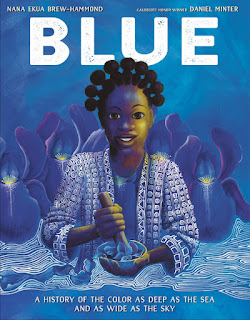
For now, as the snows of winter cover nearly everything, the only natural blue is that found in the waters of the surrounding lakes, not frozen, and the sky.  Soon as birds return from their annual migrations, blue will filt and glide from place to place.  As flowers push from the earth and buds blossom, even more blue will appear.  Blue: A History Of The Color As Deep As The Sea And As Wide As The Sky (Alfred A. Knopf, February 15, 2022) written by Nana Ekua Brew-Hammond with illustrations by Daniel Minter is a gorgeous portrait of the history of this color.  You will be transported through time and place.  


The color blue is all around us.

Have you ever wondered where it comes from?

It's in the sky, but you can't touch it.
It's in the sea, but when you cup it,
it disappears.

While attempts were made the color blue, sometimes captured, faded.  Then, it was found in the strangest place.  Did you know that sometime around 4500 BC rocks, blue rocks, were mined deep underground in what is today Afghanistan?  They were used in jewelry until people, as time passed, found other ways to use them, eye makeup and as a paint on multiple surfaces.

It was expensive to make, so others sought another source of the color blue.  It was found near water around the world in snails.  Yes, snails!  Each dyer extracted the blue in their own manner, but it was labor intensive.  Only a few drops came from each snail.  This rarity of being able to produce the color blue elevated it to sacredness in many cultures.

Later, it was discovered blue could be made from plants

called Indigofera.

Around the world, as with the snails, dyers used their own techniques to produce the blue they desired.  This blue was highly valued and much easier to develop.  The plant was even used like money.  It's worth in the world market caused greedy growers and merchants to abuse people for its growth.  

Despite finding blue in rock, snails, and indigo, scientists were seeking a way to make it chemically.  It took Adolf von Baeyer forty years to accomplish this task.  It earned him a Nobel Prize.  Now, regardless of your economic status you could afford blue.

In the final pages of this narrative, readers come to understand blue as more than a color.  It is a feeling.  It contributed to a music known as 

the blues.

It represents the unexpected.  It is shown as first place in prizes.  It is hope.


From beginning to end, author Nana Ekua Brew-Hammond brings readers into the fascinating history of the color blue.  She explores all facets of the color through her meticulous research, weaving the production of the color, associated myths, legends, and religious symbolism, the use of poor and enslaved people for its growth, and its implications in tradition, culture, and language together to fashion a captivating and powerful whole.  Her inclusion of dates, places, and descriptive explanations adds to the appeal of this narrative.  Her technique of using the same words from the opening phrases in the closing phrases is marvelous.  Here are two entwined passages on a single page.

Perhaps because blue was
the color of the heavens,
yet so rare and hard to create
on earth,
people around the world
considered the color holy.

In an old Liberian folktale,
blue is explained as a gift
that connects God to humans.


When you think of blue, you might consider it a cool color.  But, in looking at the open and matching dust jacket and book case, you are drawn to the warmth emanating from the image.  The play of light and shadow on the dyer's face is wonderful.  The pattern in her clothing reflects her culture.  Surrounding her is the sky and beneath her are ripples of water.  Directly behind her are iris with their glowing centers.  Iris are mentioned as a flower used in making blue dye.  

On the other side of the spine, the sky, ripples of water, and iris continue.  Above them the words, in white, read:

EMBARK ON A VIBRANT JOURNEY
THROUGH THIS HISTORY OF
THE COLOR BLUE.

On the opening and closing endpapers, on the left side is a silhouette of a figure in a rich, dark blue, hand outstretched.  They are reaching toward two varied patterns of fabric in hues of blue and white.  With a page turn, the verso and dedication pages are on the left.  On the title page, between the text, is a shell with a single drop of blue falling from the interior.  

These luminescent illustrations by Daniel Minter were rendered

using layers of acrylic wash on heavy watercolor paper.

You find yourself gasping in appreciation with each page turn.  These double-page images present themselves as a single, two-page picture or two or more separate images in one illustration.  Sometimes, elements from one will blend into another.

In this artwork, perspectives will be mixed.  You might see something as if you are far away and next to it, we are brought directly into a scene.  We move from observer to participant.  The intricate, at times delicate, details ask you to pause and wonder about the people in each setting.  Like the author's words in the opening and closing phrases, Daniel Minter incorporates portions of the opening elements in his closing picture.

One of my many favorite illustrations has a background wash of many shades of blue with hints of purple and pink.  (This picture is for the discussion about iris petals being used as a blue dye.)  On the left are two exquisite fairy-like people.  They look like the flowers have come to life as people.  Around them are petals.  Moving to the right of them and across the gutter are a group of iris.  Lower, on the left side of the gutter, white lines outline and overlap shapes of iris.  These move across the gutter and to the right.  On the right side two hands and portions of arms come from the blue along the bottom and side.  In one hand, a shallow bowl holds the petals being crushed.  In the other hand, a wide wooden pestle is gripped as it pushes into the petals.  On that hand are a stack of bracelets around the wrist.


Readers will be enthralled with the information and its presentation in Blue: A History Of The Color As Deep As The Sea And As Wide As The Sky written by Nana Ekua Brew-Hammond with artwork by Daniel Minter.  At the close of the book is an author's note, a section titled Want To Explore More, A Few Blue Facts, and a Selected Bibliography.  I believe you will want to have a copy of this outstanding title in both your personal and professional collections. 

To discover more about Nana Ekua Brew-Hammond and Daniel Minter and their other work, please access their websites by following the link attached to their names.  Nana Ekua Brew-Hammond has accounts on Facebook, Instagram, and Twitter.  Daniel Minter has accounts on Instagram and Twitter.  At the publisher's website, you can view interior illustrations.  
Friday, January 10, 2020

What's Your Favorite . . .

Waiting for the next book in a series is like waiting for a special event or annual celebration.  If it's a fictional account with characters we adore (or villains we loathe) in a time and place we want to enter again, we can't wait to see how things have either remained the same or what new challenges will be presented.  Often authors and illustrators will insert a cliffhanger at the end of one book to heighten the anticipation for the next title.  In nonfiction series, there is usually a format we prefer.  The continuing structure of the narrative, the layout and design provide a sense of assurance.  Discovering new information within a known framework is like entering a familiar laboratory or workplace ready to begin a different experience.  Sometimes a series is a blend of both approaches, or perhaps, something entirely unknown.

Nearly six years ago, beloved and renowned author illustrator Eric Carle initiated a series titled, Eric Carle and Friends.  In the first volume, What's Your Favorite Animal? (Henry Holt and Company, January 21, 2014) thirteen author illustrators, Nick Bruel, Lucy Cousins, Susan Jeffers, Steven Kellogg, Jon Klassen, Tom Lichtenheld, Peter McCarty, Chris Raschka, Peter Sis, Lane Smith, Erin Stead, Rosemary Wells and Mo Willems, were invited to talk about their favorite animal and supply readers with a visual portrayal.  Each author illustrator is given two pages.  Eric Carle begins this book and each subsequent title.  Some of the author illustrators told a story about a favorite animal, wrote a poem, an ode, or a comedy.  At the close of the book, pictures of the author illustrators as children with short biographical information are supplied. Here is the open book case.

One of my many, many favorite depictions is that of Nick Bruel.  He titles his pages, Behold The Octopus.  On the left, in a series of panels, he talks about a variety of octopuses and their unique characteristics.  In the fourth and fifth of five panels, Bad Kitty enters from the bottom and side looking disgusted.  A discussion between Nick Bruel and Bad Kitty ensues on the right within eleven small images concluding with hilarity.


On May 2, 2017 the second book, What's Your Favorite Color? (Godwin BooksHenry Holt and Company) (Eric Carle and Friends) was released.  In this book the contributors are: Lauren Castillo, Bryan Collier, Mike Curato, Etienne Delessert, Anna Dewdney, Rafael Lopez, William Low, Marc Martin, Jill McElmurry, Yuyi Morales, Frann Preston-Gannon, Uri Shulevitz, Philip C. Stead and Melissa Sweet.  As in the previous book, each illustrator is asked to name their favorite, why it is their favorite and give readers a visual presentation.  The narratives of these author illustrators are indeed explanatory but also heartfelt reflections, nearly lyrical.  Two author illustrators picked the same color, gray, but Rafael Lopez and Melissa Sweet approached it in their signature styles.  You'll enjoy how similar their reasons truly are. We are treated, at the end, to childhood pictures and short biographies.  Here is the book case.


One of my many, many favorite pictures and essay is that of Yuyi Morales.  On the left, with a small portion crossing the gutter, is a picture of her as a child.  It is of her face and shoulders.  She is looking at the reader.  It is textured as if done in ink, black with flecks of deep dark pink.  One of her hands is raised to hold a brilliant pink, Mexican Pink, bougainvillea blossom.  In her narrative she speaks of cutting them on her way to visit her grandmother.  Her text is hand-written.


Readers only had to wait a year for the next title, What's Your Favorite Bug? (Godwin Books, Henry Holt and Company, July 31, 2018) (Eric Carle and Friends)  In this book, the author illustrators number fourteen (not including Eric Carle).  They are:  Joey Chou, Eric Fan, Denise Fleming, Ekua Holmes, Tim Hopgood, Molly Idle, Beth Krommes, Scott Magoon, Kenard Pak, Maggie Rudy, Britta Teckentrup, Brendan Wenzel, Teagan White and Eugene Yelchin.  As in the two previous books all royalties go to The Eric Carle Museum Of Picture Book Art founded by Eric Carle and his wife Barbara Carle.  In this book author illustrators feature the praying mantis, moths, the dragonfly, the katydid, the daddy longlegs, bees, ants, a ladybug, the firefly, peacock spiders, millipedes, the worker bee, the walking stick and the Rhino beetle.  You'll have fun looking at all the childhood pictures and reading the short biographies at the end.  Here is the book case.

One of my many, many favorite bugs showcased is the Praying Mantis by Denise Fleming.  The shades of green in this close-up of the bug are mesmerizing.  There are two splashes of purple in some blossoms.  She has the head of the praying mantis looking at readers because this is a special characteristic she notes in her essay.


For 2019's release, as soon as I read or think the last word, a tune from the musical Oliver! starts to play in my mind.  Before I know it, I'm singing it out loud.  What's Your Favorite Food? (Goodwin Books, Henry Holt and Company, July 23, 2019) (Eric Carle and Friends) highlights the talents of author illustrators, Aki, Isabelle Arsenault, Brigette Barrager, Matthew Cordell, Benji Davies, Karen Katz, Laurie Keller, Juliet Menendez, Greg Pizzoli, Misa Saburi, Felicita Sala, Dan Santat and Shannon Wright
You'll be heading to the grocery store and then the kitchen as soon as the first entry by Eric Carle is read.  By the time you finish, you'll be ready for a fourteen-course meal.  Here is the book case.

As with the three earlier titles, it is nearly impossible to select a favorite illustration but because I've recently discovered a new simple recipe I love, I am selecting Ramen by Dan Santat.  This illustration brings readers close to the table.  On the left are two possible sauces for the ramen along with a beverage.  Dan Santat explains ramen and how it is usually served.  On the right is a large bowl of ramen.  Yum! Yum!


This collection of books, What's Your Favorite Animals?, What's Your Favorite Color?, What's Your Favorite Bug? and What's Your Favorite Food?, all part of the Eric Carle and Friends series, present readers with an array of talented author illustrators and their reasons for selecting their favorites.  Their images and narratives are a distinct reflection of their work. You could use any one of these books to introduce units on animals, color, bugs or food.  They would work well to inspire drawing and writing by children on any of those topics.  They will also promote further research about those subjects chosen by the author illustrators or new ones the children pick as their favorite.  I highly recommend all four titles in the series.  I love them!

Attached to each of the titles is a link to the publisher's website where interior images are shown.  There are links attached to each of the author illustrator names so their websites can be accessed.  For those without websites, I attached links to sites with pertinent information about them.

Monday, January 14, 2013

Again...Again...Repeatedly

A book is a gift you can open again and again.
Garrison Keillor

What is it that makes us return to our favorite picture book titles?  Do we go back, even though we know exactly what is going to happen, because the story, the beginning, the middle and the end, is in perfect alignment.  Could it be the words, the narrative, the dialogue, create a kind of song in our minds, painting a picture even without the illustrations?  Or might another visit be due to the stellar artwork, the fresh color palette, intriguing layout and design?

I believe it to be when the combination of all of these is so striking, that not only is the book memorable, but you as a reader sense a kind of magic, a cosmic connection.  When I first lifted the cover of Open This Little Book (Chronicle Books) by Jesse Klausmeier with illustrations by Suzy Lee I had no idea what to expect. (I rarely consult the jacket flaps until after I read the book.)  Within a few seconds I began to feel a pull, a pull taking me right into the center of the book.


Open this...

Those first two little words offer much.  It seems so often when growing up we hear the opposite.  "Stop!" "Don't open that!"  This phrase is different; freeing, warm and inviting.  So we do as it requests.

In the Little Red Book, the Little Green Book, the Little Orange Book, the Little Yellow Book, the Little Blue Book and the Little Rainbow Book readers are introduced to Ladybug, Frog, Rabbit, Bear and Giant.  Each character is reading a book about the next as the volumes, inset in one another, continually get smaller.  As we move from book to book the characters move into the next title until a problem arises.

The pages of the smallest book cannot be turned by the hand of Giant.  But what are friends for? A book is began and finished with the story within read; to each character's individual and personal joy.

As first the Little Rainbow Book, followed by the others, is closed Giant, Bear, Rabbit, Frog and Ladybug return to their original settings.  When readers turn a page and read:

You close this little red book...

they, like the characters, are transported to a place where a passion can be pursued in the company of like-minded beings.  Read.  Read again.  Share. Read another. This is a timeless, treasured circle with no end.


According to an interview at Seven Impossible Things Before Breakfast Jesse Klausmeier first conceived this book when she was five years old.  There is a child-like wonder in the simple sentences linked together; a curiosity about what will happen next to whom.  When she chooses story, the reading of a story, to bind these characters together in friendship, the repetition of the words creates a spiral circling outward to surround you.  You, the reader, become a participant in the tale.


Every single time I read this book I discover something new in the illustrations.  Suzy Lee's interpretation is meticulous; right down to the tiniest amazing detail.  Using pencil and watercolor with digital manipulation she begins on the jacket and cover; a lofty view of a tree trunk on the left whose branches stretch as shelves providing space for books and readers alike. Her opening endpapers are rows of tiny gray raindrops on a soft creamy white background switching to a variety of colors, like a rainbow, on the closing endpapers.

Initially Lee opens using a limited palette, black, white and red with a hint of green.  As each little book is opened small spots of the other colors are added.  As the characters return home the use of color increases plus careful readers will see not only the gift of color but the gift of something else bestowed upon each. The pure happiness exhibited by Lee's Ladybug, Frog, Rabbit, Bear and yes, even Giant in each setting is marvelous to behold.


I've lost count of the number of times I've read Open This Little Book by Jesse Klausmeier with illustrations by Suzy Lee.  What I do remember is my excitement building at each page turn.  When I finish I know I am grinning from ear to ear wanting to shout from the rooftops "I love this book!"

Please follow the links embedded in this post to visit the official author and illustrator websites.  Suzy Lee did an interview at Seven Impossible Things Before Breakfast linked here.

I went right to my bookshelves and pulled off copies of Look At My Book: How Kids Can Write & Illustrate Terrific Books by Loreen Leedy, Making Mini-Books by Sherri Haab (Klutz) and The Elements of Pop-Up by David A. Carter and James Diaz because this title is guaranteed to inspire creativity.  You might also want to visit the web 2.0 application, Zooburst, to make virtual books.  It was an American Library Association 2011 Best Websites for Teaching and Learning.