Quote of the Month

When love and skill work together, expect a miracle. John Ruskin


Showing posts with label Steven Weinberg. Show all posts

Monday, March 29, 2021

You Had No Say

Unless you are an only child, you've experienced the roller coaster ride of sharing your world with a younger or older, sister or brother.  If you are the oldest child in the family, it seems as though you are expected to be the example of propriety.  When something goes wrong, you are blamed in part, even if you are totally innocent.  On the other hand, you are given privileges and opportunities your younger siblings are not.  If you are the youngest child, many times you are your parents' little sweetie pie, unable to do anything wrong. Unfortunately, you hear too many times, wait until you are older.

To be the middle child is an entirely separate experience.  It usually does not offer you any privileges or any protections.  The Middle Kid (Chronicle Books, March 23, 2021) written and illustrated by Steven Weinberg presents a day in the life of a middle child.  In between bursts of laughter, you will reach a new appreciation for all middle children or if you, like Steven Weinberg, are a middle child, you'll find validation.

6:59 AM
CHAPTER 1
GOOD MORNING!

Sniffle.
SNORE.
Sniffle, sniffle-waaaaaaa . . .

So begins a decidedly noisy day.  The quietest one in the group, and still oblivious to the surrounding sounds, is the family dog.  Not wanting to stay silent any longer, the middle kid yells out a greeting.

The breakfast table is a hullabaloo centered in demands.  The results are not good for the artwork of the middle kid.  By chapter three of nine, he is told by his older brother to be tough.  What the older brother fails to tell him is how dark and confining this lesson is.

The next scenario demonstrates how a teacher's adventures on a trip to New Zealand can find their way into a creative escapade with stuffed toy animals, yarn, and a bannister.  Needless to say, what is initially a joint project between the middle kid and his younger sister, ends poorly.  Shortly after midday and chapter four and one half, life improves.

A compassionate mom has a plan.  It is a breather trip to the middle kid's favorite place.  And then, off he and his siblings go to do one of his favorite things.  He is perfect to explore their recent discovery.  Now, he has a secret that is all his.  A popsicle incident does not add up, but this does not deter our intrepid artist and architect.  His finest hour is designed to draw attention, the right kind of attention.  And it does.  Good night.  Sleep tight.


With affectionate truth, author Steven Weinberg, spins a sixty-two-page tale of navigating sibling dynamics.  To create and maintain pacing and gentle tension, each chapter heading includes a specific time of day.  These short chapters are full of blended realistic dialogue and casual narrative. Here is a passage.

9:01 AM CHAPTER 3---> YOU GOTTA BE TOUGH

This morning, my big brother tells me, "You gotta
be tough."

 "I AM!" I yell.

"No," he says.  "You are loud.  Loud is not tough."
I turn around.  I have things to draw.

He grabs my shoulder and says, "I will teach you
how to be tough.  Because I am tough.  And I have
your back."

That might be the nicest thing he has ever told me.

Then he stops looking so nice.


The front of the dust jacket speaks volumes about the fate of being a middle kid in this happy-go-lucky family.  You can't help but laugh at the fact even the dog gets a slice of pizza!  The clever design of using the pizza box as a placeholder for the text adds to the fun.  Numerous elements are varnished.

To the left, on the back, is a portion of a double-page interior picture.  The middle kid is enjoying some alone time in the basement, papers, books, crayons, scissors, and shoes spread across the floor.  He has drawn a masterpiece mix of reality and imagination.  It is the ultimate sanctuary.

Beneath the dust jacket, the book case is a recreation of a traditional black-and-white-speckled composition notebook.  In the larger framed square is the book's title.  For name it reads Steven Weinberg.  For school, it is Lafayette Elementary, and the grade is First.  Each is written in different colored crayon.

On the matching opening and closing endpapers are two original pages from the composition notebook.  In pencil are words of warning, scribbles and a large x.  With a page turn at the front the middle kid is carrying an armload of supplies with the faithful dog trailing behind and looking hopeful at a discarded shoe.  The dedication:

To My Big Brother and little Sister 

is written in crayon.  On the title page there is a lot happening as the three siblings and the pooch pal gather around a rug on the floor, paper written in crayon spelling out the text. The table of contents and introduction are written on composition pages.

The illustrations

were rendered in watercolor, pencil, art from a few centuries ago, digital media, and a whole lot more.

They are bold, highly animated, emotionally expressive and displayed in a variety of perspectives.  The facial features, especially the eyes, allow us to gage every moment.  Steven has placed his signature watercolor backgrounds in many of the images along with his fish and fishing artwork.  Bengal, the tiger, looks a bit different because he is.  

One of my many favorite illustrations is a single-page picture.  The middle kid, his little sister, and the dog are on the floor behind the upstairs bannister.  The little sister is crying in dismay.  The dog has its paws over its eyes.  The middle kid in the center is gleefully throwing Bubba, Bo, and Fred over the railing.  Bengal is about to join them.  Bubba, Bo, and Fred are large at the bottom of the page.  They are so close; portions of their bodies are off the page.  One of Steven's beautiful fish paintings is hanging on the wall on the main floor.


You will be grinning from ear to ear the entire time you are reading The Middle Kid written and illustrated by Steven Weinberg.  It's a warm and funny family portrait, with a heartfelt nod to all those middle children.  I highly recommend it for your collections, personal and professional.

To learn more about Steven Weinberg and his other work, please follow the link attached to his name to access his website.  Steven Weinberg has accounts on Facebook, Instagram, and Twitter.  Steven Weinberg penned a guest post about this book at the Nerdy Book Club.

Monday, August 21, 2017

Constructing A Tree-ific Collaboration

It was decades ago.  There were four of us working; three had their own chainsaws.  We cleared more than twenty-five mature trees in order to build a home in the middle of the woods.  The use of a chainsaw is no easy task.

The weight of the saw and speed of the chain can cause injury in a matter of seconds, but when handled with care and skill it is much faster and more efficient than an axe.  It's handy to have so additional wood can be cut to fuel a stove in the middle of a bitter cold winter.  There is a certain sense of confidence in being able to use a tool to help you build a home and then heat that home.  I know this to be true.

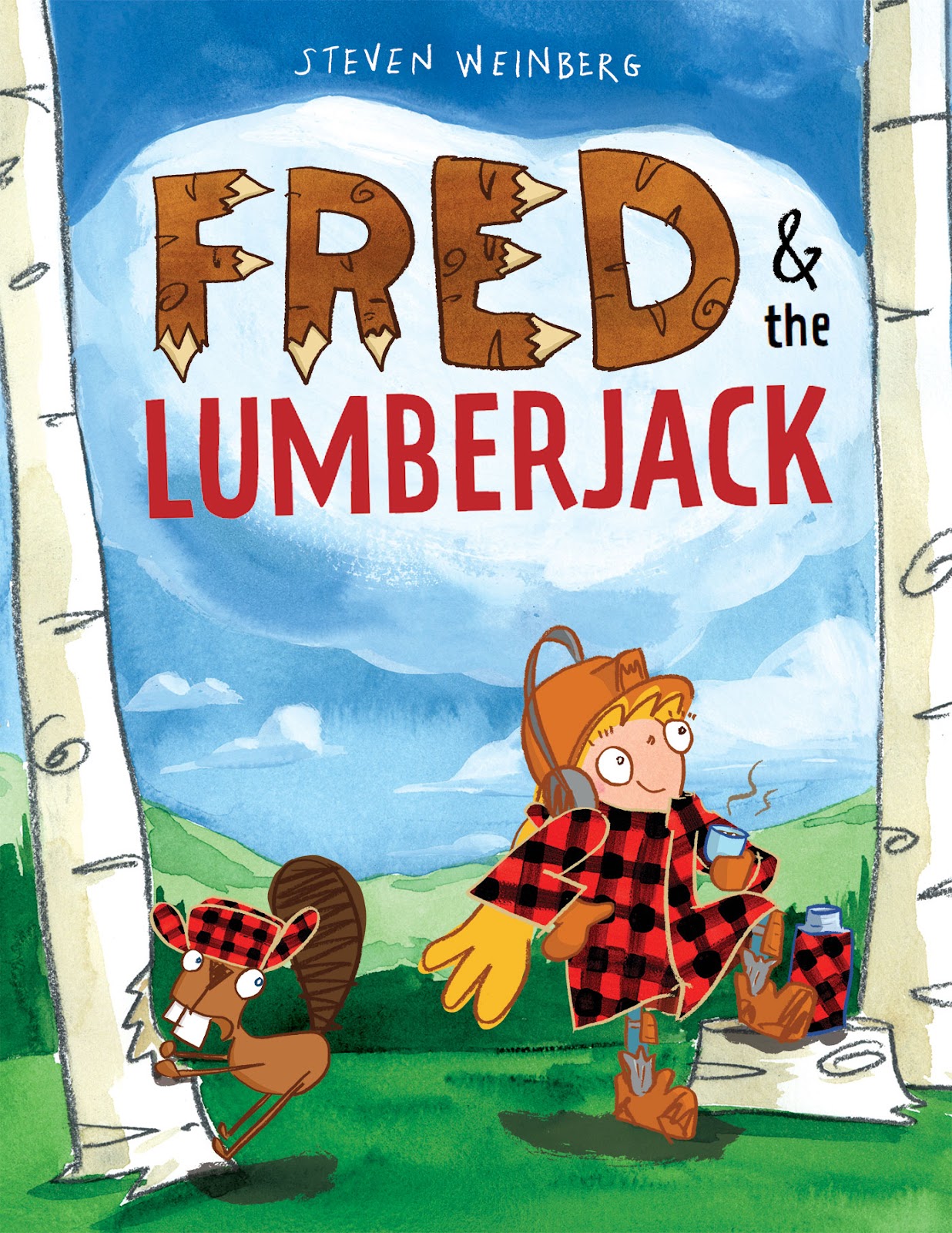
Recently I was reminded of the dexterity necessary to fell trees.  The purchase of a new house required the removal of sixteen, one nearly fifty feet tall.  Watching the lumberman climb and cut and climb and cut and lower limbs down by rope generates respect for these people and their accomplishments.  Mother Nature has her version of adept loggers, too.  In Fred & the Lumberjack (Margaret K. McElderry Books, an imprint of Simon & Schuster Children's Publishing Division, September 12, 2017) written and illustrated by Steven Weinberg (Rex Finds an Egg! Egg! Egg! and You Must Be This Tall) we are introduced to a beaver who is assuredly the Frank Lloyd Wright of streams and forests.

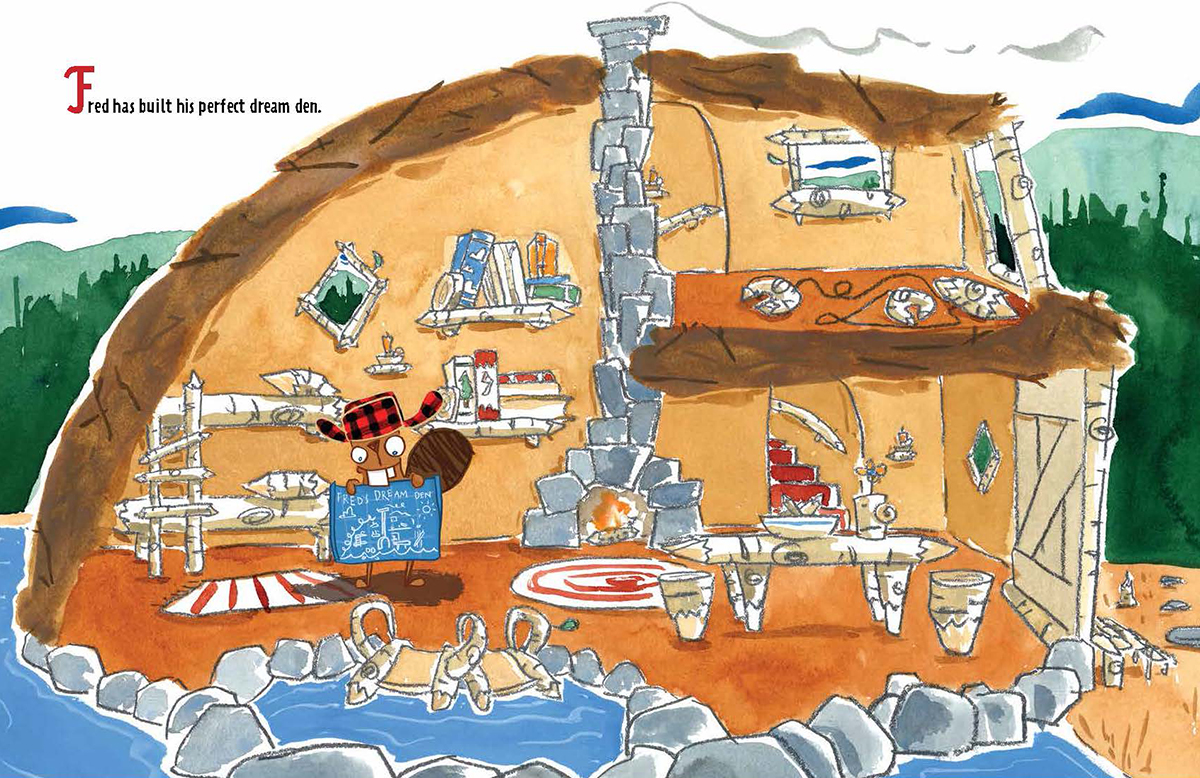
Fred has built his perfect dream den.

It has two stories with a staircase leading to a loft, hand-crafted furniture, a stone fireplace and an indoor swimming pool.  Every square inch is built according to the blueprint he designed, but something is missing.  Fred goes through his den, checking and re-checking everything.

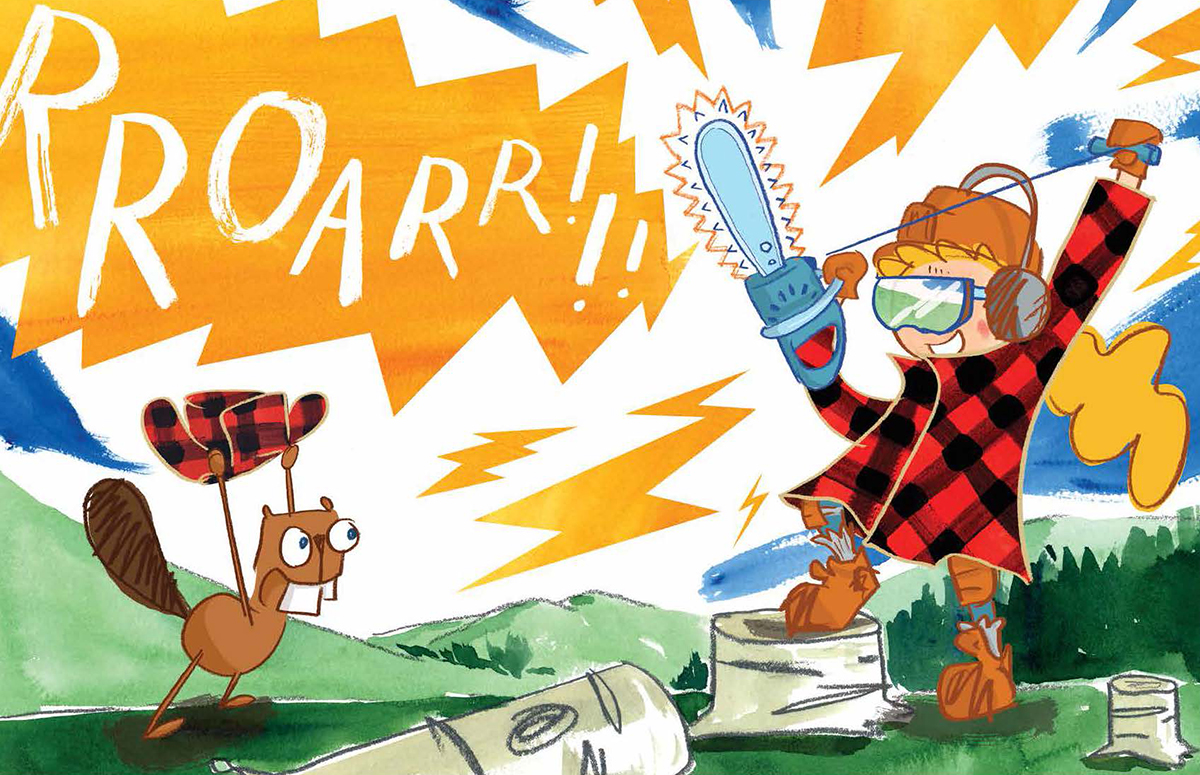
RRRRRRRRROOAARRRRR 

His musings are interrupted by a mighty loud noise in the woods.  Fred has to discover what is causing all this ruckus.  He finds multiple trees cut with smooth edges and stacked in piles.  There are even large carvings and sculptures.

Another resounding roar rips through the air.  Fred finds himself staring at a lumberjack dressed in plaid, carrying a chainsaw and building Sophia's Dream Den.  Yes, readers Fred is totally and overwhelmingly smitten with this gal and her notable abilities.

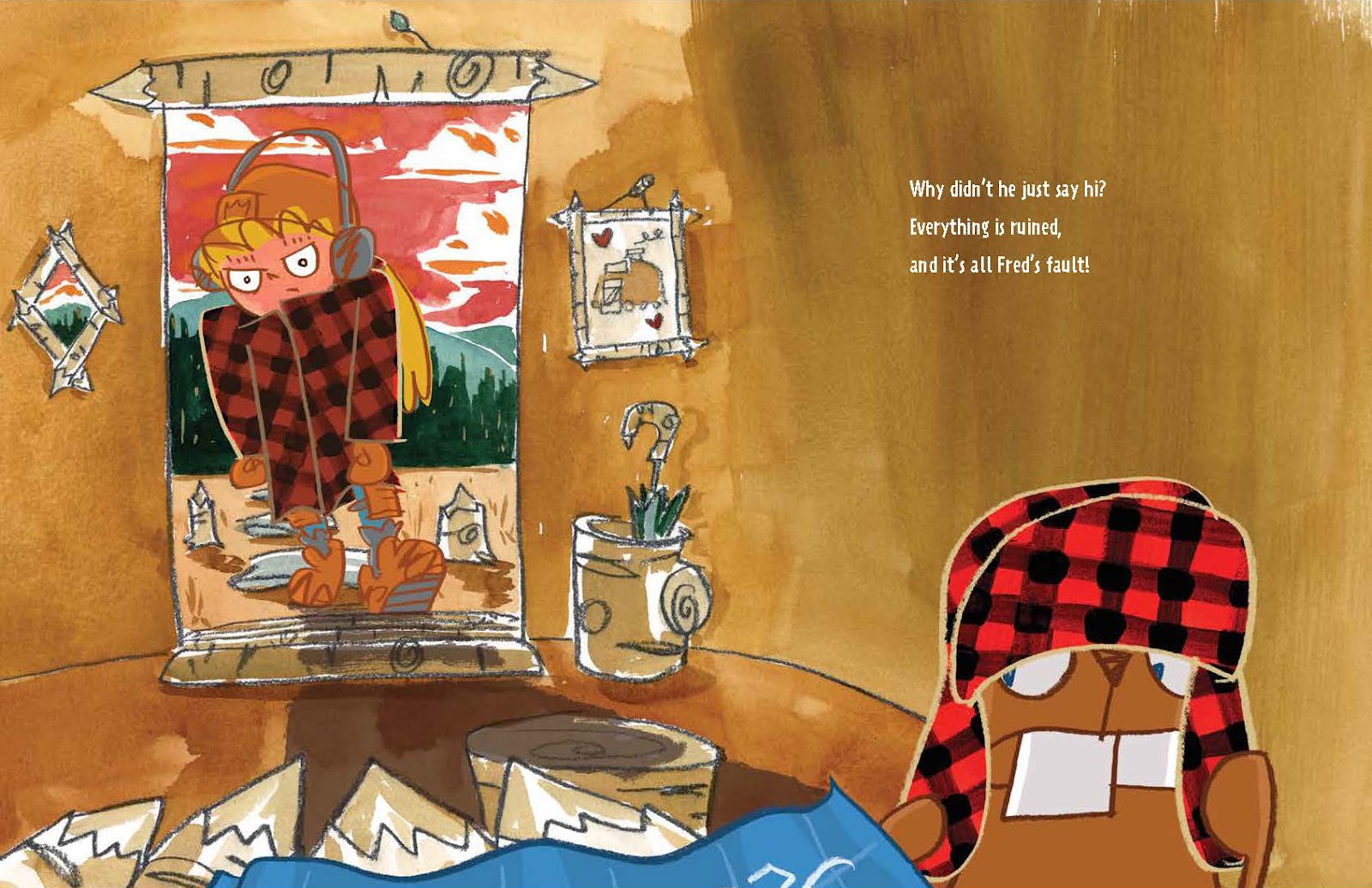
There is only one thing to do.  Fred has to get her attention using his equally excellent gifts.  OH! NO!  That's a major fail for Fred.  He runs in humiliation (and a little fear) back to his den knowing he literally made a mess of everything.  She is too furious to be his friend.

Now she's standing in his doorway.  She stops and stares.  Hope surges in an apologetic heart. It is a blueprint for dynamic duo dreams.


With his first sentence, a declaration, Steven Weinberg sets the stage for his exuberant tale with one word, perfect.  This opens the storytelling door for how things might not be quite perfect.  It's fascinating how Steven spins the narrative so in Fred's search for one thing he discovers what (who) he needs most.  The humorous touch with his play on words,

sink his teeth into,

the rhythm supplied with Fred's hunting at home, what he finds in the woods and what Sophie notices in his den along with the strategic use of the word roar all contribute to this spirited story.  Here is another sample passage.

What creature did this?
It's so precise,
so powerful
so talented!


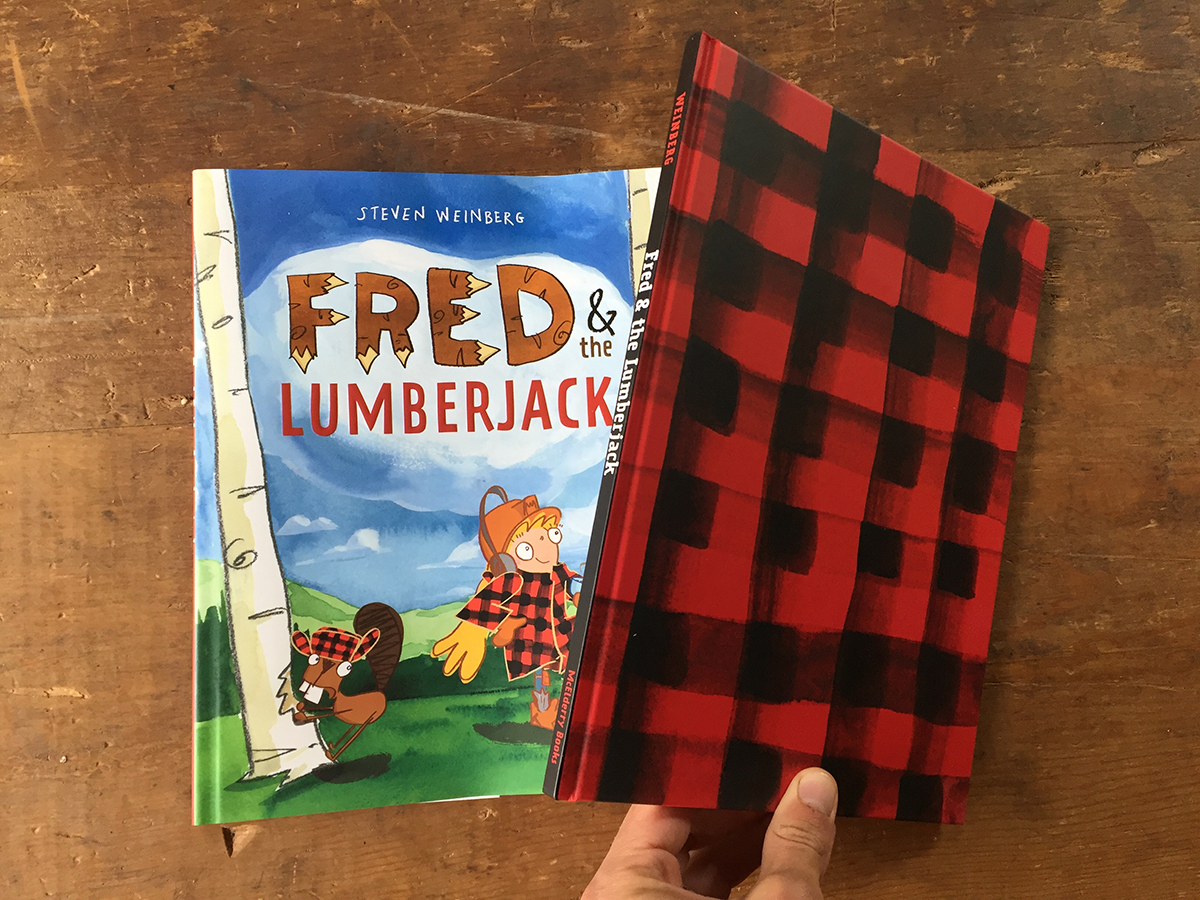
As soon as readers see the opened dust jacket they have to grin.  The buck-toothed beaver looking with adoration at the lumberjack pausing in her daily efforts and both of them attired in traditional red and black plaid is classic.  Still looking at the front, on the right, it's in keeping with Fred's skills to have his name depicted in chewed logs.  To the left, on the back, the beautiful blue sky with clouds, the mountains, forest and birch trees continue.  One of the trees is close to the reader, making us feel as though we are stepping into the story.

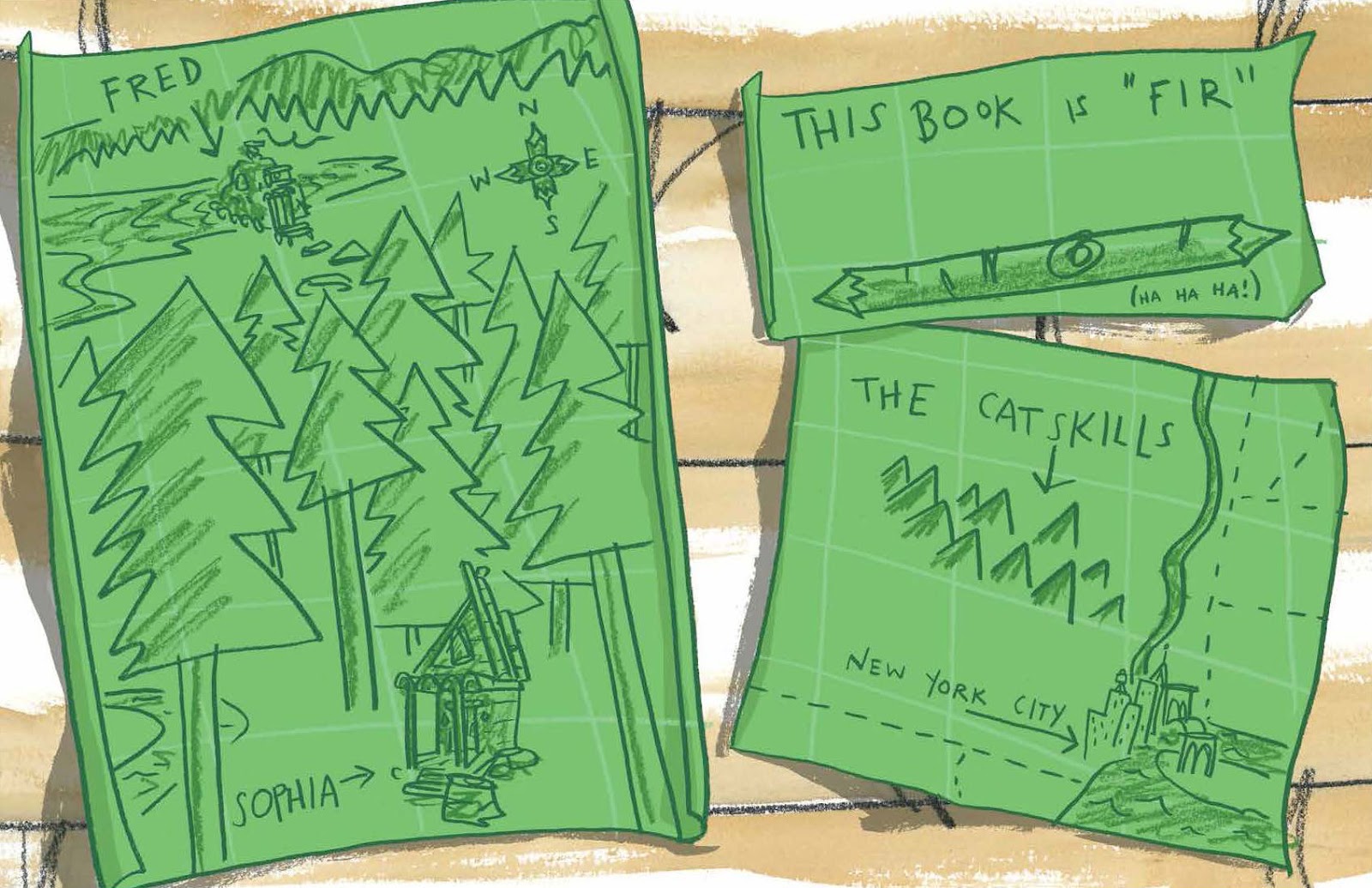
On the opening endpapers are three map images on log walls.  One is from Fred's den to Sophie's den, the other is from New York City to The Catskills and the third invites readers to write down their name,

This Book is "Fir".
     (HA HA HA!)

The closing endpapers continue the tale of Fred and Sophie.  They give readers a peek at their future endeavors....blueprint style.

Rendered using a collage of watercolor, pencil, and digital elements most of the illustrations in this title span two pages.  This mixture of styles creates a pleasing texture and contrast between the background, other items on the pages and the characters and their clothing. Multiple smaller images are grouped together to designate pacing.  A shift in perspective and font size generates a dramatic effect several times.  Readers will find themselves smiling at the wide-eyed looks on the characters, their facial expressions (although please note the color of Sophie's plaid after Fred makes his mistake), the details in Fred's den's furnishings, and the items used by Sophie.

One of my many favorite illustrations is when Fred first sees Sophie.  It spans two pages.  On the left Fred is standing with his legs spread.  Both his arms are raised as he lifts his hat off his head.  His eyes look like they are ready to pop out of his head.  His mouth is wide open.  On the right Sophie has one boot on a stump with the other behind her for support.  Her plaid coat is closed.  She is wearing her gloves, ear muffs and protective goggles.  Her pony-tail is waving behind her.  In her right hand she holds the chainsaw as the left hand grips and pulls the power chord.  There is a gigantic roar.  Sophie is grinning in total joy.


Fred & the Lumberjack written and illustrated by Steven Weinberg is pure fun from beginning to end.  When you think about it, a beaver and a lumberjack have quite a bit in common with their adept and creative use of wood.  In this title, their tools are different but their love of plaid, blueprints and dreams coming true is the perfect foundation on which to construct a lasting friendship.  You will want copies of this on your professional and personal bookshelves.

To learn more about Steven Weinberg and his other work, please follow the link attached to his name to access his website.  To view interior illustrations please follow this link to the publisher's website.  I am absolutely thrilled that Steven agreed to answer some of my questions.  I know you will love his answers as much as I do.


Was there a single incident or a series of events which helped to form the story of Fred & the Lumberjack?  Are the characters based upon real life individuals?


A little over three years ago my wife Casey Scieszka and I moved from Brooklyn to the Catskills to open a boutique hotel and bar called the Spruceton Inn. So, I mean, that basically threw me deep into the woods, changed my life forever, and has delightfully inspired a whole new way of working. (The opening endpapers include a detailed map to my house.)


But specifically, the beaver in the story is my immediate neighbor across a field from my house. In the scope of time my wife and I have renovated our spot, this beaver has been just as busy. Den, pond, landscaping, etc. It’s really amazing living this close to nature. Keeping tabs on it reminded me of how much I loved to just build with blocks or legos as a kid. So I wanted to find a story about a beaver that BUILDS.


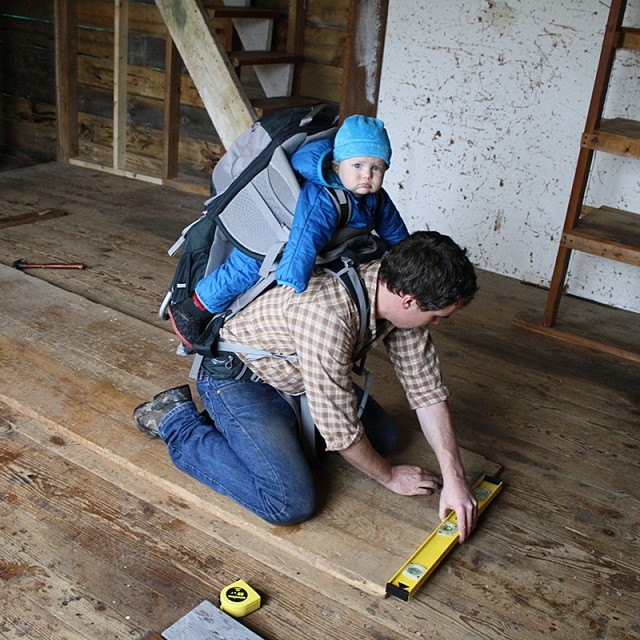
But that’s only half of it. The other half comes from our friends who have two little girls (now ages 4 and 3) who have been coming to visit since we moved. We’ve put them work! The elder Sophia especially. I’ve seen the girl play with a hammer nearly as much as her favorite stuffed owl. I mean here she is three years ago with her dad helping us with the early renovations:


Now I wish I could say one day I saw little Sophia pick up a chainsaw and was like EUREKA! But it’s probably more accurate to say she slowly built the character in my head in between grabbing piles of kindling and screaming in terror that she couldn’t have another s’more.


I read in another interview Steven you have been drawing, originally with crayons, for most of your life.  Do you have any formal art training?  If so, is there something special from one of your teachers (a favorite saying, technique or style) which still serves to inspire you?


I studied oil painting at Colby College in Maine under a professor who had me working harder (and taking art more seriously) than I had ever thought possible. She was a very intense disciple of the Josef Albers and Bauhaus color schools. Which, to maybe a non-art-nerd, means she had us painting color wheels, and color squares, and color fields, and NOTHING BUT COLOR!


It was infuriating at first, but now I realize it was an amazing education. Because everything starts with knowing how color works. So when I’m doing things like painting an insanely pink sunset I can still hear her whispering over my shoulder and asking questions like “have you really truly thought about that color choice?” And in my head I can tell her: “YES. The sunsets really are that crazy here!”


In this third title you have authored and illustrated you used a collage of watercolor, pencil and digital elements to create the images.  Is watercolor your favorite medium?  Why do you favor one medium (or not) over another?


I had been using watercolor for some elements in my work for years, but saw a show of John Singer Sargent’s watercolors at the Brooklyn Museum right before moving upstate. I’ve always been a huge fan of Sargent’s, but never got the time to really study those paintings. They’re so physical! So bold! So unpredictable! It made me take a fresh look at the medium. I haven’t really looked back since.


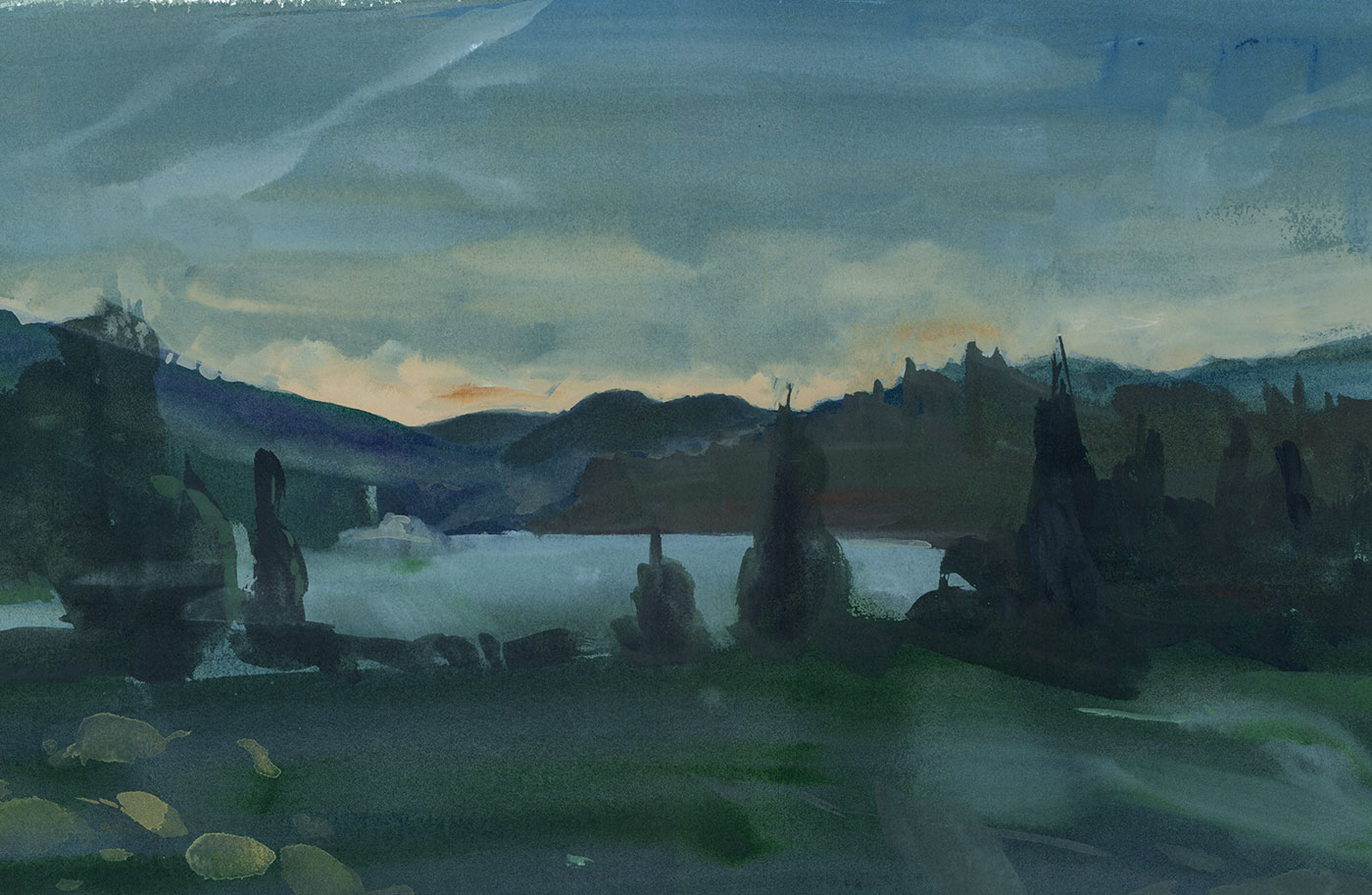
I’m basically painting watercolors landscapes constantly up here. This is a sunrise view of the mountains seen a lot in the book I painted thinking it could be an endpaper. But art’s funny. I love it, and it sits now above the bar at the Inn, but it seemed maybe too spooky for this story.


You, your wife and your dog Waldo live in the Catskills.  How is it you moved there from Brooklyn?  Did you always live in Brooklyn before moving upstate?  


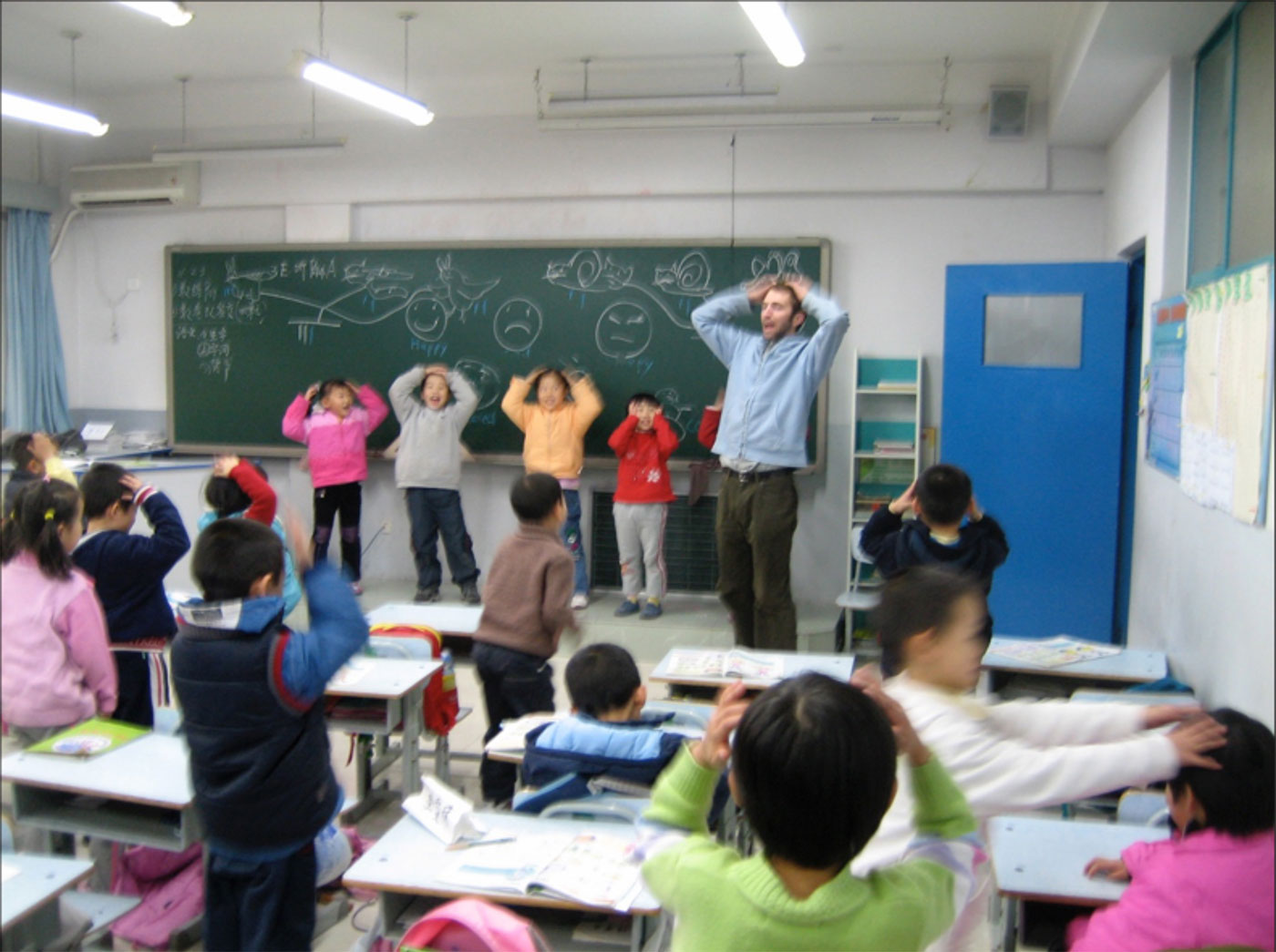
I’ve been quite a vagabond. I grew up in Bethesda, MD and after college in Maine my wife Casey and I lived all over the world: Beijing, Morocco, Timbuktu, then San Francisco for awhile. Living abroad was amazing for a ton of reasons, but probably most because when I taught English in China and Mali, I realized I wanted to make books for kids. Because no one is a crazy as kids. Especially 1st graders. Here’s a blurry photo of me singing Heads, Shoulders, Knees, and Toes with students in Beijing:


All that said, I’ve loved settling into the Catskills for LUMBERJACK. It’s where this book takes place and I can’t really describe how cool it is to see a sunset one night and paint it into your book the next morning.


I remembering reading your Mom is a youth librarian.  Do you have a favorite book she would read to you or another favorite childhood book?


Alexander and the Terrible, Horrible, No Good, Very Bad Day. Because I’m the younger brother and was basically Alexander all of the time. It just perfectly encapsulates the complete lack of agency kids have. So I felt for Alexander. And maybe with each reading I hoped the book would change and he would get to move to Australia where apparently nothing bad ever happens.


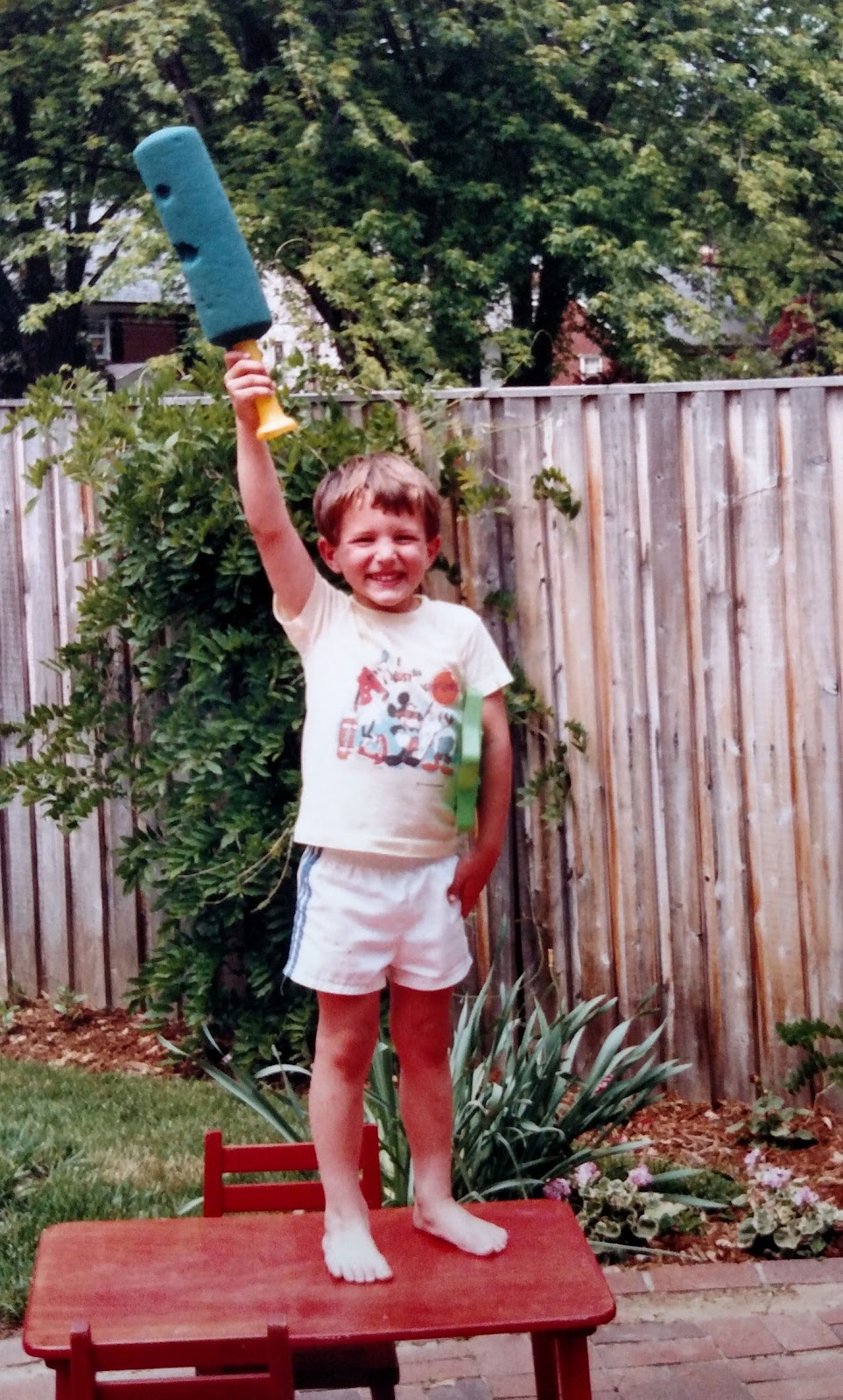
Now that I know I’ll be a dad soon (my wife is due at the end of August!!) it dawns on me how much of a terror I was. So maybe my mom just loved shoving Alexander back in my face to say: get with it! I mean, why was I standing on this table? In bare feet?


You post wonderful paintings of Waldo (dogs) on your Instagram account.  My canine companion Mulan is wondering if there are any plans in your future to write and illustrate a book featuring a dog?


Waldo is named after one of my other favorite characters growing up, the Waldo in the red and white striped shirt. This seemed like a great idea and homage, until we discovered he loves to run away. Yep, just classic. Here’s him where he seems most calm, in my studio:


So I really want to make a book called... “Where’s Waldo?”


But instead of having to find a dog or tall dude in some incredibly complicated jampacked scene, you’d see my Waldo at first running away from me. Then he’s just out in nature doing his thing, heeding the call of the wild, and having a total ball. On every spread the only words would be WHERE’S WALDO? I’d like to think it’d irritate kids just the right amount because they’d be like HE’S RIGHT THERE! Again, and again and again. I also imagine this book would really irritate Martin Hanford. But considering Hanford is one of my favorite kids’ book people ever, I’d be pretty honored to just have him mad at me at all.


If there is anything else you would like readers to know Steven?


Here’s some more images from the book!


AND I’m really excited about the case. It’s just plaid. So fun and simple.


And last last - here’s a new author photo my friend a photographer just took.
In case it wasn’t clear I was living deep in the woods...



Thank you so much for taking the time to answer my questions Steven and for including the images.  I simply can't wait for readers to enjoy your newest book.  I think we will be hearing more laughter. 

Monday, March 7, 2016

A Puzzling Predicament

For three hundred sixty-five days you and your best friend have been planning for this single day of pure childhood bliss.  Squirreling away weekly allowances and odd-job monies earned in the neighborhood are part of the grand scheme.  Past experiences help you to generate a list of those places you must visit and of those things you must do.  You have been dreaming with ever growing excitement about the mix of sights, sounds, smells and tastes of an afternoon at the fair.

It seems as though the car ride is endless but your parents finally have the car parked; you and your friend are walking to the entrance.  Strolling through the gateway, you stop and look at each other, your grins growing.  You Must Be This Tall (Margaret K. McElderry Books, an imprint of Simon & Schuster Children's Publishing Division, March 8, 2016) written and illustrated by Steven Weinberg (Rex Finds an Egg! Egg! Egg!) is about a day at the fair full of the expected fun of shared activities with more than one surprising twist.

Frank and Harold are at the fair.

Frank and Harold are as inseparable as the proverbial two peas in a pod except they are snakes.  Of the pair Frank is very long (tall) and thin.  Harold is much sturdier and shorter.

As soon as they can, they are enjoying one romping, rollicking ride after another.  Certainly this twosome is nearing exhaustion or at the very least dizzy from all their experiences.  On the contrary, they nearly shed their skins when they see the ultimate fair marvel spread before them, The Rattler.  This is the roller coaster of all roller coasters.  There is one huge problem.

A very persistent pig announces:

YOU MUST BE THIS TALL.

Harold is too short.  Even standing on the tip of his rattle, Harold is a smidgen too small.

Ever the faithful friend, Frank has a plan.  Actually Frank has several plans.  A costume booth helps them with Frank's first idea.  Unfortunately the proprietary pig has keen eyesight.  Will the high-wire, trapeze strategy work?

Frank's final approach to this dilemma is so shocking readers will be stunned.  They can't believe they are witness to this tactic but they might find themselves bursting aloud in laughter.  A persnickety pig meets his match.


Each sentence written by Steven Weinberg builds a narrative not unlike a roller coaster.  We go up, up, and up enjoying all their fun and then plunging down when they encounter the height requirement.  As Frank puts his plans into action we start going up, up, and up again and down over and over until we reach the top, crowning achievement.  When we descend to the start it is with great satisfaction.

Lots of action is infused into the story with word choices like slammin' and bouncin'.  Adjectives like scary and smelly are completely understandable and reader friendly and sure to elicit knowing nods.  If your younger self (or in my case recently) has tried to reach something on a top shelf, like hidden cookies, two of the pages might find you sitting up straighter or standing on your tippy toes.  Here is a short sample passage.

No fair!
Hang in there, Harold.
Frank has a new idea...
Together they
s t r e t c h ! ...


A kaleidoscope of color in a full illustration stretching from side to side on the open matching dust jacket and book case greets readers' eyes.  We immediately understand the problem Frank and Harold are facing.  Frank looking longingly to the left watching others, a rabbit, duck and beaver, ride the Rattler, increases our empathy.  On the opening and closing endpapers on a darker teal canvas Steven Weinberg has placed a woven wonderment of snake bodies stretching from top to bottom in vertical, rows, looking like an intricate fun-filled maze.  Careful eyes will note the differences between the two endpapers.

Frank and Harold are featured in their contrasting lengths (heights) on the two pages dedicated to the title.  Frank is hanging over the row of fair pennants mouth open above the T in tall as Harold strives to reach the top of the letter L.   Their friendship is further depicted by their happy postures on the verso and dedication pages.

Rendered in watercolor and pencil, then colored digitally the images match the pacing of the narrative.  A blend of single page visuals is followed by several smaller pictures grouped together and then there are double-page spreads.  One of them requires readers to rotate the book vertically as the pig proclaims the requirement each time.  As the team races toward the final outcome Weinberg uses only large visuals across both pages.

The expressions on the faces of Frank and Harold are sure to have readers smiling.  Frank's tongue is as demonstrative as his body.  All kinds of animals are enjoying the fair; a moose, shark and turtle ride the roller coaster on one of the interior images as two mice, a balloon-carrying turtle and an elephant stand in line. (The mice suffer the same fate as Harold.)  Frank's friendship toward Harold is continually noted by the curling of his body's around Harold in comfort.

One of my favorite illustrations of many is the first one.  Frank and Harold have just entered the fair.  They are standing beneath two strands of pennants.  In the background without the firm, bold, and blue outlines is the pink and brown landscape of a desert.  Harold and Frank are holding ice cream cones with the ends of their tails, although the scoop is falling from Frank's cone.  Their grins could not possibly be bigger.  A nearby cactus acts as a holder for three small white flags.


To reinforce the power of friendship, teamwork and the unforeseen twist a story can take You Must Be This Tall written and illustrated by Steven Weinberg is a splendid choice.  I am certain you will be reading it more than once at a sitting.  The subtle word play will be duly noted by the more sophisticated readers.  You'll want to find this title at your favorite book shop tomorrow on its release date.

To learn more about Steven Weinberg and his other work please take a moment to visit his website by following the link attached to his name.  At the publisher's website you can view several interior images.  When his first book was released author, reviewer and blogger Julie Danielson hosted Weinberg at Seven Impossible Things Before Breakfast.

Friday, March 13, 2015

Ready For Some Fun! Fun! Fun!?

Have you ever seen something in the distance thinking it is one thing, only to discover upon closer inspection it's something else entirely?  Have you ever bent down to pick something up and have it move quickly away just as your hand was about to touch it?  Both of these scenarios will leave you either laughing or gasping for breath.

Sometimes a change in the weather will alter the reality of your perceptions.  For those people living in Michigan, a walk in the rain along the northern beaches brings to light the collectible Petoskey stones.  Without water they appear like any other grayish rock; their honeycomb formations hidden.


In Steven Weinberg's debut picture book, Rex Finds an Egg! Egg! Egg! (Margaret K. McElderry Books, an imprint of Simon & Schuster Children's Publishing Division, February 24, 2015) a baby Tyrannosaurus rex carries his misconception through rather tumultuous times.  His explorations reveal a wayward object next to a nearby nest.  His delight however is short-lived.

Rex finds an ...
Egg?
Egg.
EGG!

As our toothy prehistoric youngster grasps his latest treasure, a too-close-for-comfort volcano decides to erupt.  It's time to skedaddle.  Momentarily out of harm's way, stopping to catch his breath, he gazes with fondness at his egg.

His focus on his newly acquired, spotted keepsake causes him to overlook the fact he is near the edge of a cliff. Within a matter of seconds he is falling down, down, down to the deep sea.  Surprise is etched on all the faces of the watery residents and Rex.

Fortunately a kindly Sauroposeidon lifts our wayward pal to the surface.  Whew! His relief is temporary as a Pterodactyl zooms in taking him skyward.  In a series of moments which portrays Rex like a character in a comedy of errors, he finally comes to a rolling halt with his precious prize firmly held in his hands.

It seems Rex has completed a circle back to the nest and unfortunately the volcano.  As it explodes once more, the little guy loses his grip on his

EGG!

Panic stricken he watches, races and screeches to a halt.  An even smaller dinosaur announces a conclusion identical to what Rex notices.  As the two eye each other new misunderstandings abound.  A familiar noise sends them running.


The repetition of words beginning with the title is an open invitation for reader participation.  With this cadence continuing in several subsequent sentences, Steven Weinberg then switches to a series of single word action verbs adding to the adventure before bringing Rex full circle.  The final sequence lulls you into the surprising twist with ease.  Here are the two passages following the first one.

Now he must...
Run. 
Run!
RUN!

Rex loves his ...
Egg!
Egg!
Egg!


The color palette introduced on the matching dust jacket and book case is, in a word, playful.  The bright yellow, red, purple, and two shades of green are the perfect complement to our spirited baby dinosaur.  The back, to the left, is the pattern of the egg.  On the opening endpapers land prehistoric creatures are pictured in red, pale yellow and pale blue.  Each is identified by name, as are the egg and a rock.  On the closing endpapers Steven Weinberg features creatures found in the water.  The colors are reversed with red still acting as an outline and text color.  All of the verso information is contained within an egg shape except for the dedication which reads:

For
CASEY!
CASEY!
CASEY!

Rendered in watercolor and digitally, the illustrations boldly span across double, single and two split pages.  The lines and color combinations radiate a child-like exuberance, each choice made with intention.  Readers are well aware of every emotion Rex experiences, picture perspective changing with each event.

One of my favorite illustrations is the first two-page spread.  It sets the stage immediately for all the action which follows.  Careful readers may notice the discrepancy in Rex's observations but at this point they can't quite be sure.  Here Weinberg foreshadows the entrance of the additional dinosaur.  There is a lot to be noticed in this first image other than color, layout and design.


Whether shared at storytime or bedtime, Rex Finds an Egg! Egg! Egg! written and illustrated by Steven Weinberg is a surefire winner.  The vibrancy in the word choices, simple sentence structure, color and images is a child magnet.  Being able to chime in on the repetitive words is the final glowing touch.

To learn more about Steven Weinberg please follow the link attached to his name to visit his website.  The initial illustration mentioned above is shown here.  Four other interior visuals can be found at the publisher's website.   For more about Steven Weinberg and this book read Steven Weinberg On His Children's Book, Rex Finds An Egg in the Brooklyn Magazine.  Even more can be discovered about Steven Weinberg, this book and other titles plus process art by stopping at Seven Impossible Things Before Breakfast hosted by author and blogger, Julie Danielson.