Quote of the Month

When love and skill work together, expect a miracle. John Ruskin


Showing posts with label Matt Tavares. Show all posts

Tuesday, December 6, 2022

Seasonal Celebrations

In cultures and countries around the world, especially in the northern hemisphere, this time of year represents a pause.  Mother Nature is at rest, so perhaps it is a time for us to reflect on the past seasons and celebrate.  Possibly, there are small, everyday things to honor, elevating the ordinary to extraordinary.  There are centuries-old traditions to commemorate; many steeped in religious beliefs or holiday observances.  Cold, snow, and wind bring their own special events.  For many, a new year is welcomed.

Following are six titles (with one more to arrive soon), which you might consider for reading during these several months.  The first book, Season of Light (Farrar Straus Giroux, September 13, 2022) written by Jess Redman with illustrations by Ramona Kaulitzki, takes eight single words and wraps them in activities and elements, defining those words for those who participate and for those who wish to understand.  From beginning to end, this book is uplifting.

After red and green dreams,
We wake up before the sun.
We're counting down December days
But savoring each one.

Joy, wonder, together, giving, song, story, faith, and light are featured through observing three families residing in a community.  We see them making snowflakes, hanging ornaments and stockings.  Relatives are welcomed and visited.

Kindness is presented through the giving of gifts and food. Caroling sends music throughout the town, bringing happiness to families, businesses, and those now residing in communal spaces.  Stories of Christmases past and present are shared.  Together the children in the three families participate in a Christmas play before they and their parents step outside into the snowy night for a final gathering.


Author Jess Redman focuses on people preparing and participating with an emphasis on placing others first.  Her four-line rhyming text supplies a rhythm readers enjoy and anticipate as the pages are turned.  For each of the eight words, they are preceded by the same phrase---

This is a season of . . .

This technique binds all the portions of the narrative together and references the title of the book which is also the final thought.  Here is another passage.

Our voices ring out
Silver bells and midnights clear

First noels and glorious morns
Offerings of goodwill and cheer.


On the right side, front, of the dust jacket readers can see the three families circling the community tree.  Windows, tree lights, and handheld candles are alight amid the snow falling at night.  The title text is embossed in gold.  On the back, to the left of the spine, on a crisp white canvas are four of the children from the families.  Above them the words read:

This is a season of joy . . .
of faith . . .
of light.

On the book case the image from the back of the jacket is moved to the front beneath the title text.  The same words are used on the back of the case, but they are set in a bird's eye view of the city as snow falls on the hills, road, and homes.  A snowman is featured on the right side on the top of a hill.

The opening and closing endpapers in a muted red highlight a pattern of reindeer, a branch of berries, a pine bough, and snowflakes all done in muted brown and cream.  A double-page picture of a glowing sky, snowy landscape and bare trees provides a place for the title and verso pages.  

These illustrations by Ramona Kaulitzkidigitally rendered, are colorful and embrace the emotions of the holiday. They are full-page pictures, smaller visuals grouped together, and two-page images for the single sentence text announcing the next word. The use of light in each scene elevates the narrative.

One of my many favorite illustrations is a two-page picture.  The sky, near the horizon, is glowing.  Buildings, windows lighted, line the background on the left, crossing the gutter.  Another building stands alone on the right.  In the distance is the church and another building.  In the town center is the Christmas tree.  Gathered around it are shoppers, dog walkers, children and families.  They are listening to the three musicians.  Snowflakes gently swirl in the air.


Warmth flows throughout Season of Light written by Jess Redman with artwork by Ramona Kaulitzki.  This title is both a reminder and a nod to tradition.  You will want to add this title to your personal and professional holiday collections.

To learn more about Jess Redman and Ramona Kaulitzki and their other work, please access their websites by following the link attached to their names.  Jess Redman has accounts on Facebook, Instagram, and Twitter.  Ramona Kaulitzki has accounts on Behance, Facebook, Instagram, and Twitter.  At the publisher's website, you can view interior images.


Back in 2002, author illustrator Matt Tavares illustrated 'Twas the Night Before Christmas Or Account Of A Visit From St. Nicholas (Candlewick Press).  This volume measures seven and one-half inches by eight and three-quarters inches.  Along the spine is a deep cranberry cloth binding which sets off the sage green border around St. Nicholas as he visits a home.  There are delicate gold elements in that sage green border.  That same green shade is featured within the book, outlining text and pictures with a fine line frame.  The opening and closing endpapers are patterned in shades of red, somewhat like wallpaper in homes during the time period in which the poem was penned.  The exquisite and highly detailed artwork done in pencil elevates this pictorial interpretation of the poem to spectacular.  

This year 'Twas the Night Before Christmas Or Account Of A Visit From St. Nicholas (Candlewick Press, September 13, 2022) written by Clement C. Moore with illustrations by Matt Tavares has been recreated in a larger volume measuring just under ten by twelve inches.  On the front of the book's dust jacket and book case, we can see a close-up of St. Nicholas driving his reindeer-pulled sleigh off into the Christmas night as he calls out his famous exclamation.  The golden text is embossed.  On the back, to the left of a bright red spine, the same bright red color provides a border for an interior picture.  It is Papa looking out the bedroom window  

to see what was the matter.

The same A Note from the Illustrator appears prior to the beginning of the poem with a few alterations.  The dedication to his wife, Sarah, remains in this edition.  The title page is artwork depicting town buildings glowing from snow covered objects and a full moon just as in the prior edition.  We look between those buildings, their shadows stretching from one side of the street to the other side.

In this stunning book, the artwork extends to each page edge, whether it is a single-page picture or a dramatic double-page visual.  The illustrations are darker, still as detailed, but have a slight grainy effect.  In this book the text is framed on the top and bottom with an intricate leafy border in red and white.  If the picture is a two-page illustration the border is only along the bottom.  On some of the pages of text, just as in the original book, there are smaller images representing a moment in time, like a candle just blown out or a jack-in-the-box jumping up.

One of my many favorite illustrations spans two pages.  It is if we are standing outside in the street at night.  Two different fence styles border the sidewalk, close to us as we look left to right down the street.  Behind the fences are trees and landscaping in front of magnificent homes.  When we can see the sky above those structures there are some clouds among the stars.  Santa and his sleigh are landing on one of the housetops on the right side.  It is the variety of perspectives which I find wonderful.


This volume of 'Twas the Night Before Christmas Or Account of A Visit From St. Nicholas by Clement C. Moore with artwork by Matt Tavares is a title to have in every collection, personal and professional.  It is one to compare with other artwork by other artists.  Some versions change the text, but this book keeps the text the same as it was originally published 200 years ago in 1823.

To learn more about Matt Tavares and his other work, please follow the link attached to his name to access his website.  There is a page dedicated to this book where you can view interior illustrations.  Matt Tavares has accounts on Facebook, Instagram, and Twitter.


For fans of the one-of-a-kind, buttered-toast loving pig, a new title takes readers to Deckawoo Drive for a Christmas journey.  One of the residents has a deep desire to go caroling, but not one other person wishes to join her.  They all have excuses, but our carol-loving child is not deterred.  A Very Mercy Christmas (Candlewick Press, September 27, 2022) written by Kate DiCamillo with artwork by Chris Van Dusen is a faith-restoring, miracle-believing, and soul-brightening tale which is utterly charming.

Stella Endicott felt joyful.  She felt like something
miraculous might happen.  She wanted to sing.

Frank, Stella's brother, was not ready to go caroling at the drop of a hat.  Mr. and Mrs. Watson were in the middle of a fruitcake disaster.  However, Mrs. Watson suggested Stella take Mercy with her.  Mercy was happy to accompany Stella.  They headed to the Lincoln sisters' house.  

There grumpy Eugenia Lincoln refused to go caroling with a pig and her happy sister, Baby, was told no one was at the door.  At this point, Stella is feeling a wee bit less happy.  General Washington, the Lincoln sisters' cat joins Stella and Mercy.

Horace Broom is too attached to celestial gazing to carol, so Stella, Mercy and General Washington decide to do it on their own.  The trio sing out Joy to the World, and are surprisingly joined by Maybelline, LeRoy Ninker's horse.  

As dusk descends, Stella, Mercy, General Washington, and Maybelline are greeted with new sounds, joyful sounds.  Each voice chimes in to affirm the personalities we know and love.  As they travel for a feast of buttered toast, a true miracle quietly surrounds each person.  


With her beloved skill of blending narrative and dialogue, Kate DiCamillo tells a tale of neighbors realizing the truest definition of the word, neighbor.  Each time Stella stops at a neighbor's home, another layer is built into the story.  Although Stella's original spirit is dampened, she believes that Mercy and General Washington are the best kind of pals to go caroling.  Adding in Maybelline is a stroke of genius.  In this story, Kate DiCamillo uses Stella, (and Mercy, General Washington, and Maybelline) to remind all of us miracles are possible when joy is involved. (It is guaranteed the final sentence will give you goosebumps of happiness.)  Here is a passage.

The pig looked over at Stella, and then she put her
snout up to the stars and let out a strange sound.
It wasn't an oink.  It wasn't a squeal.

It was a noise full of hope and wonder and longing.
It was---almost---melodious.


Words like bright, colorful, and bold come to mind when you look at the open dust jacket made by Chris Van Dusen.  The snow-covered landscape of Deckawoo Drive with lights and wreaths sends out a holiday hello to readers.  Mercy and Stella are looking their Christmas best.  The title text is embossed in silver.  To the left of the spine, framed in a star-studded scalloped sky, is an interior image.  It shows the neighborhood group gathered around a table as Mrs. Watson approaches with a huge stack of buttered toast.

The book case is done in a hue of blue with thin lines fashioning stripes.  Tiny diamonds make a pattern in these stripes.  A wide red cloth band covers the spine.  On the front of the case is Mercy Watson looking at an open box or ornaments.  The opening and closing endpapers are yellow and white check.  With a page turn, we see a snowpig, Mercy, alone in a white setting with a blue scalloped border.  It is the attention to details that sets the work of Chris Van Dusen apart.  Above the dedication is Mercy's Christmas stocking with a piece of buttered toast peeking out the top.

Single page images opposite text framed in the blue scalloped border followed by brilliant double-page visuals encourage readers to turn the pages as fast as they can.  What will happen to Stella, Mercy and General Washington next?  It is the final double-page picture with the final sentence that will have readers releasing a long and satisfied sigh.

One of my many favorite illustrations is a single-page picture.  Here Stella, Mercy, General Washington, and Maybelline are standing and sitting together on the sidewalk.  Snow covers the nearby lawns.  Lights twinkle in outside trees.  Windows glow with lights inside the homes.  The sky is studded with stars as the horizon shows the sun recently set.  Stella, Mercy, General Washington, and Maybelline have their heads raised and are singing Deck the Halls.


Regardless of how you feel when you first start reading A Very Mercy Christmas written by Kate DiCamillo with illustrations by Chris Van Dusen, you will feel much more joyful when you finish it.  In fact, you'll probably read it again right then and there.  Your personal and professional collections won't be complete without a copy of this title.

To discover more about Kate DiCamillo and Chris Van Dusen and their other work, please follow the link attached to their names to access their websites.  Kate DiCamillo has another site linked here.  Kate DiCamillo has an account on Facebook.  Chris Van Dusen has accounts on Facebook and Instagram.  Mercy Watson has a site linked here.  At Penguin Random House, you can view interior images.


One of the best parts of this season is discovering something new done by a person, a family or an entire country.  How wonderful it is to encounter an Icelandic tradition presented in The Christmas Book Flood (Farrar Straus Giroux, November 1, 2022) written by Emily Kilgore with pictures by Kitty Moss.  Once you've read this book, you'll agree this is a tradition to spread around the world.

Darkness blankets the land,
covering forests and homes,
mountains and bookshops.

Northern lights shine down on a village with people trying to stay warm inside and outside their homes.  Snow is coming.  So is the Book Flood.  Book Flood?

On December 24th, people give books to those they love.  

Reading is magic when you have the right book.

People shop in earnest for the perfect book for each person in their lives.  There are so many choices it is hard to select a title.  

Snow has started to fall as people hurry to make their purchases.  Each heart is happy as they move within the shops.  It is mere hours until the gift giving begins.  A final treasure is located!

Now wrapped, the waiting is nearly over. It's time!  Each present is opened.  Each book is a new beginning.  Hot chocolate is savored as are all the different books.  Reading throughout the night, stories travel throughout a community and beyond its borders.


With each sentence, author Emily Kilgore paints a picture as deftly as an artist.  She supplies us with a place and time rich in descriptive words.  We cannot help but join with the townspeople as they get ready for the Book Flood.  We feel the anticipation growing until we, like those in this town, can hardly wait.  Happiness flows from the pages as people seek the right book.  And then, satisfaction settles like a warm blanket as the reading commences.  Here is a passage.

There's laughter and hope
and holiday cheer:
bright twinkling lights,
hot cocoa, soft music,

Clouds of warm breath,
tight hugs of hello,
the soft crunch under boots
as they trudge through fresh snow.


When opening the dust jacket, the reader will first notice the city scene extends flap edge to flap edge.  The brightness of the setting sends out merriment along with the falling snowflakes and airborne books, moving like birds through the night.  The tree in the town center, made of books, draws our eyes to the main character, a child longing for the Book Flood and also seeking the right book to give.  Her furry friend is eager to start their next adventure.  The title text is embossed in gold.

On the book case, some of the shops are still the same.  The sky is darker with fewer snowflakes but books still fly.  The ground is covered in snow.  Our protagonist rides her bike down the street with her dog running alongside her.  The tree in the town center is now an evergreen trimmed in lights and ornaments.  There are so many small details on the book case and dust jacket, readers will spend hours looking at all of them.

The opening and closing endpapers feature the town before and after the Book Flood.  One shows the end of autumn with a crescent moon in the upper right-hand corner.  The other shows a snowy landscape with northern lights, flying books, and magic in the air.  The moon, still in the right-hand corner, is full.  The verso and title pages highlight a single image with the girl riding through town with her pup in the bike's basket.  It is as if they are riding inside a book.

Rendered by Kitty Moss, the illustrations appear to be alive.  The layers in each collage are intricate and well-defined covering single and double pages and once, a smaller one wrapped in white space.  They ask us to pause, and we do.  Her choice of colors mirror the time, place and mood of the narrative.

One of my many favorite illustrations is a two-page picture.  The sky is now very dark with hints of snow and stars.  On the left side, buildings in the community are a backdrop for bustling people trying to make final selections.  A couple walks up a snowy hill outside of town on the left.  On the right side, our young girl rides her bike up a large snowy hill.  She appears as a silhouette with a long shadow.  The skeletons of several trees are visible.  An owl carrying a book in its beak flies over the town.


In case you've ever wondered why some people say books make the best gifts, this title makes it abundantly clear as to why this is a truth.  The Christmas Book Flood written by Emily Kilgore with artwork by Kitty Moss is a gift.  In an Author's Note more is explained about this tradition.  Be sure to place a copy of this title in your personal and professional collections.  Let the Book Flood begin!

To learn more about Emily Kilgore and Kitty Moss and their other work, please access their websites by following the link attached to their names.  Emily Kilgore has accounts on Facebook, Instagram, and Twitter.  Kitty Moss has accounts on Instagram and Pinterest.  This title is highlighted by John Schu at Watch. Connect. Read.  At the publisher's website, you can view interior images.


In my humble opinion, you will never forget the first time you see the northern lights.  For me it was very late one night, nearly very early in the morning.  I was traveling home after an event as my school's junior class advisor.  At the time, I was living in a community in northern Michigan, less than an hour away from the top of the Mitt.  As I turned off a major highway onto my road, I was stuck speechless by the sight before me.  The entire sky was pulsating in pinks and greens, in a wide arc from horizon to horizon.  It was incredible!

In his newest title, The Lights That Dance In The Night (Doubleday Books for Young Readers, November 1, 2022), author illustrator Yuval Zommer brings his considerable talents to bear in showcasing the natural spectacle known as the aurora borealis.  In this book, we follow the beginning and journey of these lights.  Through the words and artwork of Yuval Zommer, we experience this phenomenon as if we are standing beneath them.

We are the lights
that dance in the night.

We started our journey as specks
of dust blown to Earth
from the Sun.

The lights traveled to the far reaches of the north.  They cast a colorful, shimmering glow to animals below them.  Polar bears, Arctic hares, seals and puffins all noticed their presence.  They shone on boats traversing the seas and on whales beneath the water.  

Arctic foxes, musk oxen, wolves and wild cats played under and called out to the lights.  Birds flew and gathered.  Reindeer looked up at the skies.  Animals were not the only ones to marvel at this display of dancing lights.

People paused and stared.  Storytellers told tales.  All animals and all people regardless of their size or age wondered at this natural magic.  Piercing the darkness, this magic offered something for all.  


Whether you read the words penned by Yuval Zommer to yourself or aloud, they convey an extraordinary truth of the northern lights.  We know the science behind them, but they still reveal themselves as enchanting and otherworldly.  The rhythm supplied by the words mirrors the movement of the lights, rhyming beautifully like a melody.  Here are two separate passages.

Our dancing lights made whales sing 
and bells on boats began to ring.

We lit the skies for forest birds,
we sparkled over reindeer herds.


The signature artwork of Yuval Zommer begins to shimmer on the open dust jacket.  Here, on the front, animals and people are drawn to the lights in the night sky.  Different colored glitter covers most of the elements in this scene.  On the back, to the left of the spine, swirls of color cross the sky as white birds glide upward through the glow of the lights and stars.  Text describes the book above the snowy landscape.  

On the book case, a single polar bear stands amid hues of blue above the title text in white on the right side.  A few stars are positioned above the bear.  On the left side, we are brought close to puffins who fly and play and seals who clap beneath the lights that dance in the night.

A pale dusty lavender covers the opening and closing endpapers.  A trio of white stars and a single star with a tail above them makes a pattern across these pages.  Yuval Zommer's dedication reads:

Dedicated to all
light seekers.

A two-page picture covers the verso, dedication and title pages.  A boat, puffins, northern birds, reindeer, a polar bear and whales are together here.

Two-page visuals or a series of three panels fill the pages of this volume. The intricate elements in each illustration beckon us to look and wonder.  We feel as though we are in a northern forest or near the shores of an Arctic sea.  Which animal are we?  Or are we only observers?  As humans gather, will we listen to the tales told by tellers or stand outside and watch the lights?  Or perhaps, we will do both.  

One of my many favorite illustrations is a two-page image.  Across the blue-hued sky, the northern lights pulse in yellow, purple, and green.  Forest trees are shown in white, standing among a landscape in blue and snowy white.  A reindeer on the left and a reindeer on the right face each other.  They wear traditional domestic blankets and harnesses.  Birds fly above them and rest in their antlers.


No matter how many times you read The Lights That Dance In The Night written and illustrated by Yuval Zommer, you are mesmerized by the marriage of the words and illustrations each time.  You cannot help but yearn for your next sighting of the northern lights.  Maybe it will be this year.  I highly recommend you place this title in all your collections and gift it to those you love.

To learn more about Yuval Zommer and his other work, please follow the link attached to his name which takes you to his agency's website.  Yuval Zommer has accounts on Instagram and Twitter.  Yuval Zommer frequently posts pictures from his books on both platforms, as well as artwork done by readers of his books.


After the December rest amid the celebration of holidays, families, and friends, January heralds in a new year, the start of something unlike the past filled with potential and possibilities, but typing the final entry in this post, my eyes fill with tears.  Carols, now Silent Night, are playing on an Ambient Worlds music video.  When I enter in the title, and author and illustrator names, I find it hard to believe Patricia MacLachlan is no longer with us.  In this book, Snow Horses: A First Night Story (Margaret K. McElderry Books, an imprint of Simon & Schuster Children's Publishing Division, November 8, 2022), she is collaborating again with artist Micha Archer.  Together they have created a vision of beauty, a story of tradition and hope.  This is both a memory and a captured moment.

SNOW FALLING
all day---
all night.
Drifting over
meadows
and gardens
and roads. 

In a nearby barn, sheep, covered in snow, gather inside.  Patiently waiting in their stalls are two horses, Tim and Tom.  They long to pull the large sleigh outside.  Jenny, their driver, takes them from the barn, putting on their bell-decked bridles and turns on the lights on the sleigh.  Horses and driver leave the barn gleaming with tiny white lights.

Happily, the horses move toward town.  They love this time of year.  In the town's market, horns blare.  Children climb into the sleigh, their laughter and chatter filling the air.  A golden dog races alongside the sleigh.

Children, Jenny, Tim, Tom and the golden dog move through the streets with houses lit with white lights.  After the children go home to sleep, the sleigh again fills with riders.  These are the grandparents, uncles and aunts, and old friends who were once children riding in the sleigh on this last night of the old year.  They, too, fill the air with laughter and chatter and memories.  The golden dog runs with them, too.

Finally, Jenny, Tim and Tom go home. The sheep are fast asleep.  Soon the horses rest.  And the little golden dog . . .


Patricia MacLachlan was an author with the ability to bring readers into a specific time and space through her descriptive, lyrical language.  In this book, her characters, human and animal, are fully realized.  We want to be with them.  We want to know them. We understand what it is to be the sheep on a snowy winter night and the horses who can hardly wait to pull the sleigh.  Regardless of our ages, we experience the joy of both the children and the older adults.  This is the gift of Patricia MacLachlan's writing.  Here is a passage.

Tim and Tom pull the sleigh past the
library with a light in every window,
across the old stone bridge,
along the icy river,
up the hill,
and down the hill,
where in every window
of every house
there are little lights.
The town sparkles. 


Rendered in collage with homemade papers and ink by Micha Archer, the illustrations we first see on the dust jacket and book case are an introduction to the wonder waiting inside the pages of this book.  On the right side of the jacket, children in the town come to pet Tim and Tom, standing patiently amid the falling snow.  This visual continues over the spine and to the left edge of the back of the jacket.  The author, illustrator, and title text are varnished.  You can almost hear the jingle of the bells on the horses' harnesses.

On the book case is another two-page picture.  Here we are privy to a vast country landscape as the sun sets in the background behind a grove of trees and rolling, snowy hills.  In the foreground Jenny is in the sleigh with Tim and Tom pulling.  The little golden dog runs behind the wagon.

The opening endpapers are also the dedication and verso pages.  This showcases an even more vast pastoral panoramic view.  Lines of trees, etched in darker colors line rolling hills.  We see the barn on the far right side and in the distance is the town.  A full moon hangs in the sky with a frosty circle of light around it.  This is a bird's eye perspective.  On the closing endpapers, everything is colored in hues of blue now.  Snow is heavily falling.  Lights dot the path to the barn and light windows in the town.  Anticipation hangs in the air.

Readers will study each illustration, noting the details Micha Archer brings to each scene.  On the title page, a double-page picture brings us near to the barn amid lines of trees, groves of trees, rolling hills and a fenced area for the horses, now wearing blankets. (Be sure to study the branches of the trees and the materials used to form them.)  Each of the following two-page illustrations or one and one half page pictures with varying perspectives takes us on an exploration of this New Year's Eve festivity.  You will have to remind yourself to keep breathing after seeing the sheer loveliness before you.

One of my many favorite illustrations is for the above-quoted text.  The sky and landscape are done in shades of turquoise.  The homes are varied in color with snow on their rooftops.  Some of the houses are in the foreground and others are on the other side of the river in the background.  The streetlights cast large glowing balls of light.  Each window is glowing with light.  Snowflakes fill the air and cover the tree branches.  The children ride in the sleigh driven by Jenny and pulled by Tim and Tom.  The little golden dog runs next to the sleigh.  (A portion of this image appears on the cover of the November/December issue of The Horn Book Magazine.) 


This work by Patricia MacLachlan and Micha Archer is certain to become a seasonal and holiday classic.  Readers of all ages will find themselves in the pages of Snow Horses: A First Night Story.  You cannot help longing for a sleigh ride on New Year's Eve.  Do yourself a favor and make sure a copy of this book is on your personal bookshelves in case the sleigh does not appear in your town.  Your learners will enjoy reading a copy hopefully found on your professional shelves, too.

Here is a link to the obituary for Patricia MacLachlan appearing in Publishers Weekly on April 5, 2022.  To learn more about Micha Archer and her other work, please follow the link attached to her name to access her website.  Micha Archer has an account on Instagram.  At the publisher's website, you can view interior images including the entire dust jacket and book case.


Wednesday, April 28, 2021

To The Fallen But Not Forgotten

You never forget being there, even though decades pass.  The solemnity, near reverence, of the atmosphere wraps around all who visit there.  Memories swirl in your mind of conflicts past and present and those you know who have served in our military.  This place, though, is for those who have served, fallen and are unnamed.  

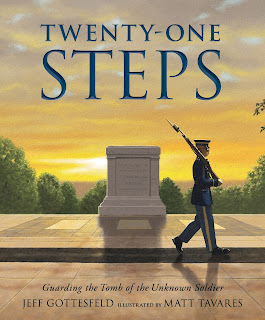
Servicewomen and servicemen have been guarding the Tomb of the Unknown Soldier every moment of every day since midnight on July 2, 1937.  This book, Twenty-One Steps: Guarding the Tomb of the Unknown Soldier (Candlewick Press, March 2, 2021) written by Jeff Gottesfeld with illustrations by Matt Tavares, gives voice to the history of this monument and those who protect those laid to rest there.  It is a remarkable tribute, lingering long after you've finished reading.

I am an Unknown.  I am one of many.

We fell for the last time in the Argonne Forest.
At Somme. Belleau Wood.
Facedown in trenches,
faceup on hillsides.
We fell a thousand ways.

The narrator concludes this opening soliloquy with haunting words about his and others' anonymity.  They continue with the heartbreak of families who cannot honor fallen members and friends.  In 1921, one unknown, is selected to represent all the unknowns.  This person is placed in the Capitol so people can morn and pay tribute to his sacrifice.  He is then taken to the Tomb.

Soon the importance of the Tomb is lost.  People go there to picnic.  Fortunately, there are others who stop this violation.  Then . . . one night under a waning crescent moon, twenty-one steps are heard.  This unknown is forever in the care of another.

To become one of the guards is an earned honor.  The clothing they wear, the manner in which they walk, and hold their arms and weapon are the epitome of precision.  These men and women come from all walks of life prior to entering the army and becoming part of the distinguished Tomb Guards.

After the World War I Unknown is placed at the Tomb, Unknowns from World War II and the Korean War are laid there.  The Vietnam Unknown is eventually removed because their identity is discovered.  Today this tomb is empty.

Tomb Guards spend every moment when not on duty preparing for their watch.  Everything about them is perfection, their minds, hearts, and that which can be seen by others.  In all weather, at all times of the day and night, with and without people watching, the Tomb Guards are vigilant taking their twenty-one steps.  The Unknowns are listening, knowing they are not alone.


To open this narrative, a decision was made to include The Sentinel's Creed, author unknown.  The first two sentences are brimming with truth.

My dedication to this sacred duty
is total and whole-hearted.

In the responsibility bestowed on me
never will I falter.

To have an Unknown be the speaker makes these words penned by Jeff Gottesfeld genuinely personal and moving.  This Unknown speaks honestly for all those fallen before him and after him.  There is a quiet power in what he says.  Readers will appreciate his introduction of the first Tomb Guard, the guards' specific work routines and dedication.  Into his story he weaves a history of the other Unknowns and a final tribute to the Tomb Guards.

Jeff Gottesfeld's writing in this book is poignant and poetic.  Twice he uses a list of single sentences to describe the dedication and work of the Tomb Guards.  You cannot read these without feeling a deep sense of respect for them and the Unknowns.  Here is a passage.

Late one half-moon night,
I heard footsteps.

The sharp click of heels.  Silence.

Another click. More silence.

Twenty-one footsteps.

Click.

Twenty-one seconds of silence.

Click.

Twenty-one seconds of silence.

Twenty-one more steps.

With each step, my war was over.


These illustrations 

done in pencil and painted digitally

by Matt Tavares are striking in their authenticity and emotional impact.  The scene of the Tomb of the Unknown Soldier with a Tomb Guard taking his twenty-one steps on the front continues on the other side of the spine to the far-left edge of the back.  The golden glow from the sun is reflected in the clouds on both the front and back.  Leafy green tree boughs rise from all sides of the Tomb's platform.  You can read the inscription on the Tomb.  

HERE RESTS IN

HONORED GLORY

AN AMERICAN
SOLDIER

KNOWN BUT TO GOD

If you listen, you'll expect to hear the twenty-one steps and the resounding click.

On the book case, the scene is night.  The moon is the same as it was on the first night a Tomb Guard took their first twenty-one steps.  A few stars are sprinkled in the sky.  On the front the Tomb stands silent and resolute.  On the back the Tomb Guard walks to the left, gun on their shoulder.  They are wearing a long coat and hat with earmuffs to ward off the chill.  

A muted steel blue covers the opening and closing endpapers.  The first page turn reveals The Sentinel's Creed.  Across the title page is a scene from a war-ravaged battlefield from the first World War.  The sky is dark with smoke from a bomb.  Barbed wire curls around posts and sandbags are placed in front.  A single helmet and canteen litter the ground.

Each two-page picture is a breathtaking reflection of the soldier's words.  Three times there are full-page images, two for those lists of sentences talking about the Tomb Guards and the final image in the winter of the Tomb of the Unknown Soldier, deep snow falling as footprints signify the twenty-one steps.  Matt Tavares takes us into a home with a soldier's picture placed on a fireplace mantle, to a vista of Arlington National Cemetery in autumn, to the Capitol rotunda as mourners pass the Unknown Soldier in state, and close to the shoes and bottom pantlegs of the first Tomb Guard walking at the Tomb at night.  There is dignity in every line drawn in every illustration.

One of my many favorite illustrations is for the above-quoted passage.  It is the close-up of the first Tomb Guard's shoes and pantlegs.  It is a double-page picture.  To the left of the gutter, the step is down.  To the right of the gutter, the step is lifted.  You can see the metal on the bottom heel and toe of the shoe.  The hems and seams of the pants are creased and trim.  The night sky supplies a background with the waning crescent moon above the line of trees on the left.  On the right is a portion of the Tomb of the Unknown Soldier.  This picture is brilliant.


This book, Twenty-One Steps: Guarding the Tomb of the Unknown Soldier written by Jeff Gottesfeld with illustrations by Matt Tavares, pays homage to many, is a history and a reminder of those who have given the ultimate sacrifice for our country and of those honored few who are sentinels for them.  No matter how many times you read this title, each time you will feel an intense appreciation for the Tomb Guards and the Unknowns.  I highly recommend this title for your personal and professional collections.  

To learn more about Jeff Gottesfeld and Matt Tavares and their other work, please follow the link attached to their names to access their websites.  Matt Tavares has a few interior illustrations on the page for this book on his site.  Jeff Gottesfeld has accounts on Facebook, Instagram, and Twitter.  Matt Tavares has accounts on Facebook, Instagram, Twitter, and YouTube.  At the publisher's website you can download a discussion guide.  At Penguin Random House you can view some interior images.  You might be interested in reading the information found at the Society of the Honor Guard, the Tomb of the Unknown Soldier.

Friday, May 15, 2020

From Many, One

The fascinating fact about picture book biographies about the same person is each new one makes the person more whole for readers.  Each author and each illustrator approach the subject from a different perspective, even if similar information is included.  Some picture book biographies focus on the person's entire life, from birth to death, focusing on their choice of accomplishments.  Other picture book biographies feature either their childhood, or adulthood.  Particular milestones reached by the individual, even a single event, are covered by other titles.

In a new title about Benjamin Franklin, we learn of a collective variety of incidents, contributing to a lifetime of remarkable achievements.  In A Ben Of All Trades: The Most Inventive Boyhood of Benjamin Franklin (Candlewick Press, March 17, 2020) written by Michael J. Rosen with illustrations by Matt Tavares, we become acquainted with a young man who had an intense focus.  His repeated attempts to prove a point, enhanced his future more than he could have imagined.

WHAT DID Benjamin Franklin love about books?  Each one was nothing like the other.

What did Benjamin Franklin not love about making candles?

Working in his father's candle making shop, Benjamin deplored the exactness of the trade.  Everything was always the same.  What Benjamin desired was to be a sailor.  His father would not agree to this.

He needed to find a trade for his son, this son preoccupied with swimming, reading and too much thinking.  His latest book fascination was a title from his library, The Art of Swimming. Josiah, though impressed with Benjamin's latest invention, paddles for his hands to make him swim faster, knew he must find something to peak his son's interest soon.

After several days working at a joinery, Benjamin and his father, on their walk home spoke.  Benjamin longed to go to sea.  Josiah, as expected, said no.  Even when Benjamin demonstrated a new swimming technique in the river, his father did not relent.  Two different and new apprenticeships did not appeal to Benjamin.  He was good at both, as he was with whatever he did, but he was bored.  Even after another swimming presentation, Josiah stood silent and firm in his resolve to forbid Benjamin to go to sea.

One day, using the acquired skills from his job training, Benjamin made an extraordinary kite.  With his sister, Lydia, and his friend, John Collins, they went to Mill Pond.  Suddenly an idea struck Benjamin.  It worked splendidly.  Eagerly, he, Lydia and John walked to his father's shop.  Even after an explanation, his father did not approve.

Benjamin was sent to work with his brother, James, who owned a print shop.  Benjamin was there for nine years.  In those years, this youth took what he knew and what he learned and melded them with the best parts of his personality.  Benjamin Franklin died more than 230 years ago, but his talents and his deeds remain.


With his first four sentences, author Michael J. Rosen presents readers with the essence of Benjamin Franklin's personality as well as how his narrative of this time in Benjamin's days will unfold in this book.  By moving back and forth between Benjamin's perfecting of his inventions and his swimming techniques and his father's attempts at finding him a trade, we feel the tension between a young man wanting something with every fiber of his being and a parent who will not allow it.  It becomes apparent, when reading the facts and dialogue as depicted by Michael J. Rosen, that even within the restrictions of this historical period, young Benjamin Franklin's mind was allowed to flourish, regardless of not pursuing the career of his dreams.

In his Notes About Young Franklin and About Creating This Book, Michael J. Rosen addresses what he did and did not include in this book.  This reinforces what readers discover.  Although Benjamin Franklin lived centuries ago, young people today can connect to a boy who took the best of every situation and used it to strengthen his gifts.  Here is a passage.

The two walked without speaking until they
approached the river.  "Father, I've learned the
Leap of the Goat.  It's the feat that shows true
mastery of the swimming arts."
"If you must demonstrate, then you must . . . "
Benjamin raced toward the water.  Floating on
his back, chest inflated, he thrashed his arms
against the sun-bright ripples until his feet
fluttered inches above the river.
Josiah applauded.
Benjamin dressed.
The two walked home in silence. 


In a breathtaking composition, beginning on the front of the open and matching dust jacket and book case, we see young Benjamin Franklin standing on a dock post looking out at the harbor in Boston.  Behind him are buildings and people portraying the architecture, clothing, and transportation of this period.  The scene extends beautifully on the other side of the spine.  A ship flying the British flag spans from the left to the right of this portion of the painting.  The use of light and shadow here is visible throughout the book.  You can feel the salty air on the breeze and hear the cries of sea birds in the distance.  The sound of the horses and wagon and voices of the people fade because you, as Ben Franklin, are looking out toward the sea and your future.

The rich velvety black of the title text is used on the opening and closing endpapers.  On the first page is a quote from Poor Richard's Almanack, 1750.  As referenced in the quote artist Matt Tavares has placed a sundial on a short square pillar among grass and foliage.  With another page turn we are standing behind Benjamin Franklin as he looks out at the harbor.  This view of multiple ships in the water against a golden sky awash is wisps of clouds is stunning.  The yearning of this boy is our yearning.

Rendered in pencil and painted digitally, these illustrations by Matt Tavares transport us to Benjamin Franklin's world as a youth.  When the focus is on Benjamin and his father, the image spans across one page and half of another page.  This creates a wide column for text which Matt Tavares frames in period lines.  He also places a smaller visual (or visuals) beneath or within the text symbolizing an item mentioned in the narrative.

When Benjamin is trying one of his inventions, the illustration is a double-page picture, edge to edge. The one exception to this pictorial rhythm is when Josiah tells Benjamin he is to become a journeyman in his brother's print shop.  It is a dramatic moment.  Another technique of Matt Tavares creating an interpretive cadence is how he shifts a visual's viewpoint.  We are brought close to Benjamin at times and then we are given a more panoramic view.  Sometimes there is a blend of the two.  One thing which is portrayed is the affection Benjamin has for his sibling, friend, and his father and how that affection is returned.

One of my many, many favorite illustrations is when Benjamin is experimenting with his kite.  This double-page picture shows the bank of Mill Pond with homes beyond it and the masts of ships rising in the harbor.  Shadows of tree branches play on the roofs from the sunlight.  Lydia and John are running along the path.  This scene is the upper one-third of the image.  The other two-thirds show ripples of water, left to right, as Benjamin is being dragged on his back by the kite.  Above the water on the right side is his smiling face, eyes alight with joy.  His arms are stretched out and up as he grasps the stick with the kite rope wound on it.


This point of view, this portion of this memorable man's life, will resonate with and inspire readers.  Ben Of All Trades: The Most Inventive Boyhood of Benjamin Franklin written by Michael J. Rosen with illustrations by Matt Tavares is a marvelous title.  You could pair it with Electric Ben: The Amazing Life and Times of Benjamin Franklin by Robert Byrd, Ben Franklin's Big Splash: The Mostly True Story of His First Invention by Barb Rosenstock with illustrations by S. D. Schindler and Mesmerized: How Ben Franklin Solved a Mystery that Baffled All of France by Mara Rockliff with illustrations by Iacopo Bruno.  In this title in addition to the previously mentioned author notes, there is a note From the Illustrator, and a Bibliography.  I highly recommend this title for your personal and professional libraries.

To learn more about Michael J. Rosen and Matt Tavares and their other work, please follow the links attached to their names to access their websites.  Michael J. Rose has accounts on Facebook, and Twitter.  Matt Tavares has accounts on Facebook, Instagram, and Twitter.  At the publisher's website you can view an interior image.  At Penguin Random House you can view other interior visuals.  Matt Tavares chats on the A Bookish Home Podcast with Laura Szaro Kopinski.


Be sure to visit Kid Lit Frenzy hosted by educator Alyson Beecher, to view the other titles selected this week by other participants in the 2020 Nonfiction Picture Book Challenge.


Monday, December 9, 2019

It's Beginning To Look A Lot Like . . . 2019 #5

It is the first and one of eight names celebrated in a poem nearly two hundred years old.  It is sung joyfully in several seasonal carols.  In fact, portions of the poem and songs containing this name have been committed to memory by even the youngest among us.  It might be said these verses are as well-known as The Alphabet Song.

This name, and the being that responds to it, are attached to an important event in the lore of Christmas.  On Christmas Eve, Santa Claus fills a sleigh full of gifts to bring to children throughout the world.  This sleigh is pulled by a team of nine reindeer, but no one knows why until now.  Dasher (Candlewick Press, September 10, 2019) written and illustrated by Matt Tavares is an original explanatory tale radiating Christmas magic.  When a dream fills a heart, that heart will find a way to fulfill that dream.

YOU MAY HAVE HEARD THE STORY of how a certain red-nosed reindeer was chosen to guide Santa's sleigh one foggy Christmas Eve.  You've probably heard of the eight other reindeer too.  Maybe you can even remember all their names.

The narrator continues by telling readers this was not always true.  Originally Santa's sleigh was pulled by a single horse that went by the name of Silverbell.  As time went on the number of children and gifts to deliver grew in number.  Silverbell needed help.  A young doe, a reindeer called Dasher, needed to escape.

Dasher, her parents and siblings were captive in a circus, the J. P. Finnegan's Traveling Circus and Menagerie.  Daily they spent hours in the heat from the sun as crowds pressed around them and long nights hauling the circus wagons to the next destination.  To lessen their misery their mother told them stories of a place with clear, brisk air and snow covering the ground to cushion their hooves.  Reindeer were free there as the North Star shown down on them at night.

Dasher longed to live in this place, but Mr. Finnegan was not likely to let any of the reindeer leave without dire consequences.  The one thing Dasher enjoyed about being in the circus was the children but still, night after night, her longing increased as she watched the North Star.

One wild and windy evening, fate gave Dasher an opportunity.  Bravery made her bold and she bolted from the enclosure.  No matter how long she followed the North Star, it still seemed far, far away.  (Sometimes when we follow our dreams, a wish gives us hope to hold.)  Dasher's wish brought the sound of sleigh bells, a man dressed in red and white fur and a horse, a horse named Silverbell.

During their conversation, the man and Dasher reached an agreement.  It was a night of many firsts for the young reindeer.  On Christmas morning and in the following days, Dasher's heart nearly burst with happiness at living in the land from her mother's stories.  Before a year passed, Dasher's biggest desire became a reality and one of the most enchanting chapters in Christmas traditions.


With his preface author Matt Tavares reaches out to readers connecting us to what we know and welcoming us into a fascinating and lasting revelation.  Like Dasher, who among us has not felt trapped by circumstances and dreamed of a better place, a place fashioned by truth and a mother's stories?  Matt Tavares increases our bond with Dasher and his family through his choice of descriptive words.  We feel the heat of their days and the work they endure at night.  We are soothed by Dasher's mother's tales of the land under the North Star.  We feel Dasher's yearning.

The repetition of specific words ties portions of the story together.  These words sustain the dream in Dasher's heart and in our collective minds as readers.  They further attach us to this reindeer as her story unfolds.  We can feel a gentle tension growing until we read seven very special words about a sound coming from the woods on a snowy night.  Here is a passage.

Dasher could hear rustling from inside Mr. Finnegan's trailer.
She glanced up at the North Star.  She looked back at her sleeping
family.  She knew that this might be her only chance.  Her heart
pounded.  She took a deep breath.


How can you look at the front of the dust jacket and not feel the spell of this picture weaving around you?  In the calm of a stormy, snowy night the moon is sending rays through parting clouds.  In this play of light and nighttime shadow stands Santa Claus with his sleigh pulled by a horse.  Is that Dasher coming from the evergreen on the right?  There is much mystery and possibilities in this scene.  The title is embossed in burnished golden foil.

To the left, on the back, on a pale blue canvas, a smaller version of a double-page interior picture is framed in fine red lines.  It is an illustration certain to have readers, young and old alike, smiling with the thrill of the moment.  This visual, like many in this book, is a portrait of the power of faith, hope and wishes come true.  On the book case, from one side to the other, is a gorgeous night sky.  On the front the North Star is shining big and bright; so close we can touch it.

The red used throughout the book covers the opening and closing endpapers.  Prior to the title page, Matt Tavares frames his introduction in those same fine red lines.  This is placed in a setting of a cold wintry night with the North Star directly overhead.  Along the bottom, walking in the snow, are two reindeer.  With a page turn the verso and title pages feature a double-page image.  It's a panoramic view, from slightly above, of the circus with its tents, wagons and the pen encircling Dasher and her family.  It depicts the heat and dust and desperation.

Using

watercolor, gouache, pencil, and pastel

Matt Tavares brings us completely into Dasher's world with his pictures.  Some are on single pages bordered by fine red lines opposite pages of white for text and a small North Star in gold beneath the words.  For a few we are brought close to the scene.  We could be standing with the children feeding Dasher carrots.  In only one picture does Matt Tavares break the frame with an element.

All the pictures are intensely atmospheric, but the double-page pictures evoke strong emotions of weariness, wanting, wishing and then the delight of a wonderful shift in the story.  When Matt Tavares creates his art, it's as if any one of them could come to life at any moment.  We want to reach out or step into the visual.

One of my many, many favorite illustrations is deep in the woods.  On the left in the darkness the text is placed in a framed box with the tiny North Star.  On the right in the light of the moon's rays, Santa is standing and talking with Silverbell in front of the sleigh loaded with gifts.  They are framed by leaves and evergreen branches.  Standing in the foreground, watching and listening is Dasher.  Looking at this picture, even without the text, you can sense a turning point.


Dasher written and illustrated by Matt Tavares is well on its way to becoming a holiday classic.  Everything about it, every tiny detail, is exquisite bookmaking.  This is a story of Christmas to share as often as you can, year after year.  I give this my highest recommendation and hope you'll add it to your personal and professional holiday collections.

To learn more about Matt Tavares and his other work, please visit his website by following the link attached to his name.  Matt Tavares has accounts on Facebook, Instagram and Twitter. At the publisher's website is an activity kit.  At Penguin Random House you can view interior images.  Matt Tavares wrote a lovely post about the process for this book at the Nerdy Book ClubAt Scholastic's Ambassador of School Libraries, John Schumacher's site, Watch. Connect. Read., please enjoy the chat between him and Matt Tavares for the book trailer premiere.

Monday, September 18, 2017

Always Together

Their song is unmistakable to even the most novice listener.  If they decide to make their home near your home, you will be awakened by their sweet melody.  Both the male and female trill the well-known cheery refrain.  It's a comfort to know they mate for life.  It's a comfort to know they have chosen to be near you.

Eleven days ago author illustrator Matt Tavares posted a photo and comment on Facebook about stepping into a hotel elevator with portraits of cardinals hanging on the wall.  It was his first event promoting his new book, Red & Lulu (Candlewick Press, September 19, 2017).  We had a short chat about "signs" but what I didn't tell Matt at the time was cardinals were my Mom's favorite bird.  Each year it became a tradition to buy her a new cardinal ornament for her Christmas tree.  My mother had red hair and all her friends including my father called her Red.  This enchanting title will resonate with readers for varied reasons but for all it lifts up the power of love and the hope of a miracle.

In the front yard of a little house, on the branches of a mighty evergreen, there lived a happy pair of cardinals.

This tree offered them all they needed during spring, summer, autumn and winter.  They preferred winter over the other seasons because the family living in the little house decorated the tree with colored lights.  They sat and listened to

O Christmas tree, O Christmas tree,
Thy leaves are so unchanging...

Do you think the carolers heard them joining their chorus?

On an early morning before autumn turned to winter Red left to find food for him and Lulu, who waited in the tree.  As he returned he was shocked by the sight before him.  The tree was on its side on a truck.  Lulu was softly singing inside the branches.

As the truck sped down the road, Red called to Lulu.  He would not leave her.  He tried to keep up but the truck was too fast.  He lost sight of the truck, tree and no longer heard Lulu's song as it headed toward a vast city.  Red was in a place in stark contrast to the yard of the little house where the tree had stood.

The noise and buildings nearly overwhelmed the exhausted cardinal as he searched for Lulu day after day.  When the snow started to fall, the ache of her absence grew stronger.  He felt so connected to her he thought he heard their winter song.  Joy flooded the brave bird's body.  He flew and flew and stopped, stunned.  Lights.  Love.  And ...


When an author begins a story prior to the title page they are inviting you into something extraordinary.  With a single sentence Matt Tavares gives us once upon a time.  He continues to explain the contentment Red and Lulu find living in that particular tree all year long.  In this way, he creates a bond between readers and the pair of birds.  We understand the value of home and lasting companionship.  In this respect we feel the same alarm as Red when the tree is moved with Lulu in its branches and when he can't keep up with the truck.  But...

Matt has also fashioned a cherished tradition the duo share during their cherished season of the year.  This is the kind of hope on which their relationship flourishes.  Here is a sample passage.

Red chirped frantically,
telling Lulu to stay 
right where she was,

telling her that he
would be right there.


When viewing the opened dust jacket (I have an F & G.) the front view is striking.  The panoramic view as seen by Red and Lulu transports us to New York City at Christmas.  We, like the two birds, are drawn to the tree.  To the left, on the back, the affection between Red and Lulu is presented by Matt Tavares by taking us inside the tree.  Red and Lulu are resting on branches as the Christmas lights twinkle.  It is a smaller, more intimate image in an oval surrounded by a pale green canvas.  The opening and closing endpapers are a muted cardinal red.

Prior to the title page we see one of the children, dressed in winter garb, filling a feeder hanging from the roof.  The large evergreen looms to the right.  Everything is frosted in a thick layer of snow.  The title page, like the front of the dust jacket, is a marvelous sweeping view but instead of the city, it's of the community where the little house is located.  The two birds fly near their names, the title, on the left.  The large tree rises between Matt's name and Candlewick Press on the right. 

Rendered in watercolor and gouache the illustrations have a limited but natural color palette.    They vary in size to provide perfect pacing. Some are framed in a generous amount of white and others flow edge to edge.  Many of them are wordless which allows for more active participation by the reader and assists in furthering our emotional attachment to the story and Red and Lulu.

With a pair of cardinals as the main characters readers are treated to numerous birds-eye-view pictures but we are also taken deep into the story with shifted perspectives.  Matt knows exactly when to make this change.  We move in close when Lulu is frightened by the tree's move, Red is flying along a city street between the legs of walkers, or when he hears a sound close to his heart.

Several other items of note are the luminosity present in each picture.  It's not just the lights but an overall glow suggestive of warmth.  Careful readers will recognize some of the skaters at the Rockefeller Center rink.  And as he did in the beginning, Matt closes the story with an extra page, the possibility of another tale.

One of my many, many favorite pictures is on a single page.  The point of view has changed to bring us close to Red.  He's flying in the city at night as snow falls.  Behind him buildings stretch on either side, windows glowing from the lights.  Street and vehicle lights shimmer.  He is not looking directly at the reader but off ahead.  His body is moving with intent.  His feathers are a vivid contrast to the night, lights and snow.


As soon as I finish reading the story, look at the final two pictures, read the author's note about The Rockefeller Center Christmas Tree and view the image on the publication page, I go back to the start of Red & Lulu written and illustrated by Matt Tavares and read it again.  You are completely captivated by it because it rests in truth.  The blend of Matt's words and artwork has a timeless quality.  You will want to have at least one copy on your professional bookshelves as well as your personal bookshelves. (It's all I can do to not read it aloud to all the classes this week but I will wait for the finished copy and a time nearer to November.)

To learn more about Matt Tavares and his other work please follow the links attached to his name to access his website and blog.  Matt has several interior illustrations you can view on his website.  Matt is interviewed on a Candlewick Press podcast.  The cover is revealed at Mile High Reading hosted by the director of the Plum Creek Children's Literacy Festival Dylan Teut.  The book trailer is revealed at Watch. Connect. Read. by Scholastic's Ambassador of School Libraries, John Schumacher.  At the cover reveal and the book trailer premiere there are interviews.  

UPDATE:  On October 4, 2017 and October 6, 2017 Matt Tavares added two posts to his blog about items he hopes we notice in his book and a last minute change he made. 

UPDATE:  On December 7, 2017 Matt Tavares chats with author, reviewer and blogger Julie Danielson at Kirkus. As a follow-up to that conversation Julie Danielson hosts Matt on her blog, Seven Impossible Things Before Breakfast on December 14, 2017.

Wednesday, May 17, 2017

As Free As A Bird

Whenever calm is broken by stiff breezes or high wind gusts, looking skyward reveals our larger feathered friends enjoying what nature has offered.  Wings spread wide; they soar on the currents of air, moving up and down, until they glide out of sight.  It's as if we've been given the gift of bearing witness to this miracle of wings and wind.  Do they feel as much joy in this act as we do watching them?

Almost two hundred, twelve years ago a first in the field of aviation was written into the history books.  Lighter than Air: Sophie Blanchard, the First Woman Pilot (Candlewick Press, March 14 2017) written by Matthew Clark Smith with illustrations by Matt Tavares brings to readers the fascinating story of how this woman fulfilled a childhood dream.  All she ever wanted to do was to fly.

It was November 1783.  For months France had buzzed about the brothers Montgolfier and their mad dreams of floating bags in the sky.

The news of their success reached five-year-old Sophie Armant.  She lived in a small town along the coast of France.  She feared and avoided the noise of crowds and carriages but the thought of flying like the seabirds thrilled her.

France was totally caught up in the balloonists and ballooning after the success of the Montgolfiers.  Two of the more famous balloonists were Jean-Pierre Blanchard and John Jeffries.  They were the first to cross the English Channel by balloon without incident. (Well, they did have to remove some clothing.)

Sophie yearned to fly and she learned all she could about the balloonists.  Now a young woman, she attended one of Monsieur Blanchard's exhibitions, introducing herself to him.  He recognized a kindred spirit in Sophie.  They were married.  After several flights with her husband, Sophie piloted a balloon solo in 1805.

Ballooning was not without its dangers and Sophie lost her husband three years later.  She continued shows as he had to make a living, loving every moment in the air.  Her preference was to ride in a form shaped like a chair, small and compact.  She flew into heights of bitter cold and thin air.  She nearly drowned.  She kept on flying, winning the approval of rulers of France.


What Matthew Clark Smith does for readers is to first give us an accurate historical perspective on the craze for balloonists and ballooning in France.  Into this he inserts Sophie's fondness for flight over other methods of travel.  We have a vivid awareness of not only this inclination but her longing to be alone, above the hustle and bustle of crowds.  By including specific incidents where she placed herself in danger, he gives us an authentic picture of her life's passion for ballooning.  Sophie Blanchard was her best self in a balloon.  Here is a sample passage from the book.

Sophie read everything she could about Blanchard and his fellow adventurers.  And there was one thing she couldn't help noticing.  All of the balloonists were men.  The sky was no place for a woman, some said.  It was too cold up there, the air too thin, the winds too fierce.  Women were made of weaker stuff.  Their place was on earth.
Deep in Sophie's windswept heart, she knew that couldn't be true.


All the glory felt by Sophie Blanchard when she was aloft alone in the balloon on her first solo flight radiates across the opened dust jacket.  Matt Tavares portrays her heart's desire to fly like the birds she loved to watch as a child.  The color choices of golden sky and clouds contrast beautifully with the delicate shades of blue and green on the balloon and the clothing worn by Sophie.

On the book case along the lower half are clouds brushed in pale yellow and green.  Above them are darker golden hues, some nearly orange.  In the upper left-hand corner of the front we see a much smaller version of Sophie flying in the balloon.  It gives us a very clear perspective of her courage and commitment.  A deep burnished orange covers the opening and closing endpapers.

Before the title and dedication pages a sky with fluffy blue and white clouds is the background for a quote by Charles-Augustine De Coulomb about any attempts by man to fly.  With a page turn a gorgeous balloon framed in tiny scrolls and tiny balloons provides space for the dedications.  Rendered in ink and watercolor the images throughout this title vary in size and point of view to heighten the impact and pacing of the text.

In the beginning and ending portions of the book, several of the pictures are framed in intricate scrolls and lines with the tiny balloons in the corners or other very small items which reflect the current storyline; fireworks, snowflakes, thunder clouds or birds.  (In almost all the visuals birds are shown.)  Matt gives us a one page view of Sophie walking the beach as a little girl with the sandpipers running ahead of her and then taking flight from the one page picture to the opposite page holding the text.  His skies often reflect the mood of the storyline.  These illustrations usually span two pages; the loss of Sophie's husband or the joy in continuing the ballooning shows.

One of my many favorite images is when Sophie is a teen.  The sky looks as if rain is coming; a mass of gray clouds.  Sophie is seated on a hill overlooking the sea.  The grass seems to hold the same color as the sky and water.  Her knees are drawn to her chest and her arms are hugging her legs.  Her expression is thoughtful but determined.  Matt has placed a light on her face as if the sun broke through from the clouds and shined on her.  Newspapers are strewn and blowing about her.  Can you see the picture on one of them?  What is it?


There is so much to be learned from reading nonfiction picture books like Lighter than Air: Sophie Blanchard, the First Woman Pilot written by Matthew Clark Smith with illustrations by Matt Tavares.  This woman overcame incredible odds to realize her heart's desire.  An Author's Note, Illustrator's Note and Selected Bibliography follow the narrative.  This is a worthy purchase for your personal and professional bookshelves.

To discover more about Matthew Clark Smith and Matt Tavares and their other work, please visit their websites by following the links attached to their names.  Matt Tavares maintains a blog here.  You can view interior illustrations at Penguin Random House and Candlewick Press.  There is a teacher's guide available at Candlewick Press.  This title and Matt Tavares's illustrations are featured by author, reviewer and blogger Julie Danielson at Seven Impossible Things Before Breakfast.  There is an interview of both these creators during the cover reveal at educator Dylan Teut's blog, Mile High Reading.


Be sure to stop by Kid Lit Frenzy hosted by educator Alyson Beecher to read about the titles selected by bloggers participating in the 2017 Nonfiction Picture Book Challenge.