Quote of the Month

When love and skill work together, expect a miracle. John Ruskin


Showing posts with label Marine animals. Show all posts

Wednesday, July 18, 2018

Ocean Occupants

Many of us when speaking of the large bodies of water covering our planet refer to them as oceans or seas interchangeably.  Geographically seas are smaller and considered a part of oceans.  Usually seas are partially enclosed by land.  Even for someone spending most of their life able to walk along the shores of Lake Michigan, to step on the sandy beach of a sea or of an ocean is stunning.  As far as you can see there's water.  If you venture in a vessel for enough time on this water, you suddenly realize the land has vanished.  There is nothing but ocean.

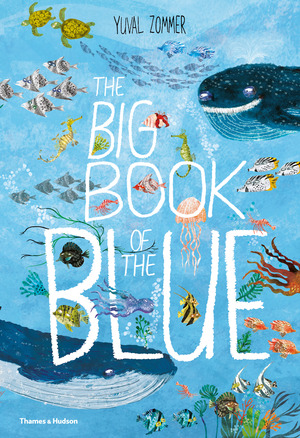
To be out in a boat on the ocean with no terra firma in sight is a lesson in perspective.  Who are we compared to this expanse?  What lies beneath our boat?  In his third title (The Big Book Of Bugs and The Big Book Of Beasts) author illustrator Yuval Zommer presents a multitude of answers in The Big Book Of The Blue (Thames & Hudson, June 5, 2018).

Can you find . . .
. . . exactly the same sardine
15 times in this book?
Watch out for imposters.

In twenty-seven separate sections following this challenge it's a given readers will be actively looking for the sardine among the flow of creatures moving on each page.  They will certainly stop at the first two-page picture dedicated to Who's Inside?  Here they receive an overview of the contents with the corresponding page numbers.

Five Ocean Families are presented based upon specific characteristics such as having gills or lungs, being cold-blooded or warm-blooded or living with a particular type of skeletal structure.  Whether you realize it or not, Fins and Flippers are not the only form of motion for these residents of the watery realm.  Seahorses are the only fish with fins swimming upright.  By gathering water into its body and blasting it out, an octopus wastes no time getting from one point to the other.  All these animals, like us, need air to survive.  How they acquire oxygen varies.  Did you know a sperm whale can go for two hours without taking a breath?

The lack of teeth does not deter sea turtles from cutting their food; knifelike jaws work very well.  In order to leap out of the water a flying fish needs to be speeding at 37 miles per hour.  Like a human's fingerprint, a seahorse's crown is unique.  You won't believe the missing parts on a jellyfish.  One of them is a heart.  Perhaps there's a folktale explaining this and the three hearts found in an octopus.

They are not vegetables but whales are grouped in pods.  Have you ever wished you could look in two different directions at the same time?  Ask a crab how this works.  There are sharks that have to keep swimming or they will suffocate.  It's been said krill form groups large enough to be seen from space.  This is amazing when you realize they are about two inches long.

It's fascinating when you learn why sea snakes shed their skin multiple times (between nine and twenty) during a given year.  Did you know a swordfish can poke a hole through a boat? The facts about tuna will make your head spin especially the number of tuna tins one blue fin tuna can fill.  The colors on a penguin protect it when it's in the water mimicking water and sky.

The second most poisonous animal in the world is the only fish that blinks.  Even tide pools are tiny kingdoms of amazing life.  You probably won't have any luck grabbing a butterfish; they're actually greasy.  We are shown what creatures live at 450 feet all the way down to 20,000 feet and beyond.  Two pages address how large vessels, overfishing and global warming are harming the oceans as well as the danger of plastic.  Thumbnails help readers locate those sardines they could not find.  Six paragraphs on two pages address terms used most often when talking about our oceans.  The title closes with sea creatures bordering a two-page index, white print on a black background.  It's an informative and striking depiction.


Yuval Zommer takes his skill as a researcher and writer and uses it to gather and present the best kind of information about each topic.  He has this childlike curiosity of wanting to know as much as possible but particularly those weird and wonderful tidbits of knowledge.  You are unlikely to forget what he tells you in this book.  His sentences are succinct but entirely conversational.  He has the gift of awakening the seeker in all of us.  Here are some of his enticing words.

Swim goggles
A sea turtle has see-through eyelids that it
uses like a pair of goggles to see underwater. 

Not half bad!
If a jellyfish is cut in half,
it becomes two living jellyfish.

Half-asleep
A dolphin sleeps by resting one
half of its brain at a time.


Opening the book case allows you to see the vast and exquisitely detailed sea creatures swimming around the text on the back (speaking about the book) and among the title text on the front.  The letters on the front and all the animals are varnished on the case.  This is a captivating introduction of what the book holds for readers.

On the opening and closing endpapers a pale-blue, nearly marbleized, canvas extends from edge to edge.  Several schools of small fish are featured in the background.  White lines circle and swirl indicating currents.  More brightly colored fish swim in from the upper left-hand corner on the opening endpapers.  On the closing endpapers this group appears in the center.  The smaller schools have moved also.

On the title page, table of contents, and index pages Yuval Zommer uses his ocean residents to frame his text. You are never quite sure the shade of the ocean you will see when turning a page but it's guaranteed you will be intrigued and entertained.  The intricacy of each scene and the elements you find there are certain to have you returning to pages repeatedly.

The illustrations are completely realistic but in Yuval Zommer's signature style.  It's as if he has lived among the animals he draws so they and their habitats are portrayed fully animated.  A seagull turns its head in curiosity at a crab on the sand.  Seals swim through a variety of fish but also lounge on rocks partially covered in seaweed.  Dragonets glide past sea fans, seaweed, octopuses, jellyfish and other inhabitants.

One of my many favorite illustrations is for the two pages dedicated to krill.  Along the top of the two pages a ship moves through the waves.  A night sky with a full moon and a few stars is partially covered in clouds.  On the right two other boats move in and out of the scene. The water color is deeper reflecting the darkness of the sky.  Krill move in swarms on the sea.  Creatures who feed on them are present.  On the left a large, hand-held magnifying glass focuses on several krill so readers can see their shape and size.


Without a doubt this title, The Big Book Of The Blue written and illustrated by Yuval Zommer, like its predecessors, will rarely be on the shelves.  Readers of all ages can't resist the illustrations and the facts found in these pages.  I highly recommend this book for your professional and personal book collections.

To learn a bit more about Yuval Zommer please follow the link attached to his name.  Yuval is a guest at the World Book Day site.  You will enjoy the Q & A.  He also has an account on Twitter where he frequently posts artwork.  You can see interior views from this book there.


Please remember to visit Kid Lit Frenzy hosted by educator Alyson Beecher to view the titles selected this week by other participants in the 2018 Nonfiction Picture Book Challenge.


Thursday, May 26, 2016

Up, Down And All Around-Animals On The Move

Walking past the glassed doors leading out to my deck and backyard Wednesday evening, I was greeted by an unexpected sight.  Lying as peaceful as milk cows in a grassy meadow were two large deer.  The closer of the two seemed to be in charge, eyes and ears alert.  The smaller deer was positioned in one of my raised gardens as if it was its own personal resting place.  I imagine all the plants there have been consumed for a snack.  The entire yard is surrounded by a chain link fence.  When they leap over it, they seem to float.

The beauty of how animals move within our communities and in their natural habitats is a constant source of amazement.  In their newest collaboration Steve Jenkins and Robin Page share seven forms of locomotion used by animals.  Flying Frogs And Walking Fish (Leaping Lemurs, Tumbling Toads, Jet-Propelled Jellyfish, and More Surprising Ways That Animals Move) (Houghton Mifflin Harcourt, May 3, 2016) is a study of travel.

Animals walk, leap, climb, and swim.  Some roll or turn flips.  Others fly or glide, and a few are even jet-propelled.  

If you could peer along the floor of the ocean you might see an octopus using only two of its eight legs, taking a stroll.  Six other fellow creatures use legs, wings, fins, and a tail to go from place to place.  If you want to add speed a leap would be handy.

You would be a super hero if you could go fifty times as high as your own body length.  That's what a jumping spider can do.  Seeing a Japanese red-crowned crane spring into the air and gently fall to the ground must be breathtaking.  To move through water a trunk becomes a snorkel.  We all know how painfully slow a three-toed sloth meanders but when in the water, it's a different story.

Wouldn't you like to see a canine climb or a bird with clawed wings seek safety in a tree?  All sorts of animals can glide with ease and fly freely.  Look out for that snake!  Look out for that ant?  Did a lizard just float by?

Gymnasts in the critter realm can somersault to freedom like the mantis shrimp, curl and roll like a hedgehog or bite its tail turning in a circle like the armadillo lizard.  Even faster than the leapers are those zipping along as if launched from a canon.  All of those noted reside in water.  They use it as a force like the nautilus pushing water from its shell.  In many places on all our continents these animals go up, down and all around.


Robin Page and Steve Jenkins have pieced together a fascinating narrative.  This team understands which particular facts will be the most interesting to readers.  Single sentences are used for each animal; a variety of descriptive verbs creating images of their movements.  Seven lengthier paragraphs give an overview at the beginning of each section.  You want to wander in the worlds their words create.  Here is a sample passage and a couple of their sentences.

Rivers, lakes, and oceans can be challenging environments for animals adapted to life on land or in the air.  But swimming, even awkwardly, helps many creatures cool off, find food, or escape danger.

A young baboon dives in and paddles around just for fun.
A sleek cormorant plunges deep into the sea as it pursues a school of fish.


Steven Jenkins unmistakable style of illustration, torn-and cut-paper collage is noticeable immediately on the matching dust jacket and book case.  The canvas of bright sky blue on both the front and the back, to the left each feature an animal in green, the flying frog and the red-lipped batfish.  The white and black text provides a stunning contrast.  On the back is an assortment of action verbs used within the body of the book. (These are great to read aloud.)  The opening and closing endpapers are a swirl of hues of red; patterns of looped-leaf-like shapes.  The two creatures on the jacket and case make an appearance again on the title page.

The realistic intricacies Jenkins achieves in his collages are astounding; the circular suction cups on the octopus, the hundreds of legs on the millipede, the fur on the ring-tailed lemur, the texture on the elephant's skin, the feathery lightness of the leaves on trees, and the armor on the pangolin.  For each animal with eyes he captures the spark of light seen in each of them.  Their body stances and the lines defining them are brimming with motion.  The introductory animal spans two pages and the remainder are grouped on the following two pages.

One of my favorite illustrations is of the hedgehog.  It's shaped into a circle with a multitude of spines, brown flecked with white and gray.  A small gray face looks at the reader, brown eyes curious and nose ready to work.


Flying Frogs And Walking Fish written and illustrated by Steve Jenkins and Robin Page is a winning title sure to increase and satisfy curiosity simultaneously.  For the sections, walking, leaping, swimming, climbing, flying, rolling and jetting, thumbnails with more information about each animal is provided at the end.  A bibliography is included on the closing endpapers with the publication information.

This educator's guide with several of Steve Jenkins' titles includes this most recent title.  To follow the process used in making this particular title please follow the link attached to Steve Jenkins's name.


Please visit educator Alyson Beecher's blog, Kid Lit Frenzy, to read about the other titles selected by bloggers participating in the 2016 Nonfiction Picture Book Challenge.


Wednesday, June 24, 2015

To See In The Sea

Marine biologists study all life in the earth's oceans and other saltwater habitats.  Exploration of a world containing more than ninety-six percent of earth's water increases understanding and assists in preservation efforts.  The adaptations made by the fauna in the given conditions are nothing short of incredible.

According to this statement

Scientists estimate that no more than 5% of the oceans have been explored. (MARINEBIO)

we've many, many more wonders to discover.  Author Brenda Z. Guiberson and illustrator Gennady Spirin (Frog Song and The Greatest Dinosaur Ever) present to readers an array of underwater residents in their newest collaboration, The Most Amazing Creature In The Sea (Henry Holt And Company, June 6, 2015).  Some of them will be familiar to most readers, others will be enchantingly different.

Who is the most amazing creature in the sea?

Twelve creatures speak with a voice of authority about assets which elevate them to the honor named in the title.  As their characteristics are revealed your respect will grow.  It will give you pause to realize something with no brain backbone, lungs or gills can be so deadly.  Having a large number of eyes and lethal venom more than compensates.

Can you name the reptile which dives up to 4,000 feet?  They also have no fear of the aforementioned creature, dining on them with relish.  One blue-blooded being uses blue light and blue goo to discourage predators.  In the search for food eyes which rotate, looking through the top of your head, then shifting to the front again, might come in handy.

The mimic octopus does exactly as the name implies replicating the appearance of other sea neighbors.  It's a tad bit creepy to learn about the young male anglerfish and their attachment to larger females.  The word gross will quickly spring to mind when learning of the habits of the hagfish, also known as the snot fish.

If you think a being would need to be big to carry 300 million eggs, you would be right.  It's a record holder.  Can you name the largest shark and its size?  In one big gulp this largest creature to ever live on earth holds 17,000 gallons of water.

You will have to be vigilant to spot a leafy sea dragon but it will be well worth the trouble.  Physical characteristics make it seem to be seaweed.  Teeth in their throat?  Wolffish live up to their name.  Seven other smaller inhabitants are named helpers.  Without them the previous twelve would find survival difficult.  The chain of life from the largest to the smallest is essential under the sea.


For the twelve selected creatures Brenda Z. Guiberson begins with I am a... followed by carefully-chosen, intriguing, and sometimes cringe-worthy, facts stated in conversation.  Each animal is speaking directly to the reader.  They are trying to convince us they are

the most amazing creature in the sea!  

Using the same format for each presentation creates a sense of anticipation as well as a cadence in the narrative.


Gennady Spirin opens his artistic portrayal of the text with an illustration spanning across the spine from the back to the front, left to right.  He takes us down into the depths of the ocean with shades of green, gold, brown and black.  Luminous and textured the intricate details invite us to reach out and touch the pages.  (I am working with an ARC.) On the title, verso, dedication and author's note pages, text is displayed on a marbleized swirl of blues and greens depicting a watery background. 

Fourteen two-page images, the creatures, helpers and conclusion, gorgeously mirror the world in which these beings live.  Rich colors and nearly photographic portraits of the marine life will captivate readers.  Spirin shifts our viewpoint from an encompassing scene to being so close we can look the animal in their eyes.   Little more than two inches are reserved at the bottom of each picture to serve as a canvas for the narrative.

One of several favorite illustrations of mine is the leatherback sea turtle.  For this picture Spirin elected to bring us close to the animal.  The turtle is at the edge of the shore, one flipper dipped into the foamy swirling water.  Patches of grainy sand spot the tough skin.  One lively eye is peering at us.


The Most Amazing Creature In The Sea penned by Brenda Z. Guiberson with pictures by Gennady Spirin is a must read and must have for all professional collections.  If you have a lover of weird and wonderful animal facts in your home or classroom, they will certainly enjoy this title.  This is one of those books which will inspire readers to search for more information such as supplied in the author's note, bibliography and online sources listed at the back of the book.

To discover more about Brenda Z. Guiberson and Gennady Spirin please visit their websites by following the links attached to their names.  At the publisher's website you can view eight interior images.


Please visit Kid Lit Frenzy hosted by educator Alyson Beecher to see the other titles selected by participating bloggers in the 2015 Nonfiction Picture Book Challenge.