Quote of the Month

When love and skill work together, expect a miracle. John Ruskin


Showing posts with label Leo Espinosa. Show all posts

Tuesday, July 19, 2022

Freedom To Have Fun

There are many individuals who adhere to the unofficial beginning of summer as Memorial Day weekend and the ending of summer after Labor Day weekend.  In truth, summer begins on the summer solstice and ends on the autumnal solstice.  Those dates are usually around the third week in June and the third week in September.  There are others who base the beginning and ending of summer with the ending and beginning of the school year.  

Regardless of when it starts, there are other signs of this seasonal shift.  Morning and evenings are heralded by the sounds of birds and crickets.  The air is thick with humidity and the scent of blossoming flowers.  In my neighborhood, fawns wander with their mothers.  Children race past on scooters and bikes.  Thunderstorms quench thirsty lawns and gardens.

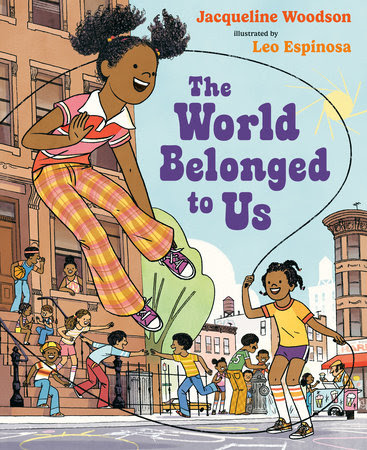
As a child summer meant floating stick and leaf boats down gutters during rainy days, spending hours under a large tree playing Monopoly when seated on an old quilt, playing softball on the vacant lot with the neighborhood kids, running through sprinklers until our skin was wrinkled, and calling out here I come, ready or not as we played hide-and-seek until mothers called us inside.  In The World Belonged to Us (Nancy Paulsen Books, an imprint of Penguin Random House LLC, May 10, 2022) written by Jacqueline Woodson with illustrations by Leo Espinosa, readers are transported to the freedom summer offers children.  Let's follow them!
In Brooklyn
in the summer
not so long ago

grown-ups always had someplace to be or some kind of work to do, but the minute school ended, us kids were free as air.
Free as sun.  Free as summer.

The heat in the city was intense even before school ended.  Wearing their school clothes, children ran through the water released by a hydrant enhanced with a can as their moms yelled at them.  The person handy with a wrench and the rest of the children intended to enjoy every single minute of summer.

All day long games were played on chalk-drawn boards on the streets.  The children were in constant motion, hopping to jump-rope chants, running, and spinning tops.  Their hearts soared.  When bumps and bruises happened, the older kids would step up and help and tell their own tales.

Cardboard creations rose like skyscrapers and the children admired the work of all their fellow builders.  During the summer in Brooklyn, imaginations and hope grew.  When others rose to renown in the world of sports, music, and literature, the kids believed they could, too.

Balls, bats, and cans were ready gear for more than one kind of game.  Senses were honed during play.  It was hardly surprising that everyone could hear the music of the ice cream truck blocks before it arrived.   Moms tossed money from windows inside tied handkerchiefs.  Ice cream was enjoyed and shared.  As the sky darkened, children still played calling out to one another in an array of languages.  When their moms began to call them home, they shouted out promises to each other.  Promises of another day filled with the freedom to have fun.


Author Jacqueline Woodson has an adept ability to reach into the past and bring it alive in the present. Five times the initial three phrase refrain is placed in the narrative to invite us into the summer with these children.  We experience what they are experiencing.  When dialogue is placed in the story, it rings with truth.  We know.  We've heard the same or similar words.  This is what Jacqueline Woodson does beautifully, she connects us regardless of when or where we were (or are) children.  Here is a passage.

In Brooklyn 
in the summer
not so long ago

we learned to watch and listen
playing tag, ringolevio, and hide-and-seek
inside hallways and behind thin-limbed trees
and garbage cans.

And our block was the whole wide world
and the world belonged to us.


There is so much fun happening on the front and back, right and left, of the open and matching dust jacket and book case, you want to jump in and join the children.  Many of the remembered activities highlighted in the text are featured in these two scenes.  These depictions do reflect when we believed

the world belonged to us.

To the left of the spine, on a background the same hue as the title text, is a golden oval.  Children are running inside and outside the oval, playing kick the can.  Underneath this image are words of praise for previous books by both the author and the illustrator.

On a marbled, muted canvas of dark orange on the opening and closing endpapers are drawings in red.  These drawings appear to be made in chalk or crayon.  They are childlike portrayals of activities enjoyed by the kids in Brooklyn.  You cannot look at these without smiling.  On the title page, we are given a more bird's eye view of the block in Brooklyn.  Along the bottom of the verso and dedication pages  are the tops of buildings in Brooklyn beneath a summer sun on the right.  The dedications read:

To young people everywhere.
Keep playing!---J.W.

To my childhood friends.
Tag, you're all it!---L.E.

Rendered by Leo Espinosa

with a mighty pencil and Adobe Photoshop

these single-page and double-page illustrations radiate warmth and happiness.  The children are placed foremost in the images in full color.  In one of the visuals, we are looking down on the block as the kids are actively engaged in a variety of games.  By their facial expressions and body postures, we know they are overjoyed that it's summer.  

Each line drawn by Leo Esinosa vibrates with fun, even when a child might be seated.  We know they are ready to spring into action.  Leo Espinosa has shown us what summer was, is and should be for all children.  Even though these scenes are in Brooklyn, there is a universality to them.

One of my many favorite illustrations is a double-page picture.  Dusk is arriving in the upper parts of the sky.  Darkening clouds move across a pale golden horizon.  Streetlights are on.  In the background on either side of the street are homes and buildings.  Children are running and calling to each other in the foreground.  One child, close to us on the right side, hands cupped to her mouth is shouting at readers.  Each of us can imagine what she is saying.


In truth, everyone feels different in the summer.  That subtle change in how time is spent affects each of us, thankfully.  In this book, The World Belonged to Us written by Jacqueline Woodson with artwork by Leo Espinosa, we are not only reminded of this, but encouraged to continue and support it.  It is a time to be cherished.  You will want to place a copy of this outstanding title on your personal bookshelves and more than one on your professional bookshelves. 

To discover more about Jacqueline Woodson and Leo Espinosa and their other work, please access their websites by following the link attached to their names.  Jacqueline Woodson has accounts on Instagram and Twitter.  Leo Espinosa has accounts on Facebook, Instagram, and Twitter.  At the publisher's website, you can view the title page.  At Seven Impossible Things Before Breakfast, Julie Danielson talks about this book as only she can and shares multiple interior images.  This book is included with two other Jacqueline Woodson titles in an Educator's Guide.  The publisher has a sneak peek preview here.

Wednesday, November 18, 2020

"My Heart's Devotion"

There is usually a song, or a group of songs, which define portions of our lives.  One record (vinyl) which captured the attention of a young teen in the 1960s was the soundtrack for the movie, West Side Story.  To her parent's probable annoyance, it was played nonstop.  Can you imagine her joy when her high school sweetheart took her to see the production at the nearby Michigan State University Fairchild Theatre?  She hummed and sang her favorite songs for months and months after seeing the show in person.

One of those songs was America. In the movie it is sung by the actress who plays the part of Anita.  A Girl Named Rosita: The Story of Rita Moreno: Actor, Singer, Dancer, Trailblazer! (Harper, an imprint of HarperCollinsPublishers, November 3, 2020) written by Anika Aldamuy Denise with illustrations by Leo Espinosa presents to readers the remarkable life of the woman who never stopped believing in or pursuing her dreams.

 
Juncos, Puerto Rico, 1935
In a tiny cottage tucked between El Yunque Peak and
a wild fragrant rainforest lives a girl: a girl with the rhythm
of the rainforest in her feet and the sweetness of the
sugarcane fields in her swishing skirts.

This girl is named Rosita Dolores Alverio.  Dancing and singing are like the breath of life to her.  When she is a little girl, she and her Mami leave Puerto Rico.  Her younger brother, Francisco, stays there.  Even the sight of the Statue of Liberty cannot not dim her sadness.  School is difficult for Rosita.  Students bully her because of her physical characteristics and the way she speaks.

She asks Mami repeatedly when Francisco will come.  She practices her English alone.  Her Mami works very hard at multiple jobs.  Spring and summer eventually come to New York City.  Missing the wonderful landscape of Puerto Rico lessens.

When she is six, her Mami takes her to receive dance lessons from Paco Cansino.  After three years, she is ready to perform in front of an audience.  Her dancing roles increase as do her speaking roles in Spanish.  She longs for a starring role.  At sixteen, Rosita takes the name of her stepfather, Moreno.  To her great joy, Louis B. Mayer of MGM studios requests an interview.  At the studio in Hollywood, they shorten her name to Rita Moreno.  

Although she has signed with MGM, her roles are not what she desires.  They are often stereotypical.  She persists.  Her persistence is rewarded in 1959.  She is cast as Anita in West Side Story after a stellar test performance, where she becomes Puerto Rico through dance and song.  At the Academy Award ceremony in 1962, the little girl, now a woman, makes history as the first Hispanic woman to win an Oscar.  (I'll bet the cheering was heard for days.)


The true spirit of Rosita Dolores Alverio, Rita Moreno, is presented on the first page and throughout the narrative by author Anika Aldamuy Denise per her descriptive single action words, dialogue, and the inclusion of Spanish language.  The text is a constant revelation of Rosita's thoughts, making the learning of her life an intimate experience for readers.  We can feel, layer by layer, an emotional moment building.  At times to enhance the storytelling rhythm Anika Aldamuy Denise employs alliteration.  A wonderful additional technique is to bookend the beginning and end with a place name and date showcasing the changes in this accomplished woman's life.  Here is a passage.

If she only knew more ingles, she could tell the bullies:
!Dejenme in paz! Leave me alone!

So while Mami scrubs and scours and sweats and sews,
Rosita practices ingles in secret.


The warmth of the color palette on the open and matching dust jacket and book case wraps around readers.  It also radiates great joy.  It is easy for readers to see the little girl still shining in the grown woman.  To the left, on the back, on a canvas of red, some elements from an interior image are used.  Rita is now in Hollywood.  Her chair is placed on a large wooden crate.  Next to it is a megaphone.  A gentleman paints her name, Rita Moreno, on the back of her director-style chair.  A woman, a make-up artist, brushes Rita's cheek.  A camera and floodlight are also present.

The opening and closing endpapers are the vivid pink shown in a few brush strokes on the front of the jacket and book case.  On the initial title page (single) we are treated to a scene of Rosita's village.  On the formal title page, a double-page picture, we are brought close to the yard of a single home in this village.  Rosita and a chicken are running from the left to the right.  She, the chicken and main title are framed by buildings and trees and shrubs.  

Each of the illustrations by Leo Espinosa digitally rendered in Adobe Photoshop span two pages, or single pages.  They are highly animated, full of real people living their best lives.  Leo Espinosa brings us deeply into the story with his perspectives.  We are there with Rosita as she looks out the ship's window at her younger brother and Papi on the dock.  When she is being bullied by her classmates, we feel her despair.  When Rosita dances her first dance on stage we see Puerto Rico mirrored in her movements.  It's the details Leo Espinosa includes here, and in each image, which elevates the words of author Anika Aldamuy Denise.

One of my many, many favorite illustrations is when Rita is practicing for her audition for Anita in West Side Story.  It is a double-page picture with a darker background.  In spot colors, swirls of blue and purple, Rita has been placed.  In each of these six positions she is alive with dance movements.  She is wearing a hot pink dress with layers to her skirt, falling in waves about her legs.  Her happiness at dancing becomes our happiness.


For those who have ever dreamed big and wondered if that dream is achievable, A Girl Named Rosita: The Story of Rita Moreno: Actor, Singer, Dancer, Trailblazer! written by Anika Aldamuy Denise with illustrations by Leo Espinosa will serve to inspire them.  This women, now in her late eighties, is still a force of nature, having acquired a part in the remake of West Side Story by Steven Spielberg, slated to be released in 2021.  At the close of the book is a Timeline, Selected Bibliography, Articles and Quotation Sources, and an Author's Note. You will want to have this glorious biography as part of your professional and personal collections.

To access more information about Anika Aldamuy Denise and Leo Espinosa and their other work, please follow the link attached to their names to access their respective websites.  Anika Aldamuy Denise has accounts on Facebook, Instagram, Pinterest, and Twitter.  Leo Espinosa has accounts on Facebook, Instagram, Tumblr, and Twitter.  Please take a few moments to enjoy the cover reveal post for this book and educator T. J. Shay's interview with Anika Aldamuy Denise at KidLit TV.