Quote of the Month

When love and skill work together, expect a miracle. John Ruskin


Showing posts with label 2016 Nonfiction PictureBook Challenge. Show all posts

Wednesday, August 31, 2016

Groovin' Movin' Greenery

Too late for a proper garden but unable to resist the temptation of growing something to eat, two large pots on my deck are home for a single pumpkin and zucchini plant.  In less than sixty days six inches have become five feet of winding vines weaving among annuals planted in layers of flower boxes.  Yellow blossoms dot the strands of green, signs of tasty goodness to come.

Plants in all seasons of the year are a promise of renewal, a continuation of life.  Plants Can't Sit Still (Millbrook Press, a division of Lerner Publishing Group, Inc., August 1, 2016) written by Rebecca E. Hirsch with illustrations by Mia Posada presents their fascinating methods of motion.  You'll be ready to focus on flora with new eyes.  

Plants don't have feet 
or fins or wings,
yet they can move
in many ways.
Look closely and you'll discover
that plants
cant't
sit still.

They begin beneath the ground twisting and turning their way upward toward their essential needs; heat and light.  Some roots form a chain sending up new plants from a central point.  A single plant may grow many arms reaching over the ground.  Vines may need other plants or structures to spread vertically or they contain hidden strengths.

Branches on plants can act as hands repelling and capturing enemies.  Plants can have internal clocks.  Have you ever walked outside after dark to see how they shift and change?  

Doing different dances, partnering with air, seeds spread on the ground or from high places.  They can burst forth from small pods attached to plant bodies.  Seeds can be sneaky attaching to unsuspecting animals or people.  Sometimes seeds become a vessel transported on water until they discover new ground.  Every place they land, regardless of how they move, gives seeds a chance to begin anew.  


An array of action words, verbs, selected by Rebecca E. Hirsch portrays the movements of plants in ways readers might not initially notice.  She takes us beneath the ground, along the ground, and upward, always upward.  Their amazing survival techniques and hidden clocks are descriptively depicted.  Like real life, Hirsch brings us full circle providing us with information on seeds and how they are spread. The More About Plants pages at the book's end gives readers a conversational overview of plants in general but also supplies us with more in-depth information about twenty particular plants, including their scientific names.  You will be pleasantly surprised by what you learn.  Here is another sample passage from the book.

A seed is a plant
built for travel.
Seeds can whirl
like helicopters
or float on
parachutes
or glide on papery wings.
But they 
can't 
sit 
still.


Readers are greeted with a rainbow of color and plants performing many movements in the collage on the front of the matching dust jacket and book case.  Their lifting, dropping, popping and shifting surround the title text which appears to be in motion too.  To the left, on the back, readers see a scene from nighttime, moonflowers opening and raising their faces to the light.  On the opening and closing endpapers, looking from left to right, seven individual illustrations on a pale blue background represent the cycle of a dandelion from parachuting seeds, to tiny sprouts, a small plant, yellow blossoms and back to an old plant ready to release seeds.  Morning glory vines and flowers frame the verso and title pages.

Rendered in cut paper collage with watercolor eight of the eighteen illustrations created by Mia Posada span from left to right across two pages.  Ten of the images are on single pages but they appear together intricately bound by background color and the type of plant pictured.  The use of light and dark and layers generate a life-like texture.  

The perspectives are varied as we view the places these plants move.  Tucked in each illustration are other creatures; a blue butterfly, a bird enjoying the seeds from a sunflower, creeping caterpillars, moths, a mouse and small red ladybugs to name a few.  It's as if we are surrounded by the worlds Posada makes for us.  

One of my favorite of many illustrations is of the exploding pods attached to a squirting cucumber.  From left to right pale green leaves, portions of vines and pale yellow blossoms spread.  On arched stems hang the pods.  One of them is shooting out seeds crossing the gutter from left to the right zooming over a full bloom.  A small green frog sits on one of the leaves.    


Plants Can't Sit Still written by Rebecca E. Hirsch with illustrations by Mia Posada is a way to discover movement secrets of plants more commonly known and seen by readers.  We can walk in the wild world, our neighborhoods or in our backyards to discover these truths.  In addition to the More About Plants section there is an author's note, glossary and more information through books and websites.  The time lapse videos at one of the websites are amazing.  It might be fun to pair this title with Rooting for You: A Moving Up Story written by Susan Hood with pictures by Matthew Cordell.

To learn more about Rebecca E. Hirsch please visit her website by following the link attached to her name.  She also maintains a blog linked here.  At the Lerner website Mia Posada participates in a short Q & A.  In a longer interview Rebecca E. Hirsch answers questions at Lerner.  To get a glimpse at interior pages please visit the publisher's website.


Be sure to stop by Kid Lit Frenzy hosted by educator Alyson Beecher to read about the other titles chosen by bloggers participating in the 2016 Nonfiction Picture Book Challenge.  


Friday, July 29, 2016

Digging Deep

There are those books which command the attention of everyone regardless of whether you are a science geek, fact finder or seeker of trivia. These books are brimming with interest on every page turn.  These books add depth and breadth to our understanding of the world in which we live.

On October 8, 2013 Maps (Big Picture Press) written and illustrated by Aleksandra Mizielinska and Daniel Mizielinski was released.  The size, 10 5/8 by 14 9/16, is indicative of the quality and quantity of the contents. Printed on heavy matte-finished paper with a sepia-toned finish on cream, the text and pictures take readers around the world. Each two-page spread is framed in an intricately rendered border varying in design.

We are treated to a world map, maps of the continents and individual countries.  We see political borders, flora, fauna, cultural foods, activities, natural and man-made wonders, housing, clothing, famous persons and specific place names. Significant bodies of water and mountains are featured.  Famous works of art and literary and historical milestones are included.  Creatures which may be found in the oceans and seas surrounding the land masses are duly noted.

Each element in the images is carefully labeled.  Sometimes one or two sentences offer further explanation.  This book of maps, this atlas, combines the best part of political, resource, and physical maps.


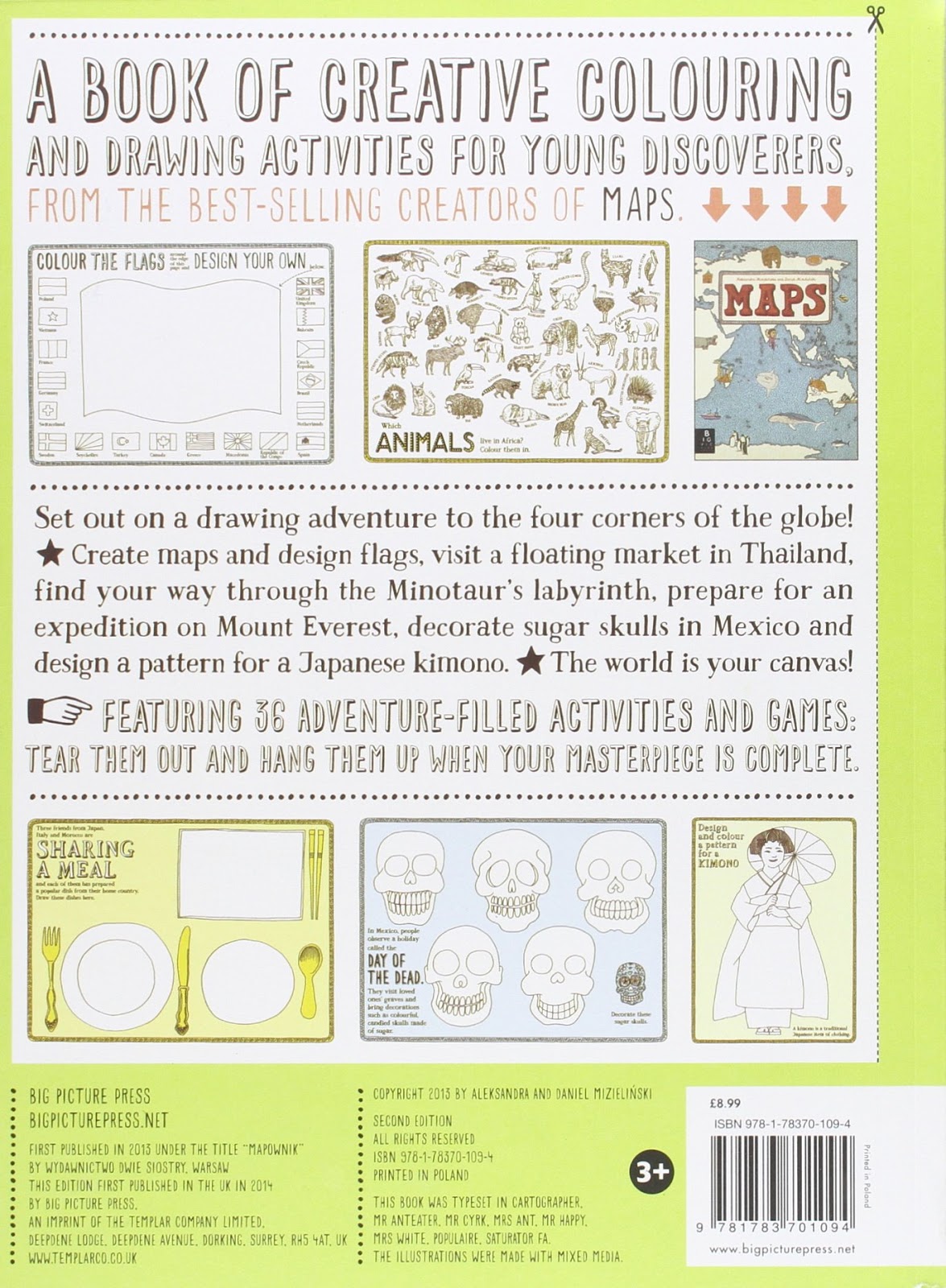
As an enhancement to the original publication Big Picture Press published the Maps Activity Book written and illustrated by Aleksandra Mizielinska and Daniel Mizielinski on July 1, 2014.  Smaller in size, 12 by 8 4/5, this paperback with special binding for ease of  page removal delivers interesting challenges involving drawing, coloring, research, and creative imagining and thinking.  On the back of each of the thirty-six activities a tiny character, children from around the world, impart more fascinating facts in a single speech balloon.


Users might be asked to draw a map of an imaginary country, pretend to be an explorer in the Amazon and draw animals, plants and people they might find there, invent another glyph to add to the ancient Mayan language, color flags from countries and design your own, select which animals on a given page actually live in a specific place or create a pattern for a kimono.  Each of these activities invites readers to discover more than they originally know. The fantastic facts on the back of the activity pages might tell us where the largest active volcano is located, its size and the number of times it has erupted or who designed the updated U. S. flag after Alaska and Hawaii became states or supply readers with information about the original inhabitants of Australia.  The pages can be used for single individuals or as a guide for the generation of more related educational adventures.


The most recent title in this trio, Maps Poster Book (Big Picture Press, February 23, 2016) written and illustrated by Aleksandra Mizielinska and Daniel Mizielinski is twenty-seven maps plus the world map found in the first volume, condensed in size to 11 3/8 by13 9/16.  On one side of the poster is the exact replica of either a country, a continent or a large area, the Arctic.  On the other side the highlighted map is shown in color within a larger two-tone map.  All of the pages are perforated for removal.


The newest book by the collaborative duo of Aleksandra Mizielinska and Daniel Mizielinski, which again demonstrates their talents in exploring our world exquisitely, is Under Earth Under Water (Big Picture Press, March 1, 2016 UK, October 11, 2016 US).  For sixty-three pages we peer into the ground until we strike the core of our planet.  In the following forty-five pages we work our way to the surface but through the seas or oceans.  A clever design allows you to begin with either the earth or the water.


If we look just beneath the dirt all kinds of creatures seen with the naked eye or under a microscope can be found.  Discovering the giant Gippsland earthworm in Australia would be rather startling as it can grow to be nearly ten feet long.  Anthills are far most vast and sophisticated beneath the surface than what we find above ground.  Did you know there can be more than one queen in one anthill?

Intriguing information about borrowing animals, moles, naked-mole rats, prairie dogs, badgers, and red foxes are revealed in greater depth.  Plants with edible and medicinal portions growing under the surface are explained as other pages showcase majestic trees.  Man-made cables stretched below the surface, the vast networks used to transport natural gas, electricity and water used in homes as well as waste disposal are presented.   Travel by tunnels, general and specific, and how tunnels are made is a fascinating section.

Archaeology, paleontology, speleology, and mining are explained.  Pages are devoted to those products made from the riches, natural resources, taken from the earth.  Information about The Pacific Ring of Fire and plate tectonics are pictorially displayed.  The deeper we go volcanoes, hot water springs, geysers, layers of the earth and the center itself are discussed.

From here we start to head upward learning of vessels like the Deepsea Challenger used to explore the bottom of the sea.  Trenches and their strange inhabitants fill several pages.  Did you know that the glow seen at the tip of the triplewart seadevil's rod is actually other tiny lifeforms?  Have you ever heard of underwater chimneys? Some of those chimneys are found as far below the surface as sixteen thousand feet!

We have studied the Titanic, other sunken ships and an array of places using submersibles specially furnished with scientific equipment.   We have drilled into the seabeds using unique platforms to extract oil and gas.  (I wonder if any of those human workers have ever seen a colossal squid or blue whale showcased in several pages.)  A history of the development of diving suits and submarines will astound readers.  Many forms of diving and famous divers are disclosed.  

As we continue to move toward the surface we learn of water pressure, sinkholes, coral reefs, and the properties necessary for something to float.  To further our knowledge a comparison is made between the residents of an ocean and a freshwater lake.  As we come to the top, seeing the sky above, we can make the choice to dive down beneath the waves again or head to terra firma and start digging once more.


As in the Maps title the authors have meticulously labeled every item in the illustrations, inviting further research by readers.  Each two-page illustration, top to bottom horizontally, places informative text in rounded boxes blending into the image.  Each of these boxes contains one to five sentences written in an easy, conversational style.  (Readers should note the measurements are given using the metric system.)  Here are some sample passages.

The roots that reach deepest are of plants that grow in deserts.  The plants send them deeper and deeper underground in search of water.

In the far north of Russia, beyond the Arctic Circle, scientists drilled the world's deepest hole to gain a better understanding of the Earth's structure.  The borehole took 22 years to create and was more than 12km deep.

The Great Lakes are the Earth's biggest bodies of fresh water.  The most extensive freshwater lake, Lake Superior-on the border of the United States and Canada-is bigger than the Czech Republic.  The world's deepest lake is Lake Baikal in Russia, which reaches a depth of up to 1642m.

At the bottom of the ocean, hundreds, or even thousands of metres underwater, unusual places lie hidden that resemble fields of smoking chimneys.  The clouds that emerge there are not smoke, but hot water full of minerals.


When the book case is opened readers can view the table of contents for each section, earth and water, laid before them like a path to follow, with small images, page numbers and titles given.  Shades of blue are used as the background in the portion on water.  Once we begin to delve into the section on the earth a more varied color palette is used.  

The fine line work, layers of complex aspects, layout and design represent painstaking planning and implementation.  Within each illustration and from picture to picture everything flows flawlessly.  You might think the large amount of elements would be a distraction but that is simply not true.  They are an invitation to explore, discover and learn.

Two of my favorite illustrations of many are one from the water and one from the earth.  The Carmagnolle brothers' diving suit is featured in a single visual stretching from top to bottom.  It is standing in a bed of seaweed entirely submerged.  Seven labels containing facts are attached to it as is an important date.  Bubbles rise from the bottom in several hues of blue.  As a gardener the six horizontal rows highlighting roots, rhizomes, tubers and bulbs are fascinating.  Each is named with most containing special uses and locations where they are found.  Realistic colors are employed.  Gals and guys will be absorbed in the cross-sections devoted to moles, naked-mole rats, prairie dogs, badgers and red foxes.  


Under Earth Under Water written and illustrated by Aleksandra Mizielinska and Daniel Mizielinski is a marvelous, mesmerizing look at our planet's earth and water characteristics, the flora and fauna residing there and the secrets they have revealed to us.  This team has also added people and scientific advancements of significance relative to both.  The sturdy book case and heavy paper make this a lasting worthwhile addition to personal and professional collections.  Your patrons and students are going to love it.  I advise getting several copies.  

I was unable to locate any information on Aleksandra Mizielinska and Daniel Mizielinski but more information about this title and the others by this team can be viewed at Candlewick Press, Big Picture Press, and Templar Publishing. Enjoy the book trailer.


 To enjoy the other titles selected by participants in the 2016 Nonfiction Picture Book Challenge please access Kid Lit Frenzy hosted by educator Alyson Beecher.


Thursday, June 30, 2016

Peeking Into A Pastry's Past

Certain foods prompt memories; the first (or only) time you tasted something new, a parent's special recipe or when you cooked a meal all by yourself.  They are an integral part of annual celebrations and cultural traditions.  One very special pastry has been a crowd-pleaser for more than one hundred fifty years.

Growing up there was nothing better than walking into the local bakery early in the morning and tasting one freshly made.  In one of my school positions whenever there was a snow day, one of my neighborhood family's made them, inviting me to join in the fun.  The Hole Story Of The Doughnut (Houghton Mifflin Harcourt, May 3, 2016) written by Pat Miller with illustrations by Vincent X. Kirsch adds a delicious ingredient to an already scrumptious treat.

Few remember the master mariner
Hanson Crockett Gregory, though
he was bold and brave and bright.

At the age of thirteen Hanson left his home in Maine to sail the seas as a cabin boy.  He became a cook's assistant and then was assigned to scale the ship's rigging releasing the sails.  Can you imagine climbing eight stories on lines in your bare feet?

Six years later he captained a cargo schooner, then in a short time lead a crew sailing a clipper ship from coast to coast.  He even received a medal from Queen Isabella II of Spain for rescuing Spanish sailors at sea.  There is little doubt as to the excellence of Hanson Crockett Gregory's skills aboard a ship.

This book is not solely about Hanson's abilities as a sailor but his ingenious leap of faith in the galley one morning cooking for the crew as an assistant when he was a teenager.  Rather than making the less than savory "sinkers", ball-shaped fried dough with gooey, greasy centers, he altered the routine.  Voila!  A new delectable treat was born.

Over time legends of an elaborate nature were told about the doughnut's origin, daring rescues at sea involving sinkers, wheels and belaying pins but we readers know the truth.  Decades later Hanson is quoted in a newspaper interview, giving a humorous and humble reply to a query.  Today in his honor he still looks to the sea from his resting place.


With her introductory two sentences Pat Miller reminds readers there are many stories within the single story of our lives.  She highlights the sailing life of Gregory first; giving us a foundation for his famous invention.  Then using a flashback technique we are privy to his creativity and how it spread from ship to shore.  The specific details in both of these narratives represent meticulous research.  By including other tales of the origin, she allows us to see how legends are formed.  Here is a sample passage representative of her conversational presentation in this book.

Hansom formed balls of sweetened dough.  Both men stood on spread legs as the cramped galley lurched with the ship.  Pans clanged overhead.
The aroma of browning sugar rose as the cook dropped in the first blobs of dough.  The iron railing on the stovetop kept the pot in place as the Ivanhoe bucked and plunged. ...


For knowing observers of children literature illustrators, they will recognize the work of Vincent X. Kirsch last seen in Gingerbread for Liberty!: How a German Baker Helped Win the American Revolution.  The attention to details on the matching dust jacket and book case enhance the narrative adding tasty pieces of humor; the medal on Gregory's jacket, the whale reaching toward the doughnut mouth open and the expression on Gregory's face after sampling his invention.  On the back, to the left, within a circle of rope (a line) all eight legs of an octopus are holding a doughnut through the hole.  The blue along the bottom edge on the front crosses the spine becoming the hue surrounding the golden shade inside the circle. Eighteen rows of nine doughnuts and life rings around a doughnut with a ship's anchor in an array of decorative patterns (Fourth of July, Halloween, and a snowman) cover the opening and closing endpapers.  A clever set of marine signal flags spells out a request on the verso page.

Throughout the volume Kirsch places his images within circles framed by white space, background visuals extending the opposite picture and rope.  His perspective shifts bringing readers into the moment;  a smaller Gregory high in the vast rigging with the sun behind him, the movement of the ship at sea, a close-up of the defining ingenious moment in the galley or brave rescues during stormy waters.  All of the illustrations are suggestive of the energy surrounding this man; nothing is static.  Although my knowledge of period attire and architecture is limited it seems that Kirsch is authentic in his work.

One of my favorite illustrations is when Kirsch zooms in on Gregory hard at work in the galley bending over a tray of "sinkers".  Behind him are the shelves in the galley lined with ingredients.  He gives additional color to the important element there.  The look on Gregory's face is determined as well as full of hope.  You can see the progress of his baking spread before him.


This nonfiction picture book biography will linger in readers' minds as surely as the first sweet taste of a well-cooked doughnut will in their mouths.  The Hole Story Of The Doughnut written by Pat Miller with illustrations by Vincent X. Kirsch is savory and informative from beginning to end.  The final four pages include a photograph of Hanson Crockett Gregory, an author's note, a timeline, acknowledgments and a selected bibliography.

To discover more about Pat Miller and Vincent X. Kirsch please follow the links attached to their names to access their websites.  Vincent X.Kirsch gives readers a peak at several interior images from this title.  Please read the review of this title at Jama's Alphabet Soup by Jama Rattigan.  She includes other helpful links on the progress of this book's creation.  On May 18, 2016 Pat Miller is a guest on a podcast at Storybook Spotlight, SSP86.


Please stop by Kid Lit Frenzy hosted by educator Alyson Beecher to discover the other books selected by bloggers participating in the 2016 Nonfiction Picture Book Challenge.


Wednesday, June 8, 2016

From Trash...A Treasure

Still like that old time rock 'n' roll
That kind of music just soothes the soul
I reminisce about the days of old
With that old time rock 'n' roll

Old Time Rock and Roll lyrics by George Jackson and Thomas E. Jones III, sung by Bob Seeger

One of the most universal lines in those now famous lyrics is that kind of music just soothes the soul.  It's not just rock and roll that soothes the soul but many forms of music.  Whether it's a portion of a song or an entire symphony, those melodies have the capacity to transform individuals or entire groups of people.  

Every refrain begins with a single note.  Ada's Violin: The Story of the Recycled Orchestra of Paraguay (Simon & Schuster Books for Young Readers, May 3, 2016) written by Susan Hood with illustrations by Sally Wern Comport is how single notes or ideas or wishes if you will, come together.  It's a story of making beauty where it appears least possible.

Ada Rios grew up in a town made of trash.  

Several miles south of the capital city Asuncion, Paraguay, lays the city of Cateura.  It is the site of an enormous landfill.  Garbage trucks deliver their loads all day long as recyclers work among the trash trying to gather what they can to make a living.  This is where Ada and her family made their home.

Music was a part of her family's life; her grandmother enjoying rock and roll music of the 60s and her father speaking of famous musicians and pointing out the sounds of specific instruments when they all listened to songs on the radio.  It was the sound of the violin Ada enjoyed the most.  As she and her younger sister, Noelia, grew up, started school, and became more independent, it was Ada who wondered what would become of them.  What kind of life would they have in this town made of trash?

The answer came in the form of a sign on the chapel wall posted by a new arrival to their community.   Ada's and her sister's grandmother signed them up for learning either violin, guitar or cello.  Favio Chavez did not have enough instruments for all the students who arrived to learn on the first day.  Half the students had nothing to play.

Favio Chavez was a man on a mission and he had an idea.  He enlisted the help of Nicolas "Cola" Gomez, a recycler and a carpenter.  With the help of another, Tito Romero, the two put their creative skills to work.  These inventive men made instruments from items gathered from others' garbage.  Guess who was given a violin?

Hours of practice in all kinds of weather outside with Senor Chavez and hours of practice on her own, honed Ada's skills as well as those of her companions.  The music these young people made transformed from discord to harmony.  Their sounds were changing the spirits of an entire community...and five years later a dream Ada never dared to dream came true.  And the songs reaching out from those recycled instruments to this day play on.


With each reading the richness of Susan Hood's use of language increases in this nonfiction narrative.  Research and interviews revealed personal and specific details which she includes in her concert of words; quotations, spoken Spanish and the insertion of sound effects adding to the authenticity.  Hood clearly represents the physical living conditions of life in Cateura but also describes the generosity of spirit found in the people highlighted in this title.  Her approach to the story with Ada's thoughts on what a garbage truck was

"a box of surprises"

 comes full circle bringing a sense of splendor to the telling.  Here is a sample passage.

Every morning at dawn, Ada heard the first garbage trucks rumble and roll down the road to Cateura.  Beep, beep, beep!  Backing into the landfill, they tipped their loads up and up and---
CRASH!  The trash came tumbling down---fifteen hundred tons each day.  


You have to pause when you open the matching dust jacket and book case.  The design in a word is stunning.  The blend of textures, images, light and shadows and individual items literally takes your breath away.  To the right on the front, placing Ada in the lower foreground with the orchestra in the background in the center on a pile of trash as scraps of sheet music rise upward is brilliant.  To the left, on the back, an interior image of Ada and her sister listening to their father speak about music, musicians and instruments as the radio plays is a glimpse of an intimate family moment. The opening and closing endpapers are a shade of the teal seen on the jacket and case.

Rendered in a

hybrid technique of collage, acrylic glazes and paints, drawings, and digital mediums, then executed on stipple paper

the images extend across two pages.  Each one of them enhances and elevates the text and invites us to study all the intricate elements.  Sally Wern Comport involves us in these pictures by altering her perspective; we look down at a city street, we look up at workers on the top of the dump piles, we gaze into Ada's thoughtful eyes as she dreams and we look upon her face as she plays her violin, and we enter the workshop of Senor Gomez as he fashions the instruments.  The emotion on the faces of all the people is marvelous.

One of my favorite illustrations, of many, is of Ada and her sister playing in the sand.  They are squatting on a board bridging some water, both dipping pails downward.  Their grandmother's two pups are playing with the girls.  Their reflections in the water and the shadows created by the sun enliven the scene.  They are all surrounded by trash.  This is an eloquent moment where you would not expect it.


Ada's Violin: The Story of the Recycled Orchestra of Paraguay written by Susan Hood with illustrations by Sally Wern Comport is one of my favorite nonfiction books of 2016.  You anticipate hearing the music of the orchestra as you read it because of the flawless combination of text and visuals.  At the conclusion of the book an author's note provides more information.  Websites and videos are also included along with other sources, quotes and several pictures.

Please visit the websites of Susan Hood and Sally Wern Comport to learn more about them and their other work.  Each contains more fascinating information about this title.  At the publisher's website are six interior images.  (More can be seen at Sally Wern Comport's website.)  Sally Wern Comport is featured at Truly Amazing Women in an interview.  Storybook Spotlight highlights Susan Hood in a podcast, SSP87.  At Nonfiction Picture Book Wednesday: Ada's Violin at Kid Lit Frenzy hosted by educator Alyson Beecher last week, Alyson talks about this title and interviews Susan Hood.


Be sure to visit Kid Lit Frenzy hosted by educator Alyson Beecher to see the selections of other bloggers participating in the 2016 Nonfiction Picture Book Challenge.


Wednesday, March 16, 2016

Positioned At The Top

Over the course of fifteen years winter has grown to become my favorite season.  It's a time when Mother Nature takes a pause, resting before renewal.  Whether walking along a worn path on crystal clear, blue sky days with air so crisp you could cut it or through drifts of new snow and biting winds, my dog Xena and I would make our way regardless of what the day offered.

On March 6, 2016 the ceremonial start of The Last Great Race, the Iditarod, began in Anchorage, Alaska.  Following these women and men and their dog teams traveling a course across the forty-ninth state is breathtaking.  The challenge of nearly one thousand miles through unforgiving land and weather is beyond comprehension but many of them have done it for decades.  At this time there are still forty-three women, men and their dogs on the trail.  Thirty have completed the journey in less than ten days.

In 1988 a trip never accomplished before was undertaken.  Helen Thayer's Arctic Adventure: A Woman And A Dog Walk To The North Pole (Capstone Young Readers, an imprint of Capstone, March 1, 2016) written by Sally Isaacs with illustrations by Iva Sasheva portrays thrilling moments of this milestone adventure.  Attitude, preparation and determination fueled every step made.

Few people have walked to the magnetic North Pole. Especially alone.

When Helen Thayer was fifty years old she knew she wanted to walk three hundred sixty-four miles around the magnetic North Pole.  If she fulfilled this dream she would be the first woman to do this.  Prior to beginning this journey she prepared for two years.

Upon her arrival at a village in northern Canada a local bear hunter advised her strongly not to go alone.  His offer for the use of a dog team was turned down by Helen.  She did agree to take one dog, a dog comfortable with staying outside and guarding his humans from polar bears.  Helen called him Charlie.

For four days it was snow and ice, walking, eating and sleeping inside the tent with Charlie on watch.  On the fifth day terror struck the duo in the form of an angry polar bear.  The following attack left Helen unharmed but Charlie ran like the wind after the retreating bear.  Helen was now alone.  Was that a speck of black against the white horizon?

By day eight Charlie was no longer sleeping outside the tent but sharing a pillow with Helen at night.  Together they survived a storm lasting days and frightening cracks in the sea ice.  A truly terrifying event happened on the twentieth day causing Helen to not only wonder if they would succeed in reaching their goal but if they would live.  A photograph supplies the answer.  Buried in the ice in the northern realms is a small metal container filled with contents only Helen Thayer could have placed there.  One woman.  One dog.  One month in 1988.


As a result of extensive research including first person accounts in print and through phone conversations with Helen Thayer, author Sally Isaacs recreates an action-packed accounting of the expedition.  Specific details heighten the intensity of situations where survival hangs in a balance.  The use of numbering the days and a blend of conversation and narrative make this a more intimate experience for the reader.  Here is a sample passage.

Charlie jumped up.  Helen did too.  She peeked outside and gasped.
There was a long crack in the ice---only 5 feet (1.5 meters) from her tent door.
How could she leave?  The violent wind was hurling ice and snow.
How could she stay?  The crack was inching toward her tent.
If the ice broke under the tent, they would fall into the icy black water.


Artist Iva Sasheva depicts the harsh environment of the Arctic along with the persistent passion of Helen Thayer and Charlie on the front of the book case.  This scene moves over the spine to the left on the back with a vision of the endless sky, snow and ice.  The opening and closing endpapers are differing images of swirling flakes against the pale gray wintry sky and pale blue landscape below.  Beneath the text on the title page, we are given a bird's eye view of Helen and Charlie each pulling their respective sleds over the snow; Helen on skies and Charlie walking beside her.

These paintings by Sasheva are nearly photographic in their detail spanning single or double pages.  The text is tucked into each illustration.  Her color palette reflects the atmosphere of the region day and night along with the precarious balance maintained by Helen and Charlie between life and death and reaching their goal.  It's easy to imagine the silence except for the sound of Helen and Charlie moving over the ice and snow, the roar of the attacking polar bear, the deafening crack of breaking ice or the howling wind tossing about pieces of ice as if they are paper.

One of my favorite pictures is of Charlie being introduced to Helen as Tony stands nearby.  Helen is squatting in front of Charlie so they can assess each other eye to eye.  Behind them in the blowing snow are the buildings of the village.


You can't help but read Helen Thayer's Arctic Adventure:  A Woman And A Dog Walk To The North Pole written by Sally Isaacs with illustrations by Iva Sasheva as fast as you can turn the pages.  Once again readers will be astonished by the feat of a single individual who succeeded in being the first woman to reach the magnetic North Pole.  At that time she was also the oldest.  The text and images in this book take you to that place and time with Helen and Charlie as surely as if you were there.  When you finish this you will realize there is nothing you can't do.  At the end of the book is A Note from Helen Thayer, More About...Helen Thayer, More About...Charlie (this is particularly interesting), a Glossary, Read More books, Internet Sites, Discussion Questions and an Index.

To become more familiar with Sally Isaacs and Iva Sasheva please visit their websites by following the links attached to their names.  At the publisher's website is a page with additional resources; three websites and five books.  At HistoryLink.org more fascinating information is available about Helen Thayer.  Trust me...you will be amazed.  Please enjoy these two additional videos.


Each week the 2016 Nonfiction Picture Book Challenge leaves me more informed and wiser about people, animals, things and places than I was before reading these books.  Please take a moment to see the titles selected by other bloggers this week at Kid Lit Frenzy hosted by educator Alyson Beecher.