Quote of the Month

When love and skill work together, expect a miracle. John Ruskin


Showing posts with label picture books. Show all posts

Sunday, November 2, 2014

Picture Book Month 2014, Then, And Now, 2017

It's day two of Picture Book Month.  Each year in November this international action highlights the print picture book.  For each date of the month an author, illustrator or author/illustrator will post an essay on the importance of picture books.

A page is devoted to ideas on how to participate and celebrate Picture Book Month.  There is a Picture Book Month Teacher's Guide along with certificates of participation.  On the promo kit page is a short video to view or give you ideas about creating one with your children or students.

Each year a theme is assigned to each day with Picture Book Month founder, Dianne de las Casas, sending out tweets asking for titles.  As I did last year I am setting up an online format, Padlet, listing two or three books around the daily themes.  Most of the titles will be fairly new with reviews attached to the title or at least a summary.  I have included a copy of the calendar below so you can see the themes.  I will start with the first six days adding two or three at a time.  Have fun and celebrate Picture Book Month.  I've also included a Popplet of books suggestions for 2013 on this Padlet. (Here is a link to take you directly to the created Padlet.)


Created with Padlet


It's been great fun to work on creating a collection of picture books around the themes selected for 2017.  I might be adding to the list as I discover more books before November 30, 2017.  It is my sincere hope you will find all three lists of benefit to you and your children.  The direct link to the Padlet is here.


Made with Padlet

Sunday, August 10, 2014

There's No AcCounting For My Love Of Picture Books---Picture Book 10 for 10

I am so excited to be participating with many others in this annual tribute to picture books.  It's an opportunity for book people to showcase those titles they simply love.  These are picture books they highly recommend for use in classrooms and sharing with other readers of all ages.

10 for 10 Picture Books is hosted by Cathy Mere, educator and blogger at Reflect & Refine: Building a Learning Community and Mandy Robek, educator and blogger at Enjoy and Embrace Learning.  All of the lists are collected in a single spot to be used as a continual resource.  Here is the link for all the participants last year. In 2012 I listed ten plus two top alphabet books.  It's not that I'm necessarily a rule breaker but this is very hard.  For 2013 I could only narrow it down to fifteen so Xena picked her top ten dog books out of those.

This year I decided again to focus on titles which might be considered strictly for younger students.  All of them can used to spread the joy of numbers and counting.  Sharing these books with them is pure fun.  I think laughter and learning are a pretty good combination.  Each of them also offers opportunities for older students to draw, search for images and write; making their own versions.

Here are my top ten...eleven...books on counting and numbers.  If a link is embedded in the title, it takes you to my complete review of the book.


1.  1-2-3 Peas (Beach Lane Books, 2012) Keith Baker

One cannot help but smile when looking at the cover of 1-2-3 Peas; a smile guaranteed to last well after the last page is turned.  Never has a counting book been quite as much fun as when written and illustrated by Keith Baker with the assistance of his personable peas.  Clever readers will be searching the pages for the consistent appearance of a special visitor.


2.  Count The Monkeys (Disney Hyperion Books, 2013) Mac Barnett, author, Kevin Cornell, illustrator

When we are asked by a friend to put the silverware on the table, we expect to see forks, spoons and knives in the drawer, not screwdrivers, wrenches and hammers.  I'm here to tell you, readers, when you open the cover of Count the Monkeys (Disney Hyperion Books) by Mac Barnett with illustrations by Kevin Cornell, you can take any expectations you might have and throw them out the window.   You are lured into the pages of this book expecting to count...well...monkeys.


3.  123 versus ABC (Harper, 2013) Mike Boldt

Beginning with my youngest patrons' first visit, through song, dance and hand motions, I introduce letters and numbers explaining, one will help them find fiction (even if organized by genre), the other will give them direction in locating nonfiction materials.  I tell them repeatedly year after year, if they know their letters and can count, they will be able to locate the correct book in any library.  The two systems, alphabetical and numerical, work together to create addresses for every item in the library.  Their school library is a lively practice field for using the public library, moving them toward independence.
In this respect numbers and letters or letters and numbers have equal importance.  But in that wonderful world of "What-If", what happens when letters and numbers arrive at the same place at the same time believing themselves to be the guest of honor?


4.  Musk Ox Counts (A Neal Porter Book, Roaring Brook Press, 2013) Erin Cabatingan, author, Matthew Myers, illustrator

Five-year-old children are not the only ones who get a kick out of knowing numbers.  The dubious duo who made their first appearance in A Is For Musk Ox have returned.  Mr. Que Sera Sera is still driving his striped companion crazy with his inability to follow the plan.


5.  Flight 1-2-3 (Chronicle Books, 2013) Maria van Lieshout

Flight 1-2-3 captures the same magic in the exploring of an airport, the deciphering of the signage, counting what can be seen and traveling by plane.  It is a companion to her Backseat A-B-See (Chronicle Books, April 11, 2012).


6.  Ten Little Caterpillars (Beach Lane Books, 2011) Bill Martin Jr, author, Lois Ehlert, illustrator

With every other line rhyming Martin created counting verses with a catchy cadence.  Readers follow each of these ten caterpillars into their habitats of flowers, fruits, vegetables, a pool, weeds and even the sea matched by close encounters with fowl, fish and feathered friends of the backyard, woods and field.  They are never idle, always in motion; crawling, wriggling, climbing, falling or scaling.  When the number ten is reached that little caterpillar hangs in stillness awaiting the change the spring will bring---miraculous metamorphosis.


7.  One Two That's My Shoe! (Disney Hyperion, 2011)

I love it when my mind's eye sees something while my conscience eyes are focused on something else entirely.  While looking ahead at a special section in the public library this past week, what should register on my radar but the  Alison Murray book, One Two That's My Shoe!(Disney-Hyperion Books)  I was as pleased as could be to see the rascally familiar black and white pooch on the cover in all his lovable glory.

As in the first book, Apple Pie ABCGeorgie and his human, Grace, are characters in the retelling of an old nursery rhyme.  Alison Murray's version of "One, Two, Buckle My Shoe" is a series of classic "catch-me-if-you-can" snapshots.  This youthful chant has never been better than when altered by the clever words and artwork of Murray.

8. 1 to 20, Animals Aplenty (POW) Katie Viggers

This rhyming counting book will have readers singing along before they (or you) know what is happening.
1 fox in a pair of socks
2 gorillas looking in mirrors
3 llamas wearing pajamas
At times one page ties in with another creating a delightful continuity.  The illustrations are simply charming.  At the end a one through ten pyramid with a corresponding eleven through twenty pyramid provide tiny thumbnails of the previous pictures.  The closing endpapers feature a world map with the animals placed in their habitats.  When differentiation is needed the kinds of animals are labeled.


9.  Bugs by the Numbers (Blue Apple Books, 2011) Sharon Werner and Sarah Forss

Readers are surrounded by numbers at every turn of the page. Squiggling lines attached to numbers decorate the front and back endpapers.  Upon closer inspection the lines are facts about the bug featured with that number.   What this typographical wizard duo has done is to combine research with art.  Rarely has a more captivating technique been employed to make learning so appealing. (Do a Google image search for the title to get peeks inside the book.  It is amazing,)


10.  Baby Bear Counts One (Beach Lane Books, 2013) Ashley Wolff

As humans we get to not only share in the explorations of our own young but also in those of the animal world.  If we could comprehend how it might be for them, Baby Bear Counts One is an appealing example.  This companion to the gorgeous Baby Bear Sees Blue is as warm and engaging further bonding us to the lovable cub and his mother.  Sounds leads to enumerating elements in this bear cub's world. 


11.  Dog Loves Counting (Alfred A. Knopf) Louise Yates

We know from his two previous titles, Dog Loves Books (Alfred A. Knopf, 2010) and Dog Loves Drawing (Alfred A. Knopf, 2012), our small, white, perky canine pal is usually able to accomplish whatever his heart desires.  You have to love the way Dog approaches everything in his life; how books are central to each and every adventure.  Dog Loves Counting pursues Dog's yearning for sleep by bringing numbers and animals together in an enlightening escapade.  Wouldn't it be fun to find other animals and the numbers they might represent?


I know I can count on all of you to take time for reading. Enjoy!

Tuesday, November 5, 2013

Picture Book Month 2013

Four full days of Picture Book Month, an international literacy initiative, have come and gone.  Each day on their website an author, illustrator or author/illustrator will be featured; explaining their views on the importance of picture books.  Another page showcases links to activities from notable authors and illustrators along with certificate and bookmark templates in PDF for printing.  A fifteen page teacher's guide, Why Picture Books Belong In Our Classrooms, is also linked on this page.

For each date during the month of November a theme has been selected.  Picture Book Month founder, Dianne de Las Casas, sends out tweets on Twitter inviting folks to tweet their favorite books under each daily category.  To that end I decided to create a Popplet revolving around those themes.

I will list three books for each theme with links to any educational materials I find; the books, of course, can be read for pure enjoyment.  To start I will list ten days.  Adding one or two days at a time until the end of the month.  I've included the calendar so you know the theme for each day.

Reprinted with permission


Here is a link to the Popplet if it is not appearing on your screen.

Saturday, August 10, 2013

August Ten For Ten #pb10for10 Xena's Favorite Dog Books

I simply can't believe that an entire year has passed since I first participated in this event.  Last year I highlighted my favorite alphabet books.  People from around the world share their favorite picture books; listing them in one spot for not only this day but as a continual resource.  I want to thank Cathy Mere educator and blogger at Reflect & Refine: Building a Learning Community and Mandy Robek educator and blogger at Enjoy and Embrace Learning for hosting this fourth annual event.


With more than seventy-five dog books in my personal bookshelves at home with the majority of them being picture books, as this day got closer and closer, I knew I would never be able to narrow it down to only ten.  (Fifteen is as low as I could go.) Each title in this collection is here for a particular reason, the artwork, the storyline or the way a dog features in one or the other or in the combination of both.  So I decided to have my sweet canine companion of almost thirteen years, Xena, pick her current top ten picture books focusing on the best, the brightest and the funniest.

One of my favorite curation tools is Learni.st.  This year I decided to use it to showcase Xena's list.  It not only allows me to add a few extras but provides an easy way for a reader to see them.

Xena thinks this list is woofer-licious.  I do too.

Monday, January 14, 2013

Again...Again...Repeatedly

A book is a gift you can open again and again.
Garrison Keillor

What is it that makes us return to our favorite picture book titles?  Do we go back, even though we know exactly what is going to happen, because the story, the beginning, the middle and the end, is in perfect alignment.  Could it be the words, the narrative, the dialogue, create a kind of song in our minds, painting a picture even without the illustrations?  Or might another visit be due to the stellar artwork, the fresh color palette, intriguing layout and design?

I believe it to be when the combination of all of these is so striking, that not only is the book memorable, but you as a reader sense a kind of magic, a cosmic connection.  When I first lifted the cover of Open This Little Book (Chronicle Books) by Jesse Klausmeier with illustrations by Suzy Lee I had no idea what to expect. (I rarely consult the jacket flaps until after I read the book.)  Within a few seconds I began to feel a pull, a pull taking me right into the center of the book.


Open this...

Those first two little words offer much.  It seems so often when growing up we hear the opposite.  "Stop!" "Don't open that!"  This phrase is different; freeing, warm and inviting.  So we do as it requests.

In the Little Red Book, the Little Green Book, the Little Orange Book, the Little Yellow Book, the Little Blue Book and the Little Rainbow Book readers are introduced to Ladybug, Frog, Rabbit, Bear and Giant.  Each character is reading a book about the next as the volumes, inset in one another, continually get smaller.  As we move from book to book the characters move into the next title until a problem arises.

The pages of the smallest book cannot be turned by the hand of Giant.  But what are friends for? A book is began and finished with the story within read; to each character's individual and personal joy.

As first the Little Rainbow Book, followed by the others, is closed Giant, Bear, Rabbit, Frog and Ladybug return to their original settings.  When readers turn a page and read:

You close this little red book...

they, like the characters, are transported to a place where a passion can be pursued in the company of like-minded beings.  Read.  Read again.  Share. Read another. This is a timeless, treasured circle with no end.


According to an interview at Seven Impossible Things Before Breakfast Jesse Klausmeier first conceived this book when she was five years old.  There is a child-like wonder in the simple sentences linked together; a curiosity about what will happen next to whom.  When she chooses story, the reading of a story, to bind these characters together in friendship, the repetition of the words creates a spiral circling outward to surround you.  You, the reader, become a participant in the tale.


Every single time I read this book I discover something new in the illustrations.  Suzy Lee's interpretation is meticulous; right down to the tiniest amazing detail.  Using pencil and watercolor with digital manipulation she begins on the jacket and cover; a lofty view of a tree trunk on the left whose branches stretch as shelves providing space for books and readers alike. Her opening endpapers are rows of tiny gray raindrops on a soft creamy white background switching to a variety of colors, like a rainbow, on the closing endpapers.

Initially Lee opens using a limited palette, black, white and red with a hint of green.  As each little book is opened small spots of the other colors are added.  As the characters return home the use of color increases plus careful readers will see not only the gift of color but the gift of something else bestowed upon each. The pure happiness exhibited by Lee's Ladybug, Frog, Rabbit, Bear and yes, even Giant in each setting is marvelous to behold.


I've lost count of the number of times I've read Open This Little Book by Jesse Klausmeier with illustrations by Suzy Lee.  What I do remember is my excitement building at each page turn.  When I finish I know I am grinning from ear to ear wanting to shout from the rooftops "I love this book!"

Please follow the links embedded in this post to visit the official author and illustrator websites.  Suzy Lee did an interview at Seven Impossible Things Before Breakfast linked here.

I went right to my bookshelves and pulled off copies of Look At My Book: How Kids Can Write & Illustrate Terrific Books by Loreen Leedy, Making Mini-Books by Sherri Haab (Klutz) and The Elements of Pop-Up by David A. Carter and James Diaz because this title is guaranteed to inspire creativity.  You might also want to visit the web 2.0 application, Zooburst, to make virtual books.  It was an American Library Association 2011 Best Websites for Teaching and Learning.


Monday, October 1, 2012

El Lugar Tranquilo

Up until college I never had to make new friends or be in unfamiliar surroundings.  After graduation seeking a position lead to moving more than once; four new school districts, communities, neighborhoods, colleagues and friends.  As an adult I had to abandon my shyness letting my passion for what I do take over.  Knowing this I can understand how hard it must be for someone coming into a new country, a strange culture and learning another language when they are young.

How a child adjusts to new circumstances is dependent on support of family, their new school environment, teachers and classmates and, in some instances, the power of imagination.  At times they (we) may dream of a more comfortable spot.  In the newest collaboration by Sarah Stewart and David Small, The Quiet Place (Farrar Straus Giroux, September 18, 2012), a little girl creates her own kind of beauty in her new home.

It is mid-spring in the year 1957.  Isabel, her older brother, Chavo, with her mother and father have left Mexico for the United States to live in a city near Lake Michigan.  In a series of letters, so she can practice her English, she writes back home to her Aunt Lupita, a school teacher.

She recounts the landscape in her journey, of making snow angels in a late winter snow and how speaking and reading Spanish makes her feel safe. Understandably, she is shy at school and although her teacher does not speak her language, she welcomes Isabel with a smile.  Something wonderful happens, too.

Her father buys a refrigerator and gives Isabel the box; her own sanctuary for writing letters and keeping her books.  Even a sudden rainstorm cannot discourage her quest for boxes. Every time her mother cooks for children's birthday parties is a new opportunity to bring home one of those cozy cubbies.

Her supportive family helps and allows her creativity to flower; a single room grows to many.  Each celebration leads to another until it is Isabel's special day.  Gifts of words, the practice of writing, paint, paper, pencil and perseverance are reflected in Isabel's joyful one-of-a-kind quiet place.


Twelve letters sent to Mexico, concise, conversational thoughts filled with emotion, convey to readers the true ups and downs felt by a child trying to fit into one life while longing for her old one.  We journey with her, seeing a blending of the two worlds, past with the present.  Sarah Stewart writes as if her heart is the heart of this young girl.

Words are carefully chosen, as if done by a person learning to think, write and read in another language. A single sentence tells us Chavo has a way with words, Father is thinking how to help his daughter adapt and Mother is understanding in so many ways.  We readers feel compassion and admiration for Isabel because of Stewart's ability to say much with little.

Here are a couple of her sentences from this story.

Chavo said, "We left a sea of blue at our feet and entered an ocean of blue over our heads."

Writing to you is easier than speaking to all the new people in my life. That is because I know you love me.


David Small begins and ends this story on the book's endpapers.  His impressive ink drawings are further brought to life with watercolor and pastel chalk wonderfully evoking a captured moment.  His altered perspectives are a ready invitation; the green landscape of the Mexican village nestled beneath the mountains with a close-up looking into the back of the retreating car, Isabel squatting, elbows to knees, and gazing at the snow angel or looking into the newly acquired refrigerator box with the house, delivery men and truck in the background.

His attention to those tiny, poignant details adds much to his two page spreads throughout the book.  At the Mexican border we see Isabel extending her arm out the car window, teddy bear in hand so he can see what everyone else is seeing, or at the diner counter (1950s Formica pattern) Chavo is reading an edition of Life magazine or when we see the created quiet place, a doll is wearing the same dress as Auntie Lupita in the farewell scene.  Isabel's teddy bear can be found in nearly every illustration.

Four illustrations, in addition to the endpapers and title spread are without text but they continue the story beautifully.  The four-page fold-out near the book's end is a stunner.  Isabel's quiet place is revealed in all it's colorful, imaginative glory.  It's a tribute to her Mexican culture, her resilience and joyful spirit.


The Quiet Place written by Sarah Stewart with illustrations by David Small is a gentle, graceful, story about coming to a new country and starting over surrounded by a loving family who embrace their heritage and their new community.  I love everything about this book; absolutely everything.

If you follow this link to Macmillan  there is a mini-slide show of illustrations.  This link  to Seven Impossible Things Before Breakfast shows the illustrative process David Small used for this title. There are some gorgeous drawings.

These are links to interviews given by Sarah Stewart and David Small prior to the release of this title.
To get to their main website follow the link embedded in David Small's name at the beginning of this post.

Friday, August 10, 2012

The Fabulous Twenty-Six...Picture Book August 10 for 10... #pb10for10


This will be my first time participating in what is now the third annual August 10 for 10 hosted by Mandy Robek of Enjoy and Embrace Learning and Cathy Mere of Reflect & Refine:  Building a Learning CommunityThis is a time for people who love picture books to come together highlighting those books used in a classroom setting previously, those they intend to use this coming year, those with a common theme or those they would have to have with them in case they are stranded on a desert island.  Because my personal collection is extensive and after spending thirty-four years as a school librarian, picking only ten seemed impossible.  But as I tell my students start small and build up. 

I love alphabet books and have been collecting them for quite some time.  My list includes ten (plus one)(shoulder shrug) some of which I have used in the classroom for lessons, some because their approach to the alphabet is innovative or clever and all for their illustrations.  I have listed them in order by publication date.


1.  A My Name is Alice (Dial Books for Young Readers, 1984) by Jane Bayer, pictures by Steven Kellogg
Students have loved this book for years and years.  The rhyming and rhythm are contagious.  It invites prediction on every turn of page.  As a follow up activity students work in pairs thinking of a letter, names for the wife and husband beginning with the same letter, a place to live using the chosen letter, what they might sell and an animal for each beginning with the letter.  They can then pick the place where they live or either of the animals to do further research.


2.  Alphabatics (Simon & Schuster Books for Young Readers, 1986) written and illustrated by Suse Macdonld (Caldecott Honor Book, 1987)
Creativity abounds in this book where gradually a letter changes into a word beginning with the same letter.  Students love to figure out what the letter becomes as well as think up their own. 


3.  Animalia (Harry N.Abrams, Inc., 1986) written and illustrated by Graeme Base
 I will never forget the first time I saw this book.  I spent days looking at the illustrations searching for as many words beginning with each letter of the alphabet not to mention trying to find a small portion of the stripe-shirted boy hidden in each detailed picture (which Base states took more than three years to complete).  This is a wonderful volume to use when teaching alliteration, or extending vocabulary. I believe there are still posters available for each of the letters.  My favorite is, of course, Lazy Lions Lounging in the Local Library.


4.  Tomorrow's Alphabet (Greenwillow Books, 1996) by George Shannon with pictures by Donald Crew 

A is for seed---
tomorrow's APPLE
B is for eggs----
tomorrow's BIRDS
U is for stranger---
tomorrow's US

This is another of those books that invites readers to think outside the box; many times asking them to predict a less than tangible answer.  After a read through a class alphabet book is generated.  Every year I am impressed by the thoughtful pages designed by the students.


5.  Quilt Alphabet (Holiday House, 2001) by Lesa Cline-Ransome, illustrated by James E. Ransome
This is a collection of poems for each letter of the alphabet.  The poems are riddles which describe something which might be found in a country setting.  My favorite is for the letter "N":

As the sun lies down
for an evening nap
And the day begins to fade
The moon and stars come out
to play
And the sky pulls
down the shade

The poems might be difficult for younger children; varying each year with a particular grade level.  This volume could be used for a study of country life, historical fiction, a themed unit on quilts, poetry or an alphabet study.  I use it with younger students having them create a quilt block (graphically) with a letter in the center.  In one corner goes the letter before the center letter and in the opposite corner the letter which follows.  In the alternate corners are pictures of items beginning with the center letter.


6.  Alphabet Under Construction (Henry Holt and Company, 2002) written and illustrated by Denise Fleming
This is used in conjunction with an author study of Denise Fleming, as a Caldecott Award winning author.  The same mouse appears in another of her titles, Lunch which acquaints readers with colors, fruits and vegetables.


7.  The Hidden Alphabet (Roaring Brook Press, 2003) written and illustrated by Laura Vaccaro Seeger
This book is an example of sheer beauty.  The students love the lift and look idea. 


8.  Alphabeasties and other Amazing Types (Blue Apple Books, 2009) by Sharon Werner and Sarah Forss

I cannot even begin to imagine the time it took to compile the art for this book.  Every time I look through it, I find something I have never seen before.  Each animal representing a letter of the alphabet is created with a compilation of those letters. Surrounding the animal are visuals of other words beginning with the same letter.  There are flaps to flip and folds to open.  Created on heavy paper it is bookmanship at its best.  (Is bookmanship a word?) If you do an image search in Google or Bing you can see other images found in the book.


9.  L M N O Peas (Beach Lane Books, 2010) written and illustrated by Keith Baker
We are peas---alphabet peas!
We work and play in the ABCs.
I never would have thought to have peas act out occupations but this book is a boatload of fun.  Try it with a unit on possible careers or things people do outside of their daily work.


10.  Apple Pie ABC (Disney/Hyperion Books, 2011) written and illustrated by Alison Murray
This delectable volume follows a dog and his human during a pie baking adventure.  I reviewed this here.  I really like the idea of taking the letters of the alphabet to create short phrases when combined are a story.


10A.  Z is for Moose written by Kelly Bingham, pictures by Paul O. Zelinsky
I could not make a list without including this book.  Certainly it is one of the best alphabet books of 2012.  My full review is here.


Okay, I am sorry but I was about to close this post out when I remembered another that must, must be included.
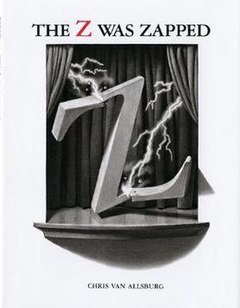
The Z Was Zapped written and illustrated by Chris Van Allsburg.  Each year all the grades complete an author study of this phenomenal illustrator.

I will try to follow the rules better next year.


Friday, June 29, 2012

A Book...A Life

When it was announced on Sunday, February 26, 2012, that The Fantastic Flying Books of Mr. Morris Lessmore had won the Oscar for Short Film (Animated), I did a little jig of joy.  For every class in subsequent weeks the video was shown, each time the students were silent, mesmerized.  Their comments and questions varied according to their ages.  And I...every time I watched, it was like seeing it for the very first time.

Not surprising for its first week on The New York Times Best Sellers, Children's Picture Books, list the print version of The Fantastic Flying Books of Mr. Morris Lessmore (Atheneum Books for Young Readers), released on June 19, 2012, is in the number one position.  To have books, their stories, our stories, so magnificently honored is exhilarating and truly touching.  William Joyce, in this volume, clearly demonstrates his skills as an extraordinary author and illustrator.

Morris Lessmore loved words.

He loved stories.

He loved books.

Each day begins with Morris entering the story of his life in a very special book.  But the world in which Morris resides is about to go topsy-turvy.  A tremendous wind storm blows Morris, his books, even the words on the pages in his personal book, to another place.

His world, as he knew it, is gone so, much like readers beginning a new book, not sure what to expect, Morris begins to meander along a road, destination unknown.   Looking skyward Morris is amazed to see a beautiful woman floating by, kept airborne by a bundle of flying books attached to red ribbons grasped in her hand.  The wise lady sends Morris her favorite, the happy fellow, on legs, with Humpty Dumpty on his pages, leads Morris to a marvelous structure with books flying through the doorway.

Within the room are more books than Morris has ever seen, pages moving, whispering words he's never heard, beckoning him to discover what can be found within.  So begins Morris's life with the books, he giving them the upmost care.  Like every reader knows, Morris, too, would lose days caught up in a good story.

What pleases Morris most is to share the books, with their blessing, with others.  At days end with all the books settled for the night, Morris is seen writing in his very special book.  Time passes, season after season, years upon years. 

In his old age the books are now taking care of Morris, reading their stories to him at night.  Filling the last page of his book one day, Morris realizes his story is complete.  Like the lady before him, Morris lifts skyward holding the red ribbons attached to books whose pages move as if wings.

It is in the silence of Morris's leaving the books realize Mr. Lessmore has left an object of power behind.  Soon another will follow in the "heartsteps" of Morris using his story as a guide.  For as Morris stated earlier:

"Everyone's story matters."

There is a richness one feels when holding and reading this creation of William Joyce.  All the pages are heavy with endpapers done in a deep red and black picturing Mr. Lessmore's hat and book in a repeated diamond pattern.  Joyce varies his illustrations; some covering two pages, others a single page, all bleeding to the edge except for the occasional insets.

Full color is used except when Mr. Morris Lessmore has lost his book.  It is in the finding of a story color is restored.  The renderings of the passage of time, the seasons, are breathtaking. Of note are the  fascinating details of the building housing the books; a homage to the writing of story and the printed page. 

As beautiful as the film is, so too, is this title.  Joyce's narrative is the voice of a master storyteller weaving words that will wrap around your heart like a warming blanket.   Readers will come to love Mr. Morris Lessmore and the world of his fantastic flying books.

A picture may be worth a thousand words but words once spoken or written create a picture forever painted on our hearts.  This is the nature of story, the gathering of words, to be printed on the pages of a book, a book to treasure like The Fantastic Flying Books of Mr. Morris Lessmore.  An author's dedication says much about who they are.  Please read William Joyce's dedication page found in the back of this volume.

For more information about this title follow a link to The Fantastic Flying Books of Mr. Morris Lessmore.    For additional insight into William Joyce's other titles and projects follow the link embedded in his name above.

Thursday, November 3, 2011

November Is Picture Book Month

About a month ago I wrote a post about the fantastic Literacyhead site.  If you only have one site to go to for your literacy needs this should be the site.  I have also mentioned in later posts that Literacyhead provides additional resources via Twitter and Facebook that enhance what can be done in our classrooms.

I could not wait until my weekly wrap-up of tweets on Twitter to share about a site they mentioned on November 1, Picture Book Month.

Picture Book Month is an international initiative to designate November as Picture Book Month, encouraging everyone to celebrate literacy with picture books.


Founders of this initiative further state:


We are doing this because in this digital age where people are predicting the coming death of print books, picture books (the print kind) need love.  And the world needs picture books.  There's nothing like the physical page turn of a beautifully crafted picture book.


Every day this month the site will feature a post from a person championing the relevance and importance of pictures books; authors, illustrators and picture book lovers alike.  A media release on site further explains what prompted the creation of this endeavor.  A list of author/illustrator sites hosting activity tie-ins is a great additional resource.


I will be designating a special spot in the Charlevoix Elementary School Library Media Center that highlights a book each day per the suggestions on this calendar to Read! Share! Celebrate!

Sunday, May 8, 2011

They Are Still The One!

Anyone stopping by during story time, no matter the grade level, at our elementary school would be hard pressed not to agree that it is and always will be a favorite with children.  There is a quality of companionship generated in those moments that can not be duplicated during any other activity.  Even though they would be loath to admit it, the middle school students still sense those mesmerizing moments created by the compelling combination of text and most importantly, the illustrations.

Having read it mentioned in two different blogs this morning and in turn reading it myself, I urge you to read this post on the The Horn Book Magazine site.  It is an article that appears in the May/June issue of The Horn Book Magazine.
Written by Allyn Johnston and Marla Frazee Why We're Still in Love with Picture Books (Even Though They're Supposed to Be Dead) couldn't have said any better what I have known to be true for years.