Quote of the Month

When love and skill work together, expect a miracle. John Ruskin


Showing posts with label Richard T. Morris. Show all posts

Tuesday, June 11, 2019

Upon His Arrival

Sometimes the world doesn't change but a perception of the world does.  It may seem almost magical when this happens, but one individual can alter the viewpoints of many by simply being themselves or by a quirk of fate.  We never know when this will happen.  We will remember it.

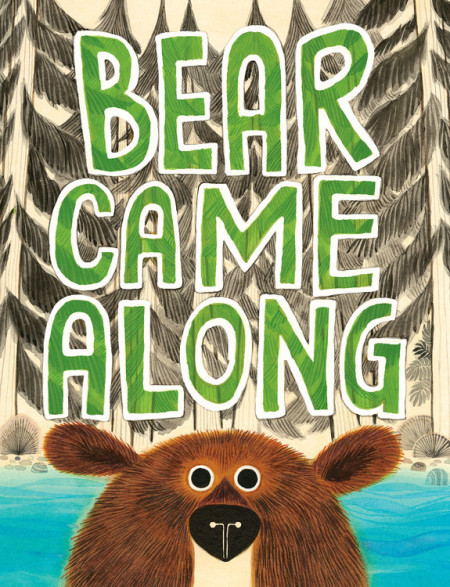
The other very important thing to consider is we not only have this memory, but now we are seeking with anticipation different perceptions of the same thing, things we encounter every single day.  Bear Came Along (Little, Brown And Company, June 4, 2019) written by Richard T. Morris with illustrations by LeUyen Pham is another outstanding collaboration by the team that brought us Sheep 101 (Little, Brown And Company, March 13, 2018).  In this title, Bear Came Along, the actions of one alter the awareness of many.  It's safe to say life along the river is newly defined in a day.

Once there was a river
that flowed night and day,

but it didn't know
it was a river . . .

until . . .

A bear meanders out of the woods, climbs on a log overhanging the river, reaches toward the water and promptly falls.  Completely soaked he fails to realize he's on an adventure until a nearby frog stops watching and begins hopping.  She hops right on top of Bear.

Bear climbs on the log as Frog, needing a friend, joins him.  When the Turtles appear, they issue warnings instead of fun-filled possibilities.  Beaver, a born captain, climbs aboard.  So now we have an adventure with growing friendships, happiness happening and a great guide who lacks knowledge of altered courses.

Two rambunctious raccoons leap from treetops to join the group racing down the river; all are oblivious of everything except for the scenery passing by them on both sides.  Unable to stop they bump into Duck who is lovingly accepted as a passenger.  Duck (and the entire group) has no idea of what they will see on this wild excursion until they make a shocking discovery.  They are at the edge of a waterfall!

Like a chain made of friendship, they cling to each other as they drop.  SPLOSH!  One bear, one frog, two turtles, one beaver, two raccoons and a duck will remember this day.  They are not alone in their remembering.


One of the first of many elements you notice in this narrative penned by Richard T. Morris is the excellent use of pacing.  The key word, until, links each of the animals' lack of understanding and discovery together. Readers will see the pattern fashioned by this technique.  They will come to realize, like the animals, how richer the lives of the animals are in the presence of each other.  The river starts the story, keeps it flowing and brings it to a conclusion that is not an ending but a beginning.  This is a brilliant circle story.  Here is a passage.

the Raccoons dropped in.

The Raccoons were so excited
about the twists and turns ahead,
but they didn't know they had to be careful . . .
until . . .


Seeing the partial face of Bear at the bottom of the front of the dust jacket, with the river and evergreen forest behind him, leads readers to ask what could possibly happen next.  Why is he there?  What is he thinking?  There are many potential scenarios.  It's when the dust jacket is opened the story thread grows.  On the other side of the spine, the forest and river continue but careful readers will see hidden among the trees, among the reeds and river, the other animal characters in the narrative.  They are not aware of each other, but it's as if they are waiting, too.

On the book case the river acts as a canvas.  Bear remains the same with the text looking watery.  To the left of the spine, we can see portions of the other animals.  There is a marked change in their expressions.

On the opening and closing endpapers we are treated to an exquisite bird's-eye view of the river winding through the forest landscape.  On the first scene shades of black are painted on a creamy white canvas.  A portion in the center is darker than the outlying areas. The bright blue river provides a pleasing contrast.  The characters are tucked into the scene in the order in which they appear.  The second view is a colorful, beautiful reflection of the story and its results.  It's enchanting!

Rendered in

watercolor, ink, and gouache on hot-press illustration board 

the artwork by LeUyen Pham makes you feel as though you are holding something rich and rare in your hands.  She makes use of every bit of space.  On the title page a double-page picture shows Bear coming to the river.  With a page turn another double-page picture shifts the perspective giving us a larger view of the river and Bear.  Then the point-of-view changes again to bring us back close to Bear as he stretches to the river from the log.  These varying contexts pair beautifully with the narrative.

The details in each image will have readers pausing.  The illustration sizes also ask readers to savor the story.  The use of portions of animals and portions of scenes is wonderful.  Sometimes the text is placed directly on the visual; other times it is within its own small rectangle.  The word until is larger and bolder.

Two double-page wordless pictures in a row are pure perfection.  A vertical image will have readers gasping.  Each time an animal is introduced readers will find a place for them in their collective hearts.  Their personalities shine in every line LeUyen Pham makes.  And yes, there is humor throughout the artwork.

One of my many, many favorite illustrations is on a single page, edge to edge.  We are very close to the animals crowded on the log.  We see portions of each of the seven.  Bear's face is looking a tad bit worried, Raccoons are thrilled with the ride on either side of Bear, Frog in front of Bear is hugging Duck, Beaver is totally jazzed with this ride to the right of Duck and the Turtles to the left of Duck are scared.  This is not a quiet snapshot, but one filled with a range of emotions.  I can't look at it without smiling.


This book, Bear Came Along written by Richard T. Morris with illustrations by LeUyen Pham, is definitely a 2019 title to include in your professional and personal collections.  It is to be read aloud.  It is to be shared often.  It is to be gifted.  It is about how we are distinct individuals but are joined by something larger than our differences.  It is important for you to read the author and illustrator notes at the end.

To learn more about LeUyen Pham, please follow the link attached to her name to access her website.  LeUyen Pham is a guest at teacher librarian, Matthew Winner's The Children's Book Podcast.  At the publisher's website you are treated to a video book chat with LeUyen Pham about this title (She reveals some marvelous meanings about her illustrations.) and a downloadable storytime kit.

Update:  On January 27, 2020 during the American Library Association Youth Media Awards, this title's illustrator LeUyen Pham was awarded a Caldecott Honor award.  This is her response.

Tuesday, April 17, 2018

Bedtime Bedlam

One of life's annoying problems is attempting to fall asleep and failing.  You've tried every trick in the book; wearing your comfiest jammies, wrapping up in your favorite blanket, plumping your prized pillow, and drinking warm milk. Nothing works.

One of the most recommended methods of inducing sleep is to count sheep.  You imagine an endless line of sheep, all looking nearly alike, jumping over a fence.  You number them until you drift off into dreamland.  Sheep 101 (Little, Brown And Company, March 13, 2018) written by Richard T. Morris (This Is a Moose Little, Brown And Company with illustrations by Tom Lichtenheld) with art by LeUyen Pham is about a little boy trying to sleep using this age-old method.

100.
101.
CRASH!
Oomph!

With Sheep 102 following close behind, it's evident Sheep 101 has taken a tumble leaping over the fence.  In the course of their conversation, Sheep 101 reveals being stuck on the fence.  An unseen narrator (the boy) interrupts.  Sheep 101 encourages the friendly flock member to continue.  The boy needs to sleep.

Bounding over the fence and counted, a cow now waltzes into the scene claiming to be Sheep 103.  There are no more sheep so the cow, usually jumping over the moon, is ready for this assignment.  You'll never guess (or maybe you can) who comes

Weee Weee Weee

from the edge of the page.

A cloud burst of tears ensues as one of the Three Blind Mice comes tapping along with his cane.  He's Sheep 105.  If you're not laughing yet you will be as the next "Sheep" saunters in after surviving a fall off a wall.

Before another leap, jump or bound happens, a loud voice issues a Code Red.  A famous man and his crew from a well-known land zoom overhead.  Their actions disclose a sought-after outcome.  Good night.  Sleep tight.


Your attention to the story is immediate when the narrative begins with two numbers and two sound effects.  When Richard T. Morris follows this with a conversation between two of the sheep and the unseen narrator, the hilarity level is heightened.  His word choices in the subsequent conversations communicate the attitude of the characters, serving to further increase the laughter factor.  Here is a passage.

You guys aren't supposed to talk to each other, you know.
Do you see we've got a sheep down?
Go on without me, 102!  We have to get him to sleep.
Ten-four, 101.
But I've got my eyes on you, sleepyhead.


Not having a finished copy in hand but working from an F & G graciously supplied by the publisher, I have seen two different jackets and book case covers.  In this one, the expressions on the faces of the sheep are guaranteed to have readers laughing before they even open the cover.  What LeUyen Pham is able to convey with eyes and noses is brilliant.  One thing certain to prompt a comment from readers is Sheep 101.  Sheep 101 is not like the other sheep.  Along the spine in purple tiny characters from the story are shown; the blind mouse, Humpty Dumpty, the cow, and one very vocal sheep.

To the left, on the back, among the backsides of the sheep shown on the front, characters from the book are facing the reader.  The looks on their faces will also cause many giggles and grins.  A decision to begin and conclude the book using the endpapers is sheer genius.

On the opening endpapers the boy is staring at the sheep clock on his dresser.  A stuffed sheep toy is on his bed.  An assortment of books, a copy of Mother Goose and Three Blind Mice among them, Lego type toys, a megaphone and a Humpty Dumpty lamp are placed on the dresser, too.  All these elements are contained in the closing endpapers but their positions have been altered.  On the verso and title pages Sheep 100 is trotting in from the left and Sheep 99 is gracefully leaping over the fence.  The fence is stretched across the quilt on the boy's bed.

With each page turn the illustrations rendered in crayon and pencil and completed in Adobe Photoshop span from page edge to page edge across two pages.  The color palette for the canvas is in hues of purple and blue with a sprinkling of stars, mirroring nighttime and bedtime.  The characters are in full vibrant color.  When the unseen narrator is speaking his words are in white.  The other dialogue is shown in speech bubbles.  The sound effects are bold and elevate the mood.

What readers will appreciate the most are the body positions and facial expressions on the characters.  They are humorous with a capital H!  Meticulous care has been given by LeUyen Pham to the details.

One of my many favorite illustrations is for a portion of the noted passage.  For this image LeUyen brings Sheep 102 close to the reader.  He fills most of the right side, crossing the gutter, and a large portion of the left side.  He is not happy and is staring directly at the reader (the boy).  His foot is raised to his eyes, conveying he will be watching the boy.  LeUyen has drawn dotted lines from his eyes to his foot.  In the background on the right, Sheep 101, stuck in the fence, is looking rather . . . well . . . sheepish.


If you are looking for a rollicking romp of a read for story time with a group or one-on-one at bedtime, Sheep 101 written by Richard T. Morris with art by LeUyen Pham is a first rate choice.  We all know there is nothing better than shared laughter with children.  They will be begging you to read it again.  You'll want to have a copy of this title for your professional and personal collections.

To learn more about LeUyen Pham and her other work, please visit her website by following the link attached to her name.  LeUyen Pham is featured at The Author Village. Enjoy the video chat.
Book Chat with the Illustrator: LeUyen Pham from LB School on Vimeo.

Thursday, May 22, 2014

Comic Camera Action

Time and time again when boys and girls, my students, get in front of a camera a different truth of which they are emerges.  Hidden talents are revealed.  A previously shy person becomes a comedian.  A rather talkative individual becomes an origami artist.

It's as if the camera gives them permission to be the way they want to be.  This Is a Moose (Little, Brown and Company, May 6, 2014) written by Richard T. Morris with illustrations by Tom Lichtenheld records the activity on a documentary film set gone wild.  Moose has a dream; an out-of-this-world dream.  Are you ready to laugh?  Well, then...

This is a Moose---Take one!
This is the Mighty Moose.
His father is a moose.
His mother is a moose.

So far this is your typical, standard rather dull, but truthful, as we know it, dialogue about a moose.  The problem, as the director sees it, is the next line.  This moose wants to be an astronaut more than anything else in the world.  The director asks someone politely to help the moose out of his space suit.  Yes, readers he is wearing astronaut gear specifically designed for his moose features.

A decidedly grumpier moose is ready for Take Two when a voice calls out from the lake.  It's Grandma Moose suitably attired to be a lacrosse goalie. Take Three is interrupted by giraffe (Isn't he supposed to be in Africa?) who wants to be a doctor.  Take Four has the characters taking matters into their own hands.

What's this?  A giant slingshot tied to two tall evergreens?  Is that moose sitting in a chair in the center?  The director is sputtering with incredulity.  Take Five can't be taken.  It would seem moose is on his way to the moon.

Duck the director is about to go quackers.  In a rage he shouts a question which is met with silence, a long, thoughtful silence.  Take Six---A sound, so loud the trees shiver, reverberates throughout the forest.


You have to admire the mind of an author who can generate a sense of impending laughter within four sentences.  Richard T. Morris manages to increase the hilarity with every take by introducing new characters acting in most unexpected ways.  The humorous tension is increased further with the interplay of conversation and narration.


Three little words in a speech bubble off to the side of the matching dust jacket and book case on this title are a huge clue as to the fun-filled action about to happen.  The placement of the ISBN riding in the center of the canoe with rabbit riding on top and the giraffe paddling are bound to bring on the smiles.  Moose, hands on his hips, glaring cantankerously at the reader makes me burst out laughing every single time.  The opening and closing endpapers in tones of brown are as if we are looking through the lens of a video camera.  A slightly blurry image of a moose is front and center.  Two spoken words,

Focus! and
That's A Wrap!

become part of the narrative.  Careful readers will notice the difference in the battery icon shown at the beginning and ending

A page turn features the title page on the right with the first spoken sentence by the director on the left of a double page panoramic view of the lake and forest.  All the illustrations by Tom Lichtenheld rendered in ink, colored pencil, and gouache extend the text superbly; telling stories of their own.  Most cover both pages, others are single page pictures.

An example of Lichtenheld's creative spirit is in the illustrating of the text

His father is a moose.
His mother is a moose.

The first time the duo are framed portraits hanging on a tree next to moose.  In the second set of sentences they are part of a fold-out brochure with a picture of Saturn in the center.  When we see them the third time father moose is driving a speed boat, pulling mother moose behind on water skis.

Moose's best friend a chipmunk mirrors moose's actions accentuating the bond between the two while increasing the wonderful wit.  Comic facial expressions, body language and extra details make the visuals soar to the moon along with moose.  Details like chipmunk holding a rope which he uses to pull Grandmother's canoe into shore, the big lipstick lips on pearl-necklace-wearing Grandmother, bear holding a cup of tea, and rabbit using a carrot to point out moose's position in space on a blackboard diagram are playfully perfect.

I have many favorite illustrations in this title but my most favorite has to remain a secret.  I simply can't spoil anything for you.  I can't look at it without grinning like crazy.


When you read the narrative of this book for the first time, in between fits of laughter, you know you can hardly wait to read it aloud to a group of children.  This Is a Moose by author Richard T. Morris with illustrations by Tom Lichtenheld is meant to be shared.  And trust me when I say you will be reading it more than once at each sitting.  You might want to have extra copies on hand too.

Please follow the link embedded in Tom Lichtenheld's name to access his website.  Carter Higgins, teacher librarian and blogger at Design of the Picture Book features this title in a recent post. UPDATE June 16, 2014 Carter Higgins has invited Tom Lichtenheld back for another post.