Quote of the Month

When love and skill work together, expect a miracle. John Ruskin


Showing posts with label Dieter Braun. Show all posts

Friday, July 6, 2018

Up, Up, Up And All Around

Standing at their feet is like being in the presence of divine royalty.  From their summits, regardless of the height, the panoramic view makes you feel as if you're soaring on lofty air currents.  They are home to flora and fauna found no other place on this planet. 

You will never forget pausing in their shadows or hiking up and around their sides. Their silence is powerful. In Mountains Of The World (Flying Eye Books, June 5, 2018) written and illustrated by Dieter Braun we journey to points known and unknown; our understanding of all things mountain, mountain residents, mountain climbing and other mountain activities greatly increasing.

What is a Mountain?
A mountain is a natural formation that is much higher and steeper than a hill. The distinction between a mountain and a hill differs from region to region.

Once an explanation of a mountain is delivered and we comprehend how one is formed, we are whisked away to the highest mountain in the world, Mount Everest.  We are then intrigued by how a shift in point of view can alter the determination of the highest mountain with several comparisons being revealed.  It all depends on where we begin.  Before a discussion of mountain ranges and what determines a range, we learn about the Andean condor.  Get out a ruler and mark off ten feet.  That's their wing span.

Notable names of summiteers, then and now, are shared along with their accomplishments.  Types of climbing and equipment are presented. With a page turn we are gazing at Mount Fuji in Japan as well as reading of the Japanese macaque who lives up to 10,430 feet high in the mountains.  Can you guess how they become warm?  And did you know mountain lions are also known as pumas? 

If you were to visit Huang Shan, a mountain range in China, you might realize what it has in common with the movie Avatar.  Seven countries are crossed by the largest mountain range in Europe.  Have you ever considered mountains might be made of something other than rock?  Are there mountains in the Sahara or in Antarctica?

Skiing and equipment along with other sport challenges on and around mountains are discussed before we are presented with the truth of mountain longevity.  Yosemite National Park, man-made creations carved from mountains, animals living at the highest heights, Mount Kilimanjaro, waterfalls, Halong Bay, Iceland, Uluru, Norway and Table Mountain are only some of the specific topics as this title continues.  The plight of wild yaks is shared along with facts about the chamois, rock badgers, snow leopards, Dali sheep and the Alpine chough.  The creation of glaciers, stalactites and stalagmites is covered.  One of the final chapters asks us to care for the mountains by being environmentally aware.


When he begins his narrative with a story about the lack of mountains near him as a child, Dieter Braun strikes a chord in many readers' hearts.  In his introduction he continues with his first visit to mountains.  That's all he needs to fuel his curiosity.  Dieter Braun has a technique of finding those facts most fascinating to his reading audience.  He is careful to include basics about everything having to do with mountains but also gives us memorable tidbits about a range of items.  Every few pages he adds a

Did you know . . . 

paragraph.  Each element in his illustrations is captioned with information.  Here are several passages.

Did you know that a mountain on Earth can't
go much higher than 30,000 feet?  Once it 
reaches this altitude the base of the mountain will
start to liquefy due to the enormous pressure of the 
mountain's weight.

In Southern France there is a small, peaceful place called Roussillon, known for its red soil that contains ochre.  Roussillon is surrounded by curious formations of ochre rocks that look like huge termite mounds.  They have beautiful patches and stripes of brown, ochre, yellow and radiant red.  Not surprisingly, the colorful soil from these cliffs can be used to make paint!


When you open the book case illustrated and designed by Dieter Braun you recognize a few elements from interior images used to fashion entirely different scenes.  Both of the places provide readers with majestic glimpses into the world of mountains in two different locations.  To the left, on the back, climbers are scaling a mountain, mostly in silhouette. 

The opening and closing endpapers are a layered look at the heights of mountain peaks around the world.  They are depicted in varying shades of teal.  Each peak is named with the height in feet in white text.  On the title page a black bear cub scampers beneath the words.

Each chapter (with direct and sometimes clever names) and the accompanying pictures, spanning two pages and portrayed in full color, urge readers to stop.  And we do.  We can't help but notice the care taken in the color selection.  It is realistic but evokes an emotional response too. We don't want to miss all the intricate and stylized details. We also want to stand back and look at the breathtaking representations. 

One of my many, many favorite illustrations is for The Alps chapter.  On the left, framed by other mountainous slopes is the Matterhorn.  Shades of blue, brown and green with black and white supply a stunning vista.  Along the bottom on the left are native flowers.  To the right Alpine ibexes with large curved horns are standing on rocky ledges.  The perspective of this image places the animals closest to us.  It's like we are watching them against the backdrop of the mountains. 


When you read Mountains Of The World written and illustrated by Dieter Braun it is like holding a travelogue in your hands.  Dieter Braun is our guide furnishing us with pertinent knowledge and marvelous pictures.  You will want this title along with his Wild Animals of the North and Wild Animals of the South on both your professional and personal bookshelves.

To learn more about Dieter Braun and his other work, please follow the link attached to his name to access his website.  It is brimming with his art.  His work is also found on Facebook and Tumblr.  His multiple boards on Pinterest give you further insights into his interests.  At the publisher's website you can view interior images from this book.


Please take a few minutes to visit Kid Lit Frenzy hosted by educator Alyson Beecher to see what titles other participants in the 2018 Nonfiction Picture Book Challenge have listed for this week.


Monday, September 11, 2017

5 Faves: Expository Nonfiction

With more than one hundred eighty science books to her credit author Melissa Stewart more than deserves her award-winning status.  She is known for her captivating writing style specifically geared to the intended audience but all ages can learn from her fascinating factual presentations.  Her research is meticulous and authentic.

Starting on this date, September 11, 2017, Melissa is hosting a series of blog posts based on expository nonfiction on her blog, Celebrate Science.  She spoke about expository nonfiction at length in a Nerdy Book Club post.  I am honored to be the first educator contributing to this series.

I think you will enjoy my five favorite selections.  They are centered on the animal kingdom.  The start of the school year has clearly demonstrated the demand for animal titles is as strong as ever at all age levels.  Happy reading to you and the readers in your life!

Thursday, April 21, 2016

Look. See. Wonder.

No single day passes without observations of creatures in the wild.  It can be as normal as birds flying from one place to the next or as surprising as looking out your window and seeing the local fox trotting down the neighborhood sidewalk at dusk.  We see them.  We hear them.  And, in the case of skunks, we smell them, hopefully prior to an encounter.  Regardless of the number of times we experience these sights, sounds and smells it still is, and should be regarded as, a miracle.

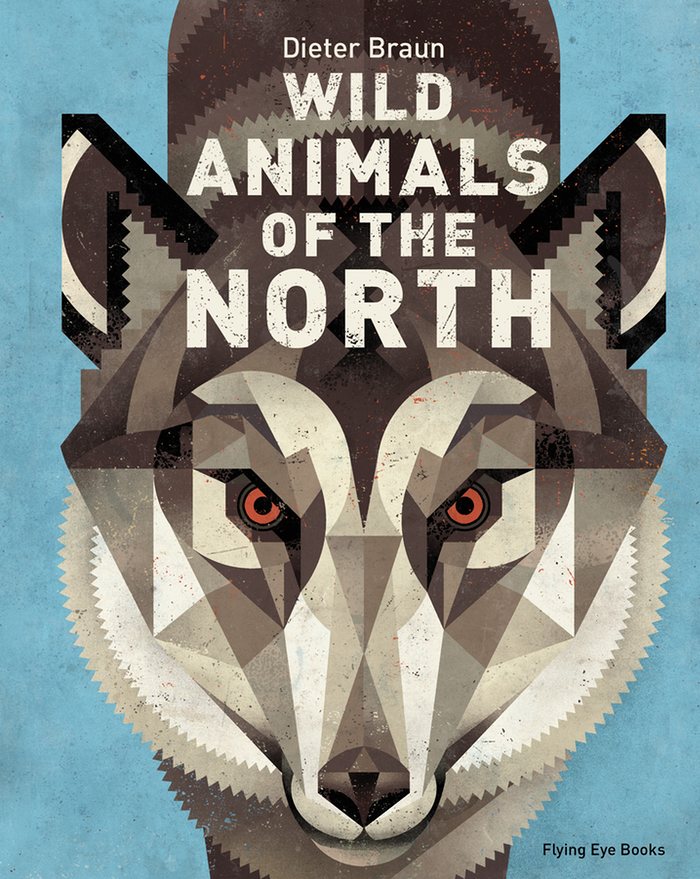
We are most fortunate to be sharing this planet with beings who have adapted as best as possible to the changes made in their habitats.  Wild Animals Of The North (Flying Eye Books, June 7, 2016 [April 1, 2016 UK]) written and illustrated by Dieter Braun is a stunning visual presentation of eighty animals.  Within the one hundred forty pages of this title three regions of the north are visited; North America, Europe and Asia.


Wild Animals of the North
It's hard to imagine that fantastic creatures like bald eagles or snow leopards could have evolved from the first single-celled organisms that appeared on Earth around 3.5 billion years ago.  

With this opening sentence in the introduction we marvel at the growth and diversity found in the animal kingdom.  As we read further we are reminded of the precariousness of their habitats.  We are invited to increase our appreciation of these magnificent animals.  

We begin our exploration with the puma.  Their agility and skill at standing jumps are astounding.  We soar next with the bald eagle.  Did you know they add to their nest every year increasing it in size?  We hunt salmon with the Kodiak bear, climb to new heights with a mountain goat and dive with orcas.  Their communication techniques vary from family to family.

The coloration for the the Blue-footed booby is disclosed.  You might want to think twice before getting near a Texas rattlesnake; their size and venom are larger than you might imagine.  You'll never guess who binge eats before winter. (Hint: Mask)

Traveling to Europe we discover the range of dietary delicacies enjoyed by a red fox.  Like several other animals within this book, barn owls mate for life.  In a hospitable moment badgers might be likely to allow other animals to share one of their vacant cubbies in a barrow.  Six thousand spikes?! Yes, as an adult, a hedgehog can have that number of spikes.

You will never guess that the fastest bird also has the most extensive habitat, being found everywhere except for Antarctica.  Roe deer and the red deer are at opposite ends of the size spectrum.  The northern bald ibis enjoys a very distinctive mating ritual of bowing.  

To the east we go to meet the elusive snow leopard called the ghost of the mountain by the native population.  Its tail is used for balance and warmth.  The bitter cold is combated by the Japanese macaque by enjoying the benefits of hot springs. There is actually a deer, musk deer, with teeth looking vaguely like Dracula in feast mode.

The Przewalski's Horse is indeed a rare equine; the only truly wild one on our planet.  Did you know there are birds that capture food, fish, by forming a horseshoe shape?  While you might know about a camel's ability to go without water, you won't believe what they do when dust becomes a problem.  As you get farther into the book journeying from North America to Asia, your respect will increase as well as your humility.  

Of the eighty animals featured by Dieter Braun the scientific name is given for all of them; forty are selected to provide further information for readers.  Woven into conversational paragraphs are a variety of facts.  Braun has chosen items of information of interest to a wide range of readers but easily understood by those that are younger.  Here is a sample passage for White Stork//Ciconia ciconia

When two storks meet, a typical ritual for them is to clatter their beaks together.  Storks' voices are so weak that this is the way they communicate with one another, and it is also how they have earned the nickname 'rattle stork'.  It is said that the white stork delivers babies.  According to legend it brings them in bundles to human mothers or lets them slide down the chimney.  This story might have come from the habit of storks nesting on chimneys and roofs to incubate their own offspring.  They like to keep close to human settlements so they can always find food nearby. 


The striking facial image of a wolf on the front of the book case captivates.  The light and dark hues and the precise geometrical layers create a sense of anticipation and animation.  To the left, on the back, Dieter Braun has created a circular shape consisting of some of the animals.  It's a tribute to the assortment of wonder animals bring to all of us.  

Preceding the three sections we are shown a map of the world; each division contains a map with several animals placed within it. The heavy, matte-finished paper is an excellent canvas for the images.  We are never quite sure but more than eager to see what each page turn will bring.  

Braun might give us a close-up side view of the animal along with it active in its habitat.  These could be two separate pictures or super-imposed one on the other.  Sometimes the animal will be looking directly at the reader.  In breathtaking displays two pages are used for a single creature.

Perspectives welcome us into each animal's world; for the chipmunk we seeing it scampering off the page but we also see it with cheeks bulging with peanuts.  Seasons and time of day are varied so we get a true sense of place as we travel.  In many of the images a mirror reflection is beneath the animal adding more dimension.  

Choosing a favorite illustration is nearly impossible.  So I will pick two to share with you.  In the first done in shades of brown, cream and very pale yellow a roe deer fawn lies curled in tall grass.  The grass is vertically layered around the deer.  The tops of the grass look like stalks of wheat.  They are beautiful on a background of rich, warm brown.  In the second picture it's raining.  We are close to a fire salamander.  The salamander is on a rock as water splashes around him.  He is facing us looking calm and content. The muted hues of the rock, ground, sky and rain make the colors on the salamander pop right off the page.

  Wild Animals Of The North written and illustrated by Dieter Braun is an eloquent presentation; a masterful example of bookmaking.   It is visually breathtaking, an art gallery in your hands.  You will gasp at the beauty.  There are no source notes or a bibliography included but I verified nearly every single fact.  This volume is going to be enjoyed by readers.  I would plan on more than one copy.  

To learn more about Dieter Braun and his other work please follow the link attached to his name to access his website.  In an article at The Guardian Children's Books there is a visual presentation of eight pages including two of my favorites.  Fine Fine Books gives a sneak peek at pages from his next book, a companion title.


Be sure to stop at Kid Lit Frenzy hosted by educator Alyson Beecher to see the other titles features by bloggers participating in the 2016 Nonfiction Picture Book Challenge this week.