Quote of the Month

When love and skill work together, expect a miracle. John Ruskin


Showing posts with label Water. Show all posts

Monday, August 10, 2020

We Must Care

 If it were not for the reminder tweets by founding educators Cathy Mere and Mandy Robek, I might have been rushing to get my list ready in time for the annual event of Picture Book Ten For Ten.  Each year readers gather ten (or more) picture books they feel best define a theme.  In 2020 we will be adding links to Mandy Robek's blog.  You can access her blog by following the link embedded in her name. 

 Over the course of my participation in this celebration I've centered on themes of the alphabet, dogs, counting and number books, bedtime, sleep and sweet dreams, robots as main characters, friendship, and bees.  Last year my focus was on books featuring grandmothers and grandfathers.  Links to all the previous posts are in last year's post.

Prior to this writing I had another theme chosen, but the news this week about a portion of the Milne Ice Shelf, in Ellesmere Island, Canada falling away due to climate change makes the peril our planet is facing even more pressing.  The size of the lost ice was greater than that of Manhattan in New York City.  I have chosen titles reflecting ways to protect, preserve, and appreciate our Earth.  They are listed in order of publication date, and then alphabetical by title.  You can find more about each title by following the link attached to it.


1. It began in the most populated city on the continent of Australia thirteen years ago.  It was a single event lasting sixty minutes.  It was an act of faith in people and hope for our planet by its organizers. One year later countries on all seven continents participated.  By 2009 it broke


all records of mass participation, becoming the world's largest grassroots movement for the environment.

This year, 2020, Earth Hour will be celebrated on March 28th, 8:30 PM local time, wherever you live.  Debut picture book author Nanette Heffernan and debut picture book illustrator Bao Luu collaborate to bring readers Earth Hour: A Lights-Out Event for Our Planet (Charlesbridge, January 21, 2020).  It reflects the use of energy in places around the world, the Earth Hour event and how each individual can contribute to the conservation of energy not only on this one day, but on every day of the year.

All over the world, millions of people use energy, every day, every night.


2.  From the sun she is third, sustaining life for all.  For this she is to be cherished.  My Friend Earth (Chronicle Books, February 25, 2020) written by Patricia MacLachlan with illustrations by Francesca Sanna is a love letter to our planet.  The text and images, with flaps and die-cuts, work in marvelous unity.

My friend Earth wakes
from a winter nap.


3. On March 3, 2020 another book was released with a focus on our Blue Planet.  One EARTH (Worthy Kids) written by Eileen Spinelli with illustrations by Rogerio Coelho is a special counting book.  In a rhyming poetic intonation with sweeping cheerful images readers are reminded of the spectacular beauty of our home and how we can honor her.
One wide, sweeping sky.
Two honeybees. 


4.  With millions and millions of people around the world currently confined to their homes under a quarantine or because of isolation, the appeal of the outdoor world and being a part of it has more allure than ever.  Why is it we don't fully appreciate the value of something until it's no longer readily available?  During this time some will be able to go solo in parks or designated walkways or neighborhoods, some will dream of days when nature will envelope them again, others will recall countless adventures in the outdoors, and many can travel within the pages of a book.  HIKE (Candlewick Press, March 17, 2020) conceived and illustrated by Pete Oswald is a nearly wordless trek into the best nature has to offer.  


5.  Having lived near many different small lakes and rivers or one of the Great Lakes in Michigan for more than sixty-eight years, I have witnessed their splendor and their challenges due to the careless hands of humans.  We Are Water Protectors (Roaring Brook Press, March 17, 2020) written by Carole Lindstrom (Anishinaabe/Metis and tribally enrolled with the Turtle Mountain Band of Ojibwe) with illustrations by Michaela Goade (of Tlingit descent and tribally enrolled with the Central Council of the Tlingit and Haida Indian Tribes of Alaska) is powerful in both words and artwork.  It speaks to the fierce dedication of Indigenous Peoples to guard our water and invites everyone to stand strong against those who wish to do it harm.

Water is the first medicine, Nokomis told me.


6. From a true story comes The Bear's Garden (Imprint, a part of Macmillan Publishing Group, LLC, March 24, 2020) written by Marcie Colleen with illustrations by Alison Oliver.  Through the imagination of a child a dream takes shape.  Through an accident and efforts of many, this dream becomes a reality.


IN THE BIG, BUSTLING CITY, all the people were busy. 


7. Although in northern Michigan at the moment snow is swirling in high winds, for months collective minds here and in other parts of the world have been turning to gardening. Seeds and soil have been gathered.  On warmer days, walks have revealed shoots from bulbs pushing through the dirt and perennials are starting to turn green as buds get larger.  In My Garden (Neal Porter BooksHoliday House, March 24, 2020) written by the late Charlotte Zolotow (1915-2013) with illustrations by Philip Stead is a journey through the seasons.  It is a shared trip through time and the offerings Nature bestows on all of us if we choose to notice.

IN THE SPRING what I love best in my garden
are the birds building nests. 


8.  In his newest brilliant artistic entry in children literature, author illustrator Henry Cole does not disappoint.  The conception and illustration of One Little Bag: An Amazing Journey (Scholastic Press, an imprint of Scholastic Inc., April 7, 2020) is a wordless display of transformation.  It is a loving tribute to people, their lives and their love of each other and our Earth.

Prior to the title page, Henry Cole in a series of framed single-page pictures, horizontal and vertical panels and two large double-page pictures, takes us through the process of making paper from logged timber to large rolls of paper to the delivery of boxes of paper bags and to the use of a single bag at a small community market. We follow one particular tree through the use of spot color as it makes its way from the forest, to a logging truck, to the paper mill, the processes at the mill, and the packing of one paper bag among hundreds in a box.  The final two-page image before the title page is an amazing display of the interior of a small grocery store highly stocked with all kinds of items.  People walk on wooden floors with carts laden with their groceries.  At the counter is a boy and his father and the brown-colored paper bag.


9.  When we venture into the outdoors, whether at a national or state park or designated forest, we are temporarily residents with the wild.  There are detriments to this adventure but the advantages, even brief moments, can last a lifetime.  The Camping Trip (Candlewick Press, April 14, 2020) written and illustrated by Jennifer K. Mann shadows Ernestine as she goes camping for the first time. It's an experience she and readers will long remember.

MY AUNT JACKIE invited me to go camping with her and my cousin Samantha this weekend, and my dad said yes!


10.  Our rewards from Nature are proportionate to the attention we give it.  The more we look, the more we see.  Every detail is a delightful discovery.

In her newest release, A New Green Day (Neal Porter Books, Holiday House, April 14, 2020), Antoinette Portis asks us to think about alternate descriptions for that which is familiar.  Through her words and illustrations, magic happens.

"Morning lays me on your pillow, an invitation, square and warm.
Come out and play!"

Who is speaking in these first two sentences?  With a page turn we realize we have been welcomed to participate in a guessing game with elements found in Nature.  Sunlight is talking first.


10 +1.  Never has it been more apparent than the beginning of 2020 how vital the outside world is to all living things.  We humans, if not previously so appreciative, are now.  We recognize the value of embracing what has been so freely present.  The urgency of preserving and protecting it is heightened.  

In their first collaboration author Deborah Underwood and illustrator Cindy Derby work to show readers the allure of what we find beyond the four walls of our homes.  Outside In (Houghton Mifflin Harcourt, April 14, 2020) looks at the benefits of becoming one with the world around us.  It awakens memories of the past bringing it to the present.

ONCE
we were part of Outside
and Outside was part of us.

Thursday, March 26, 2020

Guardians Of Life

For some it starts at an early age.  We are taught by our parents, grandparents or adult mentors, to nurture and care for Earth in her entirety.  For me it was my father.  We spent early morning and evening hours in summer on the lakes and rivers fishing.  He taught me to watch the weather, the time of day and how fish might think.  We walked for miles in the woods in autumn during bow hunting season.  To and from our spot, he was always whispering to me about the various trees and plants and how to look for signs left by all animals.  (On our hunting trips, an animal never lost its life in our presence.  There is a reason for this, but that's another story.)

When it came to water, my dad had rules.  You never put anything on or into the ground which might harm the water table or any animals who frequented that area. You used water sparingly, except for keeping a garden healthy or for drinking.  To this day, I'm the one homeowner digging out hundreds of certain unwanted weeds from my gardens and lawn rather than applying harmful chemicals.

Having lived near many different small lakes and rivers or one of the Great Lakes in Michigan for more than sixty-eight years, I have witnessed their splendor and their challenges due to the careless hands of humans.  We Are Water Protectors (Roaring Brook Press, March 17, 2020) written by Carole Lindstrom (Anishinaabe/Metis and tribally enrolled with the Turtle Mountain Band of Ojibwe) with illustrations by Michaela Goade (of Tlingit descent and tribally enrolled with the Central Council of the Tlingit and Haida Indian Tribes of Alaska) is powerful in both words and artwork.  It speaks to the fierce dedication of Indigenous Peoples to guard our water and invites everyone to stand strong against those who wish to do it harm.

Water is the first medicine, Nokomis told me.

We come from water.

A grandmother chats with her granddaughter explaining how water sustains all life and how water connects us all.  Water is to be cherished.  Its sounds and movements are our sounds and movements.

It is foretold there is a deadly danger coming.  It is described as a black snake.  This black snake will bring destruction to Mother Earth, water and all the flora and fauna.  Unfortunately, the black snake has arrived, poisoning all it touches, poisoning the water.

This granddaughter listening to her elders, places their words in her heart.  There, those words fuel her actions.  She will protect her people.  She will protect their water.  She will lead them in fighting the black snake to preserve Mother Earth.

This young warrior knows this is difficult, but who else is to defend those who cannot defend themselves. Our planet and every living thing upon it, needs us to step forward as its caretakers.  Nokomis taught her granddaughter that water has a spirit, a spirit with memories of individuals' spirits.  For this reason, this daughter of Mother Earth and other Indigenous Peoples are strong in their resolve, battling as one against the black snake.  Join them.


With her meticulously chosen words, Carole Lindstrom, builds on generational traditions with respect to the vital role water plays in all aspects of life.  It is by listening to elders a continuous connection is created.  Each sentence contributes to the energy building within this narrative.

Woven into this story is the repetition of a poetic chorus, like a heartbeat, supplying strength and inspiration to readers.  This pulse ties the other portions together as if we are running in a race with the number of participants swelling until they stop and remain firm like a wall of resistance against a common foe.  Here is a passage.

The river's rhythm runs through my veins.
Runs through my people's veins.


Looking left to right across the matching and open dust jacket and book case, readers find themselves marveling at the beauty of the scene before them.  On the left, toward the upper, left-hand corner wide ripples of water waves in several hues of teal. These move over the spine to the right, in front and behind the granddaughter.  She stands tall, confident in the midst of the water, a beacon for her people.

As you can see, above the water is the royal blue landscape.  It is topped by people clasping hands, a line of defense.  These people extend over the spine to the left edge.  This entire setting is placed beneath a star-studded sky.  Some of the waves of water, as well as the granddaughter, are varnished.

The opening and closing endpapers are a pale yellow.  On the initial title page, the text is placed in a wash of blue.  On the verso and title pages waves span from left to right, providing a canvas for the words.

The illustrations by Michaela Goade, according to an interview were rendered in watercolor with

some colored pencil and gouache detailing with some digital edits in photoshop at the end.

These mostly double-page images are sweeping in the portrayals of water, the land, animals, trees and flowers and the people.  At times other details are super-imposed on the central illustration generating an effect of layers.  One page flows into the next page, like water.  The pages holding the repetitive chorus show an increase of people each time, representing a gathering force.

Each picture asks readers to pause and ponder the reality and the symbolism depicted.  To accentuate the words, Michaela Goade gives us varying points of view.  We are brought close to a hummingbird sipping nectar among flowers as other insects and a snail go about their day.  The colors are brilliantly natural.  We gaze in wonder at a landscape of rolling hills, a wide river (or lake) bordered by dense forests and a small cabin near the water.  A family of bear wander on one shore as a deer drinks from the water on the other shore.  Two birds watch from a distance as the sun lowers in the sky.  The colors are rich shades of golden yellow, pink, purple and blue.

One of my many, many favorite illustrations is on a single page.  The canvas is a pale, nearly white, blue.  In the center stands the granddaughter.  She is looking forward, at the reader.  The tresses of her hair become swirls of water flowing out to the edges and bottom of the page.  On top of the water are stunning pink and peach water lilies, lily pads and fish.  Her hands, palms up, are cupped.  This is the picture for the passage quoted previously.


This book, We Are Water Protectors written by Carole Lindstrom with art by Michaela Goade, pays homage to water, the Indigenous Peoples who protect it and invites others to participate.  At the close of the book in a portion titled More On Water Protectors, the author talks about tribal traditions, prophecies and paths.  Her motivation for writing this book were the events surrounding the Standing Rock protest of the Dakota Access Pipeline.  Here is an excerpt.

This is not just a Native American issue; this is a humanitarian issue.  It is time that we all become stewards of our planet so we can protect it for our children and our children's children.

A title is supplied for additional reading as well as a glossary of six terms.  The Illustrator's Note is very informative.  Here is an excerpt.

Standing Rock is just one powerful example of what happens when we rise up, resist, and join together in solidarity for Mother Earth regardless of where we come from.  

The final page, Earth Steward And Water Protector Pledge, has a place for a name and a date.  With certainty I can recommend this book for every personal and professional collection.  Its value is priceless.

To learn more about Carole Lindstrom and Michaela Goade and their other work, please follow the links attached to their names to access their respective websites.  Carole Lindstrom has accounts on Facebook and Twitter.  Michaela Goade has accounts on Facebook, Instagram and Twitter.  At the publisher's website you can view interior images.  Here is a link to an activity kit provided by the publisher. This book and its creators are featured at Publishers Weekly, and CBC-Radio-CanadaCarole Lindstrom is highlighted at KidLit 411 and Prairie Public NewsMichaela Goade is showcased at Let's Talk Picture BooksCarole Lindstrom reads their book in this video.

UPDATE:  You will enjoy this interview with Carole Lindstrom and Michaela Goade about this book at author Cynthia Leitich Smith's Cynsations.


Wednesday, April 17, 2019

Seventy-One Percent

Close to two-thirds of our planet is covered in water.  Of that water, ninety-six point five percent is contained in our oceans.  Depending on your geographic location you can dig through the ground and reach a point that is completely saturated with water.  You have found the water table.  There is a certain amount of water in the air we breathe measured by our humidity (currently ninety-seven percent in my community).  You would be astonished to realize how much of our blood contains water.   Liquid life is literally everywhere, whether we can see it or not. 

Being one of those fortunate people, within five minutes the expanse of Lake Michigan is available for me to see, spread out until it touches the far horizon. It is both a humbling and joyful moment.  Hey, Water! (Neal Porter Books, Holiday House, March 26, 2019) written and illustrated by Antoinette Portis (Wait, Best Frints in the Whole Universe and Now) explores all the marvelous manners in which water touches our everyday existence.

Hey, water! I know you!
You're all around.

faucet

Unless you've experienced the lack of it firsthand, the act of turning on a faucet with clean, clear water running out is nothing short of a miracle.  (It should never, ever be taken for granted.)  How fortunate are we to be able to run through a sprinkler in the hot weather as our lawns or gardens are watered.  To stand in a shower and feel it cleanse our bodies is a little bit like heaven.

Have you ever noticed how the water coming out of the end of a hose replicates this same action on a grander scale?  Watch a stream as it winds through a forest or field.  Watch a river racing toward a larger body of water.  

These larger bodies of water are as majestic as an ocean or as peaceful as a lake or as geometrically-shaped as a manmade swimming pool.  Who among us has not laughed and jumped in the smallest area of water?  Once warmer weather descends, do you see the drops of dew sparkling like diamonds in the early hours of the day?

The shapes of water are found near us and around us.  They are found inside our homes and high above our heads in the outdoors. They can be solid and bitter cold but feel as light as a breath of a breeze.  Water is recognizable everywhere.  Let's look!


The exuberant voice of our youthful girl guide, as penned by Antoinette Portis, has our immediate attention.  In her conversation to water, she shifts her focus in a relatable, flawless flow.  Water comes from things humans have made, then it moves naturally until it comes back to where we start.  Along with the narrative, single words are attached to the descriptive action. A hose trickles water.  A stream gurgles with water. Rain roars and pours. Here is a passage.

Water, even when you try to fool me, I know you.

You blast and huff.

You whistle and puff.

steam


From left edge to right edge, back to front, on the open and matching dust jacket and book case, ripples of water, in varying hues of blue form a pleasing welcome pattern.  As if block-printed the text appears like another form of water, clouds.  The girl, the first-person voice in the narrative, smiles in open invitation.  The mask on her face is varnished on the jacket.

On the opening and closing endpapers lighter blue waves wash over the pages and follow on the first and last page turn.  On the title page, the girl, seated, grins at us from a bathtub.  On the towel rack, a brick-red striped towel hangs.  It is matched by a solid-colored rug on the floor.  In a puddle next to the tub sits a toy whale. 

Rendered with brush and sumi ink with color added digitally, the illustrations brilliantly move from one form of water to the next mirroring shapes.  The spray from the faucet (down) is the same as the spray from the sprinkler (up) and from the shower head (down).  The s-shape in the trickle attaches to the s-shape in the stream which attaches to the back and forth motion of the river.  This is replicated when other groups are gathered and introduced.  

A limited color palette elevates each image as does the matte-finished paper.  Both enrich the tactile experience for the reader.  Antoinette Portis varies the perspective in her pictures bringing us close to the actions or giving us a more panoramic view depending on the action or object.   We see the ends of the girl's feet and the tips of her toes next to the light blue trickle of water coming from a bright emerald green hose on the grassy green grass.  Huge, no-two-snowflakes-alike visions fall from the sky as we look down on a tiny version of the girl wearing winter clothes and rolling another snowball toward a standing snowman wearing a top hat.

One of my many, many favorite illustrations is for the word puddle and the narrative:

I stomp in you and
scatter droplets everywhere.

The text is placed on the left.  On the right a blue puddle is brushed into place.  The girl, wearing a red and white checked skirt or coat (We can only see the bottom portion.) is stomping with her yellow boots in the puddle.  Drops of water cross the gutter to the left on a background of white on both sides of the double-page picture.


You will read Hey, Water! written and illustrated by Antoinette Portis repeatedly for the share joy and information found in its pages.  The use of words, color, design and layout are fabulous in this ode with gratitude to water.  At the close of the book Antoinette Portis includes a one-page discussion on the forms, liquid, solid and gas, of water and another page dedicated to the water cycle.  This is followed by a conversation on conserving water and five print resources.  This title is highly recommended for your personal and professional bookshelves.

To learn more about Antoinette Portis and her other work, please follow the link attached to her name to access her website.  Antoinette has accounts on Instagram and Twitter.  At the publisher's website is an essay on the making of this book.  Antoinette Portis has a recent interview at Only Picture Books


Be sure to visit Kid Lit Frenzy hosted by educator Alyson Beecher where titles are featured by those participating in the 2019 Nonfiction Picture Book Challenge.


Friday, July 29, 2016

Digging Deep

There are those books which command the attention of everyone regardless of whether you are a science geek, fact finder or seeker of trivia. These books are brimming with interest on every page turn.  These books add depth and breadth to our understanding of the world in which we live.

On October 8, 2013 Maps (Big Picture Press) written and illustrated by Aleksandra Mizielinska and Daniel Mizielinski was released.  The size, 10 5/8 by 14 9/16, is indicative of the quality and quantity of the contents. Printed on heavy matte-finished paper with a sepia-toned finish on cream, the text and pictures take readers around the world. Each two-page spread is framed in an intricately rendered border varying in design.

We are treated to a world map, maps of the continents and individual countries.  We see political borders, flora, fauna, cultural foods, activities, natural and man-made wonders, housing, clothing, famous persons and specific place names. Significant bodies of water and mountains are featured.  Famous works of art and literary and historical milestones are included.  Creatures which may be found in the oceans and seas surrounding the land masses are duly noted.

Each element in the images is carefully labeled.  Sometimes one or two sentences offer further explanation.  This book of maps, this atlas, combines the best part of political, resource, and physical maps.


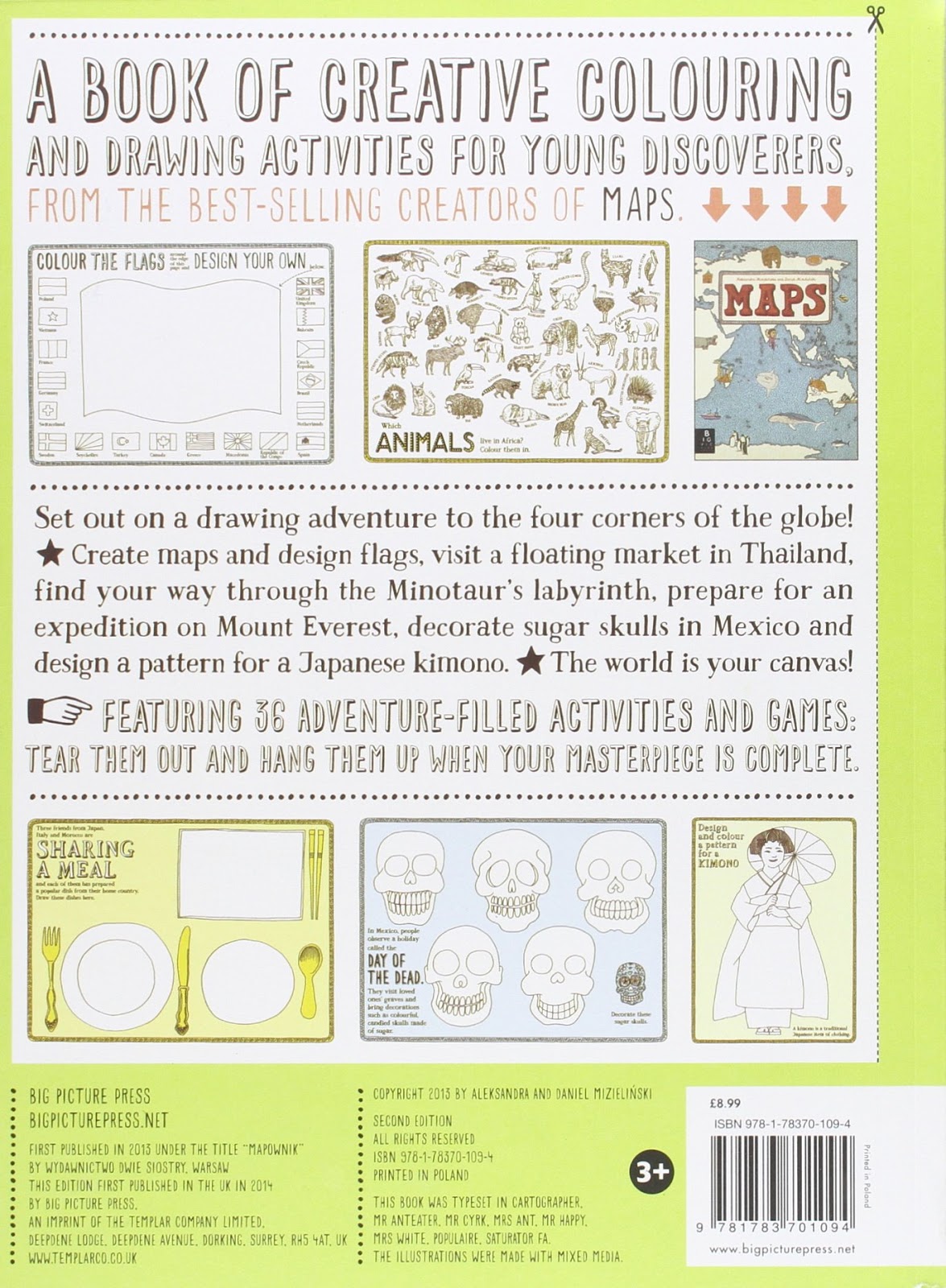
As an enhancement to the original publication Big Picture Press published the Maps Activity Book written and illustrated by Aleksandra Mizielinska and Daniel Mizielinski on July 1, 2014.  Smaller in size, 12 by 8 4/5, this paperback with special binding for ease of  page removal delivers interesting challenges involving drawing, coloring, research, and creative imagining and thinking.  On the back of each of the thirty-six activities a tiny character, children from around the world, impart more fascinating facts in a single speech balloon.


Users might be asked to draw a map of an imaginary country, pretend to be an explorer in the Amazon and draw animals, plants and people they might find there, invent another glyph to add to the ancient Mayan language, color flags from countries and design your own, select which animals on a given page actually live in a specific place or create a pattern for a kimono.  Each of these activities invites readers to discover more than they originally know. The fantastic facts on the back of the activity pages might tell us where the largest active volcano is located, its size and the number of times it has erupted or who designed the updated U. S. flag after Alaska and Hawaii became states or supply readers with information about the original inhabitants of Australia.  The pages can be used for single individuals or as a guide for the generation of more related educational adventures.


The most recent title in this trio, Maps Poster Book (Big Picture Press, February 23, 2016) written and illustrated by Aleksandra Mizielinska and Daniel Mizielinski is twenty-seven maps plus the world map found in the first volume, condensed in size to 11 3/8 by13 9/16.  On one side of the poster is the exact replica of either a country, a continent or a large area, the Arctic.  On the other side the highlighted map is shown in color within a larger two-tone map.  All of the pages are perforated for removal.


The newest book by the collaborative duo of Aleksandra Mizielinska and Daniel Mizielinski, which again demonstrates their talents in exploring our world exquisitely, is Under Earth Under Water (Big Picture Press, March 1, 2016 UK, October 11, 2016 US).  For sixty-three pages we peer into the ground until we strike the core of our planet.  In the following forty-five pages we work our way to the surface but through the seas or oceans.  A clever design allows you to begin with either the earth or the water.


If we look just beneath the dirt all kinds of creatures seen with the naked eye or under a microscope can be found.  Discovering the giant Gippsland earthworm in Australia would be rather startling as it can grow to be nearly ten feet long.  Anthills are far most vast and sophisticated beneath the surface than what we find above ground.  Did you know there can be more than one queen in one anthill?

Intriguing information about borrowing animals, moles, naked-mole rats, prairie dogs, badgers, and red foxes are revealed in greater depth.  Plants with edible and medicinal portions growing under the surface are explained as other pages showcase majestic trees.  Man-made cables stretched below the surface, the vast networks used to transport natural gas, electricity and water used in homes as well as waste disposal are presented.   Travel by tunnels, general and specific, and how tunnels are made is a fascinating section.

Archaeology, paleontology, speleology, and mining are explained.  Pages are devoted to those products made from the riches, natural resources, taken from the earth.  Information about The Pacific Ring of Fire and plate tectonics are pictorially displayed.  The deeper we go volcanoes, hot water springs, geysers, layers of the earth and the center itself are discussed.

From here we start to head upward learning of vessels like the Deepsea Challenger used to explore the bottom of the sea.  Trenches and their strange inhabitants fill several pages.  Did you know that the glow seen at the tip of the triplewart seadevil's rod is actually other tiny lifeforms?  Have you ever heard of underwater chimneys? Some of those chimneys are found as far below the surface as sixteen thousand feet!

We have studied the Titanic, other sunken ships and an array of places using submersibles specially furnished with scientific equipment.   We have drilled into the seabeds using unique platforms to extract oil and gas.  (I wonder if any of those human workers have ever seen a colossal squid or blue whale showcased in several pages.)  A history of the development of diving suits and submarines will astound readers.  Many forms of diving and famous divers are disclosed.  

As we continue to move toward the surface we learn of water pressure, sinkholes, coral reefs, and the properties necessary for something to float.  To further our knowledge a comparison is made between the residents of an ocean and a freshwater lake.  As we come to the top, seeing the sky above, we can make the choice to dive down beneath the waves again or head to terra firma and start digging once more.


As in the Maps title the authors have meticulously labeled every item in the illustrations, inviting further research by readers.  Each two-page illustration, top to bottom horizontally, places informative text in rounded boxes blending into the image.  Each of these boxes contains one to five sentences written in an easy, conversational style.  (Readers should note the measurements are given using the metric system.)  Here are some sample passages.

The roots that reach deepest are of plants that grow in deserts.  The plants send them deeper and deeper underground in search of water.

In the far north of Russia, beyond the Arctic Circle, scientists drilled the world's deepest hole to gain a better understanding of the Earth's structure.  The borehole took 22 years to create and was more than 12km deep.

The Great Lakes are the Earth's biggest bodies of fresh water.  The most extensive freshwater lake, Lake Superior-on the border of the United States and Canada-is bigger than the Czech Republic.  The world's deepest lake is Lake Baikal in Russia, which reaches a depth of up to 1642m.

At the bottom of the ocean, hundreds, or even thousands of metres underwater, unusual places lie hidden that resemble fields of smoking chimneys.  The clouds that emerge there are not smoke, but hot water full of minerals.


When the book case is opened readers can view the table of contents for each section, earth and water, laid before them like a path to follow, with small images, page numbers and titles given.  Shades of blue are used as the background in the portion on water.  Once we begin to delve into the section on the earth a more varied color palette is used.  

The fine line work, layers of complex aspects, layout and design represent painstaking planning and implementation.  Within each illustration and from picture to picture everything flows flawlessly.  You might think the large amount of elements would be a distraction but that is simply not true.  They are an invitation to explore, discover and learn.

Two of my favorite illustrations of many are one from the water and one from the earth.  The Carmagnolle brothers' diving suit is featured in a single visual stretching from top to bottom.  It is standing in a bed of seaweed entirely submerged.  Seven labels containing facts are attached to it as is an important date.  Bubbles rise from the bottom in several hues of blue.  As a gardener the six horizontal rows highlighting roots, rhizomes, tubers and bulbs are fascinating.  Each is named with most containing special uses and locations where they are found.  Realistic colors are employed.  Gals and guys will be absorbed in the cross-sections devoted to moles, naked-mole rats, prairie dogs, badgers and red foxes.  


Under Earth Under Water written and illustrated by Aleksandra Mizielinska and Daniel Mizielinski is a marvelous, mesmerizing look at our planet's earth and water characteristics, the flora and fauna residing there and the secrets they have revealed to us.  This team has also added people and scientific advancements of significance relative to both.  The sturdy book case and heavy paper make this a lasting worthwhile addition to personal and professional collections.  Your patrons and students are going to love it.  I advise getting several copies.  

I was unable to locate any information on Aleksandra Mizielinska and Daniel Mizielinski but more information about this title and the others by this team can be viewed at Candlewick Press, Big Picture Press, and Templar Publishing. Enjoy the book trailer.


 To enjoy the other titles selected by participants in the 2016 Nonfiction Picture Book Challenge please access Kid Lit Frenzy hosted by educator Alyson Beecher.


Wednesday, June 3, 2015

When It Is, When It Isn't

When living in a state surrounded by four of the Great Lakes, large bodies of water can be easily reached in a few hours.  According to the Michigan Department of Natural Resources there are more than 46,000 inland lakes ranging in surface size from less than a half-acre to more than 1,000 acres.  For three of the four seasons I can stand on my back deck and see Lake Charlevoix between the trees.  Being near, in or on the water has been a part of my life.

Essential to all living things, as a resource and a source of rest and relaxation, the value of water has never been more evident.  As a glorious ode to one of earth's prized elements Water Is Water: A Book About the Water Cycle (A Neal Porter Book, Roaring Brook Press, May 26, 2015) written by Miranda Paul with illustrations by Jason Chin will leave you with an even greater appreciation for the wonder of water.  You will long to step inside the pages of this book.

Drip.
     Sip.
Pour me a cup.
Water
     is
          water
unless...

As water moves from place to place heat or cold can make it alter its shape as steam or clouds.  In the right conditions clouds drop stretching out velvet cloaks to wrap around the world below.  It's hard to see clearly.

Clouds can release the moisture they hold as rain where it gathers in hollows, basins and crevasses.  Let's all jump in the puddles!  If it were winter those puddles would freeze into ice.  This surface would provide for an afternoon of figure skating, crack the whip or maybe some hockey.

Remember those clouds?  When they form in the winter no-two-alike snowflakes fall.  As much as we like the crisp air and the fun of these chilly months, the next season chases them away.  Melting snow and early rains mix with the soil to make mushy mud.

Roots dip deep into the dirt.  Water travels from blossoms to tiny fruit to sweet, crunchy apples.  How do we get the water from apples?  What is it called?  Ahhh...the tangy taste of cider.


The words penned by Miranda Paul make music.  Whether read silently or aloud, they move to a specific rhythm mirroring the different forms water takes.  Alliteration, onomatopoeia and rhyming flow from page to page.  Here is another sample passage.

Steam is steam unless... (page turn)
it cools  high. 
A dragon
     in a wagon?
A crow
     kneading dough?
Clouds are clouds unless...


Rendered in watercolor and gouache the illustrations by Jason Chin are marvelous.  The scene on the matching dust jacket and book case on the front actually begins the story.  On the back, to the left, Chin shifts seasons at the pond.  It's a full-moon-winter night.  Children are running across the frozen pond.  The feline friend is still sitting on the dock.  The darker shade of blue in the title text is used on the opening and closing endpapers.

Before the title page we see a single page picture of the sister and brother net in hand on the grass next to the pond.  A turtle is resting on a nearby rock.  Extending edge to edge on the title page the duo has captured the turtle.  Their mother is calling them from the hill on which their house sits.  Their father is working in the garden.  And the cat...is gazing at a bird in the birch tree.

The dedication pages feature another double-page illustration; the first of sixteen.  It's a cloud burst rain shower with the children running to their house as their parents wait for them on the porch.  Chin moves beautifully from outside the children's home to inside to their porch to the pond.  We follow them to school, and home again for gatherings of friends in winter and the end of summer.

Delicate details, lively, charming facial expressions, and a soft, realistic, color palette draw you into each illustration.  Chin tells small stories across several illustrations.  The turtle netted in one is cherished for a day before being released back to the pond.  The sister pays back her brother for scaring her with a garter snake as he lets it go.  There are others but you need to discover them for yourself.

I could frame any one of these images to hang on the wall in my home.  One of my favorite visuals is of the sister and her brother waiting for the school bus on a foggy morning.  They are standing beneath a striking red maple, leaves blanketing the ground.  Other autumn colors swirl across the page as their ride crests the hill.  The boy is reaching down to catch the snake.  The cat watches at the top of the hill near their house.  A tire swing dangles from a tree.  A jack-o-lantern looks out sitting next to the mailbox post.


Water Is Water:  A Book About the Water Cycle written by Miranda Paul with illustrations by Jason Chin is in a word beautiful; beautiful for the story, beautiful for the paintings and beautiful because all children will see themselves featured within these pages regardless of their race.  Like water the text and pictures begin and end during the same season bringing readers full circle. At the end of the book each of the changes in water is explained further on two pages.  The following two pages compare the percentage of water in some of the living things pictured along with other facts about water.  There are sources for Further Reading and a Selected Bibliography.  Pair this title with Raindrops Roll, Every Last Drop: Bringing Clean Water Home, Blue on Blue, All the Water in the World, Water Rolls, Water Rises, El agua rueda, El agua sube  and Water Can Be...  

To learn more about Miranda Paul and Jason Chin and their work, please follow the links attached to their names to access their respective websites.  Miranda Paul has some activities for teachers regarding this title.  At the publisher's website you can view eight single page interior illustrations.  For a look at the process in creating some of the illustrations please head to Seven Impossible Things Before Breakfast hosted by author and blogger Julie Danielson.  My favorite picture is there!


To discover what other titles are featured by bloggers participating in the 2015 Nonfiction Picture Book Challenge be sure to go to educator Alyson Beecher's blog, Kid Lit Frenzy.


Tuesday, April 22, 2014

If Not For Them...

Living in northern Michigan there are two things you simply can't ignore, trees and water.  One of my favorite hikes is through the woods along the shore of Lake Michigan.  When no one else is around, early in the morning, I've seen white-tailed deer playfully jumping in the water along the beach and a bald eagle soaring above the treetops.  By climbing a series of hills on paths winding among pines, oaks, maples, poplars, beeches and ferns, I can see two different arms of Lake Charlevoix.

It would be easy to take such abundance of both for granted, but I don't.  Reverence would be an apt description of how I feel about trees and water, knowing they could disappear if not protected.  In 2012 a book garnering a Golden Kite Honor Award, Picture Book Text, placement on the International Reading Association Teachers' Choices 2013, Primary Readers, the position of a Minnesota Book Award Finalist 2013, The John Burroughs Riverby Award for 2012 and listed on the National Council of Teachers of English 2013 Notable Children's Books in the Language Arts titled A Leaf Can Be... (Millbrook Press) written by Laura Purdie Salas with illustrations by Violeta Dabija spoke (still speaks) to the youngest of readers (which means all of us) about the place of leaves in the natural realm. 

A leaf is a leaf.
It bursts out each spring
when sunny days linger
and orioles sing. 

After these introductory poetic phrases which truly make you feel like singing yourself (go ahead, read them aloud now), you read the title of the book followed by eleven, rhyming, two-word defining sentence finishers; one set per page.  Then the first sentence of the volume is repeated with three new lines moving from spring to fall.  Again two-word, lyrical, rhyming descriptions depict the ever-changing potential of leaves in the lives of many.

Clearly Laura Purdie Salas is a keen observer of the out-of-doors; noticing the multiple purposes of leaves.  Her true gift though lies in her combinations of words.  Not only are they true but absolutely beautiful. Here are two sets of couplets.

Tree topper
Rain stopper

Wind rider
Lake glider

After the narrative concludes, she takes each of her two-word phrases, explaining them in more factual terms. This is not only an invitation for learning but for readers to challenge themselves to think of their own two-word portrayals of leaves.  The final page includes a small glossary as well as a list of four books containing more information.


Fortunately for readers three short weeks ago Laura Purdie Salas and Violeta Dabija released a new collaboration bringing us a second stellar title, Water Can Be... (Millbrook Press).  Having watched the levels of Lake Michigan fall to their lowest in my memory, this ode to the splendor of water in all its forms is timely and timeless.  From drop to downpour, it's never been more eloquently depicted.

Water is water---
it's puddle, pond, sea.
When springtime comes splashing,
the water flows free.

As in the previous title we readers are treated to eleven representations of water in the world.  Each pair's cadence creates a melody not dissimilar to the sounds water can make; almost silent to a roar.  We are magically moved to each location.

Water is a birthplace and residence, a mirror, a source of food and drink, a land shaper, a cycle maker, a disguiser, a temperature changer, a color coordinator and a source of destruction.  Its capabilities, like a leaf, change with the seasons.  We can see its distinctive values in the outer world as well in our homes and workplaces.

When you read the word choices of Laura Purdie Salas, you want to grab a pencil and paper as fast as you can, to start jotting down what you notice about water in the spring, summer, fall and winter.  She makes you realize you need to pay closer attention, to be more appreciative.  Her use of language challenges you to stretch beyond the obvious, renaming what you see, hear, smell, touch or taste.  Here are several twosomes from this title.

Thirst quencher
Kid drencher

Salmon highway
Eagle flyway

Four pages are devoted to clarifying water's role in the double word phrases.  Her sentences are enlightening and entertaining at the same time.  Salas is careful to speak as if in conversation with her readers.  Here is a single sample.

Rainbow jeweler: Did you know that without water, we would have no rainbows? They form when sunshine meets water vapor in the air.  The sunlight hits the water vapor, bends, and travels to your eye.  The light makes different colors depending on how it bends.

A glossary and list of five books ends this title.


Of Violeta Dabija the publisher's website says:

She works in both traditional and digital media and often mixes them to produce delicate and atmospheric illustrations with a traditional feel.

The matching dust jacket and book case on each volume features an altered version of a visual from within the pages.  On the back is a smaller illustration framing or highlighting a question to the reader about a leaf or water.  The endpapers are a solid color, taken from the front of the jacket and case.

The shapes and hues on the title page blend and extend into the verso and first page, softly stunning, so lovely you wish you were standing beneath the tree branches filled with singing birds or next to the rapidly moving stream.  For each set of words, Dabija has created lively, graceful images endearing and expressive, favoring shades of green in the first and of blue in the newest title.  That is not to say she does not use other colors to great effect.

 She adds her unique, skillful brand of marvel and magic on every page.  The final two pages, a single illustration in both books, show men and women creating topiaries from shrubs and trees and a castle, crescent moon, rabbit and dragon from ice.  In A Leaf Can Be... one of my favorite pictures (nest former) is of a flock of white birds gathering leaves to make homes in a single tree.  The combination of greens, blues and browns, tiny white blossoms surrounding the shape of the branch ends, is life affirming, full of peace and hope.  Featuring a cascading stream, white-tipped waves forming, falling down through the spring forest with snow-capped mountains in the distance, Dabija pictures Downhill speeder from Water Can Be...  You can almost hear the racing sound of the water.  This is one of several favorites of mine.


Let us hope that A Leaf Can Be... and Water Can Be... written by Laura Purdie Salas with illustrations by Violeta Dabija are the first two of many collaborations.  These books are breathtaking in word and pictures.  Read them for the quiet pleasure they bring.  Read them for the information they provide.  Read them to see a leaf and water in a new light.  Most of all, share them with everyone often!

Please follow the links embedded in the author's and illustrator's names to access their official websites. Laura Purdie Salas has numerous extra features for educators; how the book began (for A Leaf Can Be...), reading guides, videos and activity sheets. Follow this link to the publisher's website for inside views of both books, and a PDF downloadable bookmark for A Leaf Can Be... At this link to Cynthia Leitich Smith's blog, Cynsations, view several videos about Water Can Be...  Here is a link to a Pinterest board Laura Purdie Salas created for Water Can Be...

Do not miss the #SharpSchu Book Club tonight on Twitter which features these two books.  Be sure to check back here later for a link to the archive if you miss the chat.  Watch. Connect. Read. John Schumacher  Sharpread Colby Sharp