It's woven into every single day. We drift into daydreams of accomplishments to reach for the next hour, day or weeks ahead. We form visions of special spaces to create. We brainstorm with others to make something better. We pretend to be other people at other places in other times to enhance or survive our current circumstances. These pictures in our minds are painted with hope.
Our imaginations are a gift allowing us to create pathways for the impossible to become the probable. Imagine That: A Hoot & Olive Story (Henry Holt and Company, July 16, 2019) written and illustrated by Jonathan D. Voss features two endearing characters we met inBrave Enough for Two (A Hoot & Olive Story(Henry Holt and Company, June 12, 2018). These friends are embarking on another adventure to find something valuable.
Olive had a great big imagination, which was only just a smidge smaller than her huge heart. Her best friend, Hoot, had a heart that was equally big.
One day during a rainstorm, when playing outside is out of the question, Olive wants to explore in the realm of make-believe. While Hoot agrees it is a good idea, he cannot imagine a single thing. He is sure he lost his imagination or worse yet, it might be broken. Olive is certain they can find it or fix it.
First, as the rain comes down even harder, Olive thinks a puddle outside the window is getting deeper and the house suddenly shifts. As she shouts about the house drifting away, Hoot still only sees a puddle. Next, Olive grabs a colander and rigs it with wires. She tells Hoot it works to unscramble his mind. Unfortunately, he does not see the G I A N T in the corner of the room.
Olive tries another tactic. Hoot is unable to see the fairies in the basement. Olive is the kind of friend who never gives up. All sorts of things are attempted but Hoot cannot imagine. After sitting in silence for a bit, Hoot makes a statement. It awakens an idea in Olive's mind.
Eyes closed; Hoot tries again. All good things have a tiny beginning. Sometimes things are not lost or not broken. We simply need a friend to help us flourish through love.
Using narrative and heartwarming conversations Jonathan D. Vossbrings readers into this enchanting story. Without reading the first book, he describes all we need to know about Olive and Hoot in the first two sentences. In the third sentence we know there is a problem and we can't wait to find out what happens.
Each attempt by Olive to help Hoot leads us into spellbinding possibilities. They are building to a changing point. This moment, thanks to Jonathan D. Voss, is one to tuck away into your memory for future reference. It bursts into happiness and imagining the best thing of all. Here is a passage.
They stepped into the dark. Something fluttered. Olive froze. "Do you hear that?" she whispered. "Fairies!"
When you open the dust jacket the landscape on the front extends over the spine to the far left on the back. The glowing sky courtesy of sunlight provides an atmosphere of magic. If readers look closely, they can see the imaginations of Olive and Hoot have fashioned another world in the water. A bird becomes a dragon. Dock posts become castle spires. A rowboat becomes a pirate ship. To the left, on the back, the calm water becomes a stormy sea with hints of events to come within the book.
A sepia-toned wash spreads over the front and back of the book case. A wide cloth in pale blue covers the spine. On the front Olive and Hoot, holding hands (hand and wing) and carrying sticks, walk among daisies. On the back, a tiny field mouse looks up at a single flower. The image of Olive and Hoot walking hand-in-hand becomes part of a diamond pattern on the opening and closing endpapers in two shades of pale blue.
On the verso page Olive and Hoot are decked in armor as heroic knights. A field of flowers frames the text on the title page. All the illustrations are rendered using
watercolor with pen and ink on Arches Hot Press Watercolor Board and added color digitally.
They are full-page pictures, smaller images placed on the sepia-toned wash or dramatic double-page visuals. Sometimes the illustrations span a page, cross the gutter and make a column for text on the opposite page. While there is a lightness around the elements in each image, we are aware of the rainy day by the color palette.
Readers will be captivated by all the details in each picture. Certain items are larger than normal; ABC wooden blocks, flowers in a floating vase, large boots, a discarded beverage can or a one metal jack. Some details in one illustration will appear in a new one as the story progresses such as their floating house or the G I A N T. This strengthens the idea of the power of imagination.
One of my many, many favorite illustrations is of the G I A N T in the living room. Hoot wearing the colander with wire antenna coming from the top is listening to Olive. She is pointing to shadows in the room. The G I A N T fills up the entire right page crosses the gutter and his right hand is next to Olive on the left, palm-side down. He is kneeling on his right knee and the other leg, bent at the knee, extends from the floor to the ceiling. He is a friendly G I A N T, dressed in shabby shoes, a white shirt and green tie, green pants and a red workman's cap. He is holding a single daisy in his left hand.
This book, Imagine That: A Hoot & Olive Story written and illustrated by Jonathan D. Voss, is one of those books you immediately love but with every reread it fills up more of your heart. You are emotionally attached to the characters and their adventures. Our imaginations are precious and vital just like best friends. This is a story which celebrates both with love. I highly recommend this book for your personal and professional collections.
To learn more about Jonathan D. Voss and his other work, please follow the link attached to his name to access his website. At his site you can view interior images from the book and a wonderful book trailer. (I've lost count of how many times I've watched it.) Jonathan D. Voss has accounts on Facebook and Twitter. At the publisher's website you can view interior images.
Distance and decades do not weaken the bond between them. Unexpected circumstances do not deter these individuals. Strength, courage and good fortune are offered in the face of weakness, fear and adversity. They tend to place others first and themselves second.
Friends appear when they are least expected and most needed. They know us better than we know ourselves. In the following three volumes published in 2018, friends come in all shapes and sizes.
Friends Stick Together (Dial Books for Young Readers, April 10, 2018) written and illustrated by Hannah E. Harrison (Extraordinary Jane and Bernice Gets Carried Away) is a classic case of the attraction of opposites. What's one to do when another wishes you would disappear? You don't give up.
I'm Rupert. I like reading dictionaries, listening to classical overtures, and eating cucumber sandwiches with no crust.
The next character we meet is Levi. He is not a rhinoceros, but he is a tickbird. Corny jokes, armpit farts and popping wheelies are a few of his favorite things.
One minute he isn't in Rupert's classroom and the next minute he is on Rupert's nose. Levi is one obnoxious bird and he won't leave Rupert alone. Rupert doesn't really have many friends but Levi chases everyone away.
Rupert starts a campaign to get rid of Levi. Rupert tries once, twice and three times to vanquish this pest. Finally, the truth works and Levi leaves.
Levi does not appear at school the following day; not in music, or gym class and not during lunch. Guess what? Rupert is miserable without Levi. There is a path to take. Will Rupert follow it?
Author Hannah E. Harrison begins slowly and with intention acquainting us with the two main characters. They are total opposites which brings in the humor. It intensifies in a combination of narrative and conversations. When each character reaches their point of no return, we are hopeful and totally engaged in the story. One clever bit of writing by Hannah E. Harrison is the inclusion of two different definitions of symbiosis at the beginning and at the end of the story. This ties every portion of the story together. Here is a passage.
During lunch, he makes a big to-do about eating my ticks, and grosses everyone out.
"Yummy! Tastes like chicken!" "Just kidding, tastes like tick!"
What people remember the most about the artwork of Hannah E. Harrison in her books is her portraits of her animal characters. Their animated body positions and facial expression endear them to us. When we look at the front of the matching dust jacket and book case, we can already see the distinction between Rupert and Levi; the one is straight-laced, and the other is happy-go-lucky. We are already curious about events to come.
To the left, on the back, Levi is standing with his arms spread wide and says:
"A friend is a friend through TICK and thin!"
The opening and closing endpapers are different. The first is a blue and white check. The second is shades of golden yellow-orange in an argyle pattern. Rendered with acrylic paint on Bristol board the illustrations shift in size to place emphasis on portions of the story and assist with pacing.
There are collections of small images, full-page pictures, and illustrations in circular shapes with elements extended beyond their borders. Sound effects inserted in the visuals add to the emotional engagement of readers. Although all the items in the illustrations are valuable Hannah E. Harrison makes sure our attention is drawn to the animals.
Her animals look and act as if they could walk off the page at any minute. Their physical traits are realistic, but how many rhinoceros do you know that own headsets for listening to Beethoven? You can hardly contain your laughter at Levi making arm farts when he's on the back of Rupert.
One of my many favorite pictures is a bird's eye view of Rupert on the spinning roundabout. He is hanging on tight as can be with most of his body off and above the ground as it circles. He is hoping Levi will fly off. This takes up most of the full-page picture on a grassy background.
While enjoying the antics of Levi and the annoyance of Rupert, readers also see the value in having a friend, even if at first we are not sure of their intentions. Friends Stick Together written and illustrated by Hannah E. Harrison is an excellent selection for an introduction to symbiosis and friendship. By following the link attached to Hannah E. Harrison's name, you can access her website. At the publisher's website you can view interior illustrations. Hannah E. Harrison is interviewed at Brightly.
Being a new student in a new town is rarely easy for any gal or guy. If you happen to be a child genius, it's even harder to acquire friends. Albie Newton (Sterling Children's Books, May 1, 2018) written by Josh Funk with illustrations by Ester Garay is an exploration of the dynamics of friendship.
Little Albie Newton was a thinker from the start. He built a mega-stroller after taking his apart.
Before attending school, this brilliant boy counted to infinity and learned multiple languages with ease. A cheerful song was sung by his classmates on Albie Newton's first day in the classroom and that gave him an idea. He would build a gift hoping to make new friends.
It wasn't long before everyone realized Albie was super smart. They would do one activity and he would do another. They were painting shapes on paper during art and Albie created a masterpiece like those seen in museums. Soon he was working alone, gathering discarded items and sneaking away with materials others were using.
During reading time the noise from Albie's newly established science lab rang out over the entire school. Albie just kept working. His classmates were at the proverbial end of their collective ropes. They were mad. Shirley stopped them in their tracks. Wait a minute!
She asked them to look at Albie's creation. It was a spectacular sensation. (I couldn't resist the urge to rhyme.) In a heartbeat they knew this wasn't going to be a normal year. Albie was going to take them into their wildest imaginations.
Readers are quickly invited into the story of Albie with the cadence Josh Funk builds through his use of language. Every two sentences or phrases has a rhyming word at the end. What is striking about Albie is he does not flaunt his intelligence but uses it instead to form friendships. Readers will also appreciate the wisdom Josh gives to Shirley; the ability to see deeper into Albie's persona. Here are two passages.
Kai and Jane played dress-up till they heard a giant CRASH! Albie dumped the garbage bin and sifted through the trash. Arjun ate his snack and finished Albie's cleanup duties as Albie built a science lab (and found a cure for cooties!)
The bright red used as a canvas for the matching dust jacket and book case spreads cheer to all who see it. Albie looks like someone you want to know. All the gadgets and gizmos surrounding him peak your curiosity. Who are the cat and red-haired girl? What is the significance of the watch? Portions of the front of the jacket are varnished.
To the left, on the back, text further invites us to open the book. Images of Albie, his drawings and new friends have us wondering what will happen next. On the opening and closing endpapers all kinds of tools, scientific experiments, drawings and pictures, placed on a green background, hint at what is to come and what happens. The two sets of endpapers are different.
Illustrator Ester Garayrendered the illustrations digitally. On the title page the text is fashioned from tools Albie might use in his inventions. Each image, sometimes two on a page, full-page, or double-page, is lively and filled with fun-loving details. The hamster in the classroom is also singing to Albie on his first day at his new school. The pictures and posters on the classroom wall make you wish you were a student there, too.
One of my many favorite pictures spans two pages. On the left, Shirley, the red-haired girl is peeking around a barricade of blue storage crates. She watches Albie hard at work on his invention. Albie has built a lab from other furniture in the classroom. He, wearing special glasses, is totally focused on his latest project. There are lots of pieces of objects around him.
When I think of Albie Newton written by Josh Funk with illustrations by Ester Garay I know there are children who can readily identify with him from personal experience. This book shows readers there isn't a single right path to friendship. This is an excellent choice for a theme on friendship, inventions and determination. To learn more about Josh Funk and Ester Garay, please follow the links attached to their names to access their websites. Josh is interviewed at Jena Benton's website. The cover for this title is revealed at educator Pernille Ripp's website. The book trailer is premiered at KidLit TV. Josh has accounts on Twitter and Instagram. Ester has an account on Instagram.
Oh, the comfort many find in a treasured toy. Stuffed animals make wonderful friends. They can go wherever you go. They listen to your out-loud-thoughts, wishes, dreams, happiness and sadness. Their silence absorbs everything and provides constant reassurance.
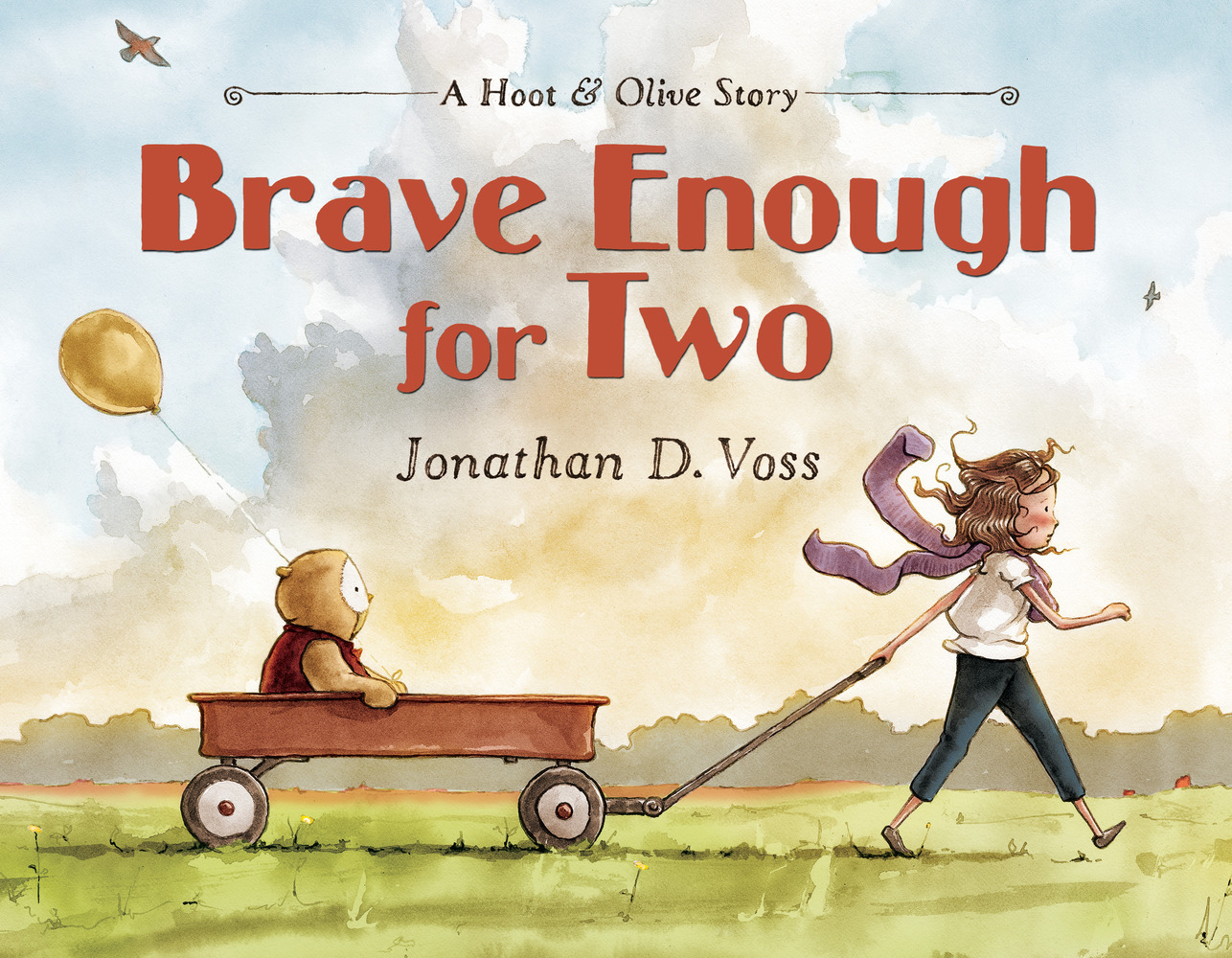
Have you ever wondered what it would be like if they could talk and walk? Brave Enough for Two (A Hoot & Olive Story) (Henry Holt and Company, June 12, 2018) written and illustrated by Jonathan D. Voss is about a girl and her toy owl and their remarkable adventures. Courage comes in many forms.
Hoot was Olive's very best friend in the whole wide world. But as you know, best friends don't always like the same things.
Their definition of adventure was one of their differences. Olive liked to read about them. Hoot preferred the action of experiencing them in real life. Hoot decided he was going to change Olive's outlook.
One day he took her to something he made, hoping to make her braver. It was a basket big enough for two, topped with a huge bundle of balloons. Olive worried about the heights they would climb. Hoot told her it would go up but not scary up. They went so high everything appeared in miniature below them. It was amazing but for Olive it was a bit frightening.
It started to rain. It started to storm. Olive was afraid they would get lost. As suddenly as it appeared, the thunder, lighting and rain left. (Whew!) Hoot got them safely to the ground, one balloon at a time.
Full of ideas, Hoot had another plan. They took that basket and used it like a boat on a river. It was going much too fast. They barely made it to shore. When they did, Hoot went quiet. He had a tear. His stuffing was coming out. In a beautiful reversal of roles, Olive knew exactly what they needed to do. And they did.
With gentleness and truth Jonathan D. Voss pens a story of friendship all would welcome. Each character recognizes their insecurities, but the other is there to bolster them. They do this with confidence, shown in the repetition of certain phrases. In a marvelous blend of narrative and conversations these characters find a special place in our hearts. Here are two passages.
"I've never been in a boat before," said Olive. "Then it will be the first time for both of us," said Hoot. "Will we go fast?" asked Olive. ""Maybe just a little," said Hoot, tying a flag to their new ship's mast. The boat bobbed and spun like a carnival ride. "What do you think?" asked Hoot. "I think we are going faster than just a little!" said Olive.
The view on the front of the dust jacket moves across the spine to the back. It's a peaceful pastoral scene with gorgeous clouds and birds which you can almost hear singing. Although Olive likes her adventure in books, she certainly looks determined in our introduction of her. Placing Hoot riding in the red wagon allows us to be surprised when he comes alive in the story. The single yellow balloon is a delightful bit of foreshadowing. The title text is varnished.
On the book case a wide, rich red (the shade seen on the dust jacket) creates a cover for the spine. To the left a single balloon floats in the air. On the right Olive is still pulling Hoot in the wagon but her stride has changed. The hues for these images are like old photographs, sepia-toned, in an album.
The pattern on the opening and closing endpapers is in two shades of green. It looks like wallpaper. A closer examination shows Olive holding Hoot's hand as they walk away from us. This is in the center of a leafy frame. On the verso page entwined leaves form a corner border. Olive and Hoot peek at each other around the trunk of a tree in the opposite corner. The basket and two balloons, in full color, are under the text on the title page.
The artist used watercolor with pen and ink on Arches Hot Press Watercolor Board and added color digitally to create the illustrations for this book.
Each picture is brimming with whimsy. Jonathan D. Voss shifts his perspective and image sizes. He often extends the illustration over the gutter to make a column for text. A smaller image in brown accompanies the narrative. Sometimes we are right next to the characters, other times it's as if we are birds watching them from the sky. And we often feel out breath catch when a double-page illustration is spread before us.
One of my many, many favorite illustrations is a double-page visual. From left to right a vista of rolling hills, plowed fields and hedgerows are spread before us. A clearing sky still holds stormy clouds, but a wide rainbow extends from the left, over the gutter and disappears to the top right. Just off center to the right, on the right, Olive and Hoot ride in the basket with the colorful balloons keeping them afloat. Their backs are to us. Readers will long to join them.
Tender and loving, this story, Brave Enough for Two (A Hoot & Olive Story) written by Jonathan D. Voss, is like having a best friend you can keep on your bookshelf to help you whenever you need it (of even if you don't). We would count ourselves very fortunate to have either of these two for a friend. Read this aloud often and share it widely, please. This is Jonathan D. Voss's author/illustrator debut.
To learn more about Jonathan D. Voss, please follow the link attached to his name to access his website. At his site and the publisher' website, you can view interior illustrations. Jonathan maintains an account on Twitter.
For each person entering the field of education the reasons for doing so are varied. Some believe each generation should strive to make the world better for the next generation. Some know creating life-long learners leads to individuals becoming the best they can be. Others seek to be a positive influence hoping they can make a difference.
What educators quickly learn is children equal hope. We learn as much from them as they do from us. Sometimes they have little or no say in changes affecting their lives but they in turn exhibit extraordinary resilience. Ella & Monkey at Sea (Candlewick Press, August 7, 2018) written and illustrated by Emilie Boon gives us an intimate look at the voyage a child makes from her homeland to America.
Monkey doesn't like good-bye hugs. He doesn't want to say good-bye to Oma. Oma wipes away tears and hugs Mama too.
Ella is not happy about boarding the ship with her mother. She knows they are leaving their home permanently. Monkey agrees with Ella.
He does not like the tiny beds on the ship. Thankfully Ella sings a special lullaby that night. At the ship's playroom the next day, Ella and Monkey only watch. When the Captain and waiter approach their table at dinner the companions are polite but without Oma the food, especially the fish, is not good.
Every day in the playroom Ella and Monkey do not play. As the sea gets wilder, the friends get sadder and crankier. Plates slide at dinner and sleeping is impossible as the ship rocks in the howling wind. It's a hurricane!
With all activities cancelled due to the storm, Ella and Monkey use paper and crayons to replicate its ferocity in their room until a broken crayon changes the little girl's attitude. All the new pictures are handed out to the Captain and helpers on his crew. The sun is always shining behind the clouds and they never stay. Ella finally remembers.
Most readers will immediately identify with Ella and her monkey. We have survived countless times of sadness and shared great joy with a beloved stuffed toy. Emilie Boon understands this, projecting Ella's thoughts as if they are Monkey's feelings. Emilie's short, descriptive and direct sentences convey Ella's emotional moods perfectly. Here are another two passages.
The hallways are empty. The dining room is empty. The playroom is almost empty, and there's nothing to watch. So we try the crayons, I scribble with angry black. Scared gray. Cold blue. Bluer, grayer, blacker--- until my crayons snaps.
Seeing Ella with Monkey on the ship as it arrives in the harbor allows readers to become acquainted with her in all her cheerful glory. This is Ella being resilient. This is Ella having endured the changes and challenges on the voyage. We can't help but fall in love with this little girl and Monkey. All the colors on Ella radiate warmth in contrast to the pale blues of the water and sky.
To the left, on the back of the dust jacket (I'm working with an F & G.) Ella and Monkey are peering through a porthole looking worried. They are surrounded by the light blue gray of the ship's exterior. Emilie Boon begins her visual story on the title page. Ella's mama, Ella and Oma, her grandmother, are walking hand in hand to the ship.
Rendered in watercolor, graphite, colored pencil, and crayon the visuals alternate between double-page illustrations and full page pictures. On several of the full page pictures there is a liberal amount of white space used to draw our attention to the characters. The delicate lines and intensity of the hues convey and elevate mood. With a few lines and dots Emilie creates facial expressions brimming with emotion.
One of my many favorite illustrations is when Ella and Monkey are tucked in bed on their first night at sea. In this picture we are brought close to them. We can see Ella singing the song while tenderly holding her cherished stuffed toy. In caring for Monkey she is easing her own fears.
Giving up your home, friends and family is never easy but when you leave one country for another the change is huge. Ella & Monkey at Sea written and illustrated by Emilie Boon reveals the heart of a child making this transition. Readers will connect with Ella and her monkey and be inspired by her courage. I highly recommend this title for your professional and personal book collections.
To learn more about Emilie Boon and her other work please follow the link attached to her name to access her website. Emilie maintains an account on Instagram and Facebook. Emilie is interviewed by Vivian Kirkfield at Picture Books Help Kids Soar. Emilie has a guest post at the Nerdy Book Club about this title. At Penguin Random House and Candlewick Press you can view interior images. Candlewick Press provides a Teacher Tip Cardhere.
UPDATE: Emilie Boon is featured at KidLit 411 on January 25, 2019.
 Our imaginations are a gift allowing us to create pathways for the impossible to become the probable. Imagine That: A Hoot & Olive Story (Henry Holt and Company, July 16, 2019) written and illustrated by Jonathan D. Voss features two endearing characters we met in Brave Enough for Two (A Hoot & Olive Story (Henry Holt and Company, June 12, 2018). These friends are embarking on another adventure to find something valuable.