Quote of the Month

When love and skill work together, expect a miracle. John Ruskin


Showing posts with label Gus Gordon. Show all posts

Friday, November 22, 2019

In Search Of The Ideal

Completion of a mental check list is essential.  The contentment found in a long walk by a canine companion is met.  A favorite beverage is close at hand.  Received as a gift, a cozy blanket is ready to offer comfort.  Now the last but the most important item must be found.

It's the foundation upon which joy is discovered; a joy enveloping readers and listeners alike.  The Perfect Seat (Disney Hyperion, November 12, 2019) written by Minh Le with illustrations by Gus Gordon seeks to ensure the final objective is achieved.  It's no easy task for this parent and child but together they find the absolute best place.

Can you read to me?

Those five words in that order, no matter the age of the person requesting or the person hearing the request, are five of the most cherished words in any language.  They are asking for an affectionate connection through story.  This child and father are leaving a book shop with a new book.  They are looking for the perfect seat.

Inside a nearby coffee shop the sofa is entirely too large and a fire hydrant outside is much too little.  A space between two buildings has seen better days and a chair in a store window looks ill-designed for its purpose.  As they travel around the neighborhood opposite extremes seem more prevalent than the excellence they desire.

The seated duo is either too close or too far apart as they journey to the park.  There possibilities, natural and fashioned by human hands, present no welcome outcome.  When it looks as if the father and child have found an agreeable space, a tumble suggests otherwise.

The dejected and water-soaked dad plops down against a tree trunk certain they can't find the perfect seat.  With the infinite wisdom children spring on adults when we need it the most, a leap supplies a solution.  Sometimes with the right perspective, the answer has been there from the beginning.


As a story time aficionado, Minh Le writes with a beautiful blend of short two word statements and a little bit of dialogue.  The comparisons are a welcome invitation into the father and child's dilemma.  These gently lead us to the conclusion we are all hoping they recognize.  What do you think this comparison refers to?  Where do you think they are?

Too Funky.
Too Fancy.


It's only when the dust jacket is open you can determine what the generous sweep of white represents.  (Although it may vary with each viewer.)  The scene continues to the left (back) flap but stops on the right (front) flap to allow space for the introduction.  Careful readers will get their first hint on the jacket of the mediums employed by Gus Gordon for this book.  Can you see the print in the father's antlers and in the clouds?  The title text, father, his child and two insects flying on the back are varnished.

On the book case the sky blue presents the largest area of color.  Along the bottom are white puffy clouds and other thinner clouds above them.  A dotted line begins near the upper left-hand corner of the back and waves over the spine to the center of the front.  The line is made by the red-covered book, case and spine on top, with the pages open and flying like a bird.

On the opening and closing endpapers in a limited color palette, shades of gray with a hint of blue, greens, black and yellow is a map of places the father and child visit looking for the perfect seat.  It's here we get to see some indication of the humor Gus Gordon uses in his images in this book.  The streets are named

street to nowhere interesting and
over here street.

Prior to the title page the pictorial interpretation and narrative begins as the twosome stands in front of

CLAIRE'S BOOKS.

With a page turn the conversation continues and becomes the title as they walk down the street.  The illustrations throughout are rendered

using watercolors, pencils, crayon, and collage.

For each picture, portions are chosen to be bolder and brighter in color with other elements done as drawings with collaged items completing the scene.  Most of the illustrations are on single pages employing large areas of white space for splendid effect.  For emphasis and pacing three visuals are shown on two pages.  The details in the lines and facial expressions are fascinating and at times hilarious.

One of my many, many favorite illustrations is a full-page picture.  It is for the words

Too short.

All we can see of the father is from his chest down on the left standing with his hands (hooves) by his side.  His child, holding the red book in both hands (hooves) is smiling.  He is looking at a tablecloth covered table on the grass.  On top of the table is a teapot and two cups and saucers.  One mouse is seated at the table.  The other mouse is standing up and offering its chair to the moose parent and child.


You can't help smiling when you read The Perfect Seat written by Minh Le with illustrations by Gus Gordon.  Everything about it, the words and artwork, is charming and brimming with truth.  It's ideal like the seat finally found.  It's a story time, bedtime and any time treasure.  I can already imagine the conversations about readers' and listeners' favorite places to read aloud.  I highly recommend this title for your professional and personal collections.

To learn more about Minh Le and Gus Gordon and their other work, please follow the links attached to their names to access their respective websites.  Minh Le has accounts on Instagram and Twitter.  Gus Gordon has accounts on Instagram and Twitter.

Tuesday, June 4, 2019

Considering A Choice

There is nothing as desirable as the last of a whole lot of things.  It does not matter if it's the last for a day, month, season, year or possibly forever.  We all understand how vital the remaining minutes of light before night comes are when something needs to be done outside.  Is there anything more delicious than the final scoop of your favorite ice cream?  The world is bathed in magic on full moon nights.  It's hard to wait an entire month for the next one to appear.  It could also be cloudy!  The conclusion of summer vacation is bittersweet.  It's full of wonderful memories but signals the end of a welcome season, and for many a return to a more restricted schedule.

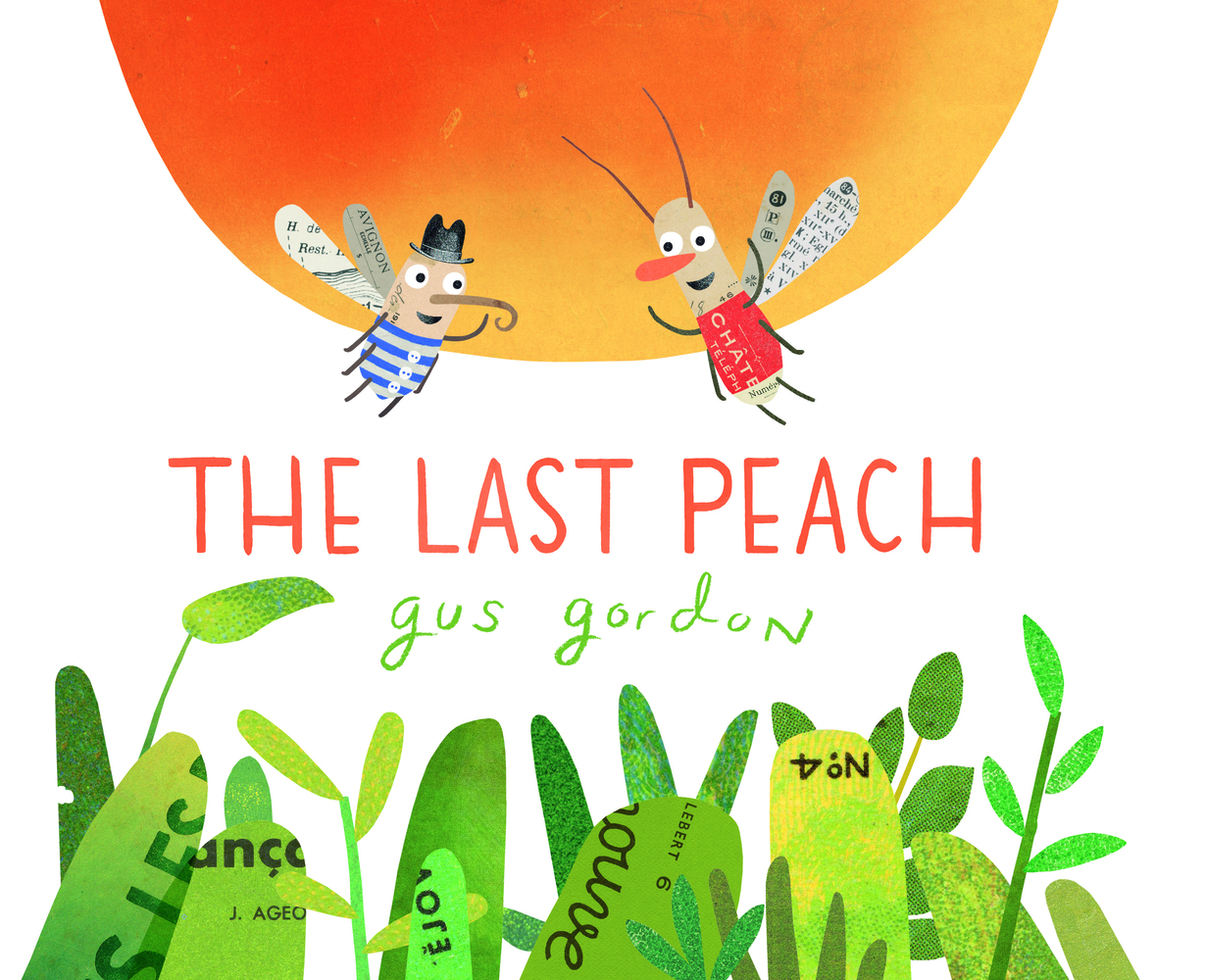
When faced with a last item, the situation is more complicated when appreciation turns into desire and that desire is denied for a variety of reasons.  The Last Peach (Roaring Brook Press, April 2, 2019) written and illustrated by Gus Gordon explores this dilemma with considerable insight.  Two bugs find themselves debating multiple issues after their magnificent discovery.

Oh my, now THAT is a fine peach!

Yes, indeed, the finest! 

After extolling the virtues of the peach, the bugs decide it must be eaten . . . immediately.  When they are ordered to stop because it is the final fruit of the season, they pause with reluctance.  This pause is short-lived.  As they are about to consume the peach in earnest, another bug interrupts.  It might only be good on the outside.

The duo reaches an alternative to full-blown consumption, but they talk themselves out of that approach. With their imaginations working overtime, they wonder about the magical qualities of the peach.  They wonder if they should share the peach.  They even suppose what the peach would say if it could speak.

Their musings proceed to over-the-top status when a poem is penned for the fruit.  Quiet, respectful gazing at the peach by both suddenly turns into a bitter feud.  Perhaps only one of them deserves the peach.  As suddenly as the argument starts, it stops.

With the consistency of a swinging pendulum on a clock, the bugs' minds switch back to the beginning.  The perfection of the peach outweighs any of their cravings.  They bid it adieu.  What?!  What kind of ending is this?  A page turn reveals a most hilarious turn of events.


Told entirely in dialogue author Gus Gordon spins a tale replete with some of life's biggest questions.  Through the back-and-forth discourse of the two bugs we see them wrestling with possibilities.  Humor plays a big part in their contemplations.  Here is a passage.

It might be a magical peach!  What if we ate it and could suddenly do magical things?

LIKE FLY! 

YES!

Hang on, we can already fly . . .

Oh, yeah.


Everything about these two insects, when we first see them on the front of the matching dust jacket and book case, depicts hilarious.  Look at their bodies dressed in shirts with one wearing a hat.  Notice their long noses, expressive body positions, and, dare I say it, bug-eyed looks.  Their bodies and the text on the jacket are varnished.

To the left, on the back, a green from the foliage is used as the canvas.  Within a small circle the duo is looking directly at readers. Their arms are lifted in greeting.  On the opening and closing endpapers, artist Gus Gordon has illustrated in three rows of six, left to right, eighteen peaches.  They appear lifelike and as if categorized in a botany catalog.  They are gorgeous.

On the verso a red beetle (with seven legs) stops above the informational text and under the dedication.  On the right, the last peach hangs from the top of the title page above the text.  Rendered in predominantly collage, the illustrations, with the exception of two wordless, double-page pictures, are full-page visuals on the left.  The narrative is placed on the right.

During their conversations, to emphasize pacing and emotional moments, the points of view shift from image to image.  We are taken very close to the bugs; only seeing the upper portion of their bodies.  We are then given a wider scene including branches, leaves, flowers and the peach.  Readers will enjoy seeing other bugs come and go in the illustrations.  One might be wearing a hat, a bow tie, eyeglasses or overalls.  It's interesting to observe the red shirt of the one bug from picture to picture.

One of my many favorite illustrations is a wider perspective of the two bugs and the peach.  Rounded, oval-shaped leaves frame the sides.  Leaves and flowers stretch from the bottom of the page.  That red beetle is crossing a large leaf along the bottom.  Nearly in the center and extending from the left side is a long leaf.  The companions are standing on it with their backs to us.  Deep in a discussion, they look at the peach, a portion hanging down from the top.


It is easy to imagine the laughter resonating in the room when The Last Peach written and illustrated by Gus Gordon is either read silently by one or listened to by many during a storytime.  Be sure to read it using voices.  It invites creative drama either as a readers' theater or a puppet show.  You'll want to have a copy of this on your personal and professional shelves especially for a theme on decisions, perspective or insects.

To discover more about Gus Gordon and his other work, please visit his website by following the link attached to his name.  Gus Gordon maintains an account on Instagram.  At the publisher's website you can view interior images.  Gus Gordon is interviewed at Kids' Book Review, and Creative Kids Tales.