Quote of the Month

When love and skill work together, expect a miracle. John Ruskin


Showing posts with label Susan Hood. Show all posts

Wednesday, December 8, 2021

One Is Never Lonely

When you define one according to Merriam Websterit is being a single unit or thing.  So, this morning one school librarian walked her dog along one route in one town.  If you really think about it, is that the whole truth?

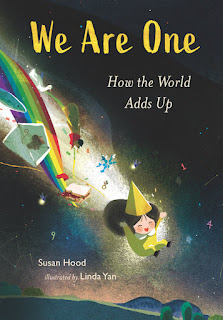
Is there more to the one school librarian, her one dog, their one route, and the one town in which they reside? Author Susan Hood and illustrator Linda Yan believe there is.  We Are One: How the World Adds Up (Candlewick Press, November 2, 2021) introduces a variety of mathematical concepts and expands our perspectives at the same time.  This is what makes our world so marvelous!
One can be one thing
all on its own---
one star,
one stream,
one stick,
one stone.

But those on their toes, those using their smarts,
know one can be more than the sum of its parts.

Our views are broadened one number at a time.  How many combinations of two can you imagine that equal one?  How many slices of bread make one sandwich?

Number by number, three, four, and five allow us to see how combinations of each can make one.  A haiku poem is formed with three lines.  How many points are there on a single compass?  Famous author Williams Shakespeare determined each of his plays would have five acts.

A way for the blind to see incorporates the number six.  The next time you look at a rainbow what number will come to mind?  What geometric shape has eight sides?

This numerical journey ends with nine and ten, but there is more to consider.  We know we are one individual human being, but are we not part of an ever expanding number beyond ten?  Numbers grow larger and larger when we go beyond our family, our workplace (school), our community, our country and our Earth.  And yet, that greatness, that vastness, comes back to the beginning.


We are joyfully welcomed into this counting realm with rhyming couplets meticulously penned by Susan Hood. We are skillfully presented with multiple parts that equal one.  On each page recounting these truths is more information.  Along the bottom like a conversational aside, Susan Hood supplies us with fascinating facts relative to the number being discussed. (These are in a golden yellow band.)  Here is a passage.

Three letters together spell out the word you!

Letters add up to words.  Words add up to sentences.  Many stories and poems follow the rule of
three, a writing principle that suggests characters and events are more satisfying when they come in
threes.  Just think of "The Three Little Pigs" and "Three Billy Goats Gruff."  From a three-ring circus to
the three primary colors, the rule of three (omne trium perfectum in Latin) says trios equal perfection. 


The digitally rendered illustrations by Linda Yan first seen on the matching dust jacket and book case elevate the happiness radiating from the text.  The image on the jacket and case stretches from the far left edge on the back to the far right edge on the front.  Multiple elements mentioned in the narrative and pictorially interpreted page by page spill from the top of the far-left corner in a trail of stardust behind our guide dressed in yellow.  Numbers tumble down from this pathway, falling to the rounded horizon.  Those elements and the main character are varnished on the jacket; making a stunning contrast to the dark atmosphere.

The opening and closing endpapers are covered in a bright sea green.  On the title page, the child wearing their yellow suit and pointed hat is standing on a stool on a rounded surface.  Colored building blocks are scattered about them.  A tripod holding a telescope is directly in front of them.  The dark sky holds tiny colored numbers like stars.

Two-page pictures and full-page visuals flawlessly flow from beginning to end.  Careful readers will see elements in one illustration appear in the next one or two or three or four.  The sandwich mentioned in the number two sequence is next to the child in the first image.  That sandwich is carried away by two mice into their hole.  It is the food for their wedding reception.

Linda Yan, complementing the text, brings us close to a particular scene when necessary or moves back to give us a larger view.  We see the mice carrying the sandwich to their hole from a distance, back with the child.  In the next image, she is peeking through the mouse hole.  We are brought close to the mice as they marry.

Readers will delight in seeking the child in each picture.  Sometimes she is larger than life, and other times you have to search for her.  Toward the end of the book, the child is joined by other children of diverse ethnicity and genders.  Total bliss resonates.

One of my many favorite illustrations is for the number five and the reference to five moves central to ballet.  We are inside a dance studio.  Light beams in three arched windows along the upper portion of the picture.  In front of the windows are a bluebird (large), a giraffe, a fictional character, a red squid, and pig.  They are all wearing ballet slippers and tutus as they demonstrate the five poses.  Our guide, still wearing her signature yellow, also has a tutu.  A musical score with notes is behind her as she runs across the wooden floor.


As soon as you understand the rhythm of the words written by Susan Hood and the accompanying artwork by Linda Yan, you will find yourself wondering what will be revealed with the next page turn in We Are One: How the World Adds Up.  You won't be able to stop thinking of other numbers.  How much fun is that?!  At the close of the book are Source Notes, Sources and Resources, Especially for Kids (sections expanding on the facts given in most of the numerical discussions), and More About How the World Adds Up:  Here are some other things that come in groups of . . . Under each number beginning with ten are lists to get you thinking.  I know you'll want to have a copy of this book in both your personal and professional collections.

By accessing their respective websites, following the link attached to their names, you can discover more about Susan Hood and Linda Yan and their other work.  Susan Hood has accounts on Facebook, Instagram, and Twitter.  Linda Yan has an account on Twitter.  At Penguin Random House, you can view interior images.

Wednesday, May 22, 2019

Out Of Darkness

We are captivated by events in our communities, cities, states and country, some more than others as a result of personal connections.  We have, along with many others, felt much joy and deep sadness, laughed until we cry and wept uncontrollably and known unbearable loss. As citizens of the world, we find ourselves missing a lot of happenings but some capture not only our attention but the attention of people around the globe.  We watch and feel with a collective consciousness.

One event, lasting eighteen days, kept the world riveted to any available access to the news.  Titan and the Wild Boars: The True Cave Rescue of the Thai Soccer Team (Harper, an imprint of HarperCollinsPublishers, May 7, 2019) written by Susan Hood and Pathana Sornhiran with illustrations by Dow Phumiruk is a moving, memorable and accurate account of those eighteen days.  Once you begin this reading the words and pictures will hold you fast until the final page. 

Like his friends in Mae Sai and many kids in Thailand, eleven-year-old Chanin grew up obsessed with soccer.  He started playing at age six and joined the Wild Boars team a couple of years later.

Nicknamed Titan by his family, Chanin is a fierce competitor despite his small size.  His commitment to the sport is obvious in his training and in his saving for his own new shoes.  On June 23, 2018 after a Saturday soccer practice, Titan's life and the lives of eleven other players and their coach change drastically.  They decide to hike inside a cave six miles from the practice field.  Monsoon season has not started, so they believe they are safe.

Unbeknownst to the thirteen, the rains start in earnest while they are exploring.  Upon turning around to go back to the entrance, they find the tunnel flooding with water.  Coach Ek leads them to a ledge farther into the cave.  The boys pray.  Their coach offers assurances.  He asks them to turn off their flashlights.  It is completely dark.

The news of the missing boys and their coach being trapped within the cave sends shock waves around the world.  Helpers and experts in diving and rescue, numbering in the thousands, come from many countries.  Pumps are put in place to try to lower the water levels. People search for other possible entrances and exits to the cave with no luck.  Inside the cave, Coach Ek teaches the boys meditation to help calm them.  They try to sleep on the rocky spot, drink water dripping from the ceiling, dig through the cave walls and try not to think of their constant hunger.  Day five comes and goes.

Divers are trying to locate the boys and their coach.  The water current is swift and dark with stirred-up silt.  The temperature is bone-chilling.  Dangers lurk in the form of mudslides, huge boulders (house size) and narrow passages.   They set up guidelines along a pathway and leave spare air tanks at selected positions.  After ten day . . . ten days . . .Titan and his teammates hear something.  It's two divers!

In each of the succeeding days, divers make the arduous journey to the boys.  Communications are exchanged between the trapped and their waiting families.  More supplies and equipment arrive to assist in the rescue but on day fourteen tragedy strikes. 

Petty Officer First Class Saman Kunan, a thirty-eight-year-old former Thai Navy SEAL diver and volunteer

dies on his way back to the entrance.

Time is running out for the boys; more rain is coming, and their air supply is diminishing.  Did you know four divers stayed with them until all the boys were rescued?  Did you know how the boys are prepared to be rescued?    Did you know only four were rescued each day?  This factual narrative reads like an action-packed thriller regardless of the facts we know about the outcome. 


Written with meticulous care by Susan Hood and Pathana Sornhiran, a journalist born and raised in Thailand who reported outside the cave last summer, readers are given a sensory and intimate perspective of the trapped boys and their coach and the efforts of all those gathered to save them.  In telling this nonfiction narrative by focusing on the youngest member, Titan, we become keenly aware of each portion of the event as it unfolds.  Through a blend of prose and poetry we feel as though we are in the cave with the boys and the divers. 

Tension builds as the days are divided into sections divulging what occurs inside and outside the cave.  What becomes abundantly clear is the courage and determination of everyone involved.  Including letters from the boys and correspondence from their families heightens our involvement.  Quotes from The Buddha are included.  (Coach Ek was a novice at a monastery for ten years.)  Here is a poetic passage in part and some narrative text.

TRAPPED!
Stone-cold water
whirling, swirling
sounds of falls
echoed off the walls
smells of mud, sweat, fear
dank humid air
closed in like the jagged rocks
above and below
hunger pains
endless rains
poured
down 
 down
  down 
   underground.

Narrow passages in the rock (one only fifteen inches high) obstructed
progress; the divers could not fit through with their air tanks.  Hours went by,
and each time the tanks ran low, the divers couldn't just surface to breathe.
They were forced to turn back.
Where could the boys be? the divers wondered.  How would they find
them?  And after so many days without food, could they still be alive?


It is with a sense of growing anticipation that we look at the matching dust jacket and book case rendered using pencil, charcoal, and ink sketches and Photoshop to create the digital illustrations by artist Dow Phumiruk.  We are led into the cave through the glow of flashlights (torches) by the boys.  We can see the excitement and curiosity reflected on their faces.  To the left, on the back, on a green canvas a large circle frames the faces of the boys lying in a circle, head to head, with a soccer ball in the center.  Colorful folded cranes sent by well-wishers flutter from left to right and bottom to top.

On the opening and closing endpapers using orange on a paler orange Dow Phumiruk has drawn a map of the cave entrance to the place where the boys are found.  It gives us a visual perspective of the distance between points, stations and pertinent notes as well as a list of the divers and their locations.  Distances are in meters.  On the title page we see the boys riding their bikes to the entrance of the cave.  Our point of view is as if we are inside looking out.  The verso and dedication pages are a vast landscape view of the area; mountains, fields, roadways and, in the scheme, the small entrance to the cave are shown.  The placement of clouds hint at the humidity.

With each illustration, whether a double-page picture, full-page image or several visuals gathered together on one or two pages, Dow Phumiruk brings us deeply into the emotional moments of this story.  We sense the urgency of the rescuers' endeavors and the stress faced by the boys and their coach.  She shifts perspective to accentuate each portion of the story.  Every element is placed in her illustrations with intention.

One of my many, many favorite illustrations spans two pages.  Darker colors are used here as we are inside the cave.  On the right two divers each carry a single boy with them to safety.  Along the bottom, on the left and right, almost in silhouette, are a series of divers and rescue workers assisting in helping the boys.  Above this on the right sits Titan and his coach, wondering if they will be saved.  Behind them are the other three boys waiting to leave the cave.  They are the last to leave.  The only light is supplied by head lamps and a large lamp on solid ground above the water.  It's important to note that Dow Phumiruk uses the color in the boys' soccer shirts to add, in my opinion, hope.


Without hesitation I highly recommend Titan and the Wild Boars: The True Cave Rescue of the Thai Soccer Team written by Susan Hood and Pathana Sornhiran with illustrations by Dow Phumiruk for your professional and personal collections.  You will find yourself moved to tears more than once at the bravery and teamwork exhibited by these humans.  I am grateful for the collaborative efforts of Susan Hood, Pathana Sornhiran and Dow Phumiruk to bring this story to us.  At the close of the book is More About the Cave Rescue, Fascinating Facts, The Wild Boars, Stateless No More, Legend of the Tham Luang Nang Non Caves, a Timeline: June to July 2018, an Interview with British Divers Chris Jewell and Jason Mallinson, words about Saman Kunan and Sources and Interesting Websites.

To learn more about Susan Hood and Dow Phumiruk and their other work, please access their websites by following the links attached to their names.  Susan Hood has accounts on Instagram and Twitter.  Dow Phumiruk has accounts on Instagram and Twitter.  The book trailer premiere along with interviews is found on Scholastic's Ambassador of School Libraries John Schumacher's site, Watch. Connect. Read.  At Mile High Reading the site of Dylan Teut, director of the Plum Creek Children's Literacy Festival in Seward, Nebraska, there is an interview with Susan Hood and Dow Phumiruk.  Pathana Sornhiran was traveling in Asia for her work at the time.  You can read portions of the beginning of the book at the publisher's website.


To view the other titles selected this week by participants in the 2019 Nonfiction Picture Book Challenge, please visit Kid Lit Frenzy hosted by educator Alyson Beecher.


Thursday, March 8, 2018

Champions . . . Every Single One

You want to stand up and cheer.  It's as if everything you are taught to believe, everything you feel in your heart, is true.  Their accomplishments are an inspiration.  Their accomplishments changed and continue to alter conventional thought one woman at a time; bringing hope to other women then and now.

They dared to be different fueled by their knowledge and faith in themselves.  Shaking Things Up: 14 Young Women Who Changed The World (Harper, an imprint of HarperCollinsPublishers, January 23, 2018) written by Susan Hood with illustrations by Selina Alko, Sophie Blackall, Lisa Brown, Hadley Hooper, Emily Winfield Martin, Oge Mora, Julie Morstad, Sara Palacios, LeUyen Pham, Erin K. Robinson, Isabel Roxas, Shadra Strickland and Melissa Sweet is a poetic and artistic tribute to young women of distinction.  As you read the final poem graced by distinguished artwork, you might, as I did, wonder about a dinner with all these women in attendance.  Can you imagine the conversations? 

Women and girls have been shaking things up for a long time, resisting those who would box them in.  Here are fourteen inspiring young rebels (one just six years old, another only thirteen) who broke down walls to pursue their interests, talents, and rights.

After the introduction a table of contents lists the women by name in chronological order with one of thirteen different female illustrators paired with them.  First a timeline features the women beginning in the early 1780s with Molly Williams and closing in 2014 with Malala Yousafzai.  Included are World War I, the 19th Amendment, World War II, the United States Supreme Court decision finding public school segregation unconstitutional, and Title IX. 

Molly Williams, a servant of a volunteer firefighter, took it upon herself to battle a blaze in New York City.  It's shocking how long it took for another female to win the right to join the fire department.  Stricken by poverty at the death of her father another young woman at the age of thirteen discovered the bones of an ichthyosaur.  This woman defied the title of a novel, even meeting the author, to set a record for traveling around the world.  

A woman was arrested for her scandalous swimwear but went on to win awards.  Another broke barriers in public libraries inviting Spanish-speaking patrons through her story times and celebrations of their customs.  Repeated physical tragedies did not deter this Mexican artist from achieving worldwide fame.

The Nearne sisters, Jacqueline and Eileen, entered by parachute and plane war-torn France occupied by the Germans to assist the resistance.  She was only twenty-seven but her book, Diet for a Small Planet, altered thinking and is as relevant today as it was in 1971.  Many readers will know about Ruby Bridges but will they know she never missed a day of school with the same teacher in a classroom for one.

How many astronauts have a medical degree?  How many of them were the first female African American astronaut?  Mae Jemison does and she was.  Her vision, made into a reality, is seen by millions of visitors each year.  At seventeen her invention won her a coveted prize.  Fighting back after an assassination attempt on her life, Malala Yousafzai, like the other thirteen women, knows one person, one woman, can alter history for the better.


There are poems with rhyming words on lines two and four.  Others form the shape of an element in the poem (concrete).  Another one is composed of alternating four and two lines, rhyming in a rhythm.  A special cadence is created with two lines rhyming, the next two rhyming and the fifth rhyming with the first two.  To showcase Pura Belpre, author Susan Hood describes her using the letters of the alphabet, top to bottom.  Carefully chosen, each poetic style is a reflection of the woman.  Susan Hood presents a small factual paragraph at the bottom of each page including the birth and death dates.  Six of the women are still alive.  Here is the first verse from the poem about Annette Kellerman, Champion Athlete and Inventor of the Modern Swimsuit.

Turning The Tide
There was once a mermaid queen,
lovely and lithesome and lean,
who swam afternoons
without pantaloons---
her swimsuit was deemed obscene!


Each illustrator brings her remarkable and notable technique to this title.  On the opened dust jacket, the art of Oge Mora depicts a small child, Ruby Bridges, bravely entering school.  To the left, on the back, on a canvas of white, a delicate portion of one of the images for Pura Belpre by Sara Palacios is placed.  A songbird is carrying a flower in its beak, one of many on and floating above the pages of a book. (Those same flowers are part of a pattern on Pura Belpre's dress she wears during an animated story time.) The book case is a beautiful pattern consisting of tiny replicas of the full page pictures for each woman by these illustrators.  The opening and closing endpapers are a light shade of turquoise.

The illustration by Oge Mora seen on the dust jacket front is extended for the verso and title pages.  Shadra Strickland boldly portrays Molly Williams working along with the other firefighters in the dead of winter, including historical details.  Mary Anning is shown digging up bones in a color palette of blues, black, white, and tan by Hadley Hooper.  Fine lines are etching out the elements.  Nellie Bly stands on the bow of a ship, valise next to her.  Lisa Brown has placed the monkey she brought home from her travels on her extended arm.  There is an air of determination in Nellie's stature and on her face.

The soft and delicate texture and brush strokes of Emily Winfield Martin give readers the right atmosphere for Annette Kellerman, swimmer extraordinaire.   Frida Kahlo appears to be looking right at the reader as she stands tall, paint brush in hand with monkeys keeping her company.  Erin K. Robinson brings Frida Kahlo to life with her bold hues and textured art.

Sophie Blackall cleverly inserts the items carried by Jacqueline Nearne in a picture showing her floating toward a patchwork landscape in France.  Her hues are tans, browns and grays.  In her signature collage Melissa Sweet features Frances Moore Lappe driving a truck.  In the bed rests the planet covered in fruits, flowers and vegetables.  The innocence of a brilliant girl with a vision is embodied in the work of Isabel Roxas.  She shows Mae Jemison standing in front of a blackboard drawing her dreams.

By showing Maya Lin standing in front of the Vietnam War Memorial, snow falling on the already snow-covered ground, we get a true feeling for the sensory experience she designed through the art of Julie Morstad.  A row of footprints line the length of the memorial to where she stands. (This is one of my many favorite illustrations.)  LeUyen Pham enhances the poem about Angela Zhang giving us a view of her youthful face, happy and holding a book.  Above her are representations of chemical structures along with a computer screen and keyboard as other elements.  For the final illustration Selina Alko uses shades of red to indicate warmth and boldness of her subject Malala Yousafzai.  Around Malala, centered on the page, are the faces of women from around the world.

For each of these fourteen women each artist includes, in addition to the main single page picture, smaller images on the facing page with the poem.  Many of them enhance the words of the poem.  Others serve to further highlight specifics about the women.


Your spirit will be lifted and your heart will be full after reading Shaking Things Up: 14 Young Women Who Changed The World written by Susan Hood with illustrations by 13 extraordinary women, Selina Alko, Sophie Blackall, Lisa Brown, Hadley Hooper, Emily Winfield Martin, Oge Mora, Julie Morstad, Sara Palacios, LeUyen Pham, Erin K. Robinson, Isabel Roxas, Shadra Strickland and Melissa Sweet.  This blend of poetry and stunning artwork should be a part of every professional and personal collection.  It invites all readers to explore their lives further.  At the close of the book are an author's note, sources, books, websites and more and acknowledgements.  

To learn more about Susan Hood and each of the illustrator's and their other work, please visit their respective websites by following the links attached to their names.  At the publisher's website you can read an excerpt. At Scholastic's Ambassador of School Libraries, John Schumacher's blog, Watch. Connect. Read., the book trailer is revealed.  The interview is a must read before you read this book and before you booktalk it.  Teacher librarian Matthew Winner invites Susan Hood to chat with him at All The Wonders, Episode 420.


Please take a few moments to visit Kid Lit Frenzy hosted by educator Alyson Beecher to view the titles selected this week by others participating in the 2018 Nonfiction Picture Book Challenge.


Wednesday, June 28, 2017

Look Once And Look Again

If you've ever been a student or an observer in an art class, you know every single participant, when asked, will recreate the same setting differently.  We all see identical elements with new eyes.  We all have our own specific style.

You would think we might be able to come to an agreement on opposites.  It seems pretty cut and dried but when you add perspective to the conversation clarity shifts.  Double Take!: A New Look at Opposites (Candlewick Press, June 13, 2017) written by Susan Hood with illustrations by Jay Fleck encourages readers to broaden their thinking.

Do you know opposites?
YES or NO?

If I say STOP,
you say GO.

For the following five pairs, it seems simple.  The opposite of sleep is awake.  Day and night are at the beginning and end of a day.  There is no debate on these concepts.

As the narrative continues we are presented with a puzzle. How does the label small apply unless there is something bigger?  The same idea can be applied to height and speed.  It's all about comparisons.  A human is slow to a cheetah but a human is speedy to a turtle.

If you have several points on a line, how can one change from being far to near?  Sometimes a common object can look rather abstract when you are as close to it as possible.  If you move away, it looks more natural. Each time you take a picture you can experiment with this altered outlook.

What you need to do is put yourself in someone else's shoes, looking at the world with a new view.  Someone's up might be another one's down.  How many examples can you identify with opposites adjusted?


Concept books are an important form of children's literature but rarely do they challenge readers by inviting them to think outside what is ordinary (or inside the extraordinary).  This is masterfully done by Susan Hood through easing from the obvious to the more complex. The cadence created by her rhyming word choices create a path readers are willing to follow. Here are two more passages.

HIGH might look hazy
until we see LOW.

A racer's called FAST
when rivals are SLOW.

Now just when you think you've mastered that notion,
watch relative words set matters in motion.


Rendered digitally the illustrations throughout this title pair wonderfully with the lively inviting text.  On the matching dust jacket and book case debut picture book illustrator Jay Fleck  introduces us to not only to characters seen on every page turn but to the potential of what can appear when we look more than once.  On the front the reflected image is varnished.  To the left, on the back, on a lighter background two flowers in pots ask us to think about big and small, tall and short, and high and low.  Readers will want to keep their eyes open in order to spot the frequent appearance of these two other animal friends, a tiny red bird and pale gray mouse.

The endpapers are covered in a coral (muted red) canvas.  This is one of the limited color palette hues; others are blues, greens, yellow, gray, black and a little bit of pink on a two-page picture.  The title page and closing illustration feature a rising (setting) sun on a large body of water; the one with a dock and the other from a boat.  Across the publication and dedication pages is a bird's eye view of a city, an amusement park and the sea.  As the narrative begins we zoom into a portion of the city.

The precise lines, layout and design supply a harmony to the illustrations.  Readers will be unable to resist the boy with his red wagon, the black cat and the blue elephant who accompanies them.  There is a tender quality in these images endearing the characters to readers.  Fleck alternates between single page pictures, two images on a single page and two page visuals.  Readers will be searching for the exquisite details; the open and closed sign on a door, animals in building windows, sweatbands on exercisers, the helmet wearing turtle and animals driving cars in the distance.

One of my many favorite illustrations is when the three companions are seated on a bench in an art museum.  The elephant is between the boy and his cat.  All their heads are tilted to the right studying the picture before them.  It is framed in blue with red, yellow, green and blue looping swirls, dots and dashes.


The narrative and artwork in this title, Double Take!: A New Look at Opposites, written by Susan Hood with illustrations by Jay Fleck is a marvelous blend of simplicity.  Readers will eagerly look for the characters and what they are doing on every page.  It would be fun to think of other opposites and imagine what activity the trio would be enjoying in the images.  You will want to have this book on your professional and personal bookshelves

To discover more about Susan Hood and Jay Fleck and their other work please visit their websites by following the links attached to their names.  You can view interior images on publisher websites here and here.  Susan Hood is a guest writer at Scholastic's Ambassador of School Libraries, John Schumacher's blog, Watch. Connect. Read.   Susan Hood was interviewed at Mile High Reading by Dylan Teut, the director of the Plum Creek Children's Literacy Festival in Seward, Nebraska.    Jay Fleck maintains a blog and has an account on Facebook and Instagram. Jay was highlighted by author, reviewer and blogger Julie Danielson at Seven Impossible Things Before Breakfast.


Take a few minutes to enjoy the titles this week selected by other bloggers participating in the 2017 Nonfiction Picture Book Challege at Kid Lit Frenzy hosted by Alyson Beecher.


Tuesday, May 10, 2016

Springing Into Spring

One of the first sounds signaling a shift in the seasons is the raised voices of spring peepers.  When their symphony shatters the night's silence, it's a song of renewal.  As nature's alarm system their vigilance is unparalleled.  As soon as an intruder is noticed their chorus stops.  Their coloring keeps them very well camouflaged among the forests and nearby wetlands.

If you are fortunate, remain still and quiet for a long time, you may have some of them as youngsters, or one of their relatives, swim about your hands, feet or legs in a nearby pond.  Leaps And Bounce: A Growing Up Story (Disney Hyperion, March 15, 2015) written by Susan Hood with illustrations by Matthew Cordell is another spirited collaboration by the duo who brought us Rooting For You: A Moving Up Story.  For readers' enjoyment we are given pond-side seats in which to view this jazzy journey.

Round and spotted,
polka-dotted,
eggs aboard
a bubble boat---
Watch them dip and dive and float.


This mysterious mass is in motion.  Creatures of this watery world are not quite sure what it is.  Soon those tiny spheres house more than dots.

Tiny dancers twist their way out.  If they could, we would hear them shout!  Every movement made among the wary residents is brimming with mirth.  What's that we see?  First tails and now four legs are growing from baby bodies which began as eggs.

Look closely now, anticipation fills the air.  A difference is expected.  What was there has now departed.

Fully formed frogs plunge down and reach up; the pond is their playground.  These cavorting croakers inhabit continents six.  Dots in circles marvelously modify.


With the same exuberance as her subjects exhibit Susan Hood spins a tale of growth. Her collection of words when read silently or aloud literally zip off the page; alliteration and rhyme combining to bring the essence of all things frog to readers.  Not only do we fully understand the cycle of egg to adult but we are given a glimpse of other creatures making a home in their watery realm.  Here is a sample passage.

Muddy mayhem!
Honks and quacks
alert the newts
and sticklebacks

that just as sure as rivers flow,
changes come to all who grow.


From edge to edge, left to right, the matching dust jacket and book case reveal the shifts eggs, tadpoles and frogs face.  Beneath and above the water from back to front, dragonflies and a duck bear witness to the changes cheerfully embraced. The red used on the text adds to the enthusiasm maintained throughout the book.  On the opening endpapers a large expanse of sky dotted with clouds and a bright sun oversee a few eggs bobbing on waves.  Three smiling, wide-eyed frogs peer above the water's surface as stars share the night sky with a full moon on the closing endpapers.

A two-page image stretches across the verso and title pages.  Most of the scene is beneath the water with a single frog leaping at the top of the center on the right side.  All of Matthew Cordell's illustrations span two or more pages courtesy of numerous fold-outs.  There are three three-page and one four-page fold-outs.

A color palette reflective of the habitat of frogs is used by Matthew Cordell but the specific hues are his signature selections.  The lines and shapes, the comic expressions on the animals and the sheer happy energy in all the illustrations are pure Cordell.  Careful readers will notice a correlation between the lives of the frogs and the time of day shown in the sky.

One of my favorite of many illustrations is for the sample passage shown above.  The peppy tadpoles are swarming through and above the muddy bottom.  Two startled newts have their arms raised in alarm.  A fish is watching all this aghast at the mayhem.  A goose and two ducks are paddle-running on the surface of the water, squawking their dismay.

It's guaranteed when reading Leaps And Bounce: A Growing Up Story written by Susan Hood with illustrations by Matthew Cordell you will be smiling from beginning to end.  The words and pictures are full of a zest for growing and living.  I have not had quite this much fun reading about frogs since I first read Tuesday by David Wiesner.

To discover more about Susan Hood and Matthew Cordell please follow the links attached to their names to access their websites and Cordell's blog.

Thursday, March 20, 2014

Inching Upward!

The calendar may say spring has arrived but this morning I heard the grinding scrape of the plow along my cement drive after the snowfall last night.  Later walking with Xena I sunk into the snow over my knees in the backyard.  I have to hope green is peeking through the brown or maybe even through the last remnants of snow cover somewhere.

All those seeds blown about in the fall from plants, shrubs and trees certainly must be getting ready to make an appearance.  Or maybe not.  Rooting For You: A Moving Up Story (Disney Hyperion Books, March 11, 2014) penned by Susan Hood and pictures by Matthew Cordell chronicles the growth of a single reluctant seed.

I am NOT coming out!

There you have it, the latest news flash from deep underground.  Someone wants to stay right where they are.  Who knows what dangers are lurking in the dark?  What's that you say?  Now you're bored?

Well, that certainly changes everything.  Out bursts a root first.  Hmmm... That's not so bad. Next on top a shoot appears.  A close encounter with a rock prompts a sympathetic reply from a nearby friendly worm who offers to act as a guide.

It quickly becomes obvious the sprouted seed is surrounded by supporters.  Ants and beetles begin to call out words of encouragement.  Oh...oh...wait a minute.  Who knows what dangers are lurking in the light?

Not to worry, the worm speaks words of wisdom.  It's time to go up....up...and up some more.  From seed to root to sprout, give a shout...you made it out!


With spare text, at times conversational or with a rhythmic rhyme, Susan Hood gives readers the inside scoop on the world below and above ground.  The seed in all its stages, the wise worm and buggy friends all have their say.  Hood's words evoke the right amount of emotion to elicit reader attachment to all the characters; snickering snouts, stick by your side, friends all around, getting scared or talent to share.  Here is a sample passage.

With room to bloom,
to stand up straight.
Get going, get growing!
Your whole life awaits!


There is a certain something about the illustrations of Matthew Cordell which makes me smile.  Opening the matching dust jacket and book case, it's particularly pleasing to see the visual extend from one edge to the other.  (I really like the attention to detail; the seed representing the "o" in you.) A cheerful, colorful palette in delicate sunny shades is showcased above ground.  In the cutaway, giving readers a seed's eye view underground, warm rich browns, purple, pinks and a bright spring green color this world.  On the opening endpapers the single tiny seed is tucked in the lower right-hand corner looking a tad woebegone in its earthy home. All the buggy friends in their circular abodes and on their trails are portrayed on the closing endpapers.

Cordell continues his theme on the verso with ant-filled dirt loops.  On the title page the worm, wearing glasses, of course, is cleverly attached to the "f" in for.  On the first two pages readers are greeted with the solid spring green and three lines.  These represent an emphatic seed at close range.

In a brilliant feat of engineering as the seed sends out a root and a sprout, readers open a vertical page first, then a horizontal flap.  It's great fun to watch the facial expressions of the seed move to the sprout and finally to the center of the flower (which is a triple horizontal reveal).  To create continuity the nesting spider, the sprout navigates around below ground, is seen on the stem in the sunlight with a web between the petals.

One of my favorite illustrations is the triple horizontal pages unfolding on the right above ground with the underground view on the left.  Readers can see how far the seed has come to find its proper place in the sun.  It's a delightful blend of the narrative and illustrations with perfect pacing and placement of text.  The expressions on the characters and their body movements are as uplifting as the seed's transformation.

This title, Rooting For You: A Moving Up Story written by Susan Hood with illustrations by Matthew Cordell is exactly what we need to welcome in a new season or any new adventure.  I end up grinning every time I read it.  Use voices for the characters, open the numerous flaps with controlled slowness and pause at each picture, pass on the joy to readers that this book evokes on every page turn.  Wouldn't this book be fun to use for a gardening unit or teaching about seeds?

Please follow the links to the author's and illustrator's websites embedded in their names.