There comes a time in your life, hopefully when you are young, when you awake in the morning a sigh of gratitude escapes from your lips. As you step outside into the sun, rain, snow, calm or wind, heat or cold, you look around noticing light and shadow, shapes and angles. You see normal but deep inside you know it's a collection of tiny miracles.
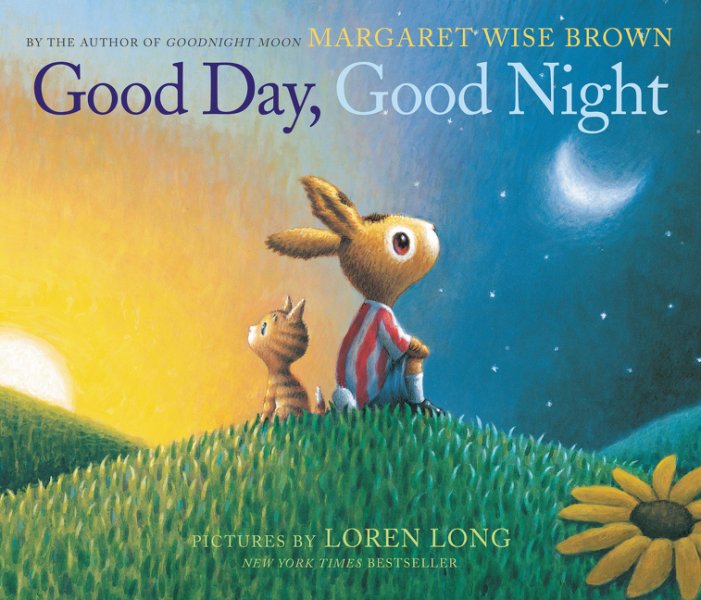
As you move through the hours of the day everything, where you go, the individuals you see and the things you do, reminds you, if you stop for the merest of moments, of the early morning thankfulness. Good Day, Good Night (Harper, an imprint of HarperCollinsPublishers, October 3, 2017) a never-before-published picture book written by Margaret Wise Brown with art by Loren Long is a gentle, affectionate poem of appreciation to the wonder of each and every day.
When the sun came up the day began.
One small soul, a bunny, saw it rise. Greetings rang out, not just to one but to everyone. It was time to bid the darkness farewell.
He looked up and saw the trees. He looked up and saw the birds. Bees busily flew away from their homes high in the trees. The bunny's companion, a tiny kitten, got a cup of milk for breakfast.
The morning was in full bloom. All the residents were asked to look for the wonder in this day. All the residents were asked to give this day their full attention. Live!
Later as the moon rose, another night started. Greetings again rang out wishing creatures a pleasant evening. Now inside the bunny bid his tiny kitten and teddy bear good night. He wasn't quite ready to go to sleep. He made sure inside and outside all those he knew received those soothing final two words. Rest well sweet rabbit.
Margaret Wise Brown in this book lifts simple words into eloquence. The repetition of good morning and good night as the bunny observes his natural world and daily surroundings supplies readers with a soothing cadence. It asks them to find the same joy as the bunny does. It's a lullaby. It's a prayer. It's masterful and beautiful.
The same tender, lasting charm we feel reading the words written by Margaret Wise Brown is elevated by the art of Loren Long. The two friends, the tiny kitten and bunny each greet the morning and the evening. The blend of the two parts of the changing skies is flawless. Notice the light and shadows on the grassy hill. See how the glow of the sun and moon highlights the characters' faces. I don't know about you, but I want to sit on that hill with them. To the left, on the back, the golden yellow from the sunrise provides a canvas for a tiny bee and Monarch butterfly facing each other.
Beneath the jacket on the book case, Loren brings the sunrise closer to us on the front and the night sky also closer on the left. To have them opposite of their appearance on the jacket signifies a continuum. A lush rolling landscape with a river winding through the created valley spans the opening endpapers. The sky shifts from deeper purple to pale lavender and then golden yellow as the sun rises. A single large tree sits in the open on one of the hills on the right side. It is the base from which the rabbit town radiates. On the closing endpapers night has fallen on the same scene. Tiny pinpricks of light are seen around the tree. Without a word being spoken the color palette for both of these says, "Hush, dear readers."
Rendered in acrylics on illustration board each image beginning on the title page, tells a story. Beneath the text, the bunny sits up in his bed, holding his teddy bear, and sees the sun rising through his bedroom window. All of the two-page pictures placed on matte-finished paper have a classic timeless quality. All are shown in full color but four are placed on a crisp white background.
The brush strokes ask us to reach out and feel the soft texture they emulate. The exquisite details ask us to stop and look at each picture carefully. Do you see the tiny mouse in the window of the bunny's house as he greets the day? The name of the newspaper another rabbit brings to homes is the Daily Warren. The Harey Dairy truckbrings milk. During the morning two ladybugs walk along a branch. At night they are tucked under the bird's nest. The caterpillar seen in two illustrations happens to be a Monarch caterpillar. Do you recognize the book one bee is reading to another at bedtime? You can't help but smile when you realize why there are two holes in the roofs of the vehicles. The bookends and bedside lamp in the bunny's bedroom are delightful. Careful readers will spy the mouse again. They will also recognize the spelling on the wooden blocks.
It's nearly impossible to select a favorite illustration. They all are gorgeous. One of my favorite pictures is when the bunny is getting ready to go to bed. The use of green, yellow and red is predominant on the furnishings and window frames. You realize where the flowers the bunny picked earlier have been placed. It seems as if his toy animals are watching him pet the tiny kitten on his bed. His teddy bear wearing a straw hat is ready for bed, sitting and waiting in the rocking chair. A fire burns in the stone fireplace hearth. (I would love to hang this picture on my wall.)
You will most definitely want to add Good Day, Good Night written by Margaret Wise Brown with pictures painted by Loren Long to your personal and professional collections. This is a book to have at your bedside to read when you first wake up and right before you go to sleep. It casts a spell of contentment and calm.
To learn more about Margaret Wise Brown and Loren Long and their other work, please follow the links attached to their names to access their websites. Loren offers looks at his process for this title on his website. Enjoy the book trailer and Loren's video about this book.
For quite some time I've been toying with the idea of starting a series using picture books, each one with a common theme, which combine older titles with recent titles. When you've had the opportunity to read many books over decades, it's interesting to see patterns and to pair similar books together. When participating in the Picture Book August 10 for 10this past summer, I wrote about and selected titles highlighting the welcome quiet at the end of the day when parents, guardians and caregivers can share books at and about bedtime with children. Here are seven recommended titles, three more than twenty-eight years old and four released within the last six months of 2015.
Goodnight Moon (Harper & Row, 1947) written by Margaret Wise Brown with illustrations by Clement Hurd
You have to stop and wonder how many times this book has been read to children in the past sixty-nine years. The first four lines refer to colors and well-known objects and the next several phrases focus on nursery rhymes and a fairy tale. There is comfort in the familiar. A rhythm is established with the repetition of goodnight followed by listing items inside and outside the room. It's a lullaby of gratitude.
In the great green room There is a telephone And a red balloon And a picture of---
Bright primary and some secondary colors on double page images alternate with shades of black, gray and white used in single page pictures loosely framed using a liberal amount of white space. The pictures on the wall, the kittens playing with the yarn and the crackling fire create a mood of serenity. The adult rabbit knitting in the rocking chair, staying in the room until the bunny falls asleep brings a sense of safety and love to the story.
There have been numerous parodies and critical observations about this book but the fact remains it is and always will be a timeless classic.
The Napping House (Harcourt Children's Books, 1984)written by Audrey Wood with illustrations by Don Wood
As rain falls outside it's quiet in the house; all are sleeping. A granny, a child, a dog, a cat, a mouse and a flea doze without the apparent knowledge one is stacked upon the other until the final tiny being does what comes naturally; bites the mouse. One after the other reacts to the scaring, clawing, thumping, and bumping. A broken bed, laughter and a rainbow signal a change in more than the weather. A cumulative tale builds throughout with one sentence added to the next. Audrey Wood knows how to tell a story supplying gentle tension and a delightful resolution.
There is a house, a napping house, where everyone is sleeping. And in that house there is a bed, a cozy bed in a napping house, where everyone is sleeping.
Rendered in oil on pressed board the illustrative work of Don Wood in hues of blue progressing to the golden light of a sunny day is brimming with energy and humor. The varied positions of the sleeping granny, child, dog, cat, and mouse along with their facial expressions are sure to generate giggles and grins. When they each start waking up expect to hear guffaws. Careful readers will notice the flight of the flea.
Follow the link attached to Audrey Wood's name to access information about the work of Audrey and Don Wood at their website. Here is a link to Harcourt containing an interview with Audrey and Don Wood. At Carol Hurst's Children's Literature Sitethere are discussion topics and activities regarding this title.
Can't You Sleep, Little Bear? (Candlewick Press, 1988) written by Martin Waddell with illustrations by Barbara Firth
After a day of playing outside Big Bear is ready to read his Bear Book in his cozy chair by the fire. In the darkest part of the cave he has tucked Little Bear into bed. Little Bear is not one bit tired and he is afraid of the dark.
Three times Big Bear goes to the lantern cupboard getting increasingly bigger lights to dispel the darkness. Each time he is a few pages closer to the good part of his book. When Little Bear admits to being as uneasy about the night, Big Bear takes him outside.
Final lights in the night, wise words and warm arms work their magic. Martin Waddell uses a repetition of key phrases to invite readers to participate in the story. The conversations between Big Bear and Little Bear are genuinely adorable.
"Can't you sleep, Little Bear?" yawned Big Bear, putting down his Bear Book (with just four pages to go to the interesting part) and padding over to the bed. "I'm scared," said Little Bear. "Why are you scared, Little Bear?" asked Big Bear. "I don't like the dark," said Little Bear. "What dark?" asked Big Bear. "The dark all around us," said Little Bear. "But I brought you a lantern!" said Big Bear. "Only a teeny-weeny one," said Little Bear. "And there's lots of dark!"
The illustrations rendered in watercolor, ink and pencil with the exception of three double page spreads, edge to edge, are framed in rounded arches, as if we are looking inside the cave. Some elements in the images break the lines to give a sense of openness. The antics of Little Bear in the bedroom are completely endearing. Readers will be drawn to the realistic items in the living room and Little Bear's bedroom.
Here is a link to a page created by Candlewick Press where Martin Waddell and Barbara Firth talk about their work on all the Big Bear and Little Bear books.
Ask Me (Houghton Mifflin Harcourt, July 14 2015) written by Bernard Waber with illustrations by Suzy Lee
This story takes us on a day long jaunt shared by a father and his daughter. We stroll through a park and past a pond filled with geese. We look closely at butterflies flitting among flowers. We visit a small carnival and a playground. As they romp and rest among the leaves, our understanding grows. At the close of day their conversations continue as she gets ready for bed, is tucked in and good nights are exchanged.
Told through a series of questions and answers Bernard Waber takes an ordinary day lifting it into the realm of marvelous. The freedom felt by the daughter to begin with
Ask me what I like.
and her dad's willing response
What do you like?
allows us to see the special bond between them. Their chatter is like listening to a symphony.
Ask me what else. What else? I like rain. I like splishing, sploshing, and splooshing in the rain. Splishing, sploshing, and splooshing. I like those words. They're rain words. I made them up.
I know. Suzi Leebegins and ends her illustrations rendered in pencil on the opening and closing endpapers. We first see the father putting on a hat and his daughter putting on her coat in their entryway. At the close both pages are filled with fireflies, one of the girl's favorite bugs. Her color palette is introduced on the matching front dust jacket and book case and continued throughout the book filling the pages with affection and the brilliance of the season. All of the pictures cover two pages except for one. Perspective shifts to match the importance of the narrative.
To discover more about Bernard Waber and Suzi Lee and their other work please follow the links attached to their names to access their websites.
The Full Moon at the Napping House (Houghton Mifflin Harcourt, September 1, 2015) written by Audrey Wood with illustrations by Don Wood
Without fail if squirrelly behavior is noted in children, dogs or cats, a check of the moon phase calendar will reveal a full one is in the offing. In a companion to their 1984 bedtime classic, Audrey Wood and Don Wood take us back to the napping house. Granny, the child, the dog, the cat and the mouse are sleepless, fidgety, playful, prowling and worried. A wee nighttime visitor pays them a visit reversing the spell cast by the moon.
Using repeating phrases Audrey Wood welcomes us into the luminous atmosphere of a single night. As words are added the activity increases until a pause announces the guest. Verbs follow canceling the effects in a peaceful rhythm.
And in that bed there is a granny, a sleepless granny in a wide-awake bed in a full-moon house, where everyone is restless.
Using open acrylics on stretched and grounded watercolor paper Don Wood begins with a moon rising over rolling hills. As the story progresses you can tell by the look on Granny's face and her eyes, the actions of the child, dog, cat and mouse are driving her a little crazy. Careful readers will enjoy watching the movement of the mouse and the visitor. The use of light and shadow is as masterful here as in the original title.
Beep! Beep! Go to Sleep! (Little, Brown and Company, September 8, 2015) written by Todd Tarpley with illustrations by John Rocco
A pajama-clad boy moves down the hallway with his three robot pals to get ready for bed. After scrubbing up in the bathroom it's time for all four to snuggle and sleep in their individual places. The problem is the robots. They simply can't get settled. One mechanical complication after another seems to plague them. Their boy is getting more frustrated by the minute. A trick as old as time works wonders. Mission accomplished! No more beeping only sleeping.
Told in rhyme Todd Tarpley lulls us with his words into the bedtime ritual. His use of robotic terms fits as smoothly as a well-oiled machine into the story. By having the automated companions interrupt the boy's rest once, twice and three times before his irritation causes a verbal explosion, the fourth and final request is more surprising and satisfying.
Three little robots, time for bed. Time to dim your infrared.
On the front of the dust jacket readers can readily see the friendship between the boy and his rambunctious robots. To the left, on the back, silhouettes of the three robots are shown jumping on the boy's empty bed with the full moon in the background. The color from one of the robots and the book in the boy's hand provides the canvas for the book case. On the right are the three robot faces. To the left Beep! Beep! appears in large bold letters. The spine is the same pattern as the wallpaper in the home. The opening and closing endpapers are used to introduce and conclude this rollicking romp.
At the close of the book John Rocco talks about the mouse we see on all the pages as being his daughter's idea. This little being ups the hilarity with his liveliness in every scene. Rendered in pencil, watercolor and digital paint the images are warm and reminiscent of the recent past. The decor and items in the home and the style of the robots mirror treasured childhood memories or those worth making.
Please follow the link attached to John Rocco's name to access his website. There you can learn more about him and his other work. He also has additional images from this book at his blog. At Todd Tarpley's blog you can view illustrations and read his comments about this book. Simply follow the link embedded in his name.
Thank You and Good Night (Little, Brown and Company, October 6, 2015) written and illustrated by Patrick McDonnell
As the day closes with a sunset, a wee bunny, Clement, is getting into his pajamas with help from his human friend Maggie. A doorbell ring announces the arrival of two friends, Jean, an elephant, and Alan, a bear. Both are wearing sleepwear. It's time for a Pajama Party!
The three take delight in bed bouncing, learning the chicken dance, participating in a funny face contest and a timeless favorite game, a bit of yoga and treats. They might pause more than once wondering if they should go to sleep but they are having too much fun. There does come a time when their activities are becoming quieter with looking, wishing and listening.
When they ask the question they have been voicing during the evening, Maggie finally says yes. The trio performs nighttime rituals and toddle toward bed. Tucked in tight they listen and then recite their thank-yous before whispering good night. A tender surprise awaits readers.
Patrick McDonnellwrites words that wrap around readers with the cozy comfort of their very own bed. His simple sentences, stating the obvious, pair beautifully with his images quietly and softly leading us into his story. The voices of the three friends are shown in speech balloons adding to the charm. Even though they would not trade in a single minute of their play, they ask from time to time in a gentle refrain
"Is it time for bed yet?"
The front picture on the matching dust jacket and book case is sure to have you gasp aloud or whisper "Aww" in your mind. Rendered in pen and ink, pencil and watercolor on handmade paper each illustration inspires a sense of calm. On the back, to the left, the three are sleeping all in a row, sharing the same pillow, in a bed. This picture, a circle, is loosely framed in a cream color. The opening and closing endpapers are blue on blue like stars in a sky.
Heavy matte-finished paper in cream is the canvas for the art work of Patrick McDonnell. Each image has a brush stroke frame or smaller pictures are placed on the page. The details are sure to have you hugging the book. When they are jumping on the bed Alan jumps right out of his pajama bottoms, their funny faces are roll-on-floor hilarious, Jean's hiding place in hide-and-seek is sure to make you laugh out loud and the attire of the singing night bird will make you smile. This book is loaded with love.
To learn more about Patrick McDonnell please follow the links attached to his name to access two websites about him and his books. Patrick McDonnell was a guest at Scholastic's Ambassador of School Libraries John Schumacher's website, Watch. Connect. Read.
Seven books speak about the time we take to rest. We follow the stories about a simple, ordinary but memorable conversation during a day, special events or as bedtime approaches beloved rituals. I predict many readings of all these titles for the comfortable connection they will create between readers and listeners.
If we trust our instincts, follow a hunch, the results are frequently surprising in the best possible way. It's almost as if some unseen hand is guiding our way. Untold treasures await us.
Twenty years ago, Amy Gary, editor of the Margaret Wise Brown Estate, on a whim asked Brown's sister, Roberta Rauch, if she knew of any unpublished works. Can you imagine hearing an affirmative reply? Stacked in a trunk kept in the attic of the barn on her Vermont farm were pages and pages of poems, stories and musical scores. Last week some of those gems were released into the world, collected in a title, Goodnight Songs: Illustrated by Twelve Award-Winning Picture Book Artists (Sterling Children's Books, March 4, 2014). The words of Margaret Wise Brown have been visualized by Jonathan Bean, Carin Berger, Sophie Blackall, Linda Bleck, Renata Liwska, Christopher Silas Neal, Zachariah OHora, Eric Puybaret, Sean Qualls, Isabel Roxas, Melissa Sweet and Dan Yaccarino.
Appealing to the inherent musical nature of children these twelve lyrical poems cast a gossamer net pulsing with a gentle cadence around all who read them. They encourage dreams of playful fantasy uninterrupted by nothing until the morning dawns. Any cares of the daytime will float away as evening falls through the text and pictures. Margaret Wise Brown's simple repetitive phrases float and dance off the pages.
Readers find themselves traveling by balloon in the company of a bear, baboon, monkey, troll and mole. They are lulled to sleep by a very particular melody or in following the nighttime rituals of a goat, or a rabbit and a bear. I'll wager most readers are unaware of the man in the moon's youth.
Safety on the seas is found in the arms of another. They learn of those who see what others do not. Roads travel vertically through an abandoned town constructed entirely of wood. One by one a donkey, a monkey, a sheep, a pig, birds, a black cat and a child are asked to close their eyes.
What do you see when you close your eyes? What do you hear in the night? What might a mouse ask for in a prayer? Blissful peace is assured.
Two pages are dedicated to each song; illustrations extending edge to edge on heavy matte finished paper. While the color of the font may vary the same is used in all the text. The text is tucked within each picture, noticeable but not a distraction. Tiny white stars seen on the dust jacket and matching book case pattern the opening and closing endpapers.
Renata Liwska captures the soft slumbering characters of The Noon Balloon nestled in fluffy clouds suspended in a pale blue sky. Intricate lines, exquisite architectural details and a boat riding the waves beneath a full moon ease a child into dreamland drawn by Sophie Blackall in Mambian Melody. Goats with teddy bears and stuffed toy rabbits and drinking from large pink tea cups populate mountains and hills where skunks carry lanterns and hedgehogs huddle in Goat on the Mountain visualized by Linda Bleck.
Sleep like a Rabbit illustrated by Isabel Roxas pictures a pig-tailed girl in a red dress sleeping near a bear and a rabbit adrift in a sea of stars. This is also the jacket and case illustration. Unique, painted, collage-like clouds and stars float around a mustached man in the moon as his younger self runs across his surface when Sean Qualls pictures When the Man in the Moon Was a Little Boy. As if surrounded in a wispy fog Song to Estyn, illustrated by Eric Puybaret, shows a man in a long golden all-weather coat, captain's hat on his head holding a child in a sailor suit on board a ship.
Melissa Sweet's signature style, of pastel collage with splashes of red, pieces together The Secret Song. White block-like houses, one on top of the other, are strung together by a ribbon road of red among green tulips on a midnight blue background by Christoper Silas Neal for Wooden Town. An orange, blue, black and white palette feature creatures looking upon and living in a town as a child gazes out his window in Little Donkey Close Your Eyes portrayed by Zachariah OHora.
Blue and white striped curtains billow around the stage set with green birds, blue clouds and rows of cut-out houses in Carin Berger's interpretation of When I Close My Eyes. Bold, bright orange-yellow, orange, green, purple and shades of dark blue mesh perfectly to create the quiet found in Sounds in the Night pictured by Dan Yaccarino. It's a windy, winter night, leaves and snow swirling about under a full moon as a child sleeps beneath a large leaf and a mouse stands in the doorway of his cozy home in The Mouse's Prayer depicted by Jonathan Bean.
Stunning pictures lift the words of Margaret Wise Brown toward dreamland in Goodnight Songs: Illustrated by Twelve Award-Winning Picture Book Artists. As if the text and visuals are not enough to hold readers spellbound, a CD with the words set to music by Tom Proutt and Emily Gary is included. I have listened to it twice as of this writing. It is truly lovely. You could not ask for a better book for closing out your day or bringing a small measure of calm into an afternoon.
Two pages at the book's conclusion include thumbnails of the illustrations along with comments about or by the illustrators. A note from the musicians and credits are inserted on the closing endpapers. An introduction by Amy Gary begins this title.
I hope you enjoy these videos. I was made aware of some of them through tweets by the illustrators.