Quote of the Month

When love and skill work together, expect a miracle. John Ruskin


Showing posts with label Mac Barnett. Show all posts

Monday, May 23, 2022

Finding Fearlessness

Fear always finds a way to wiggle into our lives.  Most of us have one thing that escapes our bravery.  Some fears seem as though they've been a part of us from the beginning.  Other worries are sneakier.  Seemingly, all of a sudden, what we once did without a thought, we now avoid.

Sometimes those things we dread, old and new, are vanquished.  The answer to dispelling them may be closer than we can know.  Courage Hats (Chronicle Books, March 22, 2022) written by Kate Hoefler with illustrations by Jessixa Bagley follows two individuals as they face fear in their own, but same, unique manner. 

Not everyone loves a train.
That's the world.

Even though trains are not a favorite mode of travel, sometimes you have to ride one to get where you are going.  Mae, a little girl, did not want to ride a train.  Bear, a younger bear, did not want to ride a train.  Mae did not want to go through forests where bears lived.  Bear did not want to go where people resided in the cities.

Mae and Bear decide to make their own courage.  They make hats to wear.  Mae's hat makes her look like a bear.  Bear's hat makes him look like a person.

Bear and Mae find each other on the train.  Bear looks like a grown-up human and Mae looks like a cub.  Each is comfortable with the other one.

They play with Mae's tea set.  They eat Bear's snacks.  Every moment they spend together sharing what they see from the train windows expands their view of the world in the forest and the city.  At their destination, several surprises are revealed.


The simple sentences penned by Kate Hoefler resonate with truth.  The use of identical words in different order supply readers with the similarity between the girl and the bear.  The repetition of phrases uttered by each with small word changes further binds the duo.  Each faces their fear by discovering togetherness eases that worry.  The cadence provided by Kate Hoefler's words is not unlike that of a train moving down the tracks.  Here is a passage.

No matter how you feel about a train,
someone else feels the same way.

You're lucky if that someone has a blanket and snack.


When you open the dust jacket, the design of the sides of the train extends flap edge to flap edge.  The train windows continue on the back, with the only break being the spine.  Bear is not the only animal riding the rails.  To the left of the spine, on the back, a wild boar is reading a book opposite a human male passenger.  A male deer with antlers is seated opposite the writer we see on the front, right side, of the jacket.  Truthfully, Bear and Mae wearing their hats and smiling as they watch the world pass outside the train is pure happiness.

On the book case, the train design is used again.  On the front, right side, we see Bear walking to the left as does Mae seen through another window.  On the back, three bunnies are looking outside as another person writes.  In the final portion of a window, on the left, a bear wearing a hat is resting.

The opening endpapers in purple with white polka-dots is the same pattern on Mae's headband.  On the closing endpapers, in lavender with white polka-dots, we see the same markings as on Bear's blanket.  On the verso and dedication page, we are looking at the top portion of Bear and Mae in their hats along the bottom of the page.

Illustrator Jessixa Bagley used

graphite and watercolor

to render these pictures.  Each page turn presents readers with a double-page or single-page image, edge to edge, or a single-page visual in a circular shape with elements outside the frame.  In several illustrations, Jessixa Bagley alters her perspective giving us a bird-eye view outside and inside the train.  There are also several wordless images, a group of four smaller pictures, a double-page image, and a single-page illustration.  These are wonderful dramatic pauses.

The textures in each illustration are soft and inviting.  The full-color pictures are full of fine lines and delicate details.  Readers are certain to enjoy the variety of expressions on the faces of Mae and Bear.

One of my many favorite illustrations is a double-page picture.  In the foreground, close to us, are the backs of Bear's and Mae's heads, hands and paws resting on the window sills, as they watch the world outside the train. (They are still wearing their hats.) It is a pastoral landscape with rolling hills in shades of green, golden yellow, and brown.  Birds fly in both directions across a pale blue sky.


We are reminded in this book, Courage Hats written by Kate Hoefler with artwork by Jessixa Bagley, there is usually someone needing the same kind of bravery we are seeking.  The rhythmic words, at times lyrical observations, paired with the wonderful drawings and paintings will find a permanent place in many readers' hearts.  You will want to place a copy of this book in both your personal and professional collections.

Author Kate Hoefler has an account on Instagram.  To learn more about Jessixa Bagley and her other work, please follow the link attached to her name to access her website.  Jessixa Bagley has accounts on Instagram and Twitter.  This book is highlighted by librarian and writer John Sch on his blog, Watch. Connect. Read.  You will love his conversation with both Kate Hoefler and Jessixa Bagley.  Author, reviewer, and blogger, Julie Danielson features this book on her blog, Seven Impossible Things Before Breakfast.  Kate Hoefler is interviewed about this book on Max's Boat.  At the publisher's website, you can see more interior images.


At times, overwhelmed, we decide to walk away from a challenge.  It is easier and more favorable than an uncertain outcome.  We believe we are not what is expected of us.  In their collaboration, Mac Barnett & Marla Frazee Present The Great Zapfino (Beach Lane Books, an imprint of Simon & Schuster Children's Publishing Division, April 5, 2022), this duo encourages us to take a leap (literally) of faith in our abilities.

Behold:
THE GREAT
ZAPFINO!  

A ringmaster announces the death-defying deed The Great Zapfino is about to perform.  Climbing a ladder to a platform ten stories in the air, this man will leap and land on a small trampoline.  The audience barely breathes watching Zapfino climb the ladder.

Zapfino, clad in striped clothing and wearing a cape, stands on the edge of the diving board.  He stands there and stands there.  He does not leap.  He climbs back down and runs far and fast from the circus.  He boards a plane and flies to a new seaside city.  There, he takes a job in a tall building as the elevator operator.

Zapfino is good at his job, chatting with people and making friends to and from each floor.  At night, he enjoys in his small room a meal of toast before looking out his window from the top floor.  Day in and day out, he finds himself loving his job and his simple afternoons and evenings.

One late afternoon, he falls asleep before taking the toast out of the toaster.  It catches on fire, filling his room with smoke.  He knows the only way to avoid disaster is through his window.  The fire department has arrived.  Below, the firepeople hold a small trampoline.  We have come full circle.

Behold!


This narrative conceived by Mac Barnett is as stunning as the described and realized feat of Zapfino.  The majority of the text is found in the ringmaster's introduction of this circus performer prior to his 

LEAP for LIFE.

This introduction allows us to see what potential is within Zapfino, waiting to be released.  Two other times the word Zapfino appears alone and then along with the single word which asks us to pause and observe.  Here is a single sentence from the ringmaster's opening.

Zapfino will dodge peril
and brave calamity in an impossible
feat of derring-do!


Beginning on the matching and open dust jacket and book case, the artwork

rendered in black Primacolor pencil on Dura-Lar matte film

for all the images in this title by Marla Frazee is a fantastic feast for our minds and hearts.  The billowing curtain proclaiming The Great Zapfino is pulled aside by a man who is unsure of his greatness.  On the front the text is raised to the touch.  On the back, on a soft white background, is Zapfino walking toward an as-yet-unknown destination.  He is carrying a box that appears to hold a toaster.  In the other hand, he holds a bag of bread.  His cape with the large "Z" floats behind him.

The opening and closing endpapers are a matte black finish.  On the title page, Zapfino stands before the circus tent opening.  Above the opening is the title text and the author and illustrator names.

With every page turn, we find scenes in various perspectives in the signature style of Marla Frazee.  A small Zapfino walks into the enormous tent.  As he climbs higher on the ladder, the trampoline, ringmaster and audience get smaller and smaller.   In the first depiction of him on the end of the diving board, the last sentence is read.  This is the moment of Zapfino's decision.  This is the moment the wordless images of Marla Frazee tell a impressive pictorial story.

For his thinking about whether to leap or not there is a series of six small pictures.  In the last one, the facial expression of Zapfino really does speak volumes.  In each subsequent scene, we seek the figure wearing the striped suit and cape.  When he gets the position at the seaside building, his garb during work hours changes.  

To show his success as an elevator operator, nine small illustrations on a single page portray the interior of the elevator and the array of people Zapfino services.  Exquisite details depict the inside of his room and how his afternoons and evenings unfold.  The next time his work is presented to us, it is a series of twenty interior views of the elevator.  (No wonder he falls asleep without taking the toast out of his toaster.)  The two-page picture of smoke swirling from the window of Zapfino's room as he stands on the ledge outside his top-floor residence with all the tiny people below will take your breath away.

One of my many favorite illustrations is a single-page picture.  We are shown the top five floors of the building at night.  Stars cover the sky on the right.  The last window on the top floor has a light shining in it.  Zapfino, head up, leans out the window, enjoying the night.  He is a man at peace.


Readers of all ages, individuals and groups, will request to read Mac Barnett & Marla Frazee Present The Great Zapfino over and over again.  Each time you read it, the thrill of Zapfino's success will warm you from the top of your head to the tip of your toes.  Readers understand fear disappears when it needs to the most.  I highly recommend you place a copy of this title in your professional and personal collections.

To learn more about Mac Barnett and Marla Frazee and their other work, please follow the link attached to their names to access their respective websites.  Mac Barnett has an account on Instagram.  Marla Frazee has accounts on Instagram and Twitter.  Please enjoy this interview of Marla Frazee at KidLit411.  This title is showcased at author, reviewer, and blogger Julie Danielson's Seven Impossible Things Before Breakfast.  The interview with Marla Frazee is fabulous as are all the process pictures and artwork.  (WOW!)  This book in a conversation with Barnett and Frazee is featured on NPR Picture This.  At the publisher's website, you can view interior illustrations including the open dust jacket.

Tuesday, October 20, 2020

Walks On The Wild Side

They walk among us, sometimes seen, and other times unseen.  Purpose is in every step they take.  A future destination guides their direction.  Perhaps they follow a well-worn path or a completely new route.  For some it takes only a day to reach their intended place and for others it is considerably longer. 

One creature known for its unhurried and steady pace is a turtle.  Turtle Walk (Greenwillow Books, an imprint of HarperCollinsPublishers, October 6, 2020) written and illustrated by Matt Phelan is a family's exceptional trek through what is expected toward something extraordinary.  This journey will be long remembered by readers for its priceless and precious delight.

Turtle walk. Nice and slow.

Here we go.

Four turtles leave their home on a green spring day.  They pass by other wildlife enjoying the season.  Voices, the two youngsters, ask if they have arrived yet.  The answer is no.

Time passes, summer sun, is warming blooming blossoms, active insects, and happy children swinging on swings on a playground.  Fireflies light the family huddled together at night.  They have not reached their goal.

Leaves are turning autumn shades of orange, red, and yellow.  People and animals are gathering apples and nuts.  A jack-o-lantern glows.  The family rests but have not come to the right spot.

Snow blankets the ground, making the traveling much slower.  The turtles still go.  When the now familiar question is asked, the answer is in the affirmative.  Another question is asked, and a surprising answer is given.  No one is anticipating the pure bliss which follows as a circle is closed.


Carefully selected words by author Matt Phelan guide readers into the story.  Their repetition elevates the narrative and encourages participation.  This repetition is also a wonderful literary technique to lead us into the contrasting conclusion.  The spare text allows for the illustrations to further enhance the story.


When you open the dust jacket the white canvas on the front, right, and back, left, accentuates the vivid green turtles and the title text representative of the four seasons, spring, summer, autumn, and winter featured in the interior.  This text is varnished.  On the back one of the smaller turtles in on the back of an adult (mother).  Beneath them in purple are the words:

NICE AND SLOW.
HERE WE GO.

On the book case the two younger turtles, left of the spine, are moving to catch up with their parents.  The adults are moving toward the right edge of the front.  On the opening and closing endpapers, the cool purple of winter provides color.  Prior to the title page an adult (father) comes out of their home in a mudbank by the pond.  Two butterflies glide by and above him.  On the double-page picture for the title page, the father beckons to the mother on the left as the two little ones yawn and stretch as they wake up, on the right.  All the letters in the title text are shades of green.

Watercolor and pencils were used to prepare the full-color art

by artist Matt Phelan.  The illustrations extend across full pages, double pages, or are clustered in loose shapes on a single page.  Black text is on white and white text is used on most of the colors in the scenes.

Each image is replete with delicate details and charming depictions of animals and some humans.  The turtles can be seen in more panoramic views like when they walk beneath black-eyed Susans or brought close to readers when they are asleep among a pile of autumn leaves.  These varying views complement the pacing and lead us, along with the younger turtles, to the marvelous moment and the expansive winterscape view.

One of my many, many favorite illustrations is during a summer evening.  The turtle family is huddled together, the two adults encircling the youngsters.  They are cozy in a circle of green.  About them are swirls of twilight blues.  Above them in golden circles, bodies glowing are five fireflies.  The perspective places us closer to the fireflies looking somewhat down on the turtles.  All the turtles are smiling at this wondrous sight.


When you read Turtle Walk written and illustrated by Matt Phelan for the first time, you do so knowing you will be reading it again and again.  The exquisite images implore you to join them on their walk as the words provide a rhythm for their journey.  I highly recommend this title for your personal and professional collections.  

To learn more about Matt Phelan, please follow the link attached to his name to access his website.  Matt Phelan has accounts on Facebook, Instagram, and Twitter.  Matt Phelan was the featured creator on Author Spotlight Friday at Annie's Bookstop WorcesterHe visits author, reviewer, and blogger Julie Danielson's Seven Impossible Things Before Breakfast today to talk about this book.  At the publisher's website is a two-page activity guide.


Up in the far northern realm of the Arctic there lives an animal who touches noses with the same kind of animal to ask for food.  Can you imagine swimming as fast as six miles per hour?  These animals can do this because of their specially designed paws and legs.  They have black skin, but appear white because their fur is translucent, reflecting light.

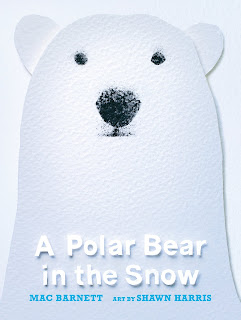
It is a survival characteristic to have white fur when living in the Arctic.  Polar bears sometimes blend in with their surroundings.  A Polar Bear in the Snow (Candlewick Press, October 13, 2020) written by Mac Barnett with art by Shawn Harris follows a polar bear on a trip through the snow.  This bear moves with purpose.

There is a polar bear in the snow.

We cannot see this polar bear in the snow until it raises its nose to test the air.  Then the bear wakes up and begins to move. We have no idea where he is going or why he is intently going in one direction.

There are lots of seals in the snow, but the polar bear passes them.  He does not wish to eat.  He also does not wish to seek the sanctuary of a cave in the blowing snow.  

When the unseen narrator questions whether this polar bear is seeking a man, the answer is a resounding

NO!

This polar bear keeps on going through the snow until he can see his reflection in the water of the sea.  Now we know where the polar bear is going, but we still don't know why.  

When the reason is revealed readers will smile, wishing they have white fur so they can join this polar bear.  Once again on the snow, the polar bear is ready to go.  Where?


Individually the sentences are simple, but when they are connected, they form a captivating story, a story which will have you smiling from the beginning to the last two words.  You are not sure where the narrative or the bear is leading you, compelling you forward, page turn by page turn.  Mac Barnett cleverly asks questions and supplies answers while repeating one key sentence. 


You can already tell from looking at the open and matching dust jacket and book case, the artwork by Shawn Harris is going to be as brilliant as sun on a landscape newly coated with fresh snow.  Using 

cut paper and ink

he, through light and shadow, creates luminous images, realistically textured.  On the front, right, the polar bear looks right at the reader.  What does that look tell us?  The title text is varnished and raised.  To the left, on the back, all we see are the indentations of paw prints in snow, moving away from us.  

The opening and closing endpapers are a turquoise blue.  The verso and title pages have a snowy look to them.  The letters on the title page, due to shadowing, appear as if they are floating.  The same snowy look continues on the first two pages with the single sentence on the left.  Each change in the first three visuals are subtle, then the cut paper artistry begins in earnest.  These illustrations span two pages.

Shawn Harris brings us close to the polar bear, then we see him in an enormous vista of snowy mounds and hills. After encountering the seals, as they vanish, we see only his back half rambling off the right side.  Our point of view of him walking through the snowy wind is as if we are one of the Arctic foxes looking out from a cave.

When the polar bear in the snow reaches the sea, the hues of blue are crisp and cool.  The next three illustrations are breathtaking in their perspectives and depictions.  The third one is wordless, but most readers will gasp in admiration.

One of my many, many favorite illustrations (I can't select a sea scene without spoiling it for readers.) is when the polar bear walks past the cave with the Arctic fox family watching him.  Most of the polar bear is to the right of the gutter.  His head is bent as he leans into the snowy breeze.  The opening of the cave does cross to the left of the gutter.  To give readers a perception of how deep the foxes are in the cave, Shawn Harris has layered torn white paper with each circle a little bit larger than the one underneath it.  The foxes are placed in the far left, bottom corner.  There is an adult, and three young foxes.  Their body postures indicate curiosity.


When you think of the Arctic, snow, and polar bears you would never imagine the clever use of language and art found in A Polar Bear in the Snow written by Mac Barnett with art by Shawn Harris.  You can easily use this book in a study of bears, the Arctic, snow, or for the sheer pleasure of a superb story.  You will definitely be reading it more than once at a single sitting.  Readers will want to listen to it repeatedly.  Your personal and professional collections will not be complete without a copy of this book.

To learn more about Mac Barnett and Shawn Harris and their other work, please follow the link attached to their names to access their websites.  Mac Barnett has another site here. He has an account on Instagram.  Shawn Harris has an account on Instagram, Pinterest, and YouTube. At Penguin Random House you can view interior images.  I hope you will enjoy these two videos.


Saturday, November 9, 2019

Considering Questions

Curious children question . . . everything.  This is the very act which makes them so amazing. Being near their inquiry is invigorating.  It's wonderful to see curious children continue to be curious teens, curious young adults and curious adults.  I can still recall, as I have mentioned previously, sitting in church thirty years ago, listening to the first female minister in any church I attended utter the words, "When you're through learning, you're through."

There will never come a time when our fascinating minds are filled to capacity; there is simply too much wonder in the world.  Two publications in the final third of the year address this compelling need to know; this lively speculation about all sorts of things.  Just Because (Candlewick Press, September 10, 2019) written by Mac Barnett with illustrations by Isabelle Arsenault follows a bedtime conversation between a child and their father.

Why is the ocean blue?

Surprisingly enough, the father elaborates with story instead of science.  According to him, the fish play guitars and sing sad songs once the child is asleep.  They then sob tears of blue.

Now accelerating the inquiries, the child asks about rain.  The father replies with a mixture of fact and fantasy.  His explanation as to why leaves change color makes perfect sense if you forget about the dryness of leaves and trees in general.  He attaches the next answer to the previous answer with astute cleverness.

When the child asks about the disappearance of dinosaurs and goes on to ask about black holes, her father gives two of my favorite interpretations tying them together.  When a barrage of questions fills the bedtime conversation, the father has a kindly request.  This, as you might expect, prompts another query.  With the special gift fathers are known to have, his response is loving, wise and truthful.


In the manner storytellers have of inviting listeners into their tale, Mac Barnett starts with one of the classic questions children are known to ask.  With the father's reply to this first question and the subsequent ones, he gives readers a gift every single time, the gift of thinking outside what is expected or accepted.  The cadence we have come to appreciate and respect in picture books of excellence is supplied when the answers to questions one and two, three and four and five and six become splendid pairs.  Here is a part of one of Mac Barnett's father's answers.

Millions of years ago,
thousands of asteroids
fell on the earth.

But the dinosaurs
had planned for this.
They fastened themselves . . .


In looking at the open dust jacket you initially notice a blend of geometric with whimsical.  This look is a pictorial representation of the verbal approach taken by the father in answering his child's questions.  The dots on the child's bedding are enlarged to hold text.  The text is placed within circles throughout the book.  The colors shown in the artwork above the text are depicted in question and answer sets.

To the left, on the back, the first question, is placed in a large circle.  Three smaller circles hold leaves, a seashell and an automobile.  In a fourth circle, white, is the ISBN.  The book case is a stunning contrast to the jacket.  On matte-finished paper is a light cream shade.  A pattern is fashioned from leaves and flowers found on land and below in the sea, and there are sea creatures.  Lavender, hues of blue and green, purple and a reddish orange are given to these elements.  It's a depiction of all the wonder waiting to be found.

On the black opening and closing endpapers are dots of various colors and sizes.  Isabelle Arsenault rendered these illustrations

in gouache, pencil, and watercolor and assembled digitally.

On the title page is the nightstand in the child's room with their jar of marbles and some of them scattered on the floor.  A two-page picture is devoted to the first question with the text in a large circle on the left and a picture of the child in her bed in her room with her father standing in the doorway on the right.  The colors are shades of black, gray, white, cream and blue for the circle.  For the answer we are taken under the sea, with a brighter focus in the play of light and shadow.  The blue is featured.  The father's answer is in white circles.

For each question and answer the father, child and the child's dog change their position and expressions.  Readers need to carefully watch.  Whatever color appears in the circle will become prevalent in the following image. For the illustration after the two pages depicting multiple questions in multiple circles, we see a larger perspective of the child's room.  Many of the items in the room are incorporated in the questions and answers.

One of my many favorite illustrations is for the answer as to why birds fly south in the winter.  For the background on the right showcasing two flying swallows, each carrying leaves in their beaks, Isabelle Arsenault selects a pale mint green.  On the left is a collage of greenery, leaves and stems in all shapes and sizes in shades of black and gray with the same pale mint green.  It's a breathtaking array.  Tucked among this collection is a small insect with two arms raised in praise.

Just Because written by Mac Barnett with art by Isabelle Arsenault is a conversational masterpiece.  It allows us to see inside the bond between a loving parent and an inquisitive child.  This book was recently selected at one of The 2019 New York Times/New York Public Library Best Illustrated Children's Books.  I can't imagine a professional or personal collection without this title on the shelves.

To learn more about Mac Barnett and Isabelle Arsenault and their other work, please follow the links attached to their names to access their websites.  Mac Barnett has an account on Instagram.  Isabelle Arsenault has accounts on Facebook and Instagram. At the publisher's website and at Penguin Random House you can view interior images.  At Art Of The Picture Book both Mac Barnett and Isabelle Arsenault are interviewed about this title.  At author, reviewer and blogger Julie Danielson's Seven Impossible Things Before Breakfast this book and the artwork of Isabelle Arsenault are highlighted.  Enjoy the book trailer.


If you could take a few moments thinking extraordinary things about what we accept as true, you might find yourself reflecting as the children in this second title do.  I Wonder (Random House, October 1, 2019) with words by K. A. Holt and pictures by Kenard Pak is an exploration of the art and craft of questioning.  It's like having a list of inquiries you could spend a lifetime searching for answers.  Speculation has rarely been this . . . wonderful.

What if the sun is really a kite?

This first of a combination of twenty-six wondering and questioning phrases is the spark that ignites a fire of possibilities.  It also generates another series of questions.  If the sun is a kite, what are the planets?  Are they kites, too?  If they are all kites, who is holding the string? 

Children from all ethnic backgrounds ponder.  Our next focus is on food.  How does it feel to be consumed?  When you think of water bottles, how big can you go?  What realm could be found inside a bottle?

We are asked to wonder if inanimate objects get tired, lonely or sad?  Insects find a place in these musings. 

Does a grasshopper take hopping lessons?

If you believe in unicorns, it stands to reason you need to know where they are now.

Clocks and a question of time makes sense, but belly buttons and galaxies are a completely new pair.  Thoughts turn to how a form of air is created.  Have you ever studied your shadow and its expressions?  As one child of many is tucked into bed, one final thought is offered.  For this one, and this one alone, there is a reply.  And it is the truth!

In reading over this collection of contemplations, you become aware it might be difficult to definitively reply to most of them.  K. A. Holt inspires us to go beyond what is known and to brainstorm the potential for stories.  Each one of these twenty-six is the ticket to a new adventure.  Here are two more for you to celebrate and pour into your imagination.

Do bubbles tickle everything they touch?

I wonder if books read us, too.


One look at the open dust jacket and you know this book is no ordinary book.  Oh . . . no.  This book showcasing a whale carrying a house with a unicorn coming from the back with fish swimming nearby and a blue car floating along with a kite flying is the stuff of fantastic.  The subtle, muted shades of the main image stand in sharp contrast to the sun and the bright colors of the title text.  This initial image urges you in the best possible way to open this book. 

To the left, on the back, five colorful kites fly upward from the darker shades of green along the bottom.  A lone smaller kite of blue stretches from the center edge on the left.  These kites frame the words in a pastel setting.  The words read:

What do you wonder about
when you look at the world?

On the book case of pristine white three children from diverse backgrounds run beneath the title text.  On the back, to the left, a home in pencil with gray shading above it is beneath a full moon and a cluster of stars.  On the opening and closing endpapers is a repeating pattern of a tiny red car, a teddy bear, a sun, a kite, a ladybug, a faint blue planet and a bubble.  The title page is like a dream.  The text is in lower case, partially in pencil and partially erased from a pencil rubbing.  The pastoral scene beneath it is very faint, mystical.

On the jacket flap it states Kenard Pak

uses watercolor, pencil, collage, ink, and digital media

to create his art.  For this book he alternates between double-page pictures and full-page pictures.  Each one is a unique perspective.  We are outside looking inside, looking upward, up-close, from a bird's point of view or shown a combination of two on a single illustration.  By looking at the light and sky in the images, it appears as if Kenard Pak is taking us from sunrise to bedtime except for the final picture. 

He begins and ends with a form of the sun bringing his visuals full circle.  Careful readers will see items in one picture appear again.  Readers will also want to see if the same children are shown in more than one image.

One of my many favorite illustrations is for the words

I wonder if books read us, too.

The floor and walls of the room are etched and lighter as is the staircase in the background, mostly in shadow.  In the center and filling more than half the space is a light tan rug.  Seated on the rug in her pajamas is a little girl.  With her a dog is calmly sitting and a kitten is seated next to her.  In front of this trio is an open book with the words

STORY TIME

on the front.  A talking yellow bird separates the two words.  Is the book reading the little girl and her furry friends?


Lighthearted, soulful and compassionate, I Wonder written by K. A. Holt with illustrations by Kenard Pak is a reflective selection of why we love what children think and have to say.  They are the reason as adults we strive to make the world better for them; so they can continue to wonder.  I highly recommend this title for your collections, professional and personal.

To discover more about K. A. Holt and Kenard Pak and their other work, please access their websites by following the links attached to their names.  K. A. Holt has an account on Twitter.  Kenard Pak has accounts on Instagram and Twitter. At the publisher's website you can view interior illustrations.  At author Cynthia Leitich Smith's website, Cynsations,  K. A. Holt is interviewed.

Wednesday, May 29, 2019

Of Significance

At times a book interests you because of specific things you find fascinating.  Other titles will be chosen because of references made by readers you admire.  Regardless of the reason, on a sunny spring morning you are likely to find yourself sitting down with a book you're eager to read.

You look at the dust jacket.  You remove the jacket to look at the book case.  You find yourself smiling at the title, verso and dedication pages.  The Important Thing About Margaret Wise Brown (Balzar + Bray, an imprint of HarperCollinsPublishers, May 21, 2019) written by Mac Barnett with illustrations by Sarah Jacoby is a book which fills every one of those previous qualifying remarks.  It is guaranteed to shift your thoughts on Margaret Wise Brown, and the art of making books as it increases your respect for creators Mac Barnett and Sarah Jacoby.

Margaret Wise Brown lived for 42 years.
This book is 42 pages long.
You can't fit somebody's life into 42 pages,
so I am just going to tell you some important things.

Within the same narrative we learn Margaret Wise Brown wrote more than one hundred books, we also are told other books are written by other people which makes perfect sense.  We are asked to think about writers as living, breathing people rather than characters in a book.  They share real-life experiences with us, some similar and some more peculiar than our own.

These musings are followed by a series of questions and answers, purely conversational in tone, about what might be important about Margaret Wise Brown.  Regardless of your age or level of curiosity or knowledge of this author, you will find something you probably did not know.  Did you know that Margaret Wise Brown's favorite dog, Crispin's Crispian, bit lots of people?

You will be astounded at the number of pets she had as a child, particularly rabbits, and how she paid tribute (if that is what it was) when one rabbit's life ends.  We are told it is significant to realize that this book and the books Margaret Wise Brown wrote depict life to children in all its aspects, even if they might seem odd.  We are offered ideas about Goodnight Moon, The Runaway Bunny and Little Fur Family.  We are given examples of what some people might consider unusual about Margaret Wise Brown and what some people might find extraordinarily wonderful about her.

We are reminded of the value of every book even if the people who write them might be perceived as strange or their content is considered strange.  Following this short discussion, we become acquainted with children's librarian Anne Carroll Moore of the New York Public Library, of her constant companion, NK, and her attitude about the books penned by Margaret Wise Brown.  (Who knew this?)  We are privy to the actions of Margaret Wise Brown and her editor Ursula Nordstrom during a notable tea party at the New York Public Library.

We, without hesitation, turn the pages until we discover or remember, depending on the reader, how Margaret Wise Brown died at an early age.  What remains is a beautiful discourse on the twists and turns of our lives and the telling of stories and their importance when the strangeness of one becomes the strangeness of the other.  We come full circle with a single sentence.


The words, sentences and paragraphs written by Mac Barnett in this book are done so after meticulous research and with intention.  This is evident in his first three sentences (and with every word written thereafter). His repetition of the number 42 is powerful and the use of the word important reflects on the title of this book, Margaret Wise Brown's books and the actual definition of the word important.

In his writing of this book, he employs a technique of stating simple truths, wondering about those truths and combining this with questions and some answers.  At times we ask ourselves is the author telling this story or are we telling it as readers?  It's an astounding feeling which grows as the pages are turned.  Margaret Wise Brown's life is depicted in Mac Barnett's words as if she had written it herself.  Here is a passage.

Now it's true that Margaret Wise Brown wrote strange books.
In her books, you would turn a page
and the story would suddenly change.
Sometimes a duck would appear for no reason.
And the narrator would often stop telling the story
and ask the reader a question.
Now isn't that a strange thing to do?


Readers will find it hard not to gasp for the first of many times when they remove and open the dust jacket.  The sky and clouds, and grass extend from the left flap edge to the right flap edge.  What readers can't see are rabbits, tucked in the grass to the left of the spine and on the right flap.  Margaret Wise Brown running after Crispin's Crispian mirrors her lively spirit to perfection.

On the book case the sky and clouds indicate in shades of peach, pink and yellow, the day is coming to a close. The scene extends across the back and the front, edge to edge.  Now Margaret Wise Brown is lying on her stomach in the grass on the right.  Some of her body crosses the spine to the left.  She is facing her beloved dog who, at rest, is facing her.  A single rabbit appears between them.  Other rabbits watch them from the left.

A pale, muted green covers the opening and closing endpapers.  On the title, verso and dedication pages Margaret Wise Brown is chasing after Crispin's Crispian again.  A portion of her body is running off the title page.  He has stopped on the dedication page to look back at her.  The illustrations rendered in watercolor, Nupastel, and Photoshop throughout this book by Sarah Jacoby are a marvelous pictorial presentation and extension of the text.

Rabbits subtly appear, almost silently, in a floral image, a field and woodland scene or as children with their rabbit librarian during a storytime featuring this book and other important books.  The details in Sarah Jacoby's work are intricate among her softly colored artwork.  Watch the rabbit listeners during the storytime.  Pay attention to the hands on the clock in the library.

Some of Sarah Jacoby's pictures are framed with borders, others span to the pages' edges, and some are small vignettes grouped together.  Her pacing is deliberate.  Among the delicate hues, line work, picture sizes and pacing, there is a spirit of joy and of a life lived completely.

One of my many, many favorite illustrations is a double-page picture.  From left to right crossing the gutter is a wagon pulled by a gray horse.  The wagon is overflowing with flowers of all shapes, sizes and colors.  You can see the surprise on the seller's face when Margaret Wise Brown asks to purchase the entire cart.  Her dog is crouched ready to run next to the cart.  I particularly love this picture because it portrays a strange and beautiful moment in her life; it's a moment to treasure.


The Important Thing About Margaret Wise Brown written by Mac Barnett with illustrations by Sarah Jacoby is a stunning, brilliant portrait of a remarkable woman's life.  When you get to the end of the book, you will immediately pause unable to believe the wonder you hold in your hands.  Then you will read it again and again and again.  It is a very important book!  On the verso page is a list of sources by books, articles and collections consulted.  I highly recommend this book for your personal and professional collections.

To learn more about Mac Barnett and Sarah Jacoby and their other work, please follow the links attached to their names to access their websites.  You can view Sarah's blog from her website.  Mac Barnett has accounts on Instagram and Twitter.  Sarah Jacoby has accounts on InstagramTumblr, and Twitter.  There is an outstanding blog devoted to the development of this book, here.  At the publisher's website you can view interior images.  There are exceptional interviews with Mac Barnett and Sarah Jacoby at Blue Willow Book Shop here and here, and at author, blogger and teacher librarian Travis Jonker's 100 Scope Notes at School Library Journal.  Sarah Jacoby is interviewed by author, blogger and teacher librarian Carter Higgins at Design Of The Picture Book and by Dylan Teut, director of the Plum Creek Children's Literacy Festival, on his blog, Mile High Reading.


Be sure to visit Kid Lit Frenzy hosted by educator Alyson Beecher to discover the other titles selected this week by those participants in the 2019 Nonfiction Picture Book Challenge.


Monday, May 14, 2018

To Be Perfectly Honest

In sporting events athletics, whether individually or as a member of a team, are constantly aiming for the flawless play, run, catch, swing, jump, routine, kick or shot.  They practice and practice and practice until one day the magic happens.  There are others who pursue their passions aiming for perfection; the exemplary musical melody, piece of art, compilation of words, architectural design, brick wall, perennial garden, or the most successful surgery or the most delicious fruit or vegetable ever tasted.  If you love what you are doing, you will continually aim high.

Will perfection be attained?  For some yes, for others the act of trying is a form of the ideal.  A shapely character introduced to readers in Triangle (Candlewick Press, March 14, 2017) returns in a companion title called Square (Candlewick Press, May 8, 2018) written by Mac Barnett with illustrations by Jon Klassen.  Square's friend, Circle, makes a request he is not sure he can honor.

This is Square.

Square has a secret cave with a square entrance in a large mounded rock.  Square's daily task is to take a square rock, a block, from down in the depths of his cave.  He pushes it with great effort up a hill.

At the top of the hill, he adds it to a stack of other blocks.  This is simply what he does.  As he is pushing a block up the hill one day, his friend Circle, glides up to him.  She believes him to be a great sculptor.  Square does not know what a sculptor is.

Circle is so excited by the shape of the block being identical to the shape of Square, she requests he make one of her.  He tries to tell her he is not as creative as she thinks he is but she has left.  This is a true dilemma for Square.

With hammer and chisel in his hands, Square begins his task but nothing works.  Soon he is in the middle of a disaster.  He is exhausted from his efforts, falls asleep and does not wake up until morning.  He realizes he is wet.

As Square stands wondering what he is going to do, Circle arrives.  She asks a question and Square replies.  She does not deter from her original assessment of Square.  She declares him a genius as she happily goes about her day.


Your enjoyment of this story does not diminish with repeatedly readings.  You find yourself smiling each and every time.  Mac Barnett gives us simple sentences but a subtle undercurrent of humor runs through the excellent blend of narrative and dialogue.  The contrast between what Circle assumes is true about Square and his conversations with her elevate the laughter factor.  He is honest enough in his thoughts to be worried about Circle's opinion.  Here is a portion of a passage.

He was surrounded by rubble.
"Whatever is the opposite of perfect,
that is what this is!  I must stay up
all night and figure this out!


A cream, matte-finished nine by nine inch cover displays Square on the front, wide-eyed, waiting and wondering.  There is something about his eyes which will have you, too, waiting and wondering.  Your anticipation is growing already.  To the left, on the back, Square's back is to readers.  His back is used as a place for four sentences giving us a hint of what we may encounter inside the book.

The opening and closing endpapers are a pale, mint green.  On the title page a tiny version of Square is placed between two clusters of rocks with delicate leaved-branches among them.  His eyes are looking to the right, inviting us to turn the page.  To the left on the verso page, all the text is placed within a square-shape.

The illustrations by Jon Klassen rendered digitally and with watercolor and graphite convey much with the placement of the elements.  (The use of the cream-colored space is outstanding in supplying pacing.)  Some are single page pictures, others cross the gutter and some extend over two pages.  We never see legs on Circle, she floats in and out of scenes.  We rarely see arms on Square and the only time we see an arm on Circle is when she and Square are giving a one-handed wave to us at the end on the dedication page.  The information about Mac and Jon which would normally appear on the closing flap is shown beneath the duo.  You will laugh when you read it.

One of my many favorite illustrations is on a single page.  Square has hammered and chiseled and chiseled and hammered a block until he is surrounded by bits and pieces of it.  What the text does not tell us is when he started this project, it also started to rain.  Now he is standing in a downpour.  A twig with two leaves is stuck to the top of his head.  His eyes are wide open but the dots are much smaller.  His hands, one holding a chisel and the other holding a hammer, are lifted in despair.  The bits and pieces of the block have formed a barrier which is holding water.


I can't imagine a professional or personal collection without a copy of Square written by Mac Barnett with illustrations by Jon Klassen.  This commentary on perfection and the joyful accident of reaching a goal is brilliant.  It shows us beauty is truly in the eye of the beholder.

To learn more about Mac Barnett and Jon Klassen and their other work, please access their sites by following the links attached to their names.  At Penguin Random House and Candlewick Press you can view interior images.  Candlewick Press has posted a short Teacher Tip Card. Please take a few moments to read the Publishers Weekly The Shape of Things to Come from Award-Winning Picture Book Team and an interview with Mac and Jon at Art Of The Picture Book.  Mac Barnett and Jon Klassen are interviewed on NPR Books about this title.  Enjoy the video.

Tuesday, April 25, 2017

Shapely Shenanigans

Nearly every culture has a trickster as a character in their traditional tales.  Anansi, a spider, is found in West African folklore.  It is believed he tricked the Sky God into giving up the box which held all stories. Originating from China the Monkey King is known to be superhero as well as one able to create considerable chaos.  Brer Rabbit is a well-known figure in African American stories besting through cunning those larger and stronger than he is.  Several Native American tribes share stories with Coyote as the trickster.  In the Northwest section of the United States Raven is strong and through his cleverness brings about change; sometimes for the good of people according to narratives in the Native American culture.

There are two fresh faces to be added to the chronicles of fictional mischief makers.  Triangle (Candlewick Press, March 14, 2017) written by Mac Barnett with illustrations by Jon Klassen will have you looking warily at basic shapes.  Who knew they were such rascals?  (Where were they when I was struggling in geometry?)

This is Triangle.

Triangle is a no-frills character with a wide-eyed expression and two legs to give him mobility.  As you might expect his home is in the shape of a triangle.  His door, a triangle, allows him ease when coming and going from his abode.

He is on a mission today.  He is on his way to Square's home.

He was going to play a sneaky trick on Square.

He treks through varying sizes of triangles, through a place with odd, rounded shapes and into the land of squares, large squares, middle-sized squares and little squares.  It is a mirror version of the realm of triangles.  He finally arrives at Square's square house.

Square, like most of us, has a fear.  He does not like snakes.  Triangle knows this, so he pretends to be a snake outside of Square's doorway (which is in the shape of a square).  Triangle's hissing is causing Square to panic and shout.  Triangle can't contain his laughter any longer.

When Square realizes Triangle has played a prank, he gives chase.  They sprint right by all those squares.  They rush by all those odd, rounded shapes.  They zoom past the triangles until Triangle escapes into his house.  What happens next leaves readers with a point to ponder after they try to stop laughing.


The simplicity of Mac Barnett's text in this story is what heightens the comedic effect.  The repetition of the words triangle and square help the suspense to grow.  You know something is going to happen; something big and hilarious.  The beauty of it, at least for this reader, is it's a completely marvelous surprise.  Here are two sentences.

He walked past shapes that weren't triangles anymore.
They were shapes with no names.


When you first hold a copy of Triangle in your hands you know you are about to experience something exceptional.  There is no dust jacket.  The book case is thick like a board book and has a smaller trim size, perfect for the intended audience. To the left, on the back of the case, is Triangle's back with words designed to make readers eager to open the book and start reading.  The opening and closing endpapers are a pale, mint green.

On the first creamy white page a little version of Triangle is giving readers a one-handed wave.  The publication information is in the shape of a triangle on the verso page.  Beneath the text on the title page, Triangle is on the move.

Jon Klassen rendered these images digitally and with watercolor and graphite.  The generous use of white space allows for the pictures to produce utterly perfect pacing.  Klassen shifts his perspective to heighten our anticipation in addition to giving us an idea of the size of the setting in which the two friends live.  Klassen's eyes on his characters tell whole stories.  Every time I see the single picture hanging on the wall of Triangle's and Square's houses, I burst out laughing.

Two of my favorite of many pictures are without words.  It's right after Square discovers Triangle has played a sneaky trick on him.  On the right Square's scene is the same as the previous page.  His eyes are looking left as he stands outside of his home.  On the left Triangle's page is nearly the same as the previous page but he is to the left of the small flowers.  He is edging off the page.  He is ready to run.


The more you read this book the more you will laugh.  I have lost count of how many times I've read Triangle written by Mac Barnett with illustrations by Jon Klassen.  The blend of pictures and words supplies over-the-top humor.  You will also be thinking non-stop trying to determine the answer to the final question.

To learn more about Mac Barnett and Jon Klassen and their other work please follow the links attached to their names to access their main online presence. Several publishers' websites have interior images for you to view.  They are here, here and here.  At the Candlewick Press site you will find several extra items to use; an article with the creators discussing the title and an activity kit.

Friday, June 17, 2016

To Follow Or To Break

Nearly every evening it was a routine during dinner.  Looking to make sure my mom was preoccupied, my dad would pick up a piece of food with his fingers. Inevitably my mom would catch him in the act exclaiming "Use your fork!"  Dad would laughingly reply "Fingers were made before forks!"  We would all laugh despite the fact we had heard this so many times we had lost count.

Even though my dad was able to do this, no one else dared to do the same.  If household "directives" were not followed, there were consequences; consequences of the variety insuring said "directives" would be followed in the future.  Rules Of The House (Disney Hyperion, May 3, 2016) written by Mac Barnett with illustrations by Matt Myers will have you rethinking your position on obeying rules.

Ian always followed the rules.
Here he is following the rule
ALWAYS PACK A TOOTHBRUSH.

Ian never falters in his steadfast adherence to what his family or society at large requires of him.  Ian's older sister Jenny is the exact opposite.  She takes particular delight in breaking the rule of not pinching.  OUCH!

The two are on their way with their dad to a large cabin in the woods to spend their vacation.  As the brother and sister squabble in the back seat, their dad reminds them of another rule,

DON'T TELL LIES.

The decor in the house is quaint and classic with an old potbelly stove, a claw-foot bath tub and a bearskin rug.  Ian loves all this stuff.  To his delight a set of rules, numbering four, have been left by The Management.  The last one states the red door is to be left unopened, ALWAYS.  Jenny agrees to comply but still calls Ian toady.

A variety of outdoor activities are enjoyed during the day but when inside the house Jenny breaks the first three rules with abandon and determination.  When Ian cautions her and chants his familiar phrase, Jenny snaps and...opens the red door.  HA!  Not one little thing happens. BUT when Ian and Jenny are all snuggled in bed, the fright comes into the night.

It's simply too scary for words.  Okay...okay...here are a few hints.  Someone is about to become an entree.  Did I mention monsters?  Another someone has to make decisions completely out of the ordinary.  Power to toothbrushes and to them who wield them!


With impeccable pacing and a masterful story arc, Mac Barnett has our attention from the very first page.  We are invited into the story with his wording as he makes statements and then demonstrates the veracity of each.  The trio of rules woven into this initial portion of the narrative is integral to the conclusion.

Barnett carefully creates the contrast between the siblings with a blend of text and dialogue.  You know something is about to change when you read two defining sentences at the close of the outdoor activities.  There is a shift in the atmosphere of the story.  It gets scary but not too scary after Jenny opens the red door.  Two short phrases speak volumes.  As readers' heart rates increase so does the tension in this tale racing toward the ending.  Here is a sample passage.

Best of all was a framed piece of paper
in the hallway that said

THE RULES OF THE HOUSE

"Look!" said Ian.  "Rules!"
"You're such a toady," said Jenny,
and then pinched him.
"OUCH!" said Ian.  "You're not
supposed to---OUCH!"

Ian drew a deep breath and read out
the rules with gusto.


Appropriately inviting and scary the front of the dust jacket screams you have to read this book.  Artist Matt Myers incorporates the tree trunk letters into the landscape.  The fiery red glow from the inside of the house draws our attention to the animated items.  To the left, on the back, a single toothbrush is highlighted in a yellow star with the rule printed beneath it.  The book case, left and right, is the red door.  We are doomed as soon as we open this book.  A pale sea green is used for the opening and closing endpapers perhaps in reference to an eye color mentioned in the story.  The title page and verso images are the red door.  Opposite the verso Myers has the children jumping back in fear at something they have seen.  The stage is set.

The picture sizes and perspectives are altered to fit the mood of the story; each one creating a separate effect.  Myers places a smaller image within a large visual.  He gives us a bird's eye view of the day's fun, mapping it out before us.  This allows for the contrast in what is to come; those haunting (but not too haunting) scenes of the cabin after everyone has gone to bed, the awful encounters in the children's bedroom and the kitchen.  The background colors play a significant role also noting a change in the current conditions.  Myers' use of light and shadow works wonderfully.

One of my favorite illustrations is of Ian standing outside in the dark wearing his pajamas and carrying his toothbrush.  He is standing on a small hill thinking.  Evergreen trees are placed in the background with silhouettes of more trees behind those.  His head is framed in a full moon.


On the first reading of this book, Rules Of The House written by Mac Barnett with illustrations by Matt Myers, I thought---Gals and guys are going to love this book!  It's a fantastic combination of scary and fun.  Beneath the fast-paced action runs an exploration of rules; when to follow them and when to break them.

To discover more about Mac Barnett and Matt Myers please visit their websites by following the links attached to their names.  Enjoy the video interviews of Mac Barnett at Reading Rockets.  Mac Barnett speaks at TED, Why a good book is a secret door.  Both Mac Barnett and Matt Myers are on Twitter.  @macbarnett and @myerspaints  Enjoy the video chat below with Mac Barnett and Matt Myers at Politics & Prose Bookstore.


Friday, May 15, 2015

A Funky Follower

One animal given a wide berth by humans is a skunk.  If you have a dog, your vigilance is continually on high alert.  The slightest glimpse of a furry flash of black and white will send your heart racing.  A skunked dog is a miserable incident for everyone but the potent pest.  A peek in pantries of people with pooch pals should show baking soda, hydrogen peroxide and liquid dish soap at the ready, specifically for a deodorizing concoction.

Despite all precautions, these smelly critters have a way of appearing as if from thin air.  The Skunk (Roaring Brook Press, April 14, 2015), story by Mac Barnett, art by Patrick McDonnell, offers readers a preposterous possibility.  It will leave you with more questions than answers.

When I left my house there was a skunk on my doorstep.

Wait a minute!  Stop right there!  There's a skunk on your doorstep?  Not only is there a skunk on this fancily-attired man's porch but after edging past him with extreme caution, the skunk trails behind him on the sidewalk.

As they get closer to the city, the man is fairly certain the skunk is shadowing his every move.  Regardless of his speed or random turns, the skunk is persistently in pursuit.  In apparent desperation, the man inquires as to the skunk's intentions.

Obviously, he receives no reply.  But then again, how often do skunks follow in your footsteps?  Frustrated to the max, the man takes a taxi to his destination.  So does the skunk.  (Yes, you read this correctly.)

Upon his arrival at the opera house, the man takes extra measures.  Once inside he sighs with satisfaction, sure he has evaded the determined follower.  Guess who shows up on the head of the woman seated next to him?

Panic filling him from head to toe, the man runs from the performance.  There seems to be nowhere he can go without the skunk.  As a last resort he sinks into the sewer system.

Appearing above ground after some distance, the man makes a series of decisions.  The skunk seems to have made some choices too.  With great care, dressed in black and white, a creature moves through the night.


You have to wonder what triggered the idea for this book in the mind of Mac Barnett.  I seem to recall several close encounters his dog had with a skunk from posts on Twitter.  However it happened, readers will laughingly agree this book is like no other they've previously read.

Each sentence is an attentive phrase in a symphony of silliness building to a startling and remarkable conclusion.  Readers are up close and personal with the man due to the first person narration.  It's like reading an entry in a diary but the puzzle has missing pieces.  Here is the passage where Barnett sets readers up for a huge dose of hilarity.

Success! I bounded up the steps and took my seat.  I was relieved to find myself between a lady and a gray old officer.  But then of course skunks can't buy tickets to the opera! ...


When you open the dust jacket you are introduced to the color palette used by Patrick McDonnell throughout most of the book.  The similarities between the man and the skunk, the fur and red nose and the tuxedo with a red tie, accentuate the ridiculous situation in which the man finds himself.  On the back, to the left, a circle is set in a red background.  The man is running from the skunk.

Six large black and white stripes supply the canvas for the front and back of the book case.  A circle on the front repeats the illustration found on the jacket.  The opening and closing endpapers continue the black and white pattern with representations of the two characters respectively.  Above the red text on the title page, a zoological, textbook-type image of the skunk is shown.

McDonnell has provided page after page of gentle tension, comedy and surprise.  With the subtlest of shifts in the characters' eyes and through the use of body language we are taken into the moment.  Regardless of the landscape in which the characters appear, we first look at them.  All of the illustrations are single pages or several on one page.  Most are loosely framed by white space.

One of my favorite illustrations in this title is the first one.  The man is looking out his front door nose bent toward the nose of the skunk.  All we see is his face and stunned eyes behind his glasses.  Calmly looking up is the skunk seated on the porch.  There is the barest hint of the house siding with a blooming rose bush and grass along the bottom.  Ever time I see this, I laugh out loud.


When you finish reading The Skunk written by Mac Barnett with illustrations by Patrick McDonnell, you can't help but read it again immediately.  You are seeking solutions.  This book is filled to the brim with possibilities.  This is a story leaving you wanting more.  It's up to you now.

I know you'll want to learn more about Mac Barnett and Patrick McDonnell and their work.  Please follow the links attached to their names to access websites.  To view interior images from the book, follow this link to the publisher's website. You will enjoy reading this recent interview with Mac Barnett at School Library Journal, Avant-Garde Children's Lit: Mac Barnett on "The Skunk" and Writing Picture Books.  TeachingBooks.net has numerous resources on Mac Barnett.
UPDATE:  Mac Barnett was interviewed at Bookish, Mac Barnet on Skunks, Good Art, and the Occupational Hazards of Writing for Children.  

Tuesday, November 11, 2014

How Deep Will You Go?

Place a child in a sandbox or a patch of dirt.  Give them a pail and a shovel.  I can guarantee they will be content for hours.  I'm pretty confident I was.  Over the years with gardeners for parents, my play advanced to the more cultivated pursuits of landscaping but nevertheless digging in the dirt is still a desired pastime.  Fourteen years ago I met my match, discovering a true champion in the art of hole-making, my chocolate Labrador retriever Xena.

 She can't be near a beach and water (or any stones and nearby dirt for that matter) without doing two things, diving for or grabbing rocks and creating enormous holes in the sand.  When she digs both front paws are used simultaneously in sync until the space is so big, not only will the rock be buried but she disappears from view.  (Those boys at Camp Green Lake (Holes by Louis Sachar) certainly could have used her skills.)

In the most recent collaboration between author Mac Barnett and illustrator Jon Klassen (Extra Yarn, Balzar + Bray, January, 2012, Caldecott Honor and Boston Globe-Horn Book Award) we have all the required elements for a first-class adventure, two boys, two shovels, a dog and dirt.  Sam & Dave Dig A Hole (Candlewick Press, October 14, 2014) is a story you simply can't read only once.  It's a true head-shaker and a major rule-breaker.

On Monday Sam and Dave dug a hole.

Digging a hole, in and of itself, is only as important as the reason why the digging is being done.  According to Dave, in reply to Sam's question of when they will stop, they are going to dig until they find

something spectacular.

As they dig first waist deep, then twice as tall as their heights, their dog goes along with them.

He knows, like we do, they have already passed by a gem of extremely large proportions.  It's to the reader's right of the current hole.  Not having found anything, Sam and Dave keep on shoveling creating a tunnel deeper and deeper. With a page turn we get excited.

They are on a direct path toward a colossal discovery.  Within inches of this amazing find, they decide to take a break.  Instead of focusing on their dog's nose pointing downward, they savor a snack of chocolate milk and animal cookies.  As they are resting Dave proposes digging to the right.  Sam readily agrees.

Again they pause, not noticing the efforts of their puppy pal behind them.  Dave has a further proposition.  Sam's not too sure, but they decide to split up going in opposite directions.  It's obvious they should have stayed the course.

Eventually meeting at the previous level, they decide to follow their original plan, going down, farther and farther.  If they had x-ray vision perhaps they would not have made this choice.  The word gargantuan comes to mind.

The last of their provisions have been shared.  These two explorers are filthy and tired but they keep digging until they can dig no more.  As they fall sound asleep, their canine companion keeps digging having smelled true doggy treasure, a bone.  His efforts succeed in more ways than one where their attempts failed.  Is this the

something spectacular?


Combining the barest of narration with conversation between Sam and Dave readers are taken on a journey of astonishing surprises.  The story line of Mac Barnett is the most marvelous of maps leading readers to make their own conclusions.  The

something spectacular

is never defined.

We are not sure of the relationship between Sam and Dave except they share a grandfather.  Dave may be the one to pose changes but Sam supports him.  They are definitely a team comfortable with one another.  Here is a sample passage.

But they did not find anything spectacular.
"Maybe we should go back to digging
straight down," said Dave.
page turn
"Yes," said Sam.
"That is a good idea."


The matching dust jacket and book case are nearly identical images.  On the back in place of the text, Sam, Dave and the dog, we have only the ISBN at the bottom of the hole.  The endpapers pick up the color found in the fruit on the single tree in the yard at the beginning and ending of the story.   The title page image starts the narrative visually as Sam, Dave and the dog walk away from a house toward the tree.  The final page with text (but not the conclusion of the story by any means) is a reverse image in that Sam and Dave are much dirtier, still carrying their shovels, but they are walking toward a house.

The creamy background on a heavier matte-finished paper supplies the needed texture for Jon Klassen's pictures rendered digitally and with colored pencils.  For the most part an illustration appears on a single page with the supporting text on the opposite page.  It's the eyes on his characters, especially the dog, which add an extra layer to the narrative.  No detail is missed; most markedly as to the enigma at the end, even extending it to the jacket flaps.

By having the dog be the silent member of the team (Dave acknowledges him in an earlier illustration with a hand gesture), we can also count him as a partner with us.  He knows because of his nose what we are able to see with the cut-away nature of Klassen's visuals.  His body movements and glances toward the monetary hidden riches, the boys and us, supply a huge dose of humor.

One of my favorite illustrations is when the two boys get dirtier, more tired and hungry and their surroundings are getting darker.  The dog already senses the bone deep below them.  We can see it too.  This bone and the dog's pursuit of his something spectacular change everything.


As I have read Sam & Dave Dig A Hole written by Mac Barnett with illustrations by Jon Klassen, over and over and over, one thought persists.  They must have had a great time creating this book.  The results of the dog's persistence will have readers thinking and guessing for decades.  I am glad this title found a place on our Mock Caldecott list.

To gather more information about either Mac Barnett or Jon Klassen please visit their websites (or Tumblr) by following the links embedded in their names.  Here is a link to a Calling Caldecott post by Martha Parravano.  Be sure to read Cynsations Author & Illustrator Chat & Giveaway: Mac Barnett & Jon Klassen on Sam and Dave Dig A Hole.  After you've read this title you should probably stop by teacher librarian and blogger Travis Jonker's blog 100 Scope Notes to read 6 Theories on the Ending of Sam & Dave Dig a Hole.  John Schumacher, teacher librarian and blogger at Watch. Connect. Read. recently hosted a visit by Mac Barnett and Jon Klassen at his school library.  His author illustrator days are the stuff of legend.