Quote of the Month

When love and skill work together, expect a miracle. John Ruskin


Showing posts with label Lane Smith. Show all posts

Saturday, August 21, 2021

Handheld Hilarity 2

Undoubtedly, humans with canine or feline members in their families can agree on certain shared experiences.  The unconditional love of our furry friends, some shown more easily than others, is without question.  This love supplies us with an incomparable form of companionship.  Each dog or cat has their own unique personality regardless of their breed.  Their individual quirks generate an endless supply of joy and laughter.

Our social media accounts are filled with photographs of our dogs and cats in their most precious, to us and sometimes to others, moments.  In Bloop (Harper, an imprint of HarperCollinsPublishers, July 6, 2021) written by Tara Lazar with illustrations by Mike Boldt, an extraterrestrial is sent to Earth to prove his worthiness.  Imagine his surprise at discovering the wonderful life enjoyed by its rulers.

Training to be the next ruler of Planet XYZ was hard work, Bloop tried to follow all the emperor's rules, regulations, and robots.
But . . .

Bloop made so many mistakes, he was issued an ultimatum. In one week, Bloop needed to become the supreme ruler of Earth.  It was his last hope.

Upon arrival, he quickly noticed fluff balls, dogs, were in charge.  Why else would the larger beings chase them, cuddle them, or scoop their poop?  He learned as much as possible about these creatures, but control of them seemed impossible.  An SOS to the Emperor on Planet XYZ gave him another option to pursue.

Bloop hid his floofers and engaged in doglike activities.  It was superb until he was snatched up by the royal guard (animal control).  At the facility he was attended by servants.  A small one decided she wanted Bloop to live with her.

If Bloop thought acting like a dog was superb, living in a home with these beings was superb plus.  His accomplishments did not go unnoticed by the emperor.  Bloop had decisions to make.  The most crucial one involved his new mission.  It was PURR-fect.


Author Tara Lazar is gifted in crafting clever comedy.  In this story, she takes what we accept as ordinary and gives it a twist.  The perspective of Bloop, a visitor from another planet, is hilarious with a capital H.  Dogs rule this world!  To him fire hydrants are identical to robots on his planet.  He delights as a dog in giving them their due.  Furthermore, Tara Lazar has him view Earth as a realm.  Squirrels are commoners, and his new family are loyal subjects, a lady-in-waiting, a footman, and a very small servant.  Text and dialogue are used to excellent effect.  Here are two passages.

Bloop had plenty of gourmet nourishment and squishy, squeaky gizmos.
He realized these were for calling the servants.
A small, sticky one approached.

"Oh, Mommy, him, him,
him. PUHLEEZE?

"Let's see . . . must be a rare breed," said
the lady-in-waiting.  "Yes, let's take him!"


The open and matching dust jacket and book case tell an interesting tale.  To the left, on the back, on a green background similar to the color of Bloop is a spacecraft.  It has crashed into the dirt, sideways.  The hatch is open.  Leading from the vehicle are paw prints.  When you pair this with the front, on the right, the floofers are the finishing-touch clue as to Bloop's origin.  Look at the faces on the dogs!  Bloop and the text are varnished on the jacket.

On the opening endpapers Bloop, inside his spacecraft, is zooming through space in various positions.  Moons, comets, planets, and stars in a dark sky are his only comfort.  On the closing endpapers, Bloop is enjoying the life of a dog.  Tucked in the upper, right-hand corner is the Animal Control truck.  These images are placed on a bright yellow canvas.

On the title page, looking like a conquering hero, Bloop is front and center.  He is standing tall on planet Earth, leaning forward.  In his right paw he holds a large light-colored flag.  There the title is placed.

These digital images by Mike Boldt were created using

Painter and Photoshop.

They are a vivid, full-color collection of double-page pictures, smaller vignettes, and single-page visuals.  They are as lively as the characters with expressive facial features and body postures.  You can't resist smiling or laughing out loud.

One of my many favorite illustrations is a single-page image.  It is on an orange canvas with a splash of bright yellow in the center.  Bloop was hoping his gathered treasures (dog toys) would ease him into the spot of ruler of planet Earth.  Instead, three dogs race around him, charge and grab at the toys, covering him in dog slobber.  They are blissfully happy, he is not.


If you are looking for laughter and a fresh perspective on the way of dogs on planet Earth, Bloop written by Tara Lazar with artwork by Mike Boldt is the title for you.  Not only does the humor flow freely through the combination of words and illustrations, but it offers us a means to ponder how the same thing can be seen differently.  You'll want a copy of this book for your professional and personal collections to add loads of humor to a story time.

To learn more about Tara Lazar and Mike Boldt and their other work, please visit their websites by following the link attached to their names.  Tara Lazar has accounts on Facebook, Instagram, Pinterest, and Twitter.  Mike Boldt has accounts on Facebook, Instagram, and Twitter.  The cover reveal and book trailer premiere were hosted by librarian, lecturer at Rutgers University, and writer John Schumacher on his blog, Watch. Connect. Read.  Tara Lazar and this title are showcased at Rhys Keller's site, Jena Benton's site, and at Laura Roettiger Books.


If you are a dog person, your experience tends to be limited with cats.  You rely on your cat-person friends' stories to inform you about their behaviors. And then, there are all those sleepovers with girlfriends and waking up to find the one's cat always sleeping on your head.  That particular tactic was puzzling to everyone, except for the cat.  Cat Problems (Random House Studio, an imprint of Random House Children's Books, August 3, 2021) written by Jory John with illustrations by Lane Smith explores the mind and attitude of at least one cat.  Or is it all cats?

Where's that sunbeam going?

HEY!

SUNBEAM!
GET BACK HERE!

Unfortunately, the sunbeam continues to move, and nineteen hours of sleep have been interrupted.  From this moment, events get worse.  The food dish is empty.  And another cat cannot remove itself fast enough from not one, but three special spots this cat, our protagonist, claims.

Bath time is necessary . . . alone if at all possible.  A box provides a temporary distraction and possible napping place.  Suddenly, a loud sound roars through the house.  It is clearly upsetting.  Wow! It's time to skedaddle to safety!  Threats are made.

The cat with problems believes it needs to leave this disaster of an existence.  Its frustrations are escalating.  It roams from space to space not satisfied with anything. Soon it sits on the top of a chair wishing and watching a squirrel on the outside.  The squirrel proceeds to give the cat a very complete lecture on its backward thinking.  The cat in turn wishes the window screen was gone for just enough time to grab that squirrel.

Feeling bored out of its mind, the cat does what cats do best.  

Mraowww!

is spoken over and over and over again.  Initial results are not as desired.  Again, the meowing is raised to a din.  A peak point in an otherwise dull day is reached.  And then . . .here we go again.


Telling this story through the first-person (cat) voice doubles the hilarity.  Every nuance of this cat's day is vocalized through the spot-on words selected and written by Jory John.  This cat finds fault with everything!  What pushes the humor over the top is the squirrel's speech and the cat's response.  Here is a passage.

sniff
sniff
sniff

Wait, why did I just sniff
that catnip toy?

Sheesh.
Now I'll be awake all night!
Goodness gracious.

Why can't I stop smelling this shoe?
I have to stop.
Still . . . it's intriguing.

What is it about
this shoe?

Is this what the 
OUTSIDE
smells like?


The matching dust jacket and book case begin the mirth found throughout this book.  Even though this cat is pleased with the box, for a split second, it looks stunned by its ho-hum life.  Even relieving its stress by clawing several letters in the title text does not work.  To the left, on the back, the background is covered in rows of 

Mraowww!

The narrator, only neck and head visible, is yowling from the bottom of the image.  Its displeasure is highly evident. 

The opening and closing endpapers mirror boards (or fabric) scratched with vertical lines spaced close together.  (You will see this pattern again.)  On the title page, the cat is snoozing in the sunbeam beneath the text. For most of the book, the color palette seen on the jacket, case, endpapers, and title page remains the same with pops of vibrant hues for the other cat, the vacuum incident, a portion of the living room, and the catnip toy.

These visuals by artist Lane Smith 

created in oil paint mixed with cold wax and digitally in Procreate

ask readers to reach out and touch them.  We believe we can feel the torn places in the title letters, the warmth of the sunbeam, the fur on the cats, the roughness of the cat's tongue, the surface of the box and foil ball, and cloth of the catnip toy.  We are offered various perspectives depending on the size of the illustration; these elevating the narrative.  

Full-page pictures, half-page pictures, horizontally and vertically, sometimes crossing the gutter to become larger, collected squares to portray panic, and a few double-page images give the story excellent continuity.  The eyes on the two cats and the squirrel send the humor soaring.  They reveal a range of emotions.

One of my many favorite illustrations is a half-page image.  The cat is on its back.  Its tail is curled and its back legs are straight up.  One arm, the left, is next to its side.  The other paw is holding a foil ball and resting it on its stomach.  Its eyes look a little crazed.  The words say:

I gotta get out
of this house.


Whether you are a cat lover or not, this book, Cat Problems written by Jory John with illustrations by Lane Smith, will have you howling with laughter due to the veracity on every page.  The words and art form a story time treasure.  No personal or professional bookshelves would be complete without a copy of the title.

To learn more about Jory John and Lane Smith and their other work, please visit their respective websites by following the link attached to their name.  (I don't just say this as routine.  You will be pleasantly surprised by what authors and illustrators include on their websites.  You might want to start with Lane Smith.)  Jory John has accounts on Facebook, Instagram, and Twitter.  At the publisher's website you can view interior illustrations.

Thursday, June 21, 2018

Dwelling In Questions

If you drive the country roads, especially those less traveled and paved with dirt and gravel, you will see remnants of previous buildings.  There are large square or rectangular areas with broken stone foundations. Some portions are entirely missing.  Other rocks are cemented in place and a foot high.  Standing fence posts designate the existence of former barnyards.  Nearby there are similar but smaller foundations for the houses.

A clearer sign of human occupation are the carefully placed lilac bushes and bunches of iris still highly visible. You can't help but wonder who called these places home.  What were their lives like?  For A House That Once Was (Roaring Brook Press, May 1, 2018) author Julie Fogliano (When's My Birthday? A Neal Porter Book, Roaring Brook Press, September 5, 2017) and author illustrator Lane Smith (A Perfect Day Roaring Brook Press, February 14, 2017) combine their marvelous talents to ask and propose possibilities about such a place.

Deep in the woods
is a house
that once was
but now isn't
a home.

This house is situated at the top of the hill.  There are signs it was previously blue on the outside.  The current visitors move slowly and silently on a path hardly visible toward the house on the hill.

As they look at the front, a door shows signs of being painted white.  It's not completely open or closed.  They decide to climb carefully through a window with the glass now missing.  Inside there is silence but also sighs given by an vacant house.

An empty bean can, a fireplace, a mirror, a bed, books, pictures on the wall, a chair and the kitchen have the explorers imagining who walked through these rooms.  Did a woman or a man or both who wished wild, wonderful wishes spend their days here?  Were there children who dreamed big dreams?

As they ponder these potential scenarios, they wonder why the people left and where they are now. They start to think of the house as another being, longing for the comfort of companionship or relishing the solitude. As the adventure draws to a close, two wanderers leave the woods taking memories with them.


With the first sentence a sense of mystery is supplied to readers.  The air is filled with questions waiting to be answered.  Julie Fogliano with atmospheric descriptions of place and the outside and inside of the home beckons to readers inviting participation.  We find ourselves drawn into speculation with the visitors through her poetry.  She uses repetition masterfully writing a melody with her words. Here is a passage.

Tiptoe creep
up the path
up the path that is hiding.
A path that once welcomed.
A path that is winding.
A path that's now covered in weeds.


Looking at the opened and matching dust jacket and book case readers are curious as to where the two children have wandered.  Upon closer examination you can't help but speculate on how long the home has been vacant.  And why is there a whale weather vane on the top of the house?

To the left, on the back, among the flowers and weeds on the overgrown path, a bluebird perches on a sturdy stem.  The opening and closing endpapers are awash in black stems covered with rusty-colored leaves.  Bits of purple, blue and green fill the space in-between them.  With a page turn these leaves continue until a textured, cream canvas provides the background for the blue bird standing beneath the title text.  Another group of leaves is in the upper, right-hand corner of the two pages.

Each of the following two page images were rendered

in two different techniques.  The "present day" illustrations were made with India ink, drawn on vellum with a crow quill pen, then pressed while wet onto watercolor paper creating a blotted line effect.  The colors were painted in oil over gesso then scanned and added digitally under the ink-line.  The "imagine" scenes were painted in oil paint on hot press board and scanned along with paper collage elements that were combined digitally.

By introducing the blue bird on the jacket, case and title page we realize this creature is going to have another story to tell.  We watch for its tale to unfold.  Lane Smith uses this extra element to excellent effect.

He alters his point of view in keeping with the lyrical narrative, giving us landscape displays, showing us only the feet and lower legs or the top portion of the faces of the children as they look at the house or he brings us close when a discovery is made.  On more than one page real photographs are inserted.  We find ourselves looking for all the tiny details Lane Smith includes; dragonflies, butterflies, lady bugs, a little mouse, words on the cans and jars, record labels and the name on the pet dish.

As stated in his explanation of his illustrative process, the "imagined" depictions have an entirely unique appearance.  You know if you reach out and touch them they will feel differently.  It's a fabulous representation of reality versus what-if.

There are many illustrations in this title which I consider favorites.  One of them is when the children, a boy and a girl, are climbing through the window into the house.  On the left side of the picture is a splendid array of sunflowers, black-eyed Susans, and lupines.  We are close to them.  In the center is a worn cement bird bath.  The blue bird is watching the children with a worm dangling from its mouth.  More distant from us on the right the boy is stepping up on boxes or stumps of wood to reach the window sill.  Already inside the girl is reaching to help him.  Not just in this image but throughout the book, the manner in which the children relate to one another is endearing.


Imaginative, soothing and reflective are words which come to mind when reading A House That Once Was written by Julie Fogliano with illustrations by Lane Smith.  Certain to promote discussions but also to make us more aware of our surroundings, this book is a highly recommended choice for your personal and professional collections.  You simply can't read it once.  It's remarkable.

To discover more about Julie Fogliano and Lane Smith and their other work, please follow the links attached to their names to access their online presence.  Julie has a page on Facebook.  Lane has a website.  If you stop by the publisher's website you can view interior pages.  Author, reviewer and blogger Julie Danielson showcase Julie Fogliano and Lane Smith on her blog, Seven Impossible Things Before Breakfat.  Julie is featured on Today's Little Ditty.  Lane Smith and Molly Leach (his wife) chat about this book (and others) at Let's Talk Picture Books. It's a great interview. 

Tuesday, February 28, 2017

It Couldn't Be Better

You wake up realizing you got a full night's rest for the first time in weeks.  As you step outside your car shortly after sunrise to walk in the park with your canine companion, there's not a whiff of a breeze.  The sun, beaming from a crystal blue sky, is warming the frost-tipped leaves on the ground.  Canadian geese are honking in the distance as a mallard and his mate float down the river on a swift current.

About a quarter mile into your walk you round a corner at the bottom of a hill.  Standing in the road ahead is a young doe.  She curiously watches you coax your stubborn puppy with treats.  Your dog has no idea the deer is present and sits without moving.  You can hardly keep from laughing out loud.

This day, while still young, has all the beginnings of being perfect.  Is it a combination of things or a single thing which makes a day perfect for you?  Accomplished author illustrator Lane Smith delivers perfection with a twist in his newest title, A Perfect Day (Roaring Brook Press, February 14, 2017).

The warmth of the sun...
felt good on Cat's back.

The daffodils were blooming in the garden where Cat lounged.  This cat enjoyed the heat, the fragrance and the comfort of being in her private outdoor parlor.  Dog had other ideas.

His human, Bert, knew exactly what made him happiest.  Keeping cool was achieved by sitting in a kiddie pool filled with water. Bert was keeping busy today.

He made Chickadee sing out a song.  Although Chickadee sent out no invitation Squirrel tried to partake of her treat but a clever contraption foiled the attempts.  A cob of corn was kindly dropped for the creature.  All was well in Bert's backyard.

Wait a minute!  What's a bear doing there?  Each animal wild and domestic skedaddled for shelter as the rambling bulk barged from one previously blissful spot to the next.  The perception of perfection has shifted.


A gentle rhythm is established with the introduction of each element, sun, water, birdseed and corncob, followed by an appreciative animal.  Lane Smith elaborates on the reason they find these simple pleasures so comforting with one, two or four short sentences.  These sentences are a reflection of the personality of each animal.

Each portion is closed with the same sentence except for the final word.  When Bear enters it is a change in the inflection of the same single verb which alters the entire tone of the story.  This supplies pure, perfect...yes perfect...pacing and humor.


When you open the matching dust jacket and book case, the texture of the elements in the image which extends front to back, right to left, and the body posture of the bear with eyes closed and nose extended to the flower, present a sense of total bliss.  At this point readers have no indication as to the events leading to this vision of a perfect day.  These muted, earth-tone colors are used throughout the title by Lane Smith. The opening and closing endpapers are a rich, golden yellow.

Heavy, matte-finished paper provides a most excellent surface for the mixed-media artwork; a blend of loose black lines, hues and painting techniques inviting you to reach out and touch the pages.  Smith alters his picture sizes, extending some page edge to page edge across two pages, and others one and a half pages, leaving a column of white (cream) space on the left for balance and the introduction of the repeating text.

This allows for further impact when Bear is introduced.  As he steps from the left into the wordless illustration we know a HUGE change is happening.  All the remaining images with Bear are two-page pictures.  These in turn create the masterful opportunity for the final page visual.  It's like the close of a movie when the outside fades to focus on a circular scene.

One of my favorite illustrations of many is of Bear in the garden.  The background is a colorful array of flowers.  In the lower, right-hand corner we get a glimpse of Cat scampering out of the way.  Bear is on his back, all four arms spread out at his sides.  They are moving as if he is making a "snow angel".


Have you decided yet what makes a day perfect for you?  You might even define it differently depending on circumstances from the past, present or even an imagined future.  After reading A Perfect Day written and illustrated by Lane Smith you will most certainly agree a day can turn completely around with the unexpected presence of an unwelcome being.  A bear can have that effect.  Of course, if you are the bear the day might be the best one yet.  Be sure to share this book with everyone you can, as often as you can.  It's wonderful!

To learn more about Lane Smith and his other work, please follow the links attached to his name to access his website and blog.  The blog is old but contains some earlier illustrations.  To see several interior images from this book please go to the publisher's website.  There is also a fun-filled activity kit.

Tuesday, October 4, 2016

If It's Not One Thing, It's Another

problem
  • something that is difficult to deal with: something that is the source of trouble, worry, etc.
  • a feeling of not liking or wanting to do something

(Merriam-Webster's Learner's Dictionary)

Within any given twenty-four hour period most living (or probably every single living) thing will experience one or more problems of varying degrees.  Some difficulties are small blips on the road of life.  Others may leave you wondering where the road went.  There are complications you can solve alone or with help.  For some situations there is no answer.  You simply have to accept the dilemma as unsurmountable despite your attempts.  

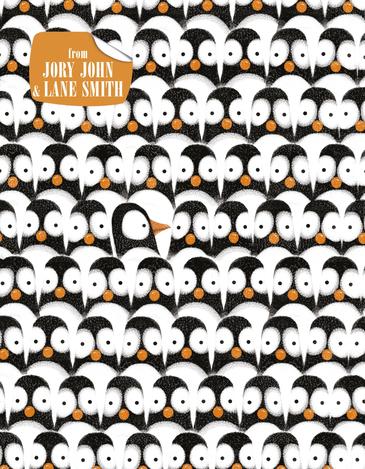
In these circumstances where you have no control, it all comes down to attitude and perspective.  Yes, it's the old adage of looking at that glass as either half full or half empty.  If we journey to the last continent of silence (according to Admiral Richard Byrd), there will be one voice more distinct than others.  In Penguin Problems (Random House, September 27, 2016) written by Jory John with illustrations by Lane Smith, readers can't help but laugh out loud at this bird who most definitely does not have an attitude of gratitude.  

It's way too early.
My beak is cold.

A catalogue of complaints begins this tale of an Antarctica resident. Granted this continent does have the coldest recorded temperature on the entire planet, but certainly there will be a bright spot in this inhabitant's day.  Nope.  Not yet. The chatter of his companions bugs this penguin too.

As luck would have it Mother Nature has the audacity to have it snow the previous night.  Doesn't she know this is the driest place on Earth?  Hunger sends our flippered friend to the sea seeking fish.

A dive into the darkness reveals a whole new set of problems, escalating by the minute.  It seems the penguin is not the only one with a craving for breakfast.  Whew! Back on terra firma physical attributes duly noted simply don't live up to expectations.  No amount of flapping is going to see this guy soaring.  

A final frustration sends our protagonist into a total tizzy.  A wise walrus moves into the scenario and proceeds to point out, in an epic declaration, how the penguin needs to view the world.  This, as you might think, is observed with a heavy dose of annoyance.  Or is it?  As night descends a lone voice can be heard.


Pointed, perfect pacing is a result of Jory John's word choices, sentence structure and keen sense of humor.  By the third sentence, a question, readers recognize this penguin does have a problem and it's only morning!  As the narrative proceeds John increases the tension by moving from the environment to daily rituals and then to very specific physical traits.  In the sequence where the penguin is seeking his parents, readers will roll on the floor laughing if they have not already done so previously. 

With a simple greeting we are aware of the passage of time.  We easily follow the penguin toward the day's end with his continued observations.  And in a final brilliant technique Jory John brings us full circle.  Here is a single passage.

I'm not buoyant enough.
I sink like a dumb rock.


Can you spot our grumbling individual on the front of the matching dust jacket and book case?  He already stands out in the crowd without uttering a single word.  To the left, on the back, the title and Jory John's and Lane Smith's names are listed covering nearly all the space.  The use of color seen here is continued for most of the book with the exception of some of the landscape, the time of day and other inhabitants.  The differences are suitably subtle. 

The opening and closing endpapers are the blackest of black perhaps to indicate the penguin's mood. We get a further inkling of how the book will proceed on the title page. The s in problems has dropped down from the other letters, threatening to fall on the top of the penguin's head.  His eyes are looking up as opposed to straight at the reader like his pals' eyes  do.

The heavier, matte-finished paper enhances the texture seen in the artwork of Lane Smith in this title.  It appears as though the illustrations were created using a blend of traditional mediums and perhaps some digital.  Lane Smith is a master of conveying much with delicate differences.  Perspective plays heavily in his perception of the narrative; a tiny penguin with flippers covering his eyes beneath a large sun in the sky, the gaping mouths of predators in a row as the exhausted penguin climbs from the water, the close-up of the penguin frankly declaring his unfortunate appearance, or the four vertical panels when the penguin seeks his parents. 

One of my many favorite pages in the book is when Smith demonstrates the penguin's waddling.  The page is sectioned into fourths with a black line on a white background. In the first three frames penguin is rocking back and forth, left to right, eyes shifting.  In the final image in the bottom right-hand corner, flippers folded in front of his body, he looks straight at the reader proclaiming

See?


If you want hilarity no matter how many times you read a book, Penguin Problems written by Jory John with illustrations by Lane Smith is a marvelous selection.  This first collaboration by John and Smith is a triumph.  There is not a missed beat in this cadence of comedy.

To discover more about Jory John and Lane Smith and their work please visit their websites by following the links attached to their names.  You can view a few interior images at the publisher's website.  Don't miss this funnier than funny interview of Lane Smith at educator and reader advocate Colby Sharp's blog sharpread.  One of my favorite images is included along with the passage noted above.

Friday, October 10, 2014

Taming Of The Wild West

The story area is filled with boys and girls restlessly waiting.  The teller strides in; the heels of her boots thudding across the floor.  Sitting squarely on her head is a well-loved Stetson, pulled down a tad bit on her forehead.  Around her neck a large kerchief hangs low but not so low as to cover the shiny sheriff badge fastened to her vest.  Black jeans and a button-down chambray shirt complete her outfit.

Pausing she looks each member of the audience straight in the eyes.  "Are you ready to hear a story that is going to knock your socks off?" she yells out.  After shouted replies of "Yes!" she settles down to begin Kid Sheriff And The Terrible Toads (Roaring Brook Press) written by Bob Shea with illustrations by Lane Smith.  "Wait a minute", one child says.  "Did you say terrible toads?"  "That I did", she replies. "They're so horrible people in town are quivering in fear."  Silence fills the room.

Drywater Gulch had a toad problem.

Now you might think the narrator is talking about the amphibious creatures of land and water.  If so, your thinking would be mistaken.  These toads begin with a capital T as in the Toad brothers; three of the nastiest varmints walking the West.

Mayor McMuffin is beside himself with worry.  Who knows what treasure will be taken, livestock smooched or chili slighted when they strike next?  But...wait a minute...someone is riding into town...someone riding on a tortoise. 

When the mayor greets and questions the stranger, he finds himself in the presence of their new sheriff.  Of course the only skill at which the youngster excels is his vast expertise on dinosaurs.  In the next moment a resounding 

BOOM!

fills the air. 

Robberies are happening left and right.  As Kid Sheriff starts tacking up wanted posters, minus the Toad trio's portraits but featuring a variety of prehistoric land giants, the criminals appear voicing their complaints.

 Dineysaurs

didn't commit those crimes.  Misters Mean, Weird and Ugly want credit given where credit is due.

The lawman matter-of-factly continues preparations for the detainment of the dastardly reptiles.  Three outraged, sputtering outlaws make a serious error in what little judgment they possess.  You never know when a passion for dinosaurs will save the day.

Bob Shea really understands kids and he loves making books for them.  It's obvious with every single word chosen and sentence written in this book.  He has the teller of this tall tale speaking precisely as much as necessary in the beginning before his crisp dialogue laden with the language of the locale picks up the story.  A single sentence spoken by the original voice concludes the book brilliantly.  Here is a short sample.

"A hole this big means one thing---T. rex," said the sheriff.
"Or dynamite," said the mayor.
"T. rex don't need no dynamite.  Largest predator of the Cretaceous period," said the sheriff.
"Wow, you're good," said the mayor.


From the minute you open the matching dust jacket and book case, you will be hard pressed to not burst out laughing.  (The best part is the whole book is like this.) On the left you have the three outlaws stacked together sneering at our young hero clad in white, boot resting on his trusty stead...er...tortoise.  On the back Kid Sheriff is riding into town across a desert scene on top of his four-footed, shelled pal.  Plain warm brown opening and closing endpapers continue the thematic color palette used throughout of rich browns, reds, deep golden yellows, black and cream.  It's like looking at an old photograph album filled with sepia-tone pictures.

Lane Smith fills single pages, double pages and crosses the gutter with his images without borders.  The layout of each visual gives readers a true feel not only for the story but the place in which it is set. The prominent elements in each picture are bolder and darker with those in the background lighter.  I can only imagine how much fun he had adding all the historic details; those more noticeable like the clothing and buildings or those much smaller like the stolen money.  Be sure to notice Kid Sheriff's belt buckle.

One of my favorite illustrations is when Kid Sheriff is measuring the size of the doorway into the jail.  He is holding one end of the tape and his tortoise is holding the other end.  We readers are seeing this through three sets of legs; those of the terrible Toad brothers.  The perspective is fantastic.


Kid Sheriff And The Terrible Toads written by Bob Shea with illustrations by Lane Smith is a rootin' tootin' rip-roaring outrageously fun read.  No matter how many times I've read this, I still laugh out loud with the line stated as Kid Sheriff comes into town and when he and the mayor are engaged in their original question and answer conversation.  So step back into the Wild West created by this dynamic collaborative team and get ready for your children to beg you to read this over and over again.

For more information about either Bob Shea or Lane Smith, follow the links embedded in their names to access their websites.  Hilarity ensues in this Q & A with Bob Shea and Lane Smith at Publishers Weekly about this title.  Follow this link to the publisher's website to view more illustrations including a portion of my favorite.  At Watch. Connect. Read. hosted by teacher librarian John Schumacher, Lane Smith is interviewed.  He talks about his process in creating the illustrations for this book.  Bob Shea was a guest interviewee at educator Colby Sharp's blog, sharpread.  Then head on over to the Nerdy Book Club to read Bob Shea's guest post, Stop what you are doing right now, and burn all your books. (Or how to tell if a picture book is good simply by reading it).


Monday, April 21, 2014

Plan R For Read This You Must

No matter how much care is given to the implementation of an idea, it sometimes does not work.  If another party is involved (your nemesis), it can be baffling as to how they seem to know exactly what your intentions are almost before you do.  They are indeed very clever or you may have discovered your soul mate; even if you are a child and they are an adult.

If you have read Lulu and the Brontosaurus or Lulu Walks the Dogs, you are familiar with this tenacious troublemaker whose mind never rests; continuously plotting to get her own way...always.  Lulu's Mysterious Mission (Atheneum Books for Young Readers) written by Judith Viorst with illustrations by Kevin Cornell, dust jacket illustration by Lane Smith, finds this manipulative maven facing her biggest challenge yet.  It seems Lulu's parents are about to do the unthinkable; take a trip without her.

But first let's go find Lulu, who is in the living room screeching "No! No! No!" although she doesn't screech much anymore. However, the news she was hearing from her mom and dad was so utterly, totally SHOCKING that it not only started her screeching but almost shocked her into throwing one of her heel-kicking, arm-waving, on-the-floor tantrums. 

Lulu is not about to take this news without a fight.  She fails to understand how her parents can enjoy themselves without her.  She wonders what kind of person could possibly take good care of her; said person might have ulterior motives like kidnapping her for ransom or starving and hitting her or locking her in the basement (the fact that their home has no basement is irrelevant).

Her parents assure her they've

hired the best babysitter in town---maybe the world---to take care of 

her.  Well, when Lulu hears the word babysitter that starts a whole new tirade.  Filled with fury she stomps up the stairs to her room when informed Ms. Sonia Sofia Solinsky will be arriving shortly as her parents are leaving the next day.  What? Tomorrow?  It gets worse and worse as far as Lulu is concerned.

Fuming she starts to hatch a plan which is executed quicker than anticipated when Ms. Sonia Sofia Solinsky loudly announces her presence, boldly walking into Lulu's bedroom despite her proclamation of being extremely ill.  Now if you are under the belief this caretaker of children is some sweet little old lady, think again.  Dressed in a military style uniform with a canteen and binoculars hanging from her belt, hair pulled back in a severe bun, combat boots on her feet, with a single glance anyone can tell she means business.  As soon as Lulu's parents are out of earshot, she tells her precisely how things are going to play out over the next week.

The next day when her parents have left, Lulu realizing plan A was an utter failure, decides it's time for plan B.   That strategy is a bust.  Plan C flops miserably.  When plan D appears to be working splendidly, Lulu gets stopped mid-argument by a single word from Ms. Sonia Sofia Solinsky.  It's time to call a truce and bargain with her archenemy.

Attached to that single word are other word groups, Repair and Restore, Disguise and Penetrate, Hacking and Codes and...those two words for which you've been patiently waiting...Mysterious Mission.  The days fly by as Lulu puts forth her best efforts (and believe me, knowing Lulu, it's not easy) to comply with the instructions of Triple S before her parents return.  Her mom and dad are absolutely bewildered when she insists they take more trips without her in the future, requesting that Ms. Sonia Sofia Solinsky stay with her. As readers you won't be the least bit surprised because Lulu gets her way...always.


Judith Viorst, as in the two previous titles, begins with a two page introduction of sorts, advising us of her unintentional deceit with the title.

STOP! Don't begin the first chapter just yet. There's something I need to tell you.  And I think I'd better tell it to you right now.

This one-on-one conversation, in a no-nonsense-let's-be-perfectly-clear tone of voice, with the reader continues throughout the story.  It's like we are getting extra information, the inside scoop, from the one person who knows everything.

You couldn't ask for characters, Lulu's mom and dad, Ms. Sonia Sofia Solinsky and Harry Potter, Lulu's trombone instructor, who play their parts any better.  Ms. Solinsky would have any other boy or girl raising a white flag after the first round but not Lulu. When a fictional character is over-the-top outrageous in their words and deeds, you can't help but laugh.  This is the Lulu, created by Viorst, whose escapades we have come to admire.

Known for not going with the flow, she still keeps us guessing as to her next plan of action.  Lulu's eeny meeny miney mo chant whispered under her breath, with a verse added after each loss and, in a twist of fate, success, definitely heightens the hilarity.  When she and Ms. Sonia Sofia Solinsky plot and converse, readers will keep those pages turning as fast as they can.  Here is a single sample.

... But before she could finish another "That babysitter's got to go," a loud "ahem!" disturbed her happy mood.
Standing at strict attention at the bottom of the tree---and what, in heaven's name, was she doing out there?---was none other than Ms. Sonia Sofia Solinsky.
"What, in heaven's name, are you doing out here?" Lulu fake-sweetly asked her. "I was just getting ready to meet you by the front door."
"I very much doubt that," said Ms. Solinsky, scowling down at Lulu and shaking a stern finger in her face. "But I'm warning you, don't bother trying that climb-out-the window-and-down-the-tree-nonsense again.  Believe me, I know tricks that you've never dreamed of.  Besides which, you were already wearing your sneakers."

For this third title in the series Kevin Cornell's illustrations rendered in graphite and watercolor on paper and then digitally manipulated add an extra spark to the text.  He leaves no doubt as to the many moods of each character, especially Lulu.  Smaller insets, full page and larger illustrations crossing the gutter fit the flow of the narrative seamlessly.

Two of my favorites are Ms. Sonia Sofia Solinsky holding the back of Lulu's skirt so she can't fake faint when her parents are leaving.  We see a highly distraught Lulu, the long legs, combat boots and arm of Ms. Sonia Solinsky with the paler outlines of the living room in the background.  When Lulu is sure plan D is proceeding toward victory, we see the text of her chant in blue as she does a determined dance, legs and arms raised, with Ms. Sonia Sofia Solinsky towering behind her in a lighter hue.

Run, don't walk, to your nearest independent bookstore or library to get a copy of Lulu's Mysterious Mission written by Judith Viorst with illustrations by Kevin Cornell.  This book is one hundred eighty-two pages of pure pleasure.  I know because I've read it twice.  I predict as soon as you finish this as a read aloud (and you must read it to one or more), you will be asked to read it again.  Everyone loves to laugh.  It's guaranteed with this book.

Please be sure to visit the illustrators' websites by following the links embedded in their names.

Thursday, February 13, 2014

Cherished Creatures

Within a heartbeat they can tell you.  Not only do they have an answer but they want to know what yours is.  No matter how many books the library may have or resources you provide, it's simply never enough.  Truthfully over the years I have learned more than I ever knew I wanted to know about a large variety of animals because of students' quests to discover everything about their favorite animal, domestic and wild.

The extent of their interest is not limited to facts either; each having an uncanny ability in their individual style to recreate their animal visually.  How exciting for all of us that Eric Carle and thirteen other illustrators decide to share their choices.  What's Your Favorite Animal? (Henry Holt and Company, January 2014) not only answers the question but entertains with text and pictures by each.

I have always liked all animals.  

So begins the story Eric Carle tells of his cat who liked to chase and fetch a string bean until she decided it was better off tucked away from view.  A ladder would definitely be needed to see eye to eye with Tom Lichtenheld's animal friend after a trip to Africa or the zoo.  You will be hard pressed not to gasp and utter yikes after seeing the smile on Mo Willems' crawling critter's face.

A Christmas tradition with a happy ending, especially for the main course, is a tale with timeless appeal as revealed by Peter Sis.  Giving us a whole new perspective on one of nature's slowest movers, Chris Raschka reminds us patience has great rewards.  Nick Bruel's Bad Kitty is up to his typical tricks.  Could it be because of a favorite animal choice?

Let's see now.  Who could possibly like a high-jumping bunny, these-pillows-are-my-spot dog, or a boastful elephant?  It might be Rosemary Wells, Lane Smith, Jon Klassen, Susan Jeffers, or Peter McCarty?  Or perhaps one of them has voiced their love of a duck (without a hat) or a herd of wild white horses?

A memory of cows coming to life at night, a kinship felt with penguins and a colorful connection to leopards fill the pages by Lucy Cousins, Steven Kellogg and Erin Stead. (No, I did not put them in order.) Just when you think you might suffer from happiness overload due to the wonderful words and colorful pictures on these pages, the final two host childhood pictures of each artist with a short biographical sketch.  Who could ask for anything more?


An amusing incident, a whimsical poem, a message of hope, personal reflections from now and then, and tales full of hilarity reach out, pulling readers into the realms of these fourteen individuals who, fortunately for us, populate the children's literature community.  All the wit and wonder we love about their work is condensed into these two page spreads; how they choose to speak about their favorite animal is a direct reflection of them as authors and illustrators.  You will find yourself alternating between a slow smile, a giggle, a guffaw, a sigh, and nod of understanding more than once. These fourteen people say much with few words.


Eric Carle's notable cut-paper collage decorates the front dust jacket with a list of the contributors and their animals on the back.  Upon removing the jacket readers see all fourteen creatures spread across both sides of the cover with the artists' signatures next to their work.  The pristine white background makes all the elements pop off the pages.  Sunny golden opening and closing endpapers brushed in paint announce the total joy to be found in this book.

Even without their name as part of the text or a signature within the illustration, each visual clearly identifies the creator; vividly displaying their unique styles and mediums.  The deft paper cuts for a cat's fur, the fluffy cloud cleverly becoming a beehive hairdo for the ruby-lipped giraffe, the loose swirls of orange, amber and blue making a home for a snail, small delicate lines and softened brush strokes bringing the essence of penguins to the page or cow paintings papering a wall as a boy dreams one into life, not only feature an animal but the considerable talents each illustrator brings to this book and everything they do.  Every single one is a masterpiece.


This variety in selected animals, narratives and illustrators is exactly what makes What's Your Favorite Animal? by Eric Carle and Friends a true treasure that everyone should read and own.  It's like holding an art gallery in your hands.  The end flap states:

All royalties from this book will be donated to The Eric Carle Museum of Picture Book Art which was founded by Eric and Barbara Carl in 2002.  

Links to each of the contributors' websites (when possible) have been placed in their names above.  Follow this link to the publisher's website for a peek inside this title.  Enjoy the videos collected by some of the artists.  If you have other videos you would like me to include feel free to leave a link in the comments below. 


Thursday, September 13, 2012

She's One of a Kind

Every child is unique.  Each is remembered for those subtle, or not so subtle, little details that make them who they are; a physical trait, a personality distinction, a phrase only they would utter.  There are also those children who are like fingernails on a chalkboard; so obnoxious they're funny as long as they're characters in a work of fiction.

In 2010 readers were introduced to one such child, a little girl about to have her birthday.  She is, in the words of the author,

...a pain.  She wasn't a pain in the elbow.  She wasn't a pain in the knee.  She was a pain---a very big pain---in the b u t t.

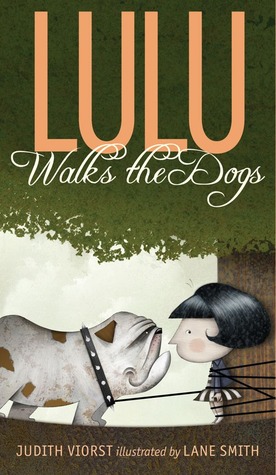
Lulu and the Brontosaurus written by Judith Viorst with illustrations by Lane Smith showed us one persistent, persnickety gal who would do anything to get her way, having a brontosaurus for a pet.  It did not end as she anticipated or as readers might have predicted.

This little bundle of feistiness has returned in all her glory.  In Lulu Walks the Dogs (Atheneum Books for Young Readers) she has her sights set on gaining a possession her parents refuse to fund.    Even parents who give their child nearly everything they want, have to draw the line at ridiculously expensive.

Lulu is aghast her parents would recommend earning the money herself.  Furthermore it irritates her to no end when they make reference to the boy down the street, Fleischman.  Fleischman is the bane of Lulu's existence.

He is kind, courteous, ever so helpful, hardworking, an expert flutist, a straight "A" student and neat as a pin.  His uncanny ability to know something about everything drives her absolutely nuts.  She makes it plain in her no nonsense way, he is to stay clear of any of her money-making enterprises.

Ultimately, Lulu believes walking dogs to be the easiest way to make the extra cash.  To her delight three neighbors respond to her promotional flyers.  Brutus, Pookie, and Cordelia will be her new four-legged morning walking buddies.

Of course, Brutus won't budge, Pookie must have her name pronounced correctly or else and Cordelia...where is Cordelia anyway?  Who should saunter into the midst of Lulu's problems?  It's Mr. Perfect Kid, Fleischman.

Fleishchman being his usual sweet self (almost too good to be true) offers his assistance which Lulu grudgingly accepts.  And so it begins, the trials and tribulations of dog walking this trio and the un-easy (mostly on the part of Lulu) sort of partnership that is formed.  And if you think there is smooth strolling ahead, think again.  After all, this is a story about Lulu.

Judith Viorst's voice, as the narrator, in this title as in the first, is just plain sassy.  Her listen-to-me-I'm-the-boss-of-this-book tone is splendid for the intended audience and anyone else who loves to burst out laughing.  It's not hard to visualize her staring intently into your eyes, demanding your undivided attention as she tells the tale.

Dialogue between Lulu and the rest of the characters, her parents, Fleischman and the dogs' humans could not be funnier.  The pacing is impeccable.  To accentuate a point or pause, a chapter might only contain a single paragraph, sentence or a question and answer time-out section.  But the added treat in this episode is the Money songs.

Here is a single passage from the book.

She was about to add that Brutus was among the everyones she didn't like when his owner said, "You're hired. You're hired. You're definitely hired. And furthermore, because Brutus is on the large side, I'm going to pay you fifty cents extra a day."
(On the LARGE side? Brutus was GIGANTIC---a mountain, a whale, an SUV of a dog!)

Pencil on pastel paper illustrations rendered by award winning illustrator, Lane Smith, make frequent appearances throughout the story.  Their placement as full page spreads, small insets or across two pages add to the emotional flavor of the story; reinforcing the hilarity.  Personalities, dogs' and humans', are emphasized through the definitive facial expressions on their prominent round heads.

If you're looking for a fantastic read aloud or a book that will have an individual reader giggling uncontrollably, then Lulu Walks the Dogs written by Judith Viorst with illustrations by Lane Smith  is the title for you.  Viorst and Smith combining their talents for another slice of Lulu's life is a major plus for readers.  I most certainly hope another volume is in the works.

If you wish to browse inside this title head over to the Simon & Schuster site linked here.


Wednesday, October 12, 2011

How Does Your Garden Grow?

As far back as I can remember each spring, summer and fall I would garden with my Dad.  We spent endless hours turning the soil, coaxing life from seeds and plants, weeding, pruning and picking.  There were huge vegetable gardens showcasing award-winning tomato plants and flower gardens with breathtaking roses.  Time spent gardening with my Dad took on a magical quality.  We were removed from the normal hustle and bustle of our days into a quiet, serene world of beauty and purpose.  Gardening is a part of who I am and my gardens are a reflection of where I have been; my Mom's heritage peony bushes, a portion of my Dad's sage plant, a lilac bush I've moved twice that was a gift from a memorable eighth grade homeroom class and numerous other plants acquired as trades from fellow gardeners.

Given my background, even before all the buzz, I was drawn to Grandpa Green written and illustrated by Lane Smith by the cover alone; the young boy hanging from the tree looking at the topiary elephant being clipped by an older guy garbed as a gardener.  Shades of green reach out enveloping you with the endpapers and a foliage title page scripted in the same white lettering as the cover.

The text tells the story of the life of the elderly man .

He was born a really long time ago, before computers, cell phones or television. 

We follow his childhood on the farm, his bout with chicken pox in the fourth grade staying home but reading classic stories, his first kiss and his dream of studying horticulture.  A world war came taking him away from that dream but introduced him to his future wife.  They had a harmonious, happy life filled with children, grandchildren and a great-grand child, a young boy. 

Older now the grandfather forgets details but the garden is adorned with his most significant memories done in elaborate topiaries. His story closes with a single visual; a continuation of that which he has depicted most eloquently.

The title page indicates that Lane Smith utilized brush and waterproof ink to render his characters for this book.  Digital paint, watercolor, and oil paint fashioned the foliage.  These whimsical, lyrical illustrations not only compliment the narration but tell a story of their own.  Our fingers walk through a botanical museum displayed on pristine white illuminating each amazing delicate detail; lush leafiness amid graceful trunks and branches.

Each visual flawlessly leads into the next; at times an extension of the previous presentation.  The initial topiary of a crying baby has an arched spray of blue seemingly coming from his eyes.  When the next page is turned at a different angle we see that it is the young grandson holding a hose upright as he turns the spigot. 

As the grandfather's life's tale is recounted readers stroll along with his grandson through the greenery of those remembrances.  Along the way he gathers items:  a trowel, a glove (left on top of a baby chick looking like a cock's comb), a dustpan and whisk broom gathering fallen berries, a wagon carrying a pot, a watering can, eyeglasses, lunch pail and remnants of a partially eaten meal, hedge shears and a floppy straw hat.  Not only gazing at the riches around him this traveler through time interacts with certain topiary commemorations of a life well lived.

It is when the young grandson pulling the wagon laden with all the gathered goodies approaches his grandfather working on a new creation, that what we readers have suspected all along is confirmed; the deep and abiding love between this pair.  As a four page spread unfolds we are greeted with an amazing artistic accomplishment by the grandfather and Lane Smith.

Musing over the works of Lane Smith that I continue to adore, one word comes to mind, versatile.  This is the man who brought us The Happy Hockey Family, numerous collaborations with the witty, wondrous Jon Scieszka including the Caldecott Award winning, The Stinky Cheese Man and Other Fairy Stupid Tales, Madam President, The Big Elephant in the Room and It's A Book

Grandpa Green has raised the bar clear up to the stars having universal appeal to all ages touching hearts, making us all as one.

The following links are to an outstanding two-part interview recently conducted with Lane Smith by the blog, Vintage Kids' Books My Kid Loves, Part One and Part Two.

Saturday, October 30, 2010

Smitten with Smith

Okay, I will freely admit that as soon as I see the name Lane Smith attached to a book this big grin starts to light up my face.  In my heart of hearts I know that at the very least I will burst out laughing once if not more.  Upon opening It's a Book to the title pages, the three characters are introduced; mouse, jackass and monkey.  Careful placement on the pages has them becoming a part of the title itself.


With short clipped sentences the computer-geek donkey and book-reading ape have a conversation beginning like this:
What do you have there?
It's a book.

How to you scroll down?                                                          
I don't.  I turn the page.  It's a book.

Do you blog with it?
No, it's a book.

On the next two page spread I defy the reader not to crack up when the donkey asks, Where's your mouse?  Without a word the ape shifts his eyes to the hat on his head which has been lifted up by the mouse who was underneath. 

Patience on the wan monkey finally asks if his partner in this conversation wants to look at the book.  At first jackass wants to reduce the page from Treasure Island to a few "texted" statements.  But within the next few lines of banter between this duo the reader knows that he has been drawn into this book not by its technological capabilities but by the sheer brillance of the writing.  In fact he does not want to give it back.  Needless to say the end will have readers young and old alike exploding with laughter as Lane via the mouse delivers yet another edgy play on words. (I have left the final exchange of words out of my review in order not to spoil the ending but please consider your audience before purchase.)

Even without the text Lane's illustrations crafted with layered oil paints, brush and ink are stunning in the subtle conveyance of exactly what his characters are thinking with the lift of an eyebrow, a twist of the mouth or a roll of the eye.  As in most of his books his choice of background colors lift the characters and setting off the page even though they are portrayed in earth-tone hues.  This is classic Lane Smith.  It's already been added to my list of favorites for 2010 and a copy has a home on my bookshelves.

View Curious Pages to get Smith's personal views on this book.  In addition to the web site associated with his name beginning this review Lane Smith Books is his official web site.