Quote of the Month

When love and skill work together, expect a miracle. John Ruskin


Showing posts with label Jacqueline Woodson. Show all posts

Tuesday, July 19, 2022

Freedom To Have Fun

There are many individuals who adhere to the unofficial beginning of summer as Memorial Day weekend and the ending of summer after Labor Day weekend.  In truth, summer begins on the summer solstice and ends on the autumnal solstice.  Those dates are usually around the third week in June and the third week in September.  There are others who base the beginning and ending of summer with the ending and beginning of the school year.  

Regardless of when it starts, there are other signs of this seasonal shift.  Morning and evenings are heralded by the sounds of birds and crickets.  The air is thick with humidity and the scent of blossoming flowers.  In my neighborhood, fawns wander with their mothers.  Children race past on scooters and bikes.  Thunderstorms quench thirsty lawns and gardens.

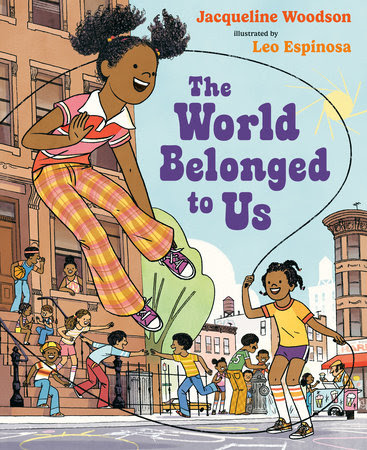
As a child summer meant floating stick and leaf boats down gutters during rainy days, spending hours under a large tree playing Monopoly when seated on an old quilt, playing softball on the vacant lot with the neighborhood kids, running through sprinklers until our skin was wrinkled, and calling out here I come, ready or not as we played hide-and-seek until mothers called us inside.  In The World Belonged to Us (Nancy Paulsen Books, an imprint of Penguin Random House LLC, May 10, 2022) written by Jacqueline Woodson with illustrations by Leo Espinosa, readers are transported to the freedom summer offers children.  Let's follow them!
In Brooklyn
in the summer
not so long ago

grown-ups always had someplace to be or some kind of work to do, but the minute school ended, us kids were free as air.
Free as sun.  Free as summer.

The heat in the city was intense even before school ended.  Wearing their school clothes, children ran through the water released by a hydrant enhanced with a can as their moms yelled at them.  The person handy with a wrench and the rest of the children intended to enjoy every single minute of summer.

All day long games were played on chalk-drawn boards on the streets.  The children were in constant motion, hopping to jump-rope chants, running, and spinning tops.  Their hearts soared.  When bumps and bruises happened, the older kids would step up and help and tell their own tales.

Cardboard creations rose like skyscrapers and the children admired the work of all their fellow builders.  During the summer in Brooklyn, imaginations and hope grew.  When others rose to renown in the world of sports, music, and literature, the kids believed they could, too.

Balls, bats, and cans were ready gear for more than one kind of game.  Senses were honed during play.  It was hardly surprising that everyone could hear the music of the ice cream truck blocks before it arrived.   Moms tossed money from windows inside tied handkerchiefs.  Ice cream was enjoyed and shared.  As the sky darkened, children still played calling out to one another in an array of languages.  When their moms began to call them home, they shouted out promises to each other.  Promises of another day filled with the freedom to have fun.


Author Jacqueline Woodson has an adept ability to reach into the past and bring it alive in the present. Five times the initial three phrase refrain is placed in the narrative to invite us into the summer with these children.  We experience what they are experiencing.  When dialogue is placed in the story, it rings with truth.  We know.  We've heard the same or similar words.  This is what Jacqueline Woodson does beautifully, she connects us regardless of when or where we were (or are) children.  Here is a passage.

In Brooklyn 
in the summer
not so long ago

we learned to watch and listen
playing tag, ringolevio, and hide-and-seek
inside hallways and behind thin-limbed trees
and garbage cans.

And our block was the whole wide world
and the world belonged to us.


There is so much fun happening on the front and back, right and left, of the open and matching dust jacket and book case, you want to jump in and join the children.  Many of the remembered activities highlighted in the text are featured in these two scenes.  These depictions do reflect when we believed

the world belonged to us.

To the left of the spine, on a background the same hue as the title text, is a golden oval.  Children are running inside and outside the oval, playing kick the can.  Underneath this image are words of praise for previous books by both the author and the illustrator.

On a marbled, muted canvas of dark orange on the opening and closing endpapers are drawings in red.  These drawings appear to be made in chalk or crayon.  They are childlike portrayals of activities enjoyed by the kids in Brooklyn.  You cannot look at these without smiling.  On the title page, we are given a more bird's eye view of the block in Brooklyn.  Along the bottom of the verso and dedication pages  are the tops of buildings in Brooklyn beneath a summer sun on the right.  The dedications read:

To young people everywhere.
Keep playing!---J.W.

To my childhood friends.
Tag, you're all it!---L.E.

Rendered by Leo Espinosa

with a mighty pencil and Adobe Photoshop

these single-page and double-page illustrations radiate warmth and happiness.  The children are placed foremost in the images in full color.  In one of the visuals, we are looking down on the block as the kids are actively engaged in a variety of games.  By their facial expressions and body postures, we know they are overjoyed that it's summer.  

Each line drawn by Leo Esinosa vibrates with fun, even when a child might be seated.  We know they are ready to spring into action.  Leo Espinosa has shown us what summer was, is and should be for all children.  Even though these scenes are in Brooklyn, there is a universality to them.

One of my many favorite illustrations is a double-page picture.  Dusk is arriving in the upper parts of the sky.  Darkening clouds move across a pale golden horizon.  Streetlights are on.  In the background on either side of the street are homes and buildings.  Children are running and calling to each other in the foreground.  One child, close to us on the right side, hands cupped to her mouth is shouting at readers.  Each of us can imagine what she is saying.


In truth, everyone feels different in the summer.  That subtle change in how time is spent affects each of us, thankfully.  In this book, The World Belonged to Us written by Jacqueline Woodson with artwork by Leo Espinosa, we are not only reminded of this, but encouraged to continue and support it.  It is a time to be cherished.  You will want to place a copy of this outstanding title on your personal bookshelves and more than one on your professional bookshelves. 

To discover more about Jacqueline Woodson and Leo Espinosa and their other work, please access their websites by following the link attached to their names.  Jacqueline Woodson has accounts on Instagram and Twitter.  Leo Espinosa has accounts on Facebook, Instagram, and Twitter.  At the publisher's website, you can view the title page.  At Seven Impossible Things Before Breakfast, Julie Danielson talks about this book as only she can and shares multiple interior images.  This book is included with two other Jacqueline Woodson titles in an Educator's Guide.  The publisher has a sneak peek preview here.

Wednesday, February 2, 2022

Lift Your Arms

Nearly thirty-seven years ago, I read a book with a collection of stories, many remaining in the coveted places of my heart.  Some of those narratives became a part of storytelling in my school libraries at the high, middle, and elementary levels.  In the past few days I reread the entire collection of tales found in the book authored by Virginia Hamilton with illustrations by Leo and Diane Dillon.  The People Could Fly: American Black Folktales is divided into four sections focusing on

animals, real, extravagnat, and fanciful, supernatural and other slave tales of freedom.

These stories are rich in tradition and cultural history, educating and entertaining us about a resilient, noble, determined, and hopeful people.  The last tale in the book takes the name of the title, The People Could Fly.  Without fail, each time I read this story tears well in my eyes.  These tears are jubilant for the people who could fly and heartbroken for those left behind.  

In her closing paragraph, Virginia Hamilton says:

"The People Could Fly" is a detailed fantasy tale of suffering, of magic power
exerted against the so-called Master and his underlings.  Finally, it is a powerful
testament to the millions of slaves who never had the opportunity to "fly"
away.  They remained slaves, as did their children.  "The People Could Fly" was
first told and retold by those who had only their imaginations to set them free. 

At the close of their newest collaboration, The Year We Learned To Fly (Nancy Paulsen Books, an imprint of Penguin Random House LLC, January 4, 2022) written by Jacqueline Woodson with illustrations by Rafael Lopez, Jacqueline Woodson makes reference to the words of Virginia Hamilton and the artwork of Leo and Diane Dillon in their 1986 Coretta Scott King Award winning title. (It also received a Coretta Scott King Illustrator Honor Award that year.) For all those who find themselves in a time and place they would rather not be, this book reveals a gift.  It shows us how to use this gift, a gift we all possess.

That was the year we learned to fly . . .

It began in the spring.  Storms raged nonstop.  A sister and her brother were confined to their home.  Their grandmother advised them to

use those beautiful and brilliant minds of yours.

She continued telling them exactly what they needed to do.  They did it, leaving their home and exploring their city, now blooming with a glorious array of flowers.  

Summer arrived.  The twosome could not agree on anything.  It seemed the only thing they were good at was arguing.  Their grandmother, in her wisdom, repeated her words.  Holding hands, sister and brother, forgot their anger.

As the shorter days and longer nights of autumn came, the girl and boy knew they could leave whenever they desired.  Their grandmother had taught them what had been passed from generation to generation, beginning with the people torn from their homes in Africa and brought across the water on ships.  Dreaming was believing.  You were (are) never alone in needing to fly.

The family moved in winter.  Everything and everyone was different.  The new neighborhood children were not friendly, but the sister and brother used remembered the words of their grandmother.  Their generosity was contagious.


Although author Jacqueline Woodson takes us through a year, season by season, of boredom, anger, loneliness, and newness, the awakening of the children's gift through the wisdom of their grandmother could aptly apply in any given situation at any given time.  In fact, as established through her poetic words used to design a cadence, the grandmother makes reference to others who might be in the same circumstances as the siblings.  These beautiful poetic instructions are enhanced by the repeated mention of another phrase.  Both combine to fashion a text that lifts readers as high as they desire to go.  Here is a passage.

That was the autumn our rooms felt too big and lonely
with only us in them and the darkness coming on so fast.
But while we hugged ourselves against the too-quiet of it all,
we remembered
that we didn't have to be stuck anywhere anymore.


When you look at the girl gazing upward on the right side of the matching and open dust jacket, you wonder what has her attention.  Are her feet on the ground or is she already flying?  What does the background indicate to you as a reader?  The wash of pastel colors seen here on the front extends over the spine to the left, back, of the jacket and case.  There, along the bottom, are three brilliant butterflies.  Above them are excerpts from starred reviews for the previous collaboration by these creators, The Day You Begin.  The text on the front is slightly raised and varnished.

Readers will be intrigued by the opening and closing endpapers.  They offer, prior to the reading of the book, an opportunity for discussion.  Both sets of endpapers show the same tree in the same setting.  The tree is placed on the right side.  On the lowest, right-hand branch a single cluster of leaves hangs down.  That is where the similarities end.  The background colors differ, as do the hues used in the ground.  There are additions in the closing endpapers.  What do they indicate?  Do these endpapers refer to other images within the book with leaves in them? (Personally, I love the leaves whenever they appear.  I have my theories.)

These illustrations by Rafael Lopez 

were created  with a combination of acrylic paint on wood, pen and ink, pencil, and watercolor, and put together digitally in Photoshop.

Each of them, double-page pictures, are full of color, emotion, and the frustration and exuberance of any given moment.  We understand how confined the children feel as the storm batters their apartment building and the other buildings in their community.  We feel deep respect for the depiction of their grandmother dressed in shades of orange, red, and purple wearing a regal and tradtionally-patterned dhuku,  And when the children fly we are there with them, uplifted and enjoying the vivid hues of the flowers and trees.

Careful readers will notice one particular bird and butterfly which seem near to the sister and brother in many of the pictures.  Rafael Lopez includes a bit of humor through the family dog.  When the children cannot seem to decide who should feed the dog, the dog, holding his dish in his mouth, patiently waits.  In two of the double-page illustrations, Rafael Lopez includes imagery from historical events woven into first, the girl's hair, and second, as portraits placed in large leaves clustered near the ground on the left of the following picture.

One of my many favorite two-page visuals is for the words referring to autumn. (It is the text above-noted.)  It is in the evening.  The background is a wash of purple hues with a bit of green and black.  The children on the right, appear to be reading in bed.  The quilt extending along the bottom of the left goes up and over the shoulders of the girl.  The orange red leaves on the quilt start to float off and around the two children.  This creates a cozy, tent-like image.  The girl is seated.  Her brother, under the covers, is in front of her.  She is holding the book she is reading aloud in front of him.  It is The Day You Begin.  There is a golden glow around and above the shoulders of the girl.  


This book, The Year We Learned To Fly written by Jacqueline Woodson with artwork by Rafael Lopez, is a marvelous tribute and an invitation to everyone.  We all have 

brilliant and beautiful minds.

With them we can accomplish as much as we can imagine and more.  What will we do with this ability?  I highly recommend you place a copy of this title in both your personal and professional collections.

To learn more about Jacqueline Woodson and Rafael Lopez and their other work, please access their websites by following the link attached to their names.  Jacqueline Woodson has accounts on Instagram and Twitter.  Rafael Lopez has accounts on Instagram and Twitter.  At the publisher's website you can view the title page. and verso.

Sunday, September 16, 2018

Each Day Start Anew

It does not matter how old you are.  It does not matter how many times you've done this in the past.  Each time, it's like starting over.  You step into an unfamiliar setting, glancing around only to discover your outward appearance is different.  Your brave, confident, inside-self grows a little bit smaller.

It should not be, but for children this is particularly challenging.  Children are courageous, compassionate and more willing to embrace change.  They are in the process of becoming their best selves and this is what makes them vulnerable.  The Day You Begin (Nancy Paulsen Books, an imprint of Penguin Young Readers Group, August 28, 2018) written by the National Ambassador for Young People's Literature Jacqueline Woodson with illustrations by award-winning Rafael Lopez explores through beauty in words and images first time apprehensions.

There will be times when you walk into a room and no one there is quite like you.

One or more things about you set you apart from the other people.  The language you speak or the accents given to the words you use are unique.  Saying your name out loud makes laughter fill the room until your teacher repeats it.  Then it envelopes you in welcoming warmth.

What do you say when the other children speak of summer visits to other countries and states, proudly holding mementos in their hands?  Your summer was a comfort to your sister.  Days of shared joy and love, quiet naptimes and hours of reading filled your shimmering-hot weeks.

What do you do when your beloved ethnic food is looked upon as strange at lunchtime?  What if no one will play with you at recess because you don't share the same skills?  This is when you call out to your inside-self asking it to be bold.

You realize, as you tell the tale of your summer, the light of awareness sparks in the eyes of those listening.  You are still a wonderful individual, as are they, but little similarities reach out to join in friendship.  Be strong, little one, your confidence is contagious.


There is a question at Jacqueline Woodson's website,

Do you think you'll ever stop writing?

Her reply shines through each word she carefully places on the pages of her books.

When I stop breathing.

In this title, the unseen narrator softly chats with a child (all children) eloquently using language to fashion scenarios so real you can recall the familiar ache of being different.  The repetition of specific phrases supplies a gentle refrain. Each portion of this story is a layer building toward a marvelous result waiting to be found and released.  Here is a passage.

And in that room, where no one else is quite like you, you'll look down
at your own empty hands and wonder What good is this
when other students were flying
and sailing and
going somewhere. 


All of the poetic truth of Jacqueline Woodson's words is depicted by the vivid, lively and heartwarming images of Rafael Lopez.  The uncertainty the little girl senses is reflected in her body posture and face on the front of the matching dust jacket and book case.  The shifting shades in the varnished colors of the text hint at the color palette. The beauty coming from her book is symbolic of the power of shared stories.  The ruler placed on the door is used several other times within the interior of the book.  This is sure to promote discussions on its significance.

To the left, on the back, text is framed with leaves, trees and flowers from the children's native countries.  Shades of muted green paint a pastoral scene on the opening and closing endpapers.  A grasshopper perches on a stem and a bird rests on a flower stalk.  A single rose-colored blossom, petals closed, is the only other hue on the opening endpapers.  The conclusion of the story is mirrored in the closing endpapers as the grasshopper leaps into the air with two other insects.  Two other birds join the first in flight.  How many flowers do you think are in bloom now?

Rendered

with a combination of acrylic paint on wood, pen and ink, pencil, and watercolors, and put together digitally in Photoshop

these illustrations begin their story on the verso and dedication pages as the child sits in her apartment window reading on a summer day.  All of the pictures extend from page edge to page edge across two pages with the exception of the final wordless single page, the perspective a birds-eye view of pure bliss found in contented children.  Rafael Lopez's rich visuals focus on the children striking a chord in our hearts.

At times we are drawn close to their faces to accentuate a moment.  Other times we step back as imagining and wonder resonate from his scenes. Birds and natural landscapes flow from page to page.

One of my many, many favorite illustrations is of the boy dismissed from playing with the other children at recess.  He walks to the edge of the ground bordering a pool of water.  The sky glows with the heat of those first few days of school, a full-bright sun hanging in the sky on the left over a single home.  The boy also on the left, closed book in hand, looks into the water. The water does indeed reflect what is above with a brilliant alteration.  The boy is grinning holding a now-opened book.  There is a yellow glow around him.  From the book loveliness pours forth in vines, leaves and blossoms.

Surely this title has been used to start many classroom sessions.  The Day You Begin written by Jacqueline Woodson with illustrations by Rafael Lopez transcends age inspiring all who read it to bring out our brave, willing to speak our truths with others.  How else are we to make our world better for everyone?  How else are we to discover our connections while preserving our singularities?  This book has my highest recommendation for your personal and professional collections.

To read and learn more about Jacqueline Woodson and Rafael Lopez and their other work, please visit their websites by following the links attached to their names. Both Jacqueline and Rafael maintain Twitter accounts and Instagram accounts here and here.  At the publisher's website is a teacher's guide for Jacqueline Woodson books, including this title.

Friday, August 29, 2014

Words...Wonder...Wondrous

After the arrival of the package, it is carefully placed on the kitchen counter.  Knowing what is inside makes the opening all the sweeter.  Fingers feel the raised letters of the author's name.  Eyes see the dust jacket colors arranged in a portrait of hope, the book case in a warm solid chocolate and page edges artfully deckled. Opening the cover and turning pages, the girl on the front is pictured again in black and white and the swirl of butterflies is gray beneath the title rising from the author's name.  Butterflies, in my way of thinking, are a marvelous choice, a symbol of transformation.  Then the dedication is read.

This book is for my family---
past, present and future.
With love.

On August 17th I began reading Brown Girl Dreaming (Nancy Paulsen Books, an imprint of Penguin Group (USA)) written by Jacqueline Woodson.  On the morning of August 27th I read the last three words,

will finally be.

Normally a book is completed in a single day, if not a single sitting but this book is so rich, so rare, it needs to be read slowly like smelling a bouquet of lilacs, tasting tea with honey, watching the sunlight sparkle on waves like diamonds, listening to the soaring notes of a meadowlark and brushing fingers over the fur of a beloved sleeping dog.  Each word or collection of words needs to be held in your mind.  Stopping to read aloud certain passages is a necessity.

Divided into five parts,

i am born
the stories of south carolina run like rivers
followed the sky's mirrored constellation to freedom
deep in my heart, i do believe and
ready to change the world,

Jacqueline Woodson through a collection of poetic memories conveys to readers her childhood.  All the many stories, moments of her days, are braided together leaving a lasting impression.  Like turning the pages of a scrapbook, her words fashion pictures profound and moving.

Born on February 12, 1963 in Columbus, Ohio the first year of her life is determined by her father's voice on naming, football, and the south, descriptions of the Woodson branch of the tree, the flow of good and bad family news, and journeys to her mother's home in Greenville, South Carolina.  We listen in on the debate to name her Jack or Jacqueline.  We ride the bus with her and her siblings at night from the North to the South and back again and again.  All this time historical events, a chorus of sound, is rising across our nation as the civil rights movement gains momentum.

home

...We are near my other grandparents' house,
     small red stone,
immense yard surrounding it.
Hall Street.
A front porch swing thirsty for oil.
A pot of azaleas blooming.
A pine tree.
Red dirt wafting up
around my mother's newly polished shoes. ...

Now moved to Nicholtown, no return to Ohio in sight, with her older siblings, Jacqueline settles into life with her mother's parents.  Years pass as life in the south, different but somehow familiar, defines their mornings, afternoons and evenings.  First her mother visits New York City, and then she goes, promising to send for her children when a home for them all is found. We understand her grandfather's ties to his garden.  We attend meetings for those participating in the civil rights marches.  We learn as she and her sister, Odella, and brother, Hope, do of her Grandmother's strong faith as a Jehovah's Witness. We feel the simple pleasure of walking into the fabric store with no labels, as people.

ribbons

...When we hang them on the line to dry, we hope
they'll blow away in the night breeze
but they don't.  Come morning, they're right
where we left them
gently moving in the cool air, eager to anchor us
to childhood.

There is a new baby brother named Roman.  There is a new home in a new city, Brooklyn, for the Woodson children.  Here there is laughter and loss, support and challenges.  We take joy in Jacqueline's affection for storytelling and her thirst to write.  We makes adjustments for each day of the week, for the weather, and for the seasons as do the children whether they are in the city of the North or the town of the South in summers.

believing

...It's hard to understand
the way my brain works---so different
from everybody around me.
How each new story
I'm told becomes a thing
that happens,
in some other way
to me...!

Keep making up stories, my uncle says.
You're lying, my mother says.

Maybe the truth is somewhere in between
all that I'm told
and memory.


A new friendship begins, a forever sister to this day.  The butterfly in Jacqueline is unfolding its wings; she listens, learns and writes.  We travel with Jacqueline to visit her uncle Robert in jail.  We laugh with her and Maria as they trade meals and share stories and secrets. We go with her to Greenville as she says last goodbyes.

writing #1

It's easier to make up stories
than it is to write them down.  When I speak,
the words come pouring out of me.  The story
wakes up and walks all over the room.  Sits in a chair,
crosses one leg over the other, says,
Let me introduce myself.  Then just starts going on and on. ...

Changes come to Jacqueline's family in Brooklyn; when one leaves, another comes.  Dedication to her writing grows and grows.  We listen to her mother's conversations.  We see the change in her uncle Robert as the revolution grows.  We feel her elation at Ms. Vivo's words.

every wish, one dream

Every dandelion blown
each Star light, star bright,
The first star I see tonight.

My wish is always the same.

Every fallen eyelash
and first firefly of summer...

The dream remains.


Poignant but full of promise Brown Girl Dreaming written by Jacqueline Woodson is a brilliant memoir of life.  We are brought into a vast array of vivid recollections told with such beauty it will take your breath away.  As I sit here completing my thoughts I have read and read passages over and over, some marked with post-its.  I know I will be getting another copy so I can highlight Woodson's thoughts.  This book needs to be on all bookshelves everywhere.

Make sure you follow the link embedded in Jacqueline Woodson's name to visit her website.  She includes important information about herself and her books.  Here is the link to a post from her editor Nancy Paulsen about Brown Girl Dreaming.  Donalyn Miller, author, educator and newly hired manager of independent reading and outreach at Scholastic Book Fairs wrote a reflection about this title and families at Nerdy Book Club.  Here is the link to interview which recently appeared in Time For Kids.  UPDATE:  Follow this link to a series of videos at Reading RocketsBelow are two videos to use to further your understanding of Jacqueline Woodson and the writing of Brown Girl Dreaming. Another UPATE:  Listen to this NPR Listen to the Story: Morning Edition--Jacqueline Woodson On Being A 'Brown Girl' Who Dreams.