Quote of the Month

When love and skill work together, expect a miracle. John Ruskin


Wednesday, April 15, 2020

A Wee Winged Warrior

If you listen closely, you'll hear them before you see them.  By remaining as still as possible, they'll hover close to you as they sip sweet nectar.  From your peripheral vision their striking colors are vividly apparent through a blur of wings.  Their size would seem to delegate them as delicate beings, but that is far from the truth.

Each year they endure an arduous adventure few humans would undertake.  Tiny Bird: A Hummingbird's Amazing Journey (Christy Ottaviano Books, Henry Holt and Company, April 14, 2020) written by Robert Burleigh with illustrations by Wendell Minor explores every aspect of this feat through facts, an exquisitely descriptive narrative and realistic, remarkable paintings.  You will enjoy memorable moments as you marvel at this inspiring wonder found in nature.

Today is the day.

In the yard,
the last orange flowers
open their petals to the slanting sun.

Three inches in length, a ruby-throated hummingbird seeks food within the orange flowers.  Wings moving rapidly, nearly imperceptible, help it to suspend above the petals.  It darts with efficient and succinct speed, sipping vital nectar necessary for the journey about to begin.

Tiny Bird, this ruby-throated hummingbird, knows with the arrival of autumn, its flight starts soon.  This bird, all alone, heads south of this well-known yard in the northeastern section of the United States.  Sometimes thirty miles an hour are traveled just above the treetops.  Along the way Tiny Bird still sips nectar from flowers and spears the occasional insect when diving closer to the ground.

In the nick of time Tiny Bird escapes the clutches of a hawk.  At times Tiny Bird rests, but the need to keep going is strong.  Soon the Gulf of Mexico stretches before the ruby-throated hummingbird.  It crosses this large body of water flying without stopping for more than twenty-hours.  With skill Tiny Bird uses waves to block the wind but watch out!  It's another close call by a predator.

Then the worst happens, a mighty storm.  Tiny Bird is losing strength fighting the wild weather. Salvation comes from two sources before the little creature continues once more.  Thankfully, in the light of a rising sun, a southern home is spotted.  A reward of rest and a banquet found in flowers await this wee winged warrior.


Information is woven into poetic lines by master of words, author Robert Burleigh.  Sound effects add authenticity to the narrative.  Alliterative and rhyming text supply a soothing but captivating cadence.  Readers are fully invested in this breathtaking and challenging trek.  Here is a passage.

Zap!
It flits down.

Flower to flower,
backward, forward, under, over,
like an acrobat of the air!

Radiant green feathers glimmering,
ruby throat shimmering,
Tiny Bird delicately dips its beak
into the heart of each flower,
extracting precious nectar.


The enlarged view of the ruby-throated hummingbird, Tiny Bird, on the front of the dust jacket (I am working with an F & G at the moment, awaiting the arrival of the new release.) brings readers close to this astonishing being.  The intricate details will have you longing to have the bird take a moment's rest on your outstretched hand.  The pale blue wash of the sky provides a wonderful canvas for the brilliant bird and flower.

To the left, on the back, a dark grass green background, one of the many hues in the small bird, showcases an oval image taken from the interior of the book.  It is a startling scene of the ruby-throated hummingbird struggling to survive during a fierce thunderstorm.  An introductory sentence arches above the illustration.

On the opening and closing endpapers are a series of explanatory images about these amazing birds.  Each illustration is captioned with facts.  The size of their nest is compared to a coin, their stature with spread wings is shown, their egg is compared to another familiar egg and there is a map of this ruby-throated hummingbird's route.

These pictures, paintings by Wendell Minor, are rendered using

gouache watercolor on Strathmore 500 Bristol paper.

Each one is connected to the next, like a row of artwork hanging in a gallery.  Wendell Minor brings us close to Tiny Bird in a double-page picture or a series of smaller visuals.  Then he takes us to larger settings or landscapes so we can appreciate the astounding nature of this bird's life and trip to the south.  Sometimes we are observers and other times it's as if we are Tiny Bird.  We gasp at its near brushes with death and sigh when it is safe.

Each brush stroke adds life to each painting in a pattern of light and shadow.  The portrayal of movement is stunning.  We can readily hear the hum of rapidly beating wings, the rush of air from an ocean breeze along the Gulf of Mexico or the rumble and crash of thunder and lightning in a horrific tempest.

One of my many, many favorite illustrations is a double-page picture.  It's a depiction of the storm Tiny Bird flies through during the crossing of the Gulf of Mexico.   The upper portion of the image is a darkened sky marbled with angry clouds only broken by a flash of lightning, forks extending to the horizon.  The horizon, a line, above the churning and white-capped water is an eerie golden shade.  The wind-tossed waves span the lower section of the scene.  On the right above splashing droplets of water flies Tiny Bird.  We are very close.  One eye is shown, determined and focused.  The wings are shown frozen in flight, one extended from the body and the other downward before it raises again.  You can feel the supreme struggle Tiny Bird is experiencing.


Compelling at every page turn, Tiny Bird: A Hummingbird's Amazing Journey written by Robert Burleigh with illustrations by Wendell Minor is an excellent informational picture book.  At the close of the book a section titled Fun Facts About Hummingbirds furnishes further items under headings such as How Tiny?, Really, Really Tiny, A Little Bird with a Big Appetite, More Than a Few Days and Feisty Hummingbirds Defend Their Territory (to name a few.)  There is also a page dedicated to How to Become a Member of the Hummingbird Helper Club. This section begins with a reminder to look, but don't touch them.  We are encouraged to plant particular types of flowers, place hummingbird feeders in our yards, given instructions on how to make a feeder and fill it with proper food and finally a list of books is shared.  I highly recommend this title for your personal and professional collections.

To learn more about Robert Burleigh and Wendell Minor and their other work, please follow the links attached to their names to access their respective websites.  At Wendell Minor's website you can view illustrations from this book, including one of my favorite ones.  Wendell Minor has accounts on Facebook and Twitter. (One of Wendell Minor's biggest fans is his lovely wife, Florence, who is also an author.  She has an account on Instagram where you can see his work.)  At the publisher's website you can view interior images.

UPDATE:  Wendell Minor is interviewed at author James Preller's Blog about this book, birds and birding, our natural world and his amazing body of work and his art.


Be sure to visit educator Alyson Beecher's site, Kid Lit Frenzy, this week to view the selections chosen by other participants in the 2020 Nonfiction Picture Book Challenge.


Tuesday, April 14, 2020

A Horde Of Hares

In our neck of the northern Michigan woods, the wild rabbits have huge appetites for . . . everything.  No item is safe from their voracious desire to sample a range of perennial plants and shrubs, regardless of the season.  They are both clever and determined despite the use of carefully placed and secured netting and burlap wrap. 

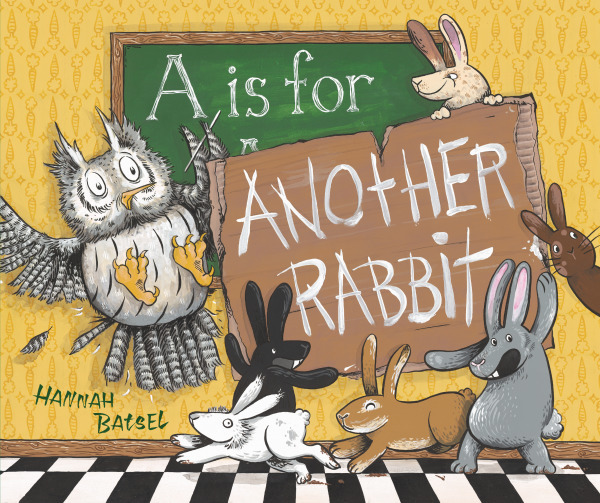
Most of them are the normal size of wild rabbits but one or two are rather large which confirms their considerable abilities not only in enjoying a banquet of edibles but in eluding the prevalent raptors and coyotes.  It's hard to know how many there are in residence, but their frequent appearances indicate their numbers are growing.  A is for Another Rabbit (Carolrhoda Books, an imprint of Lerner Publishing Group, April 7, 2020) written and illustrated by Hannah Batsel is an alphabet adventure gone awry due to an overabundance of bunnies.  Trust me when I relate that this is no laughing matter to one particular owl, but the hares find it hilarious (and you will, too.)

A is for A rabbit.

Wait---
rabbit starts with R! 

Yes, but "a rabbit" starts with A.

As you might surmise the letter B is represented by the word bunny which, I might add, is quickly pointed out by the disturbed owl as being a synonym for rabbit.  As the narrative proceeds through the letters of C and D, entire phrases represent those letters because of the first word in those very phrases.  A promise is made for the letter E.  Initially, the owl is happy because it seems this alphabet book is back on track until he uncovers a wily disguise. 

The presentations for letters F through J are outrageously focused on rabbits rather than the specific letters.  Owl is fearful of being fired.  Clearly Owl is getting more and more rattled when he mistakes the word Kit for Kite.  Kit happens to be the term for a baby . . . rabbit.

The farther into the alphabet we go, the more despondent Owl becomes. He's a complete bundle of nerves.  The unseen narrator convinces him to rest for a few pages after the letter P.  Owl readily agrees.

The silence that settles over the pages for Q is laden with suspense because the next letter is R for . . . RABBITS, oodles of rabbits.  Owl is flabbergasted as he shouts out S for stop!  An obvious message is conveyed.  With letters T through Y, it's fulfilled.  As the alphabet book comes to a close, Owl, frazzled to within an inch of his bird life, finally gets his wish.  Although, others get the last word.


Author Hannah Batsel begins her comedic tale immediately as we read the first three sentences.  It builds with each letter of the alphabet as the banter increases between Owl and the unseen narrator.  Every alphabetical statement, more preposterous than the last, is countered by Owl as his frustration escalates.  This supplies readers with humor which multiplies proportionality.  The pure fun at reading this text aloud increases with the use of alliteration and rhyming.  It's a joyful rabbit jubilee!  Here is a passage.

G is for Goodness me!
Another page
of rabbits?

Now, look here.  I may
be small, but I refuse to be
pushed around by a pack
of long-eared, carrot-eating
furballs!  If you don't stop
this nonsense, I'll---


The full-color images on the front and back of the open and matching dust jacket and book case declare shocked surprise and marvelous merriment. Clearly on the right, the rabbits have no intention of stopping their quest to occupy every single letter of this alphabet book, much to the dismay of Owl.  To the left a multitude of rabbits in an array of colors and attire are layered together.  Among them is a rabbit robot, a pastry chef rabbit carrying a cake with lighted candles, a rabbit wearing a Wisconsin cheesehead hat, a crown-wearing royal rabbit, a rabbit opera singer donned in a Viking helmet with horns and braids and rabbits wearing lion and alligator costumes.

On the opening endpapers in lavender as a canvas with brown etching is a gallery of animal portraits, meant to be a part of this alphabet book.  Owl is entering from the far-left walking along, carrying a book under one wing and a hot beverage in the other wing.  On the closing endpapers, a white rabbit on a ladder and with telltale red paint has made alterations to the gallery.  An exhausted Owl, beverage spilled and book on the floor, is sleeping on the sofa on the far right.

These images

painted with acrylics, black ink brush pens, and liquid gold leaf

by Hannah Batsel are a reflection of her gift of humor and love of rabbits per her dedication and note on the verso page.  On the title page Owl is quietly at rest in an easy chair in front of his fireplace.  Careful readers will notice an odd shape on the globe next to his chair. 

Each illustration spanning two pages or single pages is highly animated with bright and lively characters.  Their facial features especially those of Owl mirror every mood.  Readers will pause at each page turn to notice the details and myriad elements.  The use of white space is instrumental in depicting the comedy and drama to perfection most notably for the letter Q.

One of my many, many favorite illustrations is for the letter E.  Spanning across from the left, over the gutter and nearly to the edge on the right is an elephant.  This is no ordinary elephant.  This elephant is formed from patched gray blankets of different textures, with cardboard ears painted pink, cardboard tubes for tusks and a trunk manipulated by three rabbits and a stick contraption.  On the green and yellow tile floor are splatters of pink paint and a dropped paint brush.  Owl is basking in a glow of suspicious confidence with closed eyes.  This page is sure to evoke bursts of laughter.


This book, A is for Another Rabbit written and illustrated by Hannah Batsel, is a celebration of all things rabbit.  It is one of the funniest alphabet books with bunnies busting out of the seams. It can be used with other alphabet books, a unit about rabbits or a theme based on humor, one discussing what makes a book hilarious.  I highly recommend this title for your personal and professional collections.

To learn more about Hannah Batsel and her other work, please follow the link attached to her name to access her website.  At her website a page dedicated to this book provides a glimpse at illustrations.  Hannah Batsel has accounts on Facebook and Instagram.  At the publisher's website you can view interior images and read an excerpt.

Thursday, April 9, 2020

"I Do Solemnly Swear (Or Affirm)"

In the past one hundred years, humanity has rarely been more humbled.  In the midst of this global pandemic, the importance of qualified, focused and unwavering leadership is vitally apparent.  Those who lead must succeed.

In the United States the Constitution determines how our government functions. Three branches, legislative, judicial and executive, provide for a separation of powers.  Of these three, a new book release focuses on the leader of the executive branch.  The Next President: The Unexpected Beginnings and Unwritten Future of America's Presidents (Chronicle Books, March 24, 2020) written by Kate Messner with illustrations by Adam Rex approaches this office by examining what those people were before they served.  This blend of truth and extraordinary artwork takes readers down an enlightening and inspirational path.

Quick: Name The President of the United States.

In an introduction we are reminded regardless of when in history this sentence is read, there is only a single president serving.  It is proposed that in any year, others who will hold this office in the future are already engaged in a variety of activities depending on their age and circumstances.  There are also those who have yet to be born.  These premises guide this intriguing narrative.

We begin in 1789 with George Washington as president number one.  We are told nine future presidents are already alive.  Fascinating facts about presidents two, three, four and five are offered.  James Madison is already at work in Congress.  As president he is the smallest, weighing around one hundred pounds.  Presidents number six and seven, in 1789, are engaged in the same occupation.  Can you guess what it is?  Of presidents eight, nine, ten, eleven and twelve, three are children and two are not born yet.

Two snapshots, interludes in the main narrative, reveal little known information about future presidents Andrew Jackson and Abraham Lincoln.  It is now 1841.  President number nine is sworn into office.  Many more future presidents are alive at this time.  Of them, one is the grandson, of this ninth president.  Others are working as legislators, studying law, attending school or serving in the military.  In the next snapshot we are acquainted with the menagerie of pets held by six presidents.  Which one has a bear named Jonathan Edwards?

In 1897 when William McKinley assumes his duties as president, presidents twenty-six, twenty-seven, twenty-eight, twenty-nine, thirty and thirty-one are alive.  One of them is overseeing

a gold-mining operation in Australia.

The following three presidents are still children.  In their youth their activities resemble those of other boys, detailed notebooks of collections, reading biographies, family gardening and playing sports.

By 1961 the youngest president to serve, to date, John Fitzgerald Kennedy recites the oath of office.  All the future presidents including the one currently in the White House are alive.  Of these ten one earns money for college by working in the orange groves of California and washing dishes.  Another is a sports announcer.  A third individual is born in Hawaii.  It is this one who will change the course of history.  We are challenged as readers to speculate about future presidents, some already alive.

What are they doing right now?


Readers will be captivated by the presentation style employed by author Kate Messner in this book. By stating a year when an individual president is sworn into office, she opens the door to exploring future presidents alive (or not) at that time.  She adheres as much as possible to giving facts about each one in the chronological order of their time in office.  To add further interest her Snapshots between years delve deeper into individuals or a common interest shared by several.

Her research, as always is meticulous.  She searches for those unusual, but important, pieces of information about each man.  These details offer a fact-based view and history of this country's leaders.  Here is a passage about

President 12, four-year old Zachary Taylor, was living with
two older brothers on the Kentucky farmland his father had
been given for serving in the Revolutionary War.


What you can't see on the front of the dust jacket are the raised elements and changes in color.  The word The, the subtitle and tiny design like stitching which acts to tie other items together are in a burnished gold foil.  The words Next President are varnished in red.  An excellent feature is the glowing around the indistinguishable figure standing in the doorway of the White House.  To the left, on the back of the jacket, on a very pale blue background three paragraphs depict the main idea of the book.  A gold star is placed under the first word.  The tiny design loops and waves along the bottom and top.  Figures carrying flags with their number as president are following two children, a young woman and a little girl.  They are holding flags numbered 51 and 53.

On the book case the gold, zipper-like line loops from the left on the back to the spine.  Three tiny stars, white, red and gold are placed on the left.  On the front of the book case is a truly stunning image of the Oval Office focusing on the Resolute desk.  The room is in shadow except for a spot of light on the President's chair and the upper center front of the desk.

On the opening and closing endpapers a pale orange canvas is used.  On the first the golden line from the left takes us to the right and a map of the United States, the lower forty-eight, Alaska, Hawaii, and the Territories.  These maps are placed on pedestals.  Stars on strings hang from the top on the right.  On the closing endpapers, the line waves and loops from the left, where the publication information is shown, to the right.  On a pedestal numbered 16, sits Abraham Lincoln with one hand lifted in greeting.

On the initial title page, George Washington stands on a pedestal numbered one with his left hand raised. A two-page illustration for the formal title page features presidents eleven, twenty-two, thirty-three, and forty-four on the left.  The text is spread across both pages.  Under the text on the right is a pedestal numbered 55.  Six children from all races and ethnic backgrounds circle around it.

These digitally rendered pictures by artist Adam Rex request you to pause at every page turn.  They are an extraordinary blend of the past with the present and of the real with the imagined.  The smallest of details, the historical accuracy and visual interpretation are stellar.

In the first two-page pictures, an artist is painting a portrait of George Washington, the frame held by an African American.  A portion of the American flag supplies a background as other African Americans lift the White House to its place.  In front of this on the right presidents two through five are engaged in heated discussions.  Each page is connected to the previous page and the following page by the element of gold lines.

Whether the images are double-page pictures, single-page pictures or a mix of smaller illustrations together, the seamless flow is evident.  When necessary full color will fade to line drawings. Most page turns will showcase a special blue hue.  Readers will find themselves looking to see where Adam Rex places the number connected to each president.

One of my many, many favorite illustrations spans two pages.  It highlights presidents thirty-two, thirty-three and thirty-four.  On the left a huge set of sails covers most of that page and crosses the gutter.  In the sailboat is FDR with 32 on the bow of the boat.  The water crosses the gutter and becomes the rush of air as Dwight D. Eisenhower swings at a baseball. (His number is stuck in the dirt of the garden like a seed packet marker.) The ball flies into the darker shaded area beneath a piano. On the piano bench sits Harry Truman legs crossed and reading. His number appears where the brand of piano would normally appear.


There are books about individual presidents.  There are books with collected information about the presidents BUT none of them are as fabulous in format, words and illustrations as The Next President: The Unexpected Beginnings and Unwritten Future of America's Presidents written by Kate Messner with illustrations by Adam Rex.  At the close of the book are pages about Presidential Birthplaces, Presidential Requirements, The Changing Face Of America's Presidency and A Presidential Bookshelf: Suggestions For Further Reading.  These are followed by a two-page bibliography.  I can't imagine a personal or professional collection without at least one copy (or more) of this title.

To learn more about Kate Messner and Adam Rex, please follow the links attached to their names to access their personal websites.  Kate Messner has accounts on Facebook, Instagram and Twitter.  Adam Rex has accounts on Facebook, Instagram and Twitter.  At the publisher's website you can view interior images.  At author, reviewer and blogger, Julie Danielson features this book on her blog, Seven Impossible Things Before Breakfast.  There are many process pieces of art.  At the Nerdy Book Club Kate Messner interviews Adam Rex. Please enjoy this video Kate Messner prepared for readers.


UPDATE:  Today, November 8, 2020, Kate Messner and Adam Rex did a read aloud of this book.  Here is the link.   You will love this!  In light of the election results, there is additional commentary.  Many thanks to these creators for this gift to readers.


I hope you will take a few moments to visit Kid Lit Frenzy hosted by educator Alyson Beecher to see the other titles selected this week by participants in the 2020 Nonfiction Picture Book Challenge.


Tuesday, April 7, 2020

Taking The Plunge

The first time you stand on the shores of one of the Great Lakes or a sea or an ocean, the vastness of the water spread before you is a stunning revelation.  Being near something so large the opposite shore is not visible, shifts your perspective. You always knew it was immense but now, while having a special beauty, it's a bit daunting.

Your respect for this watery vision grows and little trickles of fear zing through your body.  You wonder about the safeness of leaving the shore.  Don't Worry, Little Crab (Candlewick Press, April 7, 2020) written and illustrated by Chris Haughton explores with knowledgeable insight the emotional ups and downs of venturing into new territory.

Little Crab and Very Big Crab
live in a tiny tide pool. 

Today is a very special day for the duo.  Today Little Crab is going to THE OCEAN.  He is excited.  He can hardly stand the suspense.

From their tide pool they trek over rocks, other pools of water and seaweed.  His confidence expanding after these short accomplishments, Little Crab declares his first-class ability as an adventurer.  This all changes when he gets his first glimpse of THE OCEAN.  A very small

Oh

sums up his thoughts.

He begins a series of suggestions for remaining on the cliff which are countered by Very Big Crab.  When the first wave crashes over them, fortunately both crustaceans hug the rocks.  Whew!  Another larger wave rushes toward them.  Will Little Crab stay fast?

Little Crab survives that wave but he's ready to head home.  Big Crab gently urges him to take one step and then another step and still one more step.  Little Crab can't believe it, he's in THE OCEAN!

A gigantic wave approaches and the twosome dive.  A world of wonders spreads before Little Crab.  A crowd of friends introduces themselves.  Little Crab moves from one delectable moment to the next.  The biggest surprise of the day, for him and readers, comes at the end of the day.  It's marvelously truthful.


What readers, regardless of their age, appreciate about Chris Haughton is his masterful ability to convey large feelings with few words.  He blends dialogue into the straightforward narrative.  Alliterative sound effects accompany his storyline.  Punctuation provides pacing and emotional drama.  We find ourselves drawn deeper and deeper into his words.  Here is a passage.

"Maybe it's better if 
we don't go in the
ocean," says Little Crab.

"Don't worry,"
says Very Big Crab.
"It will be OK."

But the waves are getting bigger . . .
Look! A huge wave!
Hold tight!
Here it comes!


The teal canvas on the matching dust jacket and book case spreads edge to edge, including the flap edges.  It's an ideal background for the white text and brilliant colors used in the creation of Little Crab.  His size on the front, right side, proportionality indicts how small he is.  To the left, on the back, Little Crab and Very Big Crab are shown side by side with their large eyes looking to the right.  On the front Little Crab and the text are varnished.

A darker ocean blue covers the opening and closing endpapers.  Using a lighter blue, Chris Haughton outlines two different beneath-the-sea scenes on each set of endpapers.  The initial title page is a replication of the front of the jacket and case, but Little Crab is placed on white with teal letters.  The formal title page is a two-page image of the vast ocean, rocky crags and splashing waves.  On the dedication and verso page Chris Haughton places this quote:

"Life shrinks or expands in proportion
to one's courage." --- Anais Nin

The distinctive digitally fashioned illustrations of Chris Haughton span double and single pages.  Regardless of the image size, Chris Haughton varies his point of view to accentuate the narrative visually.  He alternates his background from shades of blue to white.  Most of his pictures have large white borders.  Chris Haughton's use of color is vivid, imaginative and highly appealing.  Readers will be captivated by his ability to depict emotion with shifts in the crabs' eyes and placement of their claws.

One of my many, many favorite illustrations spans two pages with a wide white frame around it.  On the left a portion of rock generates a triangle from the upper left corner to the gutter.  On this is Little Crab.  He appears large because we are very close to him.  A tiny bit of one of his claws is in THE OCEAN.  It's fairly calm with the remnants of white foam on top.  Behind this is a teal background.  Little Crab's eyes are large with astonishment as he realizes he's in THE OCEAN.  You can feel his supreme bliss.


Sometimes if we approach our fear step-by-step with the help of a friend, our bravery builds until we can experience more joy than we imagined.  Don't Worry, Little Crab written and illustrated by Chris Haughton is a book with a jubilant blend of words and expressive visuals conveying the journey of one tiny crab in a single day.  I highly recommend this title for your personal and professional collections.

To learn more about Chris Haughton and his work, please follow the link attached to his name to access his website.  At his website you can view numerous interior images from this book.  On his blog he outlines the making of this book.  I believe you will enjoy his illustrative process.  Chris Haughton has accounts on Facebook, Instagram and Twitter.  You can view an interior image at the publisher's website and others at Penguin Random House.  Here is a link to an Activity Kit.  Teacher librarian and author Travis Jonker features this book and Chris Haughton on his blog at School Library Journal, 100 Scope Notes. Please enjoy the book trailer.

Thursday, April 2, 2020

"Both Sides Now"

For me it begins with How Much Is That Doggy In The Window and it's continued to this day.  It's like we have a library of songs in our minds.  We sing them.  We hum them.  We play them on a variety of devices over and over depending on our moods, moments and activities.  Each song by each artist is a milestone in our lives.

To this days whenever I gaze at clouds and the patterns they make, the words of Joni Mitchell from her song, Both Sides Now (Clouds), spring into my mind.  I can hear her singing it as clearly as if she is standing next to me.  This is the power of music and music makers.  Joni: The Lyrical Life of Joni Mitchell (Harper, HarperCollinsPublishers, February 25, 2020) written and illustrated by Selina Alko is an inspired walk into and through a life of making art.

Joni Mitchell painted with words.

These words were (and still are) her truth regardless of the emotions conveyed.  She grew up as Roberta Joan Anderson in a tiny community in Canada.  She was a child of nature and encouraged by her mother, but still she was more of a free spirit walled in by rules.  During her piano practicing, her own notes floated from her fingers.

At ten, Joni, caught polio.  Her confinement in a hospital was heartbreaking for a child which moved like the wind.  Her mother only visited once in six weeks.  She made a promise during her restricted activity.  This promise to herself became her life's work.

She started with painting, mentored by a teacher in junior high.  After saving on her own in high school she bought her first guitar.  Attending art school in college, opened a world for Joni to express herself in paint and words and music.  Meeting a folk singer from America, Chuck Mitchell, changed the course of Joni's life.  She ended up in Detroit, Michigan.

From Michigan, Joni moved to New York City.  Here Joni wrote and sang among heroes of the musical scene.  From New York City, Joni left for California.  She thrived among others with her same passion for song.  Joni sang what she saw.  Joni sang her feelings.  Missing Woodstock in 1969 resulted in Woodstock (1970).  Her fame grew.

One of her most popular albums, Blue, further cements her place as an artist able to portray her sincerest feelings through music.  Entering her mid-thirties, Joni altered her style, but not her commitment to truth.  It's in her truths so many see their own truths.


Threads woven into the tapestry of Joni Mitchell's life are expertly presented through the narrative penned by Selina Alko. Her words are as poetic and truthful as the lyrics of Joni Mitchell's songs.  Page by page we are walking alongside this distinctive musician as specific aspects of her life informed and heightened her talents.  Here is a passage.

It began in junior high.  The Andersons moved to
Saskatoon, where a teacher named Mr. Kratzmann
admired Joni's paintings.  He encouraged her to look
deep inside herself.

He said, "If you can paint with a brush, you can
paint with words."

Paintings turned to poems on the page. 


As soon as you open the matching dust jacket and book case, you find yourself drawn into a kaleidoscope of color, textures and artistic mediums.  The illustration of Joni playing in her room to the sights and sounds beneath her on the city street extends to the flap edge in a wide brush stroke of white.  On the other side of the spine, to the left, another swirl of white loops and circles at the top of the page over layers of vibrant colors.  There is a portion of a setting of the stage at Woodstock.  This design spans to the left edge, including information about Selina Alko, the jacket art and design.  On the front of the jacket, the text is varnished.

A sunny yellow covers the opening and closing endpapers.  On the initial title page an exquisite display of intermingled raindrop shapes points to the text.  A double-page picture provides a marvelous presentation for the verso and title pages.  Joni on the right is playing a piano as larger raindrop shapes, her musical words, fan out from right to left.  A butterfly is tucked into the shapes.  Shades of red, orange, blue and green are predominant.

Selina Alko rendered these illustrations using

acrylic paint, collage, found objects, and wild flowers.

All the pictures are double-age pictures.  They characterize a variety of aspects of Joni Mitchell's life and her songs.  They are replete with details and numerous elements. Text, lyrics, are tucked into the visuals.  Perspectives shift in reflection of the narrative.

One of my many, many favorite illustrations brings us close to the setting.  We are looking down on a younger Joni as she plays the piano.  Across the top of the page is the keyboard.  Her hands are on the keys as she plays her own melody.  Flowing from her head, like strands of hair, on the left and right are wide ribbons of textured paper, some with ledger lines.  It is a bold, stunning portrait.


For use in a biographical or musical themed unit, for those interested in Joni Mitchell and her music or for those who've never met her or her music previously, this book, Joni: The Lyrical Life of Joni Mitchell written and illustrated by Selina Alko is outstanding.  Within a two-page Author's Note Selina Alko reveals her introduction to the music of Joni Mitchell and what it means to her.  This is followed with a Discography and Bibliography.  I highly recommend this book for your personal and professional collections.

To learn more about Selina Alko and her other work, please follow the link attached to her name to access her website.  Selina Alko has accounts on Instagram and Twitter.  This book is showcased at author, reviewer and blogger Julie Danielson's Seven Impossible Things Before Breakfast.  This is a fabulous post replete with artwork.  At the publisher's website you can view other images.


To see the titles selected by other participants in the 2020 Nonfiction Picture Book Challenge, please take a few moments to stop at educator Alyson Beecher's Kid Lit Frenzy.


Tuesday, March 31, 2020

Looking For The Sunshine Side

Given the current circumstances around the world, it is safe to say with whatever people are coping, it is increasing exponentially hour by hour.  Every emotion, every incident is magnified.  Life is more terrifying.  Life is more beautiful.  Even time seems skewed; a week takes on the character of a month.


Into this comes a book revealing all the nooks and crannies in which we may find ourselves as we travel through our lives.  That's Life! (Little, Brown and Company, March 31, 2020) written by Ame Dyckman with illustrations by Cori Doerrfeld is a roller coaster ride exploring a range of experiences.  You will easily see yourself in the pages of this book.

KNOCK!
KNOCK!
Who could that be?

Life has shown up, as it always does, when we are completely unprepared.  We are instructed to be careful because Life is unpredictable.  In fact, it is downright wacky at times.

There is no guidebook for Life; learning is done on the run at a fast pace.  The thing is, Life can and does take you anywhere (literally) at any time.    We must appreciate these unplanned stops and starts.  What we need to realize about Life, too, is to expect the unexpected.

If Life bumps us off track, we swerve and resume.  Life continually reminds us our day to day situations are a series of opposites.  Life gives us something unsavory and we have the ability to make it delectable.  Let's be honest, Life is painful, but it doesn't stop.  Neither should we.

Every second is to be enjoyed because Life is finite.  In those rare moments of calm, Life will share how extraordinary and breathtaking it is.  For this reason, embrace Life, the results will fill your heart.


With the same glorious moments of laughter and light found in our lives, author Ame Dyckman delivers in full measure in her newest title.  It's wonderfully inventive (and perfect) to have life become a character with a capital letter.  This allows for the shift in contrasts Life delivers to be insightful but also humorous.  Here is a passage.

Don't waste a second.
Life is short, but---

CRASH!

Life, uh . . . finds a way.


The pristine white canvas on the open dust jacket (I'm working with an F & G.  My copy has not arrived, yet) joyfully highlights exuberant Life jumping out of the delivery box.  This illustrator's interpretation of the narrative will have you experiencing happiness at every page turn.  All the craziness of life is embodied in the fuzzy, constantly-in-motion figure.

To the left, on the back, the showcased protagonist, a wide-eyed little girl, is getting a kiss from Life, like we do from our canine companions.  She is putting on her coat, getting ready for an adventure.  The text reads:

Meet Life! Fun, messy, and MORE!

Cori Doerrfeld rendered these lively, colorful illustrations

in digital paint.

On the opening endpapers across a cloud-studded pale blue sky a red-and-white striped parachute is carrying the box labeled LIFE to its destination.  Two curious eyes peer from the inside of the box.  On the closing endpapers words of invitation are placed in a similar sky as multiple boxes drift in the air over a group of curious and excited children.  Life is busy at work, paper and pencil in hand, with the initial girl.

Each space is utilized by Cori Doerrfeld in her visual narrative.  On the verso page, the parachute releases the box upon the child's doorstep.  We see her kneeling on a chair at a table, making a list, on the title page.

Each image elevates the words of the story.  White space is used with excellence drawing our attention to the child and a specific moment.  These visuals are in various sizes dependent upon the desired emphasis.  For a single word of text and one loud sound effect we are gifted with a double-page picture.  When the story mentions you never know what

Life's gonna throw at you,

Life is shown throwing a Safari hat, paddle and life jacket to the girl.  This leads beautifully into the next scene of a wild raft trip and the upbeat wording.  Readers will delight in all the expressive facial features.

One of my many, many favorite illustrations is a response to the phrase---

When Life gives you lemons---

The girl has opened a box given to her by Life.  She's grinning at what she finds inside but Life is larger than life in this scene.  Life is giving, a nod in disguise, to a famous comedian.  This is one of those times when an illustrator tucks something in a book which speaks directly to older readers but also opens the door to a discussion.  I love this!


You could not ask for a more important book which addresses the issue of all the ups and downs life hands to all ages day after day.  In That's Life written by Ame Dyckman with illustrations by Cori Doerrfeld challenges are presented and they are countered with marvelous solutions being offered.  I highly recommend this book for your personal and professional collections.

To learn more about Ame Dyckman and Cori Doerrfeld and their other work, please access their websites by following the links attached to their names.  Ame Dyckman posts all kinds of goodness on Twitter daily.  Cori Doerrfeld has accounts on Facebook, Instagram and Twitter.  At the publisher's website you can join in the That's Life fun by participating in quiz.  Perhaps you will be amazed at the results.  Ame Dyckman and Cori Doerrfeld chat with writer and illustrator Jena Benton at her site.  Maria Marshall interviews Cori Doerrfeld on her site, July 2019.

Get to Know THAT'S LIFE! from LB School on Vimeo.

Thursday, March 26, 2020

Guardians Of Life

For some it starts at an early age.  We are taught by our parents, grandparents or adult mentors, to nurture and care for Earth in her entirety.  For me it was my father.  We spent early morning and evening hours in summer on the lakes and rivers fishing.  He taught me to watch the weather, the time of day and how fish might think.  We walked for miles in the woods in autumn during bow hunting season.  To and from our spot, he was always whispering to me about the various trees and plants and how to look for signs left by all animals.  (On our hunting trips, an animal never lost its life in our presence.  There is a reason for this, but that's another story.)

When it came to water, my dad had rules.  You never put anything on or into the ground which might harm the water table or any animals who frequented that area. You used water sparingly, except for keeping a garden healthy or for drinking.  To this day, I'm the one homeowner digging out hundreds of certain unwanted weeds from my gardens and lawn rather than applying harmful chemicals.

Having lived near many different small lakes and rivers or one of the Great Lakes in Michigan for more than sixty-eight years, I have witnessed their splendor and their challenges due to the careless hands of humans.  We Are Water Protectors (Roaring Brook Press, March 17, 2020) written by Carole Lindstrom (Anishinaabe/Metis and tribally enrolled with the Turtle Mountain Band of Ojibwe) with illustrations by Michaela Goade (of Tlingit descent and tribally enrolled with the Central Council of the Tlingit and Haida Indian Tribes of Alaska) is powerful in both words and artwork.  It speaks to the fierce dedication of Indigenous Peoples to guard our water and invites everyone to stand strong against those who wish to do it harm.

Water is the first medicine, Nokomis told me.

We come from water.

A grandmother chats with her granddaughter explaining how water sustains all life and how water connects us all.  Water is to be cherished.  Its sounds and movements are our sounds and movements.

It is foretold there is a deadly danger coming.  It is described as a black snake.  This black snake will bring destruction to Mother Earth, water and all the flora and fauna.  Unfortunately, the black snake has arrived, poisoning all it touches, poisoning the water.

This granddaughter listening to her elders, places their words in her heart.  There, those words fuel her actions.  She will protect her people.  She will protect their water.  She will lead them in fighting the black snake to preserve Mother Earth.

This young warrior knows this is difficult, but who else is to defend those who cannot defend themselves. Our planet and every living thing upon it, needs us to step forward as its caretakers.  Nokomis taught her granddaughter that water has a spirit, a spirit with memories of individuals' spirits.  For this reason, this daughter of Mother Earth and other Indigenous Peoples are strong in their resolve, battling as one against the black snake.  Join them.


With her meticulously chosen words, Carole Lindstrom, builds on generational traditions with respect to the vital role water plays in all aspects of life.  It is by listening to elders a continuous connection is created.  Each sentence contributes to the energy building within this narrative.

Woven into this story is the repetition of a poetic chorus, like a heartbeat, supplying strength and inspiration to readers.  This pulse ties the other portions together as if we are running in a race with the number of participants swelling until they stop and remain firm like a wall of resistance against a common foe.  Here is a passage.

The river's rhythm runs through my veins.
Runs through my people's veins.


Looking left to right across the matching and open dust jacket and book case, readers find themselves marveling at the beauty of the scene before them.  On the left, toward the upper, left-hand corner wide ripples of water waves in several hues of teal. These move over the spine to the right, in front and behind the granddaughter.  She stands tall, confident in the midst of the water, a beacon for her people.

As you can see, above the water is the royal blue landscape.  It is topped by people clasping hands, a line of defense.  These people extend over the spine to the left edge.  This entire setting is placed beneath a star-studded sky.  Some of the waves of water, as well as the granddaughter, are varnished.

The opening and closing endpapers are a pale yellow.  On the initial title page, the text is placed in a wash of blue.  On the verso and title pages waves span from left to right, providing a canvas for the words.

The illustrations by Michaela Goade, according to an interview were rendered in watercolor with

some colored pencil and gouache detailing with some digital edits in photoshop at the end.

These mostly double-page images are sweeping in the portrayals of water, the land, animals, trees and flowers and the people.  At times other details are super-imposed on the central illustration generating an effect of layers.  One page flows into the next page, like water.  The pages holding the repetitive chorus show an increase of people each time, representing a gathering force.

Each picture asks readers to pause and ponder the reality and the symbolism depicted.  To accentuate the words, Michaela Goade gives us varying points of view.  We are brought close to a hummingbird sipping nectar among flowers as other insects and a snail go about their day.  The colors are brilliantly natural.  We gaze in wonder at a landscape of rolling hills, a wide river (or lake) bordered by dense forests and a small cabin near the water.  A family of bear wander on one shore as a deer drinks from the water on the other shore.  Two birds watch from a distance as the sun lowers in the sky.  The colors are rich shades of golden yellow, pink, purple and blue.

One of my many, many favorite illustrations is on a single page.  The canvas is a pale, nearly white, blue.  In the center stands the granddaughter.  She is looking forward, at the reader.  The tresses of her hair become swirls of water flowing out to the edges and bottom of the page.  On top of the water are stunning pink and peach water lilies, lily pads and fish.  Her hands, palms up, are cupped.  This is the picture for the passage quoted previously.


This book, We Are Water Protectors written by Carole Lindstrom with art by Michaela Goade, pays homage to water, the Indigenous Peoples who protect it and invites others to participate.  At the close of the book in a portion titled More On Water Protectors, the author talks about tribal traditions, prophecies and paths.  Her motivation for writing this book were the events surrounding the Standing Rock protest of the Dakota Access Pipeline.  Here is an excerpt.

This is not just a Native American issue; this is a humanitarian issue.  It is time that we all become stewards of our planet so we can protect it for our children and our children's children.

A title is supplied for additional reading as well as a glossary of six terms.  The Illustrator's Note is very informative.  Here is an excerpt.

Standing Rock is just one powerful example of what happens when we rise up, resist, and join together in solidarity for Mother Earth regardless of where we come from.  

The final page, Earth Steward And Water Protector Pledge, has a place for a name and a date.  With certainty I can recommend this book for every personal and professional collection.  Its value is priceless.

To learn more about Carole Lindstrom and Michaela Goade and their other work, please follow the links attached to their names to access their respective websites.  Carole Lindstrom has accounts on Facebook and Twitter.  Michaela Goade has accounts on Facebook, Instagram and Twitter.  At the publisher's website you can view interior images.  Here is a link to an activity kit provided by the publisher. This book and its creators are featured at Publishers Weekly, and CBC-Radio-Canada.  Carole Lindstrom is highlighted at KidLit 411 and Prairie Public News.  Michaela Goade is showcased at Let's Talk Picture Books.  Carole Lindstrom reads their book in this video.

UPDATE:  You will enjoy this interview with Carole Lindstrom and Michaela Goade about this book at author Cynthia Leitich Smith's Cynsations.